Digitalization is all about simplifying workflows and making them more efficient. For decades, airlines have been interlining, however differing IT systems can make this a tricky business when it comes to booking and all the related admin. CargoAi has launched an Interline Module feature to speed things up in this area, and Qatar Airways Cargo has just gone live with it. The two companies, which have been partners since 2022, both speak of a major milestone achievement. “The launch of the Interline module enables Qatar Airways Cargo to further streamline its digital operations, offering customers faster and more efficient interline booking capabilities while continuing its ongoing collaboration with CargoAi to enhance connectivity and innovation in the air freight industry. CargoMART Interline allows airlines to instantly check and book interline capacity across multiple partners in real time, eliminating manual coordination often across different time zones and reducing operational complexity,” the release explains.
Making interlining in air cargo simpler. Image: CargoAi
More than 30,000 international bookings have been made on Qatar Airways Cargo flights, by forwarders using the CargoAi platform. These numbers are steadily increasing, and the latest module will trigger even more growth – not least in view of the joint global cargo business that Qatar Airways Cargo, IAG Cargo and MASkargo are planning and which they announced at the Munich transport logistic earlier this year. CargoMART Interline’s promise of greater efficiency, automation, and scalability is a firm step in the direction of smooth global cargo shipping.
Mark Drusch, Chief Officer Cargo at Qatar Airways Cargo, confirmed: “Digitalization remains a cornerstone of Qatar Airways Cargo’s strategic vision. Our continued collaboration with CargoAi and the introduction of CargoMART Interline reinforces our commitment to innovation, enabling us to optimize interline partnerships and deliver a seamless, efficient digital booking experience for customers across an expanded global network.”
Matt Petot, CEO of CargoAi, commented: “We are proud to celebrate three years of partnership with Qatar Airways Cargo, one of the early adopters of digital transformation in the industry. With the CargoMART Interline module, Qatar Airways Cargo can now scale its partnerships effortlessly and optimize interline revenue – a game changer for airlines seeking to maximize network synergies through technology.”
The first has been delivered, the second is yet to come. Talk is of the two converted Airbus A330-200P2F that are set to join JD Airlines’ fleet. It’s new partner, Titan Aviation Leasing handed the first aircraft (MSN 832) to the Chinese cargo operator on 04DEC25. JD Airlines is the Nantong-based air cargo division of JINGDONG Logistics, known as JD.com, China’s largest retailer (by revenue). It provides dedicated domestic and international express and e-commerce cargo flights. Launched in SEP22, with its first international flight taking off a year later, the carrier is on a mission to expand its fleet with both narrow and wide-body freighters. It currently operates 10 converted Boeing 737 freighters and now one A330 freighter, with a second due to enter the fleet in the next six months. Its original plan, revealed by then CEO Yu Rui to Bloomberg in 2021, was to have at least 100 leased or owned aircraft in its fleet by 2030, “to support e-commerce and global expansion”. Whether it is still on track to achieve that is not known at present. However, the latest A330 freighter editions are placed under long-term operating leases by Titan, which will manage both aircraft.
Two Airbus freighters will join JD Airlines current fleet of 10 converted Boeing 737F. Image: Yubo Wang/JetPhotos
Brought in to meet rising cross-border e-commerce demand across Asia, and to support JD Logistics’ expansion in Asia-Pacific, Middle East, and Europe, the Airbus freighter offers a cargo uplift of up to 61 tons per flight. Its range of up to 4,200 nautical miles, as well as its reliability and fuel efficiency, lends it perfectly to deployment on long-haul flight routes.
Eamonn Forbes, Chief Commercial Officer, Titan Aviation Leasing, said: “We are pleased to announce the delivery of the first of two A330-200P2F aircraft to JD Airlines. This transaction aligns with Titan’s strategy of deploying capital into high-demand freighter segments with strong counterparties. Leasing these aircraft underscores Asia’s strategic importance in global trade and demonstrates our commitment to providing efficient, flexible freighter capacity to operators serving e-commerce and express markets.”
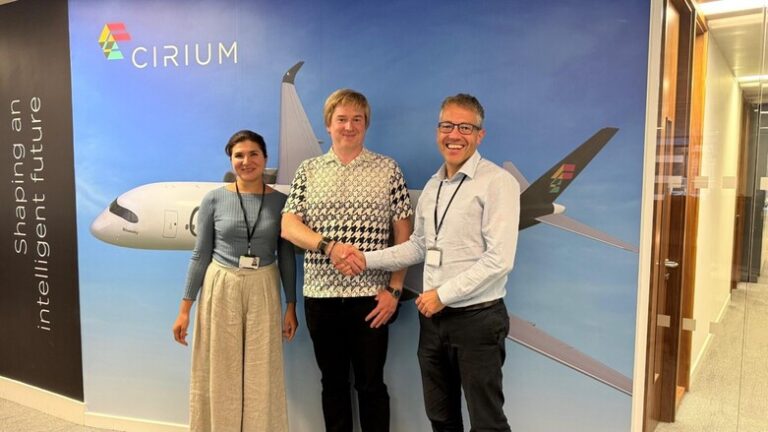
Data is gold and when it comes to aviation data and analytics, it’s what Cirium does best. After all, its experience dates all the way back to 1909. Rebranded in 2019, it today tracks over 465,000 aircraft and 26 million scheduled operations, covering 99.5% of global passenger flights, including cargo. Its aviation analytics provide schedule, routes, fleet data, real-time flight intelligence, and utilization for air cargo and logistics optimization. That global aviation intelligence is now going to be integrated into Awery’s ERP (enterprise resource planning) platform, bringing direct access to flight schedules, fleet information, aircraft utilization, and performance metrics to Awery’s users. They will be able to access up-to-date flight schedules and operational data, get information on fleet and aircraft utilization, analyze historic flight and performance trends, make informed decisions on costs and route planning, and benchmark operational performance using industry-wide metrics.
Vitaly Smilianets, Founder and Chief Executive Officer, Awery, said: “Integrating this data into our ERP increases the quality and depth of information available to our users. Access to Cirium’s trusted, regularly updated aviation data enables our users to make more accurate assessments, and improve performance tracking across all their operations.”
Rahul Oberai, Global Head of Sales, Cirium, stated: “Partnering with Awery brings Cirium’s data directly into the hands of airline professionals, where decisions are made in real time. By embedding Cirium’s intelligence within Awery’s ERP, we’re helping users see the full picture, anticipate challenges, and optimize performance across every flight and fleet.”
2,500 m² is the size of the new MRO facility that ULD management company, Unilode Aviation Solutions recently opened over in the UK’s East Midlands. Located in Unit 5b at Stud Brook Business Park in Castle Donnington, very close to East Midlands Airport (EMA), the new building has been constructed in accordance with BREEAM standards and is ‘state-of-the-art’. It runs on 100% renewable energy and its equipment and infrastructure ensure efficient, green operations. Hailed as ‘a significant milestone in Unilode’s ongoing investment in both regional and global operations’ in its press release, the MRO facility will enable Unilode to expand its support and repair services. The EMA site will support the airlines currently serving the region. Among them: DHL, West Atlantic, Singapore Airlines, Aer Lingus, Finnair, and TUI.
EMA Station Mgr, Andy Fallon, Unilode COO, Janis Balkens, Frank Steinert, Global Director Aviation Network Equipment at DHL Express. Unilode CEO, Ross Marino, and Unilode’s EMEA MRO Director, Chris Jenkins. Image: Unilode
Unilode already today manages the world’s largest digitized ULD fleet, number more than 200,000 ULDs (Unit Load Devices), and it offers the greatest global repair network serving over 90 airlines at more than 550 airports around the world. Its newest facility now joins a list of other recently opened or refurbished MRO locations in Hong Kong, Singapore, Newark (USA), and London-Heathrow (UK). The company follows a visionary global investment program centered around service excellence and the changing needs of airline and cargo operators around the world.
Janis Balkens, Chief Operating Officer at Unilode Aviation Solutions, said: “The Grand Opening represents an exciting step forward for our East Midlands team and our customers. Our new East Midlands MRO has been designed to enhance our service capabilities, support increased customer demand, and create a workplace that reflects our values and ambitions. This facility reinforces our commitment to sustainable growth. By investing in a modern, efficient operation powered by 100% renewable energy and aligned with BREEAM certification standards, we are ensuring our work benefits not just our customers but our people and the planet. Our East Midlands team has already delivered outstanding results, and this new facility enables us to grow our capabilities further, supporting our global growth and helping customers maximize performance throughout their operations.”
“Bringer Air Cargo is proud to announce our new weekly direct CAO flight from Miami (MIA) to Navegantes (NVT) in Brazil. This route opens up a streamlined, high-capacity cargo corridor, enabling U.S.–Brazil trade and e-commerce flows like never before. […] We’re committed to delivering competitive pricing, efficient handling, and the reliability that our clients have come to expect — now with even greater geographic reach and faster door-to-door transit.” Those were the words on Bringer Air Cargo’s website recently, and on 26NOV25, the airline made true on its promise and made its mark on the history books: It operated “the first international wide-body freighter to land directly at Navegantes Airport (NVT)” in the State of Santa Catarina and one of Brazil’s most strategic import gateways. It serves an important industrial and commercial region. The Boeing 767-300F flight, operated in cooperation with LATAM Cargo (with which Bringer Air Cargo has a long‑standing block‑space/charter and program partnership, whereby LATAM-operated freighters fly capacity that Bringer sells and brands with its own 417 AWB prefix), took off from Miami (MIA) to then land early in the morning of 26NOV25 at NVT. And it is this MIA-NVT route that Bringer Air Cargo has now launched – initially weekly frequencies but looking to upgrade to three to four flights per week, as per market requirements. Each B767-300F flight offers a cargo uplift of up to 50 tons.
An historic routing has been launched: MIA-NVT. Image: Bringer Air Cargo
The historic routing links the United States directly with southern Brazil, and is a dream in the making since 2019. Plans were disrupted by the pandemic as well as regulatory difficulties. “Working closely with its aeronautical consulting team, Bringer conducted in-depth technical, safety, and infrastructure analyses at NVT, concluding that several airport upgrades were essential before wide-body operations could take place,” the release states, going on to list the upgrades: a 100m extension of the runway to accommodate long-haul freighters, widening of the emergency lane by 45 meters, and improvements to maneuvering and parking areas for safe Boeing 767-300F operations. Bringer Air Cargo collaborated with Motiva Airports, and PACLOG Cargo Terminals on these points.
“This flight represents more than a new route – it’s a symbol of perseverance, collaboration, and our commitment to connecting markets with greater efficiency. We are proud to help open the door to new trade opportunities for Brazil’s fastest-growing import region,” a Bringer Air Cargo spokesperson noted.
At least, it will have from 01FEB26 on, when Cor de Man officially assumes his new position at Chief Executive Officer of Maastricht Aachen Airport (MST). He was announced this week as successor to current CEO, Jan Eerkens, who stepped in in the interim following the previous CEO, Joost Meijs’ abrupt departure after just one year in the job, on 01NOV25.
As MST CEO, Cor de Man responsibilities will extend across N.V. Holding B.V. Luchthaven Maastricht (NV HBLM), the holding company for Maastricht Aachen Airport, and Maastricht Aachen Airport Beheer & Infra (MAABI).
He brings extensive experience in all aspects of aviation and logistics, having begun his career with P&O Nedlloyd Logistics back in 1986, and then held high-ranking positions with KPMG (consulting companies such as KLM, Poste Italiana, and Deutsche Bahn), UTi Worldwide – then DSV, Broekman Logistics, Turkish Cargo, and most recently Senior Executive Advisor to Global GSA Group. It was this diverse experience and expertise in cargo, strategy and organization development that led to NV HBLM’s Supervisory Board’s decision.
Frans Weekers, Chair of the Supervisory Board of NV HBLM, commented: “Cor de Man is an experienced executive with a strong commercial profile and in-depth knowledge of both passenger and cargo operations. Cor will work closely with the management team to further strengthen operational performance, drive sustainable growth, and position MST as an environmentally conscious regional airport with international significance for both passengers and cargo. He brings proven international experience, strategic acumen, and an extensive network in aviation – we have full confidence that he will lead MST with energy and vision into the next phase of its development.” He also extended his appreciation to Jan Eerkens who will continue in an advisory function via Schiphol Group and help smooth the transition to the new management: “We are grateful for Jan’s contribution during the interim period.”
Cor de Man, incoming CEO, Maastricht Aachen Airport, said: “The coming years are crucial for the further development of Maastricht Aachen Airport – the foundation has been laid, cargo is showing an upward trend, and the team is focused on the right priorities. Together with the team, I am eager to take the next steps – Maastricht Aachen Airport has great potential for both passengers and cargo, and I look forward to working with employees, shareholders, and partners to build a future-proof, financially healthy, and sustainably operating airport.”
Amerijet published two news items this week. One was that it has leased a Boeing B767-300BCF freighter via long-term agreement with Airborne Capital, so as deliver more services across the Caribbean, Mexico, Central and South America. Tail number N566NC is the 10th B767-300 to join the 50-year-old carrier’s fleet operating out of its main hub, Miami International Airport (MIA), and serving 38 destinations. Joe Mozzali, Chief Executive Officer at Amerijet, declared: “We are thrilled to add a 10th converted B767 freighter to our fleet. This additional capacity will enable Amerijet to address the growing needs of our customers and the air freight market.”
Amerijet expands fleet with new Boeing B767-300BCF. Image: Amerijet/Mayteh Bordas-Perez
The second news item was the announcement that the airline has extended its partnership with cloud-based air cargo technology solutions provider, SmartKargo, for another five years. The two companies, who first partnered almost 10 years ago, are committed to pursuing excellence and innovation in air cargo through data technology. Amerijet uses SmartKargo’s Core SaaS Air Cargo Management Solution, to efficiently manage its global cargo operations and provide customers across its network with transparency. “This new multi-year commitment ensures Amerijet will continue leveraging SmartKargo’s modern, API-driven platform to support long-term network growth and customer-centric innovation,” the release states. “The renewed agreement also accelerates both organizations’ joint innovation, data optimization, and next-generation digital workflows that simplify cargo acceptance, tracking, billing, and complex international processes.”
Joe Mozzali, CEO of Amerijet International Airlines, explained: “SmartKargo has been a trusted technology partner for Amerijet, enabling us to modernize critical processes and deliver a more seamless, intelligent cargo experience to our customers. Extending our relationship for another five years reflects our commitment to leveraging innovation, automation, and data to strengthen our network and expand what’s possible for our customers across the Americas and beyond.”
Olivier Houri, Chief Revenue Officer at SmartKargo, commented: “Amerijet has long been recognized as an agile, forward-thinking carrier, and we’re honored to continue powering their growth with the SmartKargo platform. This five-year extension reflects our shared belief that the future of air cargo belongs to those who embrace technology and real-time intelligence. Together, SmartKargo and Amerijet are building a foundation for greater efficiency, transparency, and innovation across the global cargo ecosystem.”
Global trade is entering a new phase of realignment, and Frankfurt Airport’s cargo hub has proven its strength in navigating shifting market dynamics. CargoForwarder Global’s guest author, Sebastian Bartscher, Senior Business-Analyst Cargo at Fraport AG, illustrates Frankfurt CargoHub’s 2025 achievements in the face of rising trade tensions and tariff adjustments, and how the German hub continues to consolidate its role as Europe’s gateway for cross-border e-commerce and resilient supply chains.
Frankfurt CargoHub stays resilient in 2025: e-Commerce and Asian exports boost air cargo amid trade conflicts. The international trade landscape is undergoing a noticeable transformation. While some regions are forging ahead with impressive momentum, others remain at a standstill. In the first half of 2025, global trade grew by 4.9% year-on-year, driven primarily by strong exports from Asia (up 10.4%), whereas exports in Europe stagnated. With the overall macroeconomic situation improving, trade relations remained robust in regions not affected by tariff increases. So far, the negative effects of U.S. tariff hikes and ongoing trade uncertainty have been lower than expected, as other countries – apart from China – have refrained from implementing significant countermeasures. As a result, the WTO has revised its global trade forecast for the full year 2025 upward – from -0.2% in April to +2.4% in October. Reflecting this positive trend, global air cargo volumes are also projected to increase by approximately 2.5% overall. The main growth drivers are airports in Asia, which are forecast to achieve robust growth of about 5% in 2025. In contrast, European airports are likely to experience more moderate growth of around 2%, while North American airports are expected to stagnate.
Sebastian Bartscher, Senior Business-Analyst Cargo, Fraport AG. Image: Fraport AG
The effects of de minimis The abolition of the de minimis trade rule in the U.S. – which previously allowed low-value imports to enter the country without payment of customs duties or taxes – has caused notable shifts, particularly in global e-commerce shipment patterns. As a result, China’s exports to North America fell by 13.6% during the first nine months of the year (down 18.5% to the U.S. alone), while exports to Europe soared by 58.5% year-on-year. This development reflects a broader trend in how trade adapts to changing regulatory environments in key markets. Several European countries, including Belgium, Hungary, and Germany, experienced substantial growth in e-commerce volumes from China, with Germany recording an 83.8% increase in value and reaching a total of around USD 1 billion. At Frankfurt Airport (FRA), cargo unloaded from China flights has once again become the main growth driver, with 214,500 metric tons of air cargo marking a 32.3% increase and setting a new historic record. Notably, the share of e-commerce tonnage on routes from China to Frankfurt has risen sharply and is currently estimated at around 35%. This momentum underscores the growing importance of the e-commerce sector as a key growth driver for the Frankfurt CargoHub.
Sino-German collaboration To further strengthen the freight corridor between Asia and Europe, Frankfurt Airport and Shanghai Pudong International Airport recently signed a Memorandum of Understanding, establishing a strategic cargo partnership. Building on years of close cooperation – including last year’s roadshow in China – the new partnership aims to streamline regulatory processes, enhance efficiency in cross-border e-commerce, and jointly set new standards for handling global cargo flows. With e-commerce volumes between China and Europe rising sharply, and Shanghai serving as an important strategic market, the enhanced collaboration will enable both hubs to respond even more effectively to dynamic market developments. With around 106,000 metric tons handled at FRA between January and September 2025, cargo from Shanghai accounted for about half of the incoming tonnage from China, an increase of about 20% compared to the previous year. In 2024, the Frankfurt–Shanghai route was Europe’s top air cargo route, with around 120,000 metric tons of cargo unloaded at Frankfurt Airport and a total volume of about 215,000 metric tons.
Air cargo forecast 2026: stable outlook despite global risks For 2026, the WTO has revised its trade forecast downward from +2.5% in April to only +0.5% in October, partly due to the expected pull-forward effects from the increase in U.S. tariffs in 2025 and their long-term impact. In contrast, the Airports Council International (ACI) projects higher growth of around 3% for European and global airports in its latest World Airport Traffic Forecast for 2026. Given developments in 2025, the ACI forecast for Europe appears optimistic but not unattainable, as air cargo traffic performed better than initially expected. For Frankfurt Airport, we anticipate moderate growth in 2026, comparable to that of 2025. The decisive factor will be how the main trade routes develop amidst the ongoing tensions between the U.S. and China, the two largest air cargo markets. Overall, most industries have remained stable despite the global uncertainties, with key economic indicators such as Purchasing Managers’ Indices (PMIs) recently rising again. Air cargo demand has been growing for over two years now, driven primarily by strong e-commerce. However, there is a risk of growth being dampened in the coming year by persistent trade tensions, new EU regulations in e-commerce – including the planned abolition of the 150-euro duty-free threshold from 2026 – and a gradual shift from air to sea transport.
Flexibility is key For logistics providers, flexibility remains crucial for responding quickly to short-term changes. Frankfurt’s CargoHub demonstrates its strength above all through close cooperation with a strong network of international partners. In an environment shaped by changing regulations, shifting trade flows, and geopolitical uncertainties, these partnerships form the backbone of a resilient and future-proof cargo hub. The air cargo industry as a whole has shown its ability to adapt flexibly to evolving circumstances – an advantage that benefits Frankfurt as well. By maintaining open dialogue with stakeholders and continuously adapting to market needs, the Frankfurt CargoHub will continue to successfully navigate challenges and seize opportunities in global air cargo. This strong partner network ensures that Frankfurt Airport remains competitive and well-equipped to meet the diverse requirements of customers – both now and in the years to come.
Author: Sebastian Bartscher Senior Business-Analyst Cargo, Fraport AG
How Road Feeder Services Keep Cargo Flying – and Their Digital Road Paradox Holding Them Back
Every night, hundreds of trucks leave Warsaw, Budapest, Prague, and Bucharest bound for Frankfurt, Amsterdam, and Liège – each carrying air freight under an IATA flight number. To the untrained eye, they’re just road transport. To the cargo world, they are the ground layer of Europe’s air network.
Jan de Rijk’s road feeder fleet is part of Europe’s air network – photo: company courtesy
RFS as the silent extension of Europe’s air network Road Feeder Services (RFS) act as an extension of the air network – essentially flights on wheels. An estimated 30-40% of intra-European air cargo now moves this way, carrying automotive parts, electronics, semiconductors, pharmaceuticals, medical devices, and other time-critical exports. The customs-bonded trucks move under airline codes, following strict schedules that mirror short-haul flights. And although some flows move from West to East, the dominant direction runs East to West, where the main hubs provide long-haul capacity.
According to a 2025 market study by Mordor Intelligence, the European Road Feeder Services market is valued at approximately USD 7.5 billion, underscoring the scale and economic weight of these ‘flights on wheels’.(Source: Europe Road Feeder Services Market Size & Growth to 2030, Mordor Intelligence)
Why East dominates West The RFS network grew out of necessity, not design. Airspace congestion, short-haul cost pressures, and environmental limits pushed airlines to replace feeder flights with trucks. Western Europe’s big hubs – Frankfurt (FRA), Amsterdam (AMS), Paris (CDG), Brussels (BRU), Liège (LGG) – became consolidation platforms for global cargo. Meanwhile Central and Eastern Europe (Poland, Czechia, Hungary, Romania, Bulgaria) developed strong export industries but relatively few long-haul flights, feeding goods westward overnight. Central and Eastern Europe manufacture and globally export high-value automotive components, pharmaceuticals, electronics, and machinery. Global freight forwarders such as DHL, DSV (including the DB Schenker acquisition), and Kuehne+Nagel route this cargo through their Western ‘gateway hubs’ for customs clearance and onward flights. A typical truck from Warsaw to Frankfurt covers around 1,000 km in 11 hours, arriving before the morning long-haul departures, with major freight airlines operating extensive RFS networks across the EU. And even if trucks generate emissions, they replace short-haul flights. Industry observers estimate that a fully loaded RFS truck may carry the equivalent volume of 2-3 short-haul feeder flights – though public data does not yet document this ratio formally. The next frontier will be electric and biofuel-powered RFS fleets, and most importantly: optimized two-way utilization. Western hubs have bonded warehousing and customs pre-clearance processes optimized for RFS handling with infrastructure maturity (e.g., automated cargo handling) enabling RFS turnaround. This gives them a competitive edge when attracting new cargo services. Some cargo moves in reverse (West to East), but it only accounts for about 20%-30% of the RFS volume, as several e-commerce giants have distribution centers in Eastern Europe. Specialized express and high-value goods flows also move this way, but in smaller volumes.
The digital inequality problem The strong advance in digitally managed truck arrivals, customs pre-advice, and dock scheduling has not fully translated to RFS operations. The development of APIs, geolocation systems (real-time GPS) and AI to forecast cargo arrival based on flight delay, weather, and traffic data promise to solve these problems – but often only per hub. The digital Western advantage – Frankfurt’s Fair@Link, Amsterdam’s Smart Cargo Mainport Program, Brussels’ BRUcloud – contrasts with Eastern Europe where truck slotting is often manual or semi-automated. This digital inequality creates inefficiency across the network. A further challenge is the fragmentation among RFS operators themselves. Europe has a mix of large road feeder providers and dozens of smaller subcontractors, each using different IT tools, processes, and communication standards. This lack of harmonization makes it difficult to create end-to-end visibility or a uniform data flow across the entire RFS chain. The result is a patchwork system where cargo may be digitally visible at one hub, partially visible at another, and not visible at all once it leaves national borders.
A missing link: Cross-Airport Data Exchange Airlines and airports are working to align RFS with digital air cargo initiatives like IATA ONE Record, Airport Community Systems, and SESAR data exchange. That said, the EU-level challenges – and the issues behind the failures – are clear:
No single European airport governance framework – airports operate under national rules.
Fragmented digital infrastructure (different data systems for slots, cargo, and customs).
Uneven funding access – larger hubs get more EU grants, leaving smaller ones disconnected.
A purely competitive mindset instead of adopting gain-share or co-funded projects that allow more airports to benefit from the same outcome. This is probably the most notorious obstacle and the one that needs a mindset shift.
The Future Towards a Digital Network Imagine this case scenario:
A driver in Sofia books a slot at Liège directly via a shared EU RFS platform.
Customs pre-clearance travels with the digital shipment record.
Each truck’s ETA, emissions, and cargo milestones update across systems automatically.
Airports coordinate landside and airside flows in real time.
Eastern airports can build interoperable API-based truck slot management systems from scratch and align customs and pre-clearance with EU digital initiatives. Real-time data exchange between airports and RFS operators – with slots managed dynamically, tied to airside schedules, and supported by cross-border customs pre-clearance – would enable predictive routing and shared regional control centers. In effect, RFS moves millions of tons annually and Europe could gain a virtual air network on wheels – but only if its digital roads finally catch up with its physical ones.
Each week, CargoForwarder Global’s ‘Spotlight On…’ highlights a specific segment of the air cargo industry to show just how many functions are involved in transporting freight from A to B. Cargo is very much a people business and for it to function well today and in the evolving future, requires good leaders – people who inspire, motivate and are capable of implementing sustainable, forward-thinking strategies. Sourcing, advising, and supporting leadership development are therefore also important factors for the industry. Cormis Partners is an executive search firm specialized in those areas, and this week, Arpad Szakal (AS), its Head of Aviation & Aerospace, takes us through his role and shares his opinions and advice.
Opportunities to learn from leaders shaping the aviation and cargo sectors. Image: Cormis
CFG: What is your current function and company? And what are your responsibilities? AS: I am the Head of Aviation & Aerospace at Cormis Partners, a boutique executive search firm based in London. I work globally with airlines, airports, aerospace manufacturers, and cargo operators, helping them identify and place senior leadership talent. My role spans more than just recruiting – it’s about advising boards and HR leaders on executive search strategy, leadership development, retention, and succession planning. I also map talent markets across regions, ensuring clients have access to diverse, high-caliber leaders who can drive transformation. Beyond that, I regularly speak at industry events, sharing insights on talent strategy, executive hiring, and retention best practices, which allows me to help shape conversations about the future of leadership in aviation and aerospace.
CFG: What does a normal day look like for you? AS: There is no ‘typical’ day in executive search – it’s inherently dynamic. One day, I may be presenting a shortlist of candidates for a VP of Cargo role to a global airline; the next, coaching a senior executive on career strategy and positioning for their next move. My time is divided between client advisory calls, candidate assessments, talent mapping, and thought leadership activities such as speaking at conferences or engaging with industry boards. I also dedicate time to understanding market trends, emerging skills, and leadership gaps. The unpredictability is one of the most rewarding aspects – each day brings new challenges, perspectives, and opportunities to learn from leaders shaping the aviation and cargo sectors.
CFG: How long have you been in the air cargo industry, and what brought you to it? AS: I began my career as an aviation lawyer, advising airlines and cargo operators, which gave me a deep understanding of the regulatory, operational, and commercial intricacies of the sector. After several years, I transitioned into executive search, leveraging that legal and operational expertise to advise organizations on leadership and talent strategy. For over a decade now, I have focused on aviation and aerospace globally, including air cargo, because I am fascinated by the intersection of people, strategy, and operational excellence. Finding and placing leaders who can navigate complex environments and deliver transformative impact is what drives me professionally.
CFG: What do you enjoy most about your job? AS: What I enjoy most is helping organizations and leaders realize their potential. There is a unique satisfaction in understanding a client’s strategic vision and then identifying leaders who can bring it to life, whether that means building a high-performing cargo team or guiding an airline through digital transformation. I also thrive on the intellectual challenge of global talent mapping and advising boards on succession planning, retention, and organizational design. Additionally, I value the opportunity to speak at industry events and share insights on executive hiring and leadership trends – helping shape the broader conversation about talent in aviation is deeply fulfilling.
CFG: Where do you see the greatest challenges in our industry? AS: The industry faces several converging challenges. Talent shortages remain a significant concern, especially for leadership positions with cross-functional, global responsibilities. At the same time, technological transformation, sustainability imperatives, and shifting customer expectations are redefining operational models. Air cargo has grown exponentially, creating pressure to optimize efficiency, security, and resilience across complex supply chains. Add geopolitical uncertainty to the mix, and it becomes clear that the sector needs leaders who are agile, forward-looking, and capable of balancing operational rigor with strategic vision.
CFG: What advice would you give to people looking to get into the air cargo industry? AS: I would advise aspiring professionals to develop both operational expertise and strategic insight. Understanding logistics, cargo operations, and regulatory frameworks is essential, but the ability to think strategically and influence decision-making sets you apart. Formal training in aviation management, supply chain logistics, or international business is valuable, but equally critical is building a strong network within the industry and gaining hands-on experience. Curiosity, adaptability, resilience, and a global mindset are essential traits – air cargo operates on a global stage, and those who can anticipate change and navigate complexity will thrive. Engaging with industry events, thought leadership discussions, and professional networks is also a powerful way to accelerate learning and visibility.
CFG: If the air cargo industry were a film/book, what would its title be? AS: I would call it ‘Above and Beyond: The High-Stakes World of Global Air Cargo’. It captures the scale, complexity, and relentless momentum of the sector. Air cargo is fast-paced, high-pressure, and essential to global trade, yet much of what it achieves goes unseen. The title reflects the combination of meticulous planning, operational precision, and innovative thinking required to keep goods moving across the globe – and the people behind the scenes who make it happen.
Many thanks, Arpad!
If you would like to share your personal air cargo story with our CargoForwarder Global readers, feel free to send your answers to the above questions to cargoforwarderglobal@kopfpilot.atWe look forward to shining a spotlight on your job area, views, and experiences.