Wayne Tyndall “is impressed by CargoAi’s customer-first culture” – picture: Cargo Ai CargoAi
CargoAi has added Wayne Tyndall to its advisory ranks as Strategic Advisor to support the company’s scaling and product development efforts. Tyndall brings sector experience from roles at WebCargo by Freightos and 7LFreight, where he helped build commercial and product capabilities for digital freight services. At CargoAi he will advise on organizational scaling, product strategy and customer-success initiatives as the platform broadens its global footprint. CargoAi positions the appointment as part of a broader push to consolidate its modular SaaS offering, spanning bookings, payments, interline connectivity and predictive visibility while accelerating adoption among forwarders and airlines. CEO Matt Petot noted Tyndall’s track record in combining product focus with customer-centric growth, calling the hire “a strategic fit” for CargoAi’s ambitions. Tyndall said he was “impressed by CargoAi’s customer-first culture and innovation pace and will work with leadership to refine go-to-market approaches, support product excellence and help ensure the platform meets escalating operational requirements across diverse markets.”
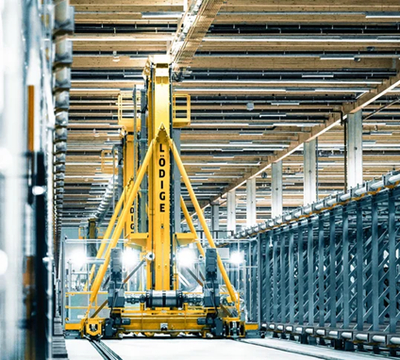
Lödige is a secret global market leader in automated material-handling systems – picture: Lödige systems.
Lödige Industries has again been named a global market leader in air cargo terminal technology, reinforcing the company’s longstanding position in automated material-handling systems.The recognition highlights Lödige’s portfolio of automation, high-bay storage, intelligent conveyor systems and driverless transport solutions that underpin cargo operations at major international hubs. Lödige points to its global reach and the scale of its deployments, technologies that currently support the handling of tens of millions of tons of air cargo annually, as evidence of sustained market leadership. CEO Philippe De Backer framed the accolade as validation of the company’s focus on scalable automation that addresses capacity constraints and labor shortages while lowering operating costs for operators and terminal owners. Recent projects and ongoing developments, including large-scale terminal installations and integrated IT-control systems, illustrate Lödige’s strategy of combining mechanical engineering with software-driven orchestration to deliver fully connected, resilient cargo terminals.
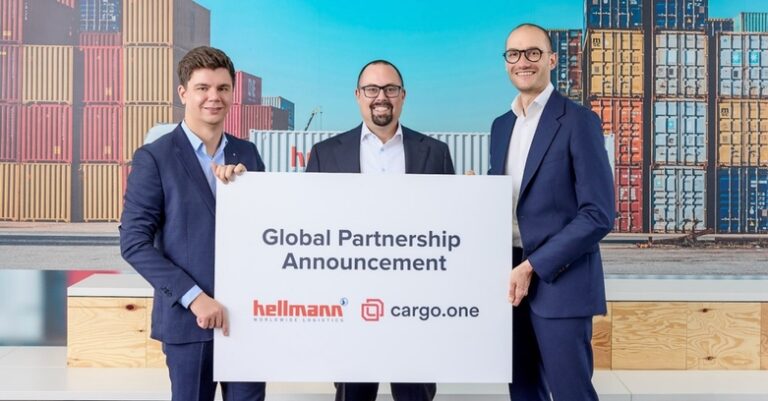
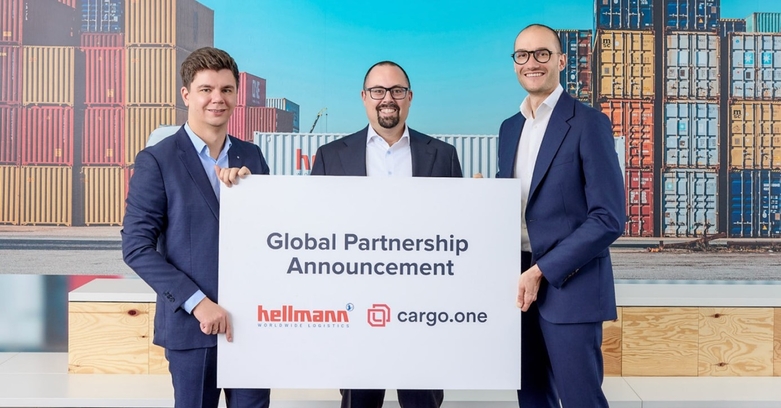
Announcing the new global technology partnership between Hellmann and cargo.one: Oliver Marschall, VP Global Airfreight Operations & Procurement Hellmann, Martin Habisreitinger, COO Airfreight Hellmann, and Moritz Claussen, Founder & Co-CEO cargo.one – picture: courtesy Hellmann
Hellmann Worldwide Logistics has implemented cargo.one’s suite of commercial tools to upgrade its global air procurement and sales workflows. The integration includes Advanced Rate Management, Live Rates, the Quotes API and cargo.one pro, consolidating rate and charge management across Hellmann’s buy-and-sell processes and enabling faster, more accurate quoting. By embedding cargo.one into its internal quotation system and connecting to its CargoWise One TMS, Hellmann aims to reduce complexity in rate management, improve response times and provide more consistent customer pricing. The initiative is presented as a strategic step to harness structured rate data, enhance procurement precision and scale digital quoting across its global network. Hellmann executives said the new infrastructure will strengthen carrier negotiations, improve market responsiveness and deliver measurable productivity gains for sales and procurement teams positioning the forwarder to better meet customer demand in a volatile airfreight market.
CargoForwarder Global’s ‘Spotlight On…’ series illustrates the wide range of careers that exist within the air cargo industry. One previously sluggish segment that really began taking off when the pandemic began, is digital services. Digital marketplaces and processes bring efficiency and opportunities to the air cargo industry – in the areas of collaboration, pricing, load-planning, booking, resource-planning, sustainability, and so much more. When data meets technology, innovation, and the right mindset, air cargo gets to move faster, smarter, and – in this particular case – at the right price. Antonia Ambrozy, Director Revenue Operations, Freightos, takes us through her responsibilities, experiences and thoughts on the industry.
Go digital, one click at a time – to infinity and beyond. Image: Antonia Ambrozy
CFG: What is your current function and company? And what are your responsibilities?
AA: I’m the Revenue Operations Director at Freightos, which connects carriers, forwarders, and shippers on a global freight procurement, pricing and booking platform. In other words, I connect the people and data points inside the organization to help us connect the global logistics players globally. I am also very much involved with our digital booking and software side, engaging with customers and partners all over the world to help them move freight faster. I love wearing many different hats and having the opportunity to own many responsibilities. For example, I bridge the gap between our brilliant backend teams and the logistics experts on the ground. Whether it’s through marketing, product strategy, or just getting people excited about the future, my job is to help our industry go digital, one click at a time and to infinity and beyond. When I’m not working, I love traveling, running, Broadway plays and running a little more.
CFG: What does a normal day look like for you?
AA: A ‘normal’ day in our industry? That’s a lovely idea! The only real constant is the coffee (and I don’t even drink coffee). My days are a whirlwind mix: I could be in back-to-back meetings with our teams and customers from all over the world, brainstorming a new marketing campaign, working with forwarders to understand their biggest daily headaches, diving into data to see how we can make our platforms even more intuitive, and shaping the strategic planning of our company. It’s fast, it’s global, and it’s never boring.
CFG: How long have you been in the air cargo industry, and what brought you to it?
AA: I’ve been in the logistics space through my entire career. I truly grew up in the industry, starting with an internship at one of the biggest airlines in the world, exactly 10 years ago. The cargo industry enabled me to find my place in working life and work all over the world, in places like JFK in New York, which I will always be grateful for. I never had a reason or even saw a reason to leave this massive, vitally important global industry that was still running on faxes (did I mention pneumatic tubes?), spreadsheets, and decade-old systems. The sheer scale of the opportunity to make a real, tangible impact was just too compelling to ignore. I love a good transformation story! And my current company allows me to spread my wings to other modes of transportation including ground and ocean. What more could I possibly ask for?
CFG: What do you enjoy most about your job?
AA: The people, without question. This industry is built on experience and relationships, and I feel so lucky that I get to work with some of the most passionate, knowledgeable, and genuinely wonderful people from all over the world. A very close second is that ‘lightbulb moment’. It’s that instance in a demo or a conversation when you see it click for a forwarder or a carrier or a partner, like a TMS, how much time and frustration they’re about to save. Helping make their day-to-day work easier is incredibly rewarding.
CFG: Where do you see the greatest challenges in our industry?
AA: Our biggest challenge is simply moving past the ‘but this is how we’ve always done it’ mindset. We’re not just changing software; we’re changing decades of habit. The technology is here, but the human element of change management is the real mountain to climb. Beyond that, sustainability is a huge one. We have a massive responsibility to make cargo more efficient, and digital tools are a key part of that – not just for booking greener routes, but for using data to optimize every single kilogram of capacity so we can reduce waste and fly smarter. And we have a responsibility to never stop. The world doesn’t either. There are so many areas that have barely moved forward – looking at cross-border and import bookings or payment methods in the industry. We owe it to ourselves to keep changing and continuously innovating.
CFG: What advice would you give to people looking to get into the air cargo industry?
AA: Just jump in! My best advice is to be relentlessly curious and ask ‘why?’… a lot. You don’t need to memorize every IATA code on day one to be successful. This industry is hungry for fresh perspectives. At the same time, it’s extremely happy to share knowledge and give best-practice examples. So, if you’re a natural problem-solver, you’ll be invaluable. But the industry is so much more. There are so many different paths, and no matter what you enjoy doing, you will very likely find the right fit. And imagine how awesome it is to know that you could be part of the bigger picture, like ensuring that disaster relief or urgently-needed medication gets to where it is most needed.
CFG: If the air cargo industry were a film/book, what would its title be?
AA: Oh, that’s a great question! I’d go with: It’s a Marathon, Not a Sprint. I love running, and I am definitely in it for the long haul to revolutionize the industry.
Many thanks, Antonia!
If you would like to share your personal air cargo story with our CargoForwarder Global readers, feel free to send your answers to the above questions to cargoforwarderglobal@kopfpilot.at We look forward to shining a spotlight on your job area, views, and experiences.
Digitalization has become one of the most persistent themes in the air cargo industry. From automation and data integration to customer visibility and sustainability goals, every company recognizes the need to evolve. Yet, while the conversation around technology is constant, the real challenge lies in turning strategy into action, reports Cristina Toscano.
Courtesy: Digital Evolution Index 2025 – Interactive Dashboard
Having worked closely with airports, airlines, handlers, and freight forwarders, I have seen that digital transformation is not just a matter of implementing new systems, it is far more, it is about people, communication, and collaboration. The following reflections come from those experiences where the pressure to “go digital” meets the operational realities that determine success or failure.
The Reality Behind the Rhetoric Anyone who has worked in sales for a leading solutions provider in the air cargo sector will recognize the pattern: digitalization dominates every strategic discussion. Every customer refers to it as a cornerstone of their long-term vision. At international conferences, it remains one of the main themes – and has been for many years.
However, the tone changes once the conference panels end and the one-to-one customer meetings begin.
What happens behind the scenes depends largely on the organization’s size and level of digital maturity. Some may already have a roadmap in place, but after a short conversation, you often realize one thing: you are not going to sell anything – at least, not yet.
In many cases, the customer is not seeking to purchase; they are seeking to understand and learn. They want to assess what your solutions can enable and whether they merit inclusion in the roadmap they are still shaping. And very often, that roadmap begins immediately after your discussion.
The Value of Consultative Sales This is where the real work begins — and why I have always valued a consultative sales approach. Digitalization cannot be achieved through transactional selling; it demands a holistic dialogue that brings together operations, IT, management, and every department that will ultimately be impacted.
At this stage, active and analytical listening becomes the most critical skill. It is about identifying the underlying challenges through the right questions, understanding where you can add genuine value and recognizing where operational improvements are achievable.
Sometimes, the right fit is an off-the-shelf solution. In other instances, creativity – combined with your ability to act as a translator within your own organization – can give rise to a new project or idea that addresses an unrecognized need. Those initiatives often evolve into solutions with wider industry relevance.
When Change Becomes the Challenge In the best-case scenario, you and the customer reach an agreement. That short phrase may represent months — sometimes years — of discussions, cross-functional alignment, and multiple approval cycles. Yet once the contract is signed, the most demanding phase begins: change management.
It matters little how positive the sales experience was or how efficiently the cycle was managed. When a core system changes, the stakes are high. Systems may fail to communicate as expected, operational teams may struggle to adapt, and initial results may fall short of projections.
But is it only the technical side that can falter? Not entirely. Sales can make an equally decisive difference. Perhaps a requirement was never properly defined. A potential scenario was overlooked. The proposed system might have been too sophisticated for the customer’s real needs. Or an omission – intentional or otherwise – created a gap that only became visible later.
Sound familiar?
If You’re Considering Digitalization If your company is planning to go digital, consider these basic principles:
Create a roadmap with a clear direction, yet one that remains flexible. Emerging technologies and market shifts will inevitably reshape priorities.
Engage (early) all affected departments not just IT or management. Digitalization is not an IT initiative, it is an organizational transformation.
Expect your salesperson to act as a consultant: challenge them, ask questions, request demos, define targets and measurable outcomes. Your KPIs are important internally, but the salesperson’s industry knowledge comes from real experience with other customers and evolving trends.
Start with quick and achievable wins: pilot small projects that show tangible results.
Prioritize data quality and integration: a new systems is only as good as the data it receives.
Invest in change management: communicate the “why”, train users, and empower early adopters as ambassadors of change.
Define clear ownership and accountability: assign responsibility beyond project manager; every department has to play a role.
Measure progress, not just outcomes. Track milestones, adoption, and ROI, but also capture feedback.
Think about scalability: Choose systems and partners that can evolve alongside your business.
Foster a culture of continuous learning: encorage experimentation, technology will keep evolving. Your team should too.
Collaborate with industry partners: The air cargo industry is interconnected. Sharing standards, data, and best practices benefits everyone.
Digitalization is not just about technology; it’s about mindset, communication, and adaptability. Success depends not only on the quality of the solution but on the partnership forged between the provider and the customer, and on how effectively both navigate the journey of change together.
As the air cargo industry continuous to evolve, recognizing salespeople as strategic partners – rather than simple vendors – can make all the difference in your digitalization journey.
This said, how is your organization balancing strategy and execution in its digital journey?
From 04-06NOV25, floricultural professionals and thousands of visitors met at the Expo Greater Amsterdam in Vijfhuizen, where the International Floriculture Trade Fair (IFTF) took place. The organizers of the exposition speak of 290+ exhibitors from 30 countries displaying their products.
Amsterdam’s International Floriculture Trade Fair is the place where the flower industry meets frequently – courtesy: IFTF
The trade show reaffirms the Netherlands’ position as the world’s leading hub for the international flower industry. It is a vibrant sector that showcases Dutch innovation, collaboration, and sustainability. It also highlights the vital role that the AMS-based home carrier Air France KLM Martinair Cargo plays in connecting growers from Africa and South America with markets across Europe and beyond.
Originally known for tulip cultivation, the Netherlands has long since developed into a global center for floriculture and flower trade. However, this would not be possible without fine-tuned air freight transport of these temperature-sensitive items.
Closely-knit ecosystem The Royal Flora Holland auction in Aalsmeer, located just a few kilometers from Schiphol, plays a key role within this extensive network, connecting growers, wholesalers, and international buyers. Together with the tightly knit air and road network surrounding Schiphol, this integrated system enables flowers to travel from greenhouse to global market within just a few days, ensuring freshness and quality.
Every single day, millions of fresh flowers arrive at Schiphol Airport by air from countries such as Ecuador, Kenya, and Colombia. Within hours, they are distributed to markets across Europe – a logistical feat that reinforces the Netherlands’ reputation as the floricultural gateway to Europe.
A trillion-euro business The economic and financial impact of the Dutch floriculture sector is shown by these figures: In the first three quarters of 2024, flower and plant exports increased by approximately 3.5%, reaching around €5.5 billion. JAN25 saw a year-on-year increase of about 7%, totaling roughly €540 million. Looking ahead, the Dutch floriculture market is projected to grow at a compound annual growth rate of around 4.7% until 2029 – expanding from approximately €4.9 billion to €6.2 billion. Meanwhile, global flower air freight services are expected to increase by about 5.1% per year, with European flows rising by roughly 4.2%. The flower trade contributes significantly to the Dutch national economy, supporting more than 150,000 direct and indirect jobs across horticulture, logistics, and air freight. The sector’s export value of over €6 billion represents a vital pillar of Dutch trade, innovation, and employment – with Schiphol serving as the beating heart of this ecosystem, illustrates Air France KLM Martinair Cargo in a statement.
GertJan Roelands is SVP Commercial at Air France KLM Martinair Cargo, photo: KLM Cargo.
Flowers, fish, vegetables and more The cargo carrier handles a significant proportion of the flower transport. From its homebase at Schiphol, the company offers its customers tailored solutions for temperature-sensitive cargo. Its freighters, extensive route network, and state-of-the-art cold-storage facilities cement the carrier’s leading role in global floral supply chains. “Flowers are not just a symbol of Dutch heritage – they represent a sophisticated, time-critical logistics system that connects growers and consumers around the globe,” illustrates GertJan Roelands, SVP Commercial at Air France KLM Martinair Cargo. “Our results in the perishable segment have been growing year over year – from flowers and vegetables to fish.”
The executive went on to say: “A strong logistical ecosystem at Schiphol, combined with our specialized services and cool-chain solutions, is a winning combination. We continue to invest in these capabilities to further enhance our customer offering and maintain this unique competitive edge.”
He also points out that sustainability is becoming an increasingly important issue for the flower industry. The sector continues to invest in digital logistics, Sustainable Aviation Fuel (SAF), smart temperature monitoring, optimized packaging, and data-driven efficiency – all aimed at reducing its carbon footprint.
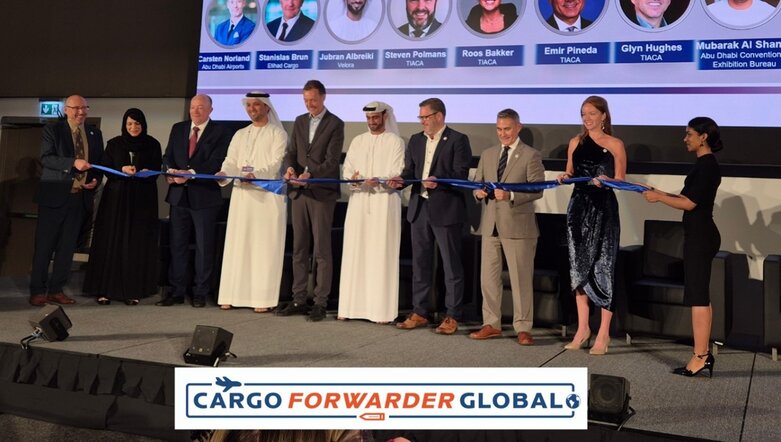
TIACA’s first-ever Abu Dhabi edition of its well-established Miami-based Air Cargo Forum (ACF) took place 03-06NOV25 at the Etihad Arena on the UAE emirate’s Yas Island. TIACA reported that more than 1,000 people attended the event, which included an exhibition hall featuring 39 company booths and generous meeting area, a handful of less obvious company rooms in side-hallways, and a large plenary hall where all the panels, keynotes, and Oasis Side Chats took place. CargoForwarder Global was in attendance and here are the takeaways.
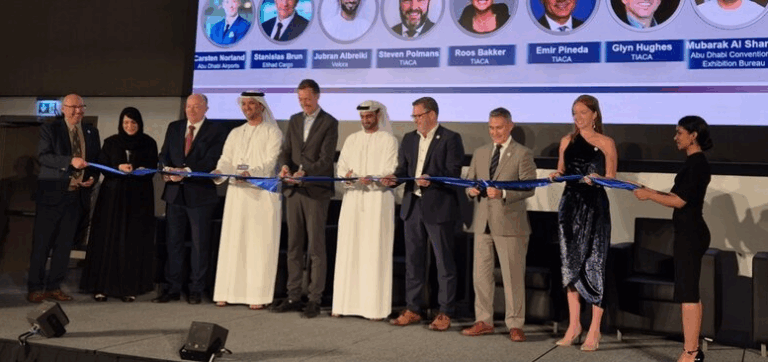
Cutting the ribbon on the first-ever TIACA ACF in the UAE. Image: CFG
“Were you in Singapore last week? And will you be in Miami, next week?” were the main opening questions often posed when people met at the arena. And indeed, many had travelled in from the previous week’s air cargo Southeast Asia and would be heading out to the Air Cargo Americas the following week. The fact that these two events were taking place either side of the Air Cargo Forum meant that some companies had decided to reduce their presence having chosen between the many events on offer at this time of the year, given travel budgets limitations. Those companies with strong Middle East customer bases or wishing to expand there, reported having fruitful meetings, but some attendees lamented the fact that contacts from other parts of the world were missing, and the atmosphere overall seemed quieter than usual – which was a shame for an event in a destination with great promise, vision, and one that is located just 6 hours from everywhere. “If there are too many events happening, the quality of the individual events suffers,” Torsten Wefers, Vice President Sales & Marketing at Liège Airport, told CargoForwarder Global. A look at the joint Belgian air cargo community stand, however, which always appeared to be lively, showed little evidence of suffering. On the contrary – people were doing what they enjoy most: networking and getting the latest on air cargo developments and gossip.
A first for the Etihad Arena The four days were very different in their layout. 51 people turned up for the golf tournament in 33°C, that took place on the Monday morning. A great many more attended the exclusive open-air Café del Mar beach-side networking kick-off that evening, with a generous buffet set up around a pool, an almost full moon, and a relaxed atmosphere.
Tuesday through to Thursday were held at the Etihad Arena – an establishment frequented by the likes of Rod Stewart, Backstreet Boys, Linkin Park, or the Musical ‘Beetlejuice’. TIACA’s ACF was its first attempt at hosting a conference and it may fare better with more conference-coordination through a local event manager for the next one, particularly with regard to ambient temperature and the refreshments and food on offer, for example – not to mention the arbitrary security checks and guiding people to the correct locations. The plenary and the exhibition hall were rather far apart from each other, and not all the rooms were easy to spot. Whereas Tuesday and Wednesday featured speakers and panels, and were the liveliest of the four days, Thursday was an exhibition-only day and far quieter, with around 100 people and stands being cleared around midday. One very definite highlight for many attendees, was the evening dinner and adrenaline-fuel rides at Ferrari World on the Wednesday evening – well organized with transfer buses to and from the event hotels, excellent and very varied food, and a raffle adding to the excitement of the evening.
A packed agenda The many topics on the agenda held great promise. Unfortunately, since neither coffee nor lunch breaks were planned, this meant that the discussions scheduled around and post lunchtime saw far fewer attendees. Hopefully, next time, the agenda will be loosened up a little, and more time allocated to some of the more crucial topics such as sustainability, and a highly interesting Pharma.Aero’s Food & Farm for Health initiative, for example, that deserves far greater attention – and opening the floor up for questions – something that worked better on the Wednesday.
While an entertaining farewell to outgoing Chair, Steven Polmans, was presented to the plenary audience, the official handover from him to incoming Chair, Roos Bakker, was done at the exclusive press event on the Wednesday afternoon. Roos will be flanked by Vice Chairs, Tushar Jani and Emir Pineda, who Glyn Hughes predicted will provide: “ the perfect balance and good mix of continuity, new look, new vision, and a new approach”. Recapping the event, he highlighted that, among the 1,000 attendees were more than 65 unique airlines in attendance – a first for TIACA, “and reflects that the decision to move here was the right one – it is a way to engage with the global community who don’t get to Miami. The panels were exceptional from the level of engagement and the quality of speakers,” he said. The panel on the Middle East illustrated how the industry is moving on,and he felt that the“fast-paced 20-minute Oasis Side Chats were good.”
TIACA is growing and has plans TIACA has much to be proud of: Membership has now surpassed the 500 mark, thanks to 60% growth since its transformation in 2019 – with every new member, it becomes more relevant for the industry. It continues to be active in Sustainability with its Roadmap and BlueSky assessments, as well as the survey and the awards – the latter will be presented at the Executive Summit in Warsaw, Poland, on 02-04JUN25. It published its first White Paper on e-commerce, earlier this year and is now working on a joint project with Pharma. Aero: Farm Fresh Economic Empowerment. Alongside an online training library for smaller businesses, and a Climate Action investment platform, TIACA represents the industry at ICAO, and similar authorities. And it has plans to nurture and encourage Startups. It recently signed an MoU with the German HOUSE 61 startup incubator, and is establishing a dedicated Startup pavilion at the ACF26, where contenders will be invited to pitch in front of investors, à la Dragon’s Den. The Miami ACF will take place 26-29OCT26. Over 200 exhibitors have already registered, TIACA says, and around 4,000 attendees are expected.
Just some of the information takeaways Abu Dhabi is the world’s safest and fastest developing city and fastest growing airport in the region. It is being developed into a regional cargo powerhouse by 2030, with a new East Midfield Cargo Terminal that will be able to handle 1.5 million tons of cargo per year, when it opens in 2027.
Overall, the air cargo industry has seen strong growth this year – at nearly 4% demand and 6% capacity growth, driven by tariff frontloading and supply chain shifts. SE Asia and India key growth regions; capacity will tighten due to delays with new freighter deliveries. 2026 expected to be more muted but positive with continued growth in SE Asia and India. Freighter profitability stable, with capacity shortages expected especially in widebody freighters. The Middle East order book is the largest globally, signaling continued growth focus.
AI is evolving from reactive management to predictive and collaborative tools. Trust in data and AI-driven decisions essential.
E-commerce now accounts for about 20% of global air cargo volumes and is projected to double in the coming decade. Airports must actively choose to support e-commerce – without strategic intent, they will miss out on growth opportunities.
Conclusion The idea of holding an event in Abu Dhabi is definitely the right one, given the shift in trade lanes and the growing importance of the region as a global cargo hub. The many posts on LinkedIn from attendees, confirms that they found it useful and inspiring. TIACA would be well advised to plan the next event at a quieter time part of the year, to avoid conference-fatigue.
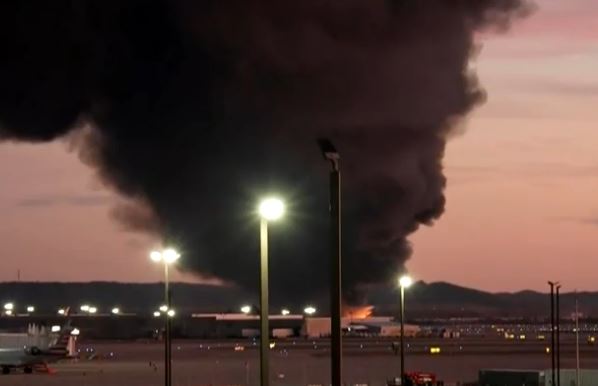
On Tuesday, 04NOV2025, a UPS-operated MD-11 freighter crashed shortly after take-off near Louisville, Kentucky, the package delivery company’s global hub. The plane was en route from Louisville Mohammad Ali International Airport (SDF) to Daniel K. Inouye Airport (HNL) in Honolulu. According to Washington’s Federal Aviation Administration (FAA) the accident claimed fourteen lives including three crew members. MD-11Fs represent about 9% of the integrator’s overall fleet.
The huge plume caused by the crash could still be seen from a great distance – source: private
UPS and FedEx said they are grounding their fleets of McDonnell Douglas MD-11 planes “out of an abundance of caution” following the deadly crash of UPS Flight 2976 on 04NOV at the U.S. integrator’s global aviation hub in Kentucky. It was the deadliest plane crash in the integrator’s history.
TheFAA is leading the investigation supported by the National Transportation Safety Board. National Transportation Safety Board investigators working to determine a cause of the crash have said the outbound MD-11’s left engine detached from the wing during takeoff. The aircraft involved in Tuesday’s crash was manufactured in 1991.
The flight suspensions affected the integrator’s global network Immediately after the crash, flight operations at Louisville Muhammad Ali International Airport were temporarily suspended. The company’s Worldport is more than 5 million square feet where 12,000+ UPS employees process more than two million packages a day, according to the integrator.
The McDonnell Douglas MD-11F is a freight plane manufactured originally by McDonnell Douglas at its plant in Long Beach and taken over by Boeing in AUG1997. The variant is primarily operated by FedEx Express, UPS Airlines and Lufthansa Cargo which retired its last MD-11F in October 2021. In total, LH Cargo operated 19 MD-11F units from June 1998 until that date.
Kentucky Gov. Andy Beshear delivers update on the UPS crash near Louisville Airport
Converted from pax to cargo The aircraft, which is powered by three engines and is therefore considered to be very tail-heavy, also served as a popular wide-bodied passenger aircraft after it was first flown in 1990 by Finnair, the former Swissair and some other operators.
As fuel costs increased, most of the three engine jets were converted to freighters which can uplift between 85 and 92 tons of cargo per takeoff depending on such as range and the specific configuration of the aircraft.
This is the second serious accident involving a UPS freighter, following one on 03SEP2010 when a Boeing 747-44AF, on way from Dubai to Cologne, crashed in an unpopulated area in the outskirts of Dubai killing the Captain and the First Officer.
Investigators determined that a rapidly progressing fire caused by lithium batteries was burning in the forward main cargo deck area. Within four minutes of the first flight deck warning, the fire had severely damaged the flight control systems, making it impossible for the crew to manually control the aircraft.
From TIACA to Swissport – a smooth transition. Steven Polmans is moving from his honorary role as Chairman of The International Air Cargo Association (TIACA) to ground handling agent Swissport. The company announced this in a statement aired 02NOV25. As new “Global Senior Vice President Cargo,” Steven’s first day in office will be 15NOV2025.
After his graduation in 1995, Steven Polmans stepped into ground handling and is now continuing his impressive career at Swissport Int’l – photo: CFG/hs
Not only does the energetic manager deserve congratulations on his new position, but so does Swissport. With Polmans, the agent has gained an extremely experienced manager who is well connected in the industry, drives innovation and – it should be added – is a person of high integrity. Together with Dirk Goovaerts, Global Cargo Chair of Swissport, he is likely to take the agent’s business to a new level.
Extensive work package Steven’s appointment aligns with Swissport’s policy to strengthen its leadership team with industry experts who can drive sustainable growth and operational excellence across its global network. It is a very extensive work package with an enormous amount of responsibility, especially in a company where processes are well established and not everyone is likely to cheer when well-trodden paths come to an end and innovations are introduced. Internal persuasion is therefore another key aspect that is likely to be on Polman’s to-do list.
Growing Swissport’s market position His main task is navigating Swissport International’s global air cargo operations by developing and driving the agent’s air freight strategy, enhancing its commercial performance, and positioning the Zurich, Switzerland-based company as an innovative, value-adding service provider in the air cargo market.
In his new role, Polmans will be responsible for identifying key growth opportunities through both organic expansion and strategic M&A activities. As the key point of contact for all commercial matters and business development initiatives, he will play a crucial role in strengthening the company’s global reputation and ensuring Swissport maintains its position as a market heavyweight in the sector.
It is no surprise that the reactions by the Swissport leadership team to Polmans’ appointment were very positive. Dirk Goovaerts, CEO Continental Europe, Middle East, Africa, India and Global Cargo Chair at Swissport stated: “His extensive experience in transforming cargo operations, building strategic industry partnerships, and driving innovation makes him the ideal leader to further enhance and grow our cargo services worldwide. Steven’s deep industry knowledge and forward-thinking approach will be instrumental as we continue to strengthen our position as a global leader in air cargo handling.”
Wide-spread network Polmans joins Swissport with an extensive background in the air cargo industry. He served as Director of Cargo & Logistics at Brussels Airport Company, where he played a key role in developing BRUcargo into a leading pharmaceutical logistics hub. In JAN2021, Steven moved on and joined Nallian as their Chief Customer Officer, a data sharing company building amongst others the innovative BRUcloud platform. In addition to his latest professional activities as an independent air cargo consultant he served eight years as Chairman of The International Air Cargo Association (TIACA), demonstrating exceptional leadership in fostering collaboration across the air cargo supply chain. His wide-spread network and deep understanding of global cargo markets will be valuable assets to Swissport as it pursues delivering best-in-practice services to airlines and freight forwarders, optimizing revenue, and driving operational efficiencies.
Focusing on China and the APAC region Swissport’s Air Cargo division handles over 5 million tons of air freight annually across 117 cargo warehouses worldwide. Only recently, Swissport inked a commercial agreement to manage and jointly operate the new Digital & Intelligent International Cargo Terminal at Shanghai Pudong Airport in partnership with Smargo, a joint venture between AVINEX Logistics and China Eastern Airlines Logistics.
According to Swissport, the opening of additional stations in China stand high on the expansion program. A task that Steven Polmans must now focus on.
Zachary Oakley and Torsten Wefers shake hands on closer collaboration. Image: Lemon Queen
Against the backdrop of the Air Cargo Southeast Asia (ACSA) event in Singapore last week, the two airports signed a ‘sister airport relationship agreement’, witnessed by top management from both airports as well as other industry leaders. What that means is that they will now work together to promote cargo traffic between their airports. On the commercial side, this will be done through joint marketing and sales initiatives aimed at attracting new cargo operators and logistics partners. For improved service quality and smoother processes on the operational side, the two will also collaborate on digital and process projects. “This landmark partnership marks a new chapter in transatlantic air cargo collaboration, reinforcing both airports’ commitment to innovation, growth, and operational excellence,” the release proclaims.
Torsten Wefers, VP Sales & Marketing of Liège Airport, said: “This agreement is a testament to our shared vision for the future of air cargo. Together with Chicago Rockford International Airport, we are building a robust transatlantic corridor that will benefit shippers, carriers, and the global supply chain.”
Zachary Oakley, Executive Director of RFD, concurred: “Liège and Rockford are both cargo-centric airports with complementary strengths. This partnership formalizes our collaboration and sets the stage for exciting new opportunities.”