Nico Le Roux, Business Development Director, Glasgow Prestwick Airport. Image: Meantime Communications
After the many Chinese-related press releases, Nico Le Roux, Business Development Director, PIK, speaking at the Air Cargo Southeast Asia Expo, Singapore on 29OCT25, shared that Glasgow Prestwick Airport is expanding its India-focused cargo operations to meet surging demand for premium Scottish exports, particularly salmon and whisky. This initiative leverages the UK’s recent free trade agreement with India, which is set to eliminate tariffs on Scottish salmon and sharply reduce duties on Scotch whisky – from 150% to 75%, with further decreases projected. As a result, Scotland’s salmon industry, which will likely see the current 30% tariffs fall away altogether, gains full access to the world’s third-largest fish market (12 million metric tons of seafood consumed in 2021), while whisky volumes shipped to India already hit record highs in 2024, with 192 million bottles exported – over 200% growth in a decade, making it Scotland’s largest whisky export market by volume. Scotch whisky exports to India have reached approximately GBP 248 million in value, and tariff reforms could potentially drive figures up to GBP one billion within five years. Prestwick is now seeking new full freighter services and partnerships to support these booming UK-India trade flows, building on past successes in direct cargo routes to key Asian markets. Nico Le Roux, Business Development Director, Glasgow Prestwick Airport, said: “The Indian subcontinent, on the back of the recent Indo-Anglo trade agreement, is a key target for Glasgow Prestwick Airport for 2026. Scotland’s national export ambitions to India are well defined and Prestwick will provide an unrivalled European gateway for India’s pharmaceutical, medical equipment, and garment industries. We are looking to mirror the successful collaborations we created with Chinese carriers, and are actively seeking out full freighter airline partners to serve the Indian market. Expanding our connections with India will ensure faster, more efficient routes for Scotland’s key products to reach one of the world’s fastest-growing markets while offering Indian manufacturers a superb hub in Europe.”
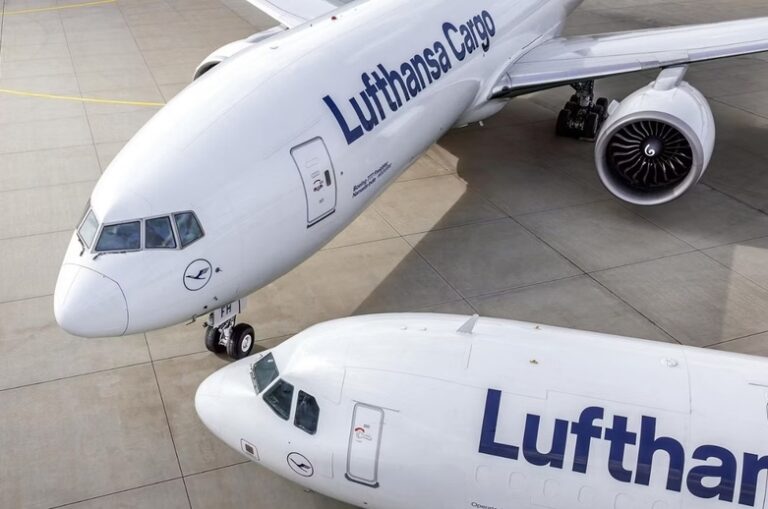
Merge two companies into one with two Managing Directors. Image: Lufthansa Cargo
Lufthansa Cargo announced on 31OCT25 that its EU customs clearance subsidiary, CB Customs Broker, and digital e-commerce transport solutions subsidiary, heyworld, will merge to become a single company from 01JAN26. At the same time, the respective companies’ Managing Directors, Uwe Glunz who has held the position since mid-2021 and Boris Hueske, who took on the role in early 2023, will be stepping down to take up new roles within the Lufthansa Cargo Group. The press release includes thanks to the gentlemen from Lufthansa Cargo’s Executive Board, “for their dedicated service and significant contributions in the past years.” In their stead follow two new Managing Directors, who will jointly lead the new company: Murat Odabas for CB Customs Broker, and Nikola Todic for heyworld GmbH. “Both leaders are committed to ensuring a smooth integration and continued excellence in customer service,” the release underlines – but it fails to explain whether the merged single company will have a new name.
Reason for the merger? Apparently a strategic move “to create new opportunities for growth and innovation [and creating] a unique one-stop offering for cross-border logistics solutions at parcel level. […] Customers with high volumes of cross-border parcel shipments will gain access to a superior level of service and expertise through the newly formed company. Tailored logistics services will combine advanced customs brokerage with cross-border transport solutions and seamless digital integration. This holistic approach is designed to improve speed, transparency, and efficiency across the entire supply chain.” If both companies have been so successful in their respective fields thus far, is the merger really necessary or is it a cost decision, perhaps?
Ashwin Bhat, CEO Lufthansa Cargo AG, announced: “The merger of CB Customs Broker and heyworld represents a key milestone in our strategic ambition of developing beyond airport-to-airport solutions. By combining their complementary strengths and expertise, we are creating a unique offering in the field of cross-border parcel logistics – one that further enhances our market position and enables us to serve customers with even greater value and precision. Over the past years, both companies have made valuable contributions to Lufthansa Cargo’s success and growth in this dynamic segment, driven by their entrepreneurship and innovative spirit.”
Murat Odabas commented: “I’m looking forward to bringing both teams together to ensure seamless business continuity and to further develop tailored and innovative logistics solutions for our customers.” Nikola Todic stated: “Combining our strengths will allow us to deliver smarter, more integrated services while driving innovation and efficiency across borders.”
Building a bridge between Canada and Europe. Image: Cargojet
Starting 01NOV25, Cargojet will operate a B767-300 from Canada to Liège in Belgium. Initially, this will be one direct flight per week, linking Canada’s main cargo hubs with the key cargo gateway to Europe. However, as demand grows, the airline plans to expand the schedule accordingly. The new European connection is a significant milestone in the airline’s strategy as it focuses on underlining its position as a reliable partner in the global logistics market. “This weekly service marks a significant expansion of Cargojet’s global network, providing customers with dependable, time-sensitive capacity and enhanced connectivity across continents. Integrated within Cargojet’s domestic overnight network, the route will offer streamlined connections across Canada, improving overall transit times and providing greater flexibility for freight forwarders, logistics providers, and shippers,” the release emphasizes.
Pauline Dhillon and Jamie Porteous, Co-Chief Executive Officers, issued a joint statement: “Leveraging Cargojet’s industry-leading record of on-time performance and reliability, we are strengthening the ties between Canada and Europe while expanding opportunities for our customers. This service allows Cargojet to be at the center of transatlantic trade, supporting the forwarder community’s evolving needs with faster transits, reliable service, and enhanced flexibility for shippers across both continents.” Torsten Wefers, VP Marketing & Sales, Liège Airport, commented: “We are thrilled to welcome Cargojet to Liège Airport, recognized as one of Europe’s very best cargo hubs. This partnership represents a major step forward for the Liège community and for Europe – Canada logistics, unlocking new potential and connectivity for our customers and partners.”
Working on becoming a key global cargo hub. Image: Etihad Cargo
In addition to Etihad recently announcing that 16 new destinations (Addis Ababa, Algiers, Almaty, Baku, Bucharest, Chiang Mai, Kazan, Krabi, Medan, Medina, Phnom Penh, Tashkent, Tbilisi, and Yerevan) will be taken up in its passenger network between November 2025 and March 2026, Etihad Cargo has now also published its expanded freighter schedule. Its Winter 2025 flight plan includes more frequencies on key routes, as well as a new service to the UK’s East Midlands airport. The move is in response increasing demand across major trade, manufacturing, and distribution markets in Asia, the Middle East, and Europe. The new dedicated route to East Midlands – one of the UK’s main cargo hubs – began on 27OCT25 and now offers two direct weekly flights from Abu Dhabi – directly supporting domestic and broader European distribution. In Asia, Etihad Cargo will substantially boost capacity including one additional flight each to Shanghai, Hong Kong, and Ezhou, and six more weekly services to Shenzhen, reflecting increased manufacturing exports in the region and aligning with its participation in Air Cargo Southeast Asia (ACSA) 2025 in Singapore, where it focused on regional growth in reach and business.
Additional flights will also be added to Riyadh (+2), Paris Charles de Gaulle (+1), and Frankfurt (+1), ensuring more flexible, reliable options for customers and supporting high-value trade flows across Etihad’s freight corridor network. “The enhanced winter 2025 schedule reaffirms Etihad Cargo’s role as a key global connector, linking major economic hubs through efficient, high-quality air freight solutions. As the group expands across new horizons, it remains focused on supporting partners with smarter, faster, and more seamless ways to move cargo around the world, building connections that truly go beyond borders,” the release states. Stanislas Brun, Chief Cargo Officer of Etihad Airways, stated: “Every shipment represents a connection that matters. As we enter the busy winter period, increasing our network capacity and introducing new trade routes means giving our customers more ways to move their goods with reliability and care. Through this strategic expansion, we hope to continue empowering businesses and communities to thrive.”
Bringing help to communities that otherwise don’t have vet access. Image: WestJet Cargo
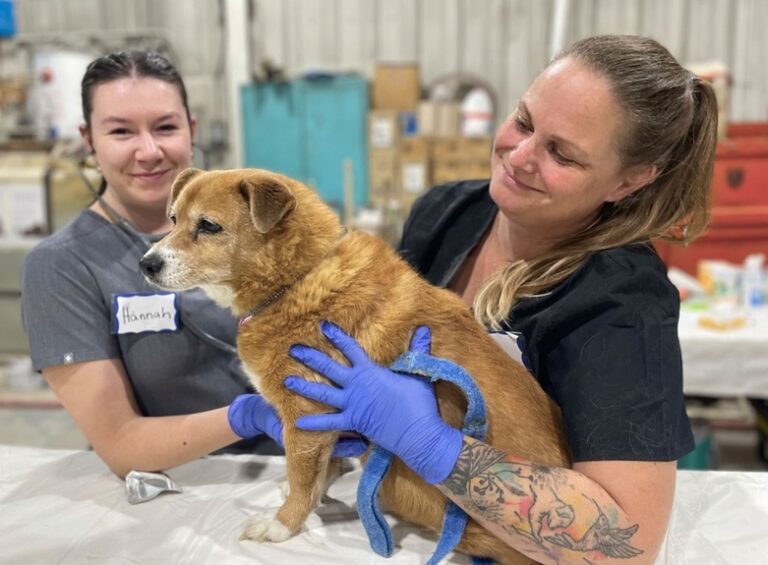
At the end of AUG25, WestJet Cargo embarked on a social responsibility mission with its support in getting vet equipment and medication to Canada’s Nunavut territory – in particular, Pangnirtung – a remote Arctic community. Working in collaboration with a national non-profit organization – the Canadian Animal Assistance Team (CAAT) – which focuses on improving animal welfare in underserved communities, the airline arranged the transportation of a 191 kg shipment to and from the small community. The shipment consisted of 12 cases of surgical tools, saline and medical supplies and equipment. It took off from Vancouver via Calgary to Ottawa, landing there on 01SEP25. From here, WestJet Cargo ensured smooth connection to its airline partner, Canadian North, which carried the cargo on its final leg to Pangnirtung. After a two-week volunteer vet mission which included several days of surgery, follow-ups, and community animal care, the equipment embarked on its return journey to Victoria, arriving there on 16SEP25. The project required careful planning, coordination and care, since the shipment had to arrive in time to enable the travelling volunteer vets to carry out their mission.
“CAAT’s ‘MASH-style’ (mobile army surgical hospital) clinics bring fully equipped, temporary veterinary hospitals directly into communities where access to veterinary services is limited or unavailable. Beyond treatment, CAAT works hand-in-hand with local leaders to create Community Animal Care Plans, long-term strategies that promote sustainable animal health and welfare,” the press release explained.
Taylor Nadeau, Cargo Sales Representative at WestJet Cargo, emphasized: “Every community deserves access to basic veterinary care – no matter how remote. These animals are family, workers and part of the community. We were honored to assist CAAT by transporting the specialized equipment that makes their work possible. CAAT’s volunteer teams have tight schedules, with flights and accommodation arranged around community needs. Any delay in the cargo’s arrival could impact the entire mission. We worked closely with Chris from CAAT to prioritize and monitor the shipment at every stage, ensuring it arrived exactly when needed. At WestJet Cargo, we’re proud to support organizations like CAAT whose compassion and commitment reach places few others can. Helping them deliver care where it’s needed most reflects what we believe in – connecting communities in ways that matter.”
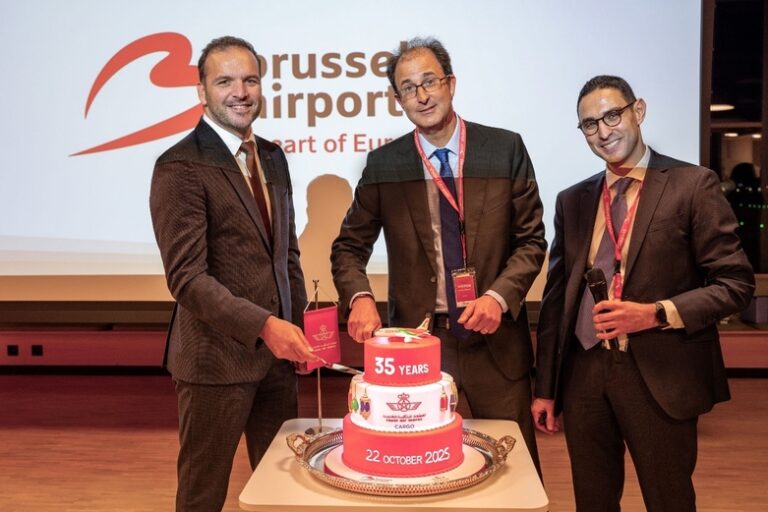
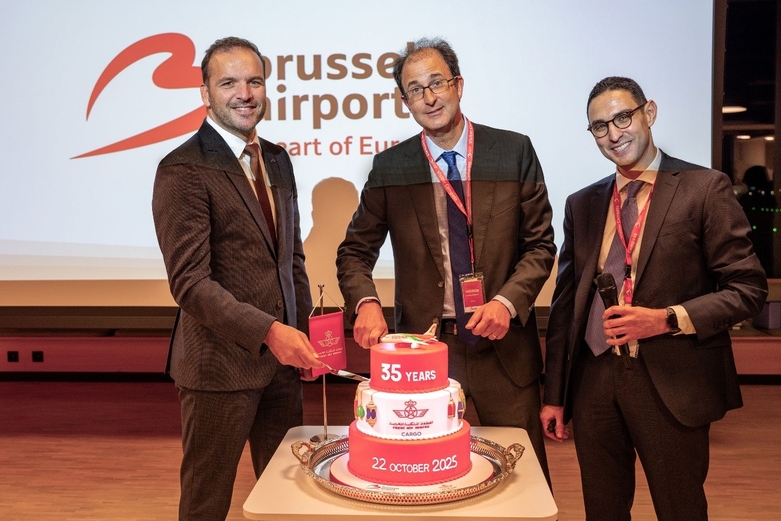
Royal Air Maroc Cargo celebrates 35 years of operations at Brussels Airport. Image: Royal Air Maroc
35 years of interrupted service definitely deserves cake to celebrate since it speaks of dedication and great cooperation – in this case between Royal Air Maroc Cargo, Brussels Airport Company, Globe Air Cargo GSA, and industry partners who all came together on 22OCT25 to mark this achievement. Congratulations on your milestone! From its inaugural flight to Brussels in 1990, Royal Air Maroc Cargo’s service has grown to today’s thrice-weekly flights between Casablanca (CMN) and Brussels (BRU), operating a Boeing 767 freighter. It now carries over 4,300 tons annually and boasts an 85% load factor. Imports to Casablanca and beyond – as the Moroccan airport acts as a key gateway to Africa – are largely industrial machinery, automotive parts, and pharmaceuticals. Brussels has long established itself as a central hub for cargo connecting Europe with African destinations such as Dakar, Ouagadougou, and Bamako, with 74% of Royal Air Maroc Cargo shipments from Brussels bound for the continent. As the airline strengthens its European network, it also continues to invest in digital modernization through platforms like cargo.one (since 2024) and CargoAi (since this year), improving transparency, booking access, and customer experience while sustaining operational excellence at Brussels Airport. Yassine Berrada, Vice-President Cargo at Royal Air Maroc, commented: “Thirty-five years at Brussels Airport is a testimony to the trust built with our customers, partners, and the Belgian logistics community. This route is essential to our network, and we remain fully committed to delivering the reliability, efficiency, and customer care that our partners expect. Together with Brussels Airport, we will continue connecting Africa to its principal European market for many years to come.”
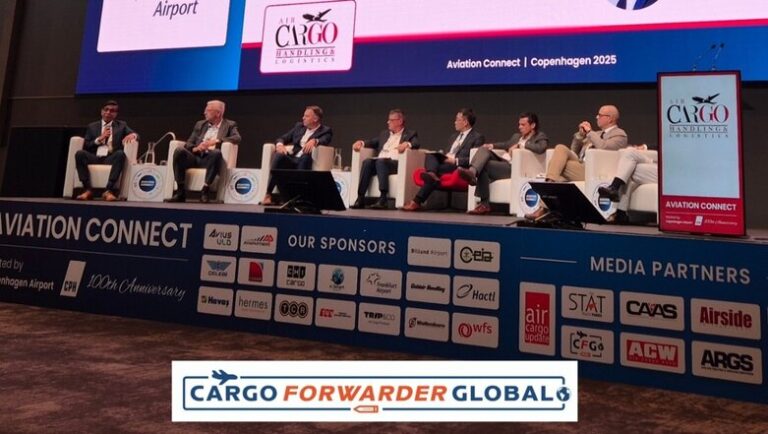
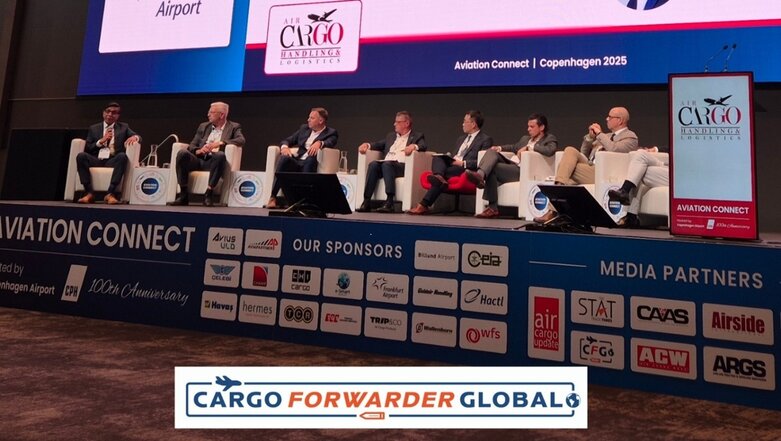
At the recent Aviation Connect/ACHL, one panel generated much discussion. It bore the title ‘Cargo Handling Landscape: Corporate Giants and Independent Players’, and was moderated by HACTL’s CEO, Wilson Kwong. Three airlines, two corporate giants and two independent players took to the stage to exchange viewpoints, highlight their requirements and services, and touch on the ongoing challenges in that segment of the air cargo industry.
Wilson Kwong in the red ‘hot seat’ moderating the panel on 15OCT25. Image: CFG
Industry expert, Wilson Kwong, who emphasized more than once during the discussion “I’m here in my function as a moderator, this time,” introduced his panel made up of LUG’s MD & CEO, Patrik Tschirsch, Delta Cargo’s MD – Operations, Vishal Bhatnagar, Emirates SkyCargo’s SVP Cargo Operations Worldwide, Robert Fordree, Cargolux’s SVP Global Logistics, Johannes Bruijs, dnata’s Chief Cargo Officer, Guillaume Crozier, Swissport’s CEO CEMEAI & Global Cargo Chair, Dirk Goovaerts, and CHI’s CEO, Kai Domscheit.
Corporate Giants vs. Independent Players “What do you think about the panel topic?”, was Wilson Kwong’s opening question to each of his panelists. Robert Fordree stated that Emirates holds contracts with a blend of global, independent, and regional handlers worldwide. “One size does not fitall,” he said, “but we prefer to work with smaller amounts of handlers who really understand our requirements.” He emphasized the need for specialized solutions and warned that “it will get harder for smaller handlers to compete in future.” That sentiment was echoed by LUG’s Patrik Tschirsch, who observed that expanding giants make it harder for independent handlers to secure meaningful business at major hubs – but also pointed to the threat of potential monopolies: “At stations above a certain size, it is hard to get what you want from the handler.” His independent counterpart, CHI’s Kai Domscheit, passionately championed the role of independents, emphasizing their “true ownership” of operations, agility, and close customer alignment as strengths that corporate giants cannot easily replicate. “We move according to the customer’s heartbeat,” he underlined.
Mission to make an airport community tick Guillaume Crozier picked up on the heartbeat comment: “A GHA, whether we are independent or global, has to ensure that our ecosystem [the airport community] ticks as it should. Our responsibility is down and upstream,” he explained, “It’s all down to leadership.” Johannes Bruijs pointed out “Sometimes we go beyond destinations, where there is no coverage by giants”, and that quality in any case depended on local leadership: “Some stations perform better than others.” Vishal Bhatnagar agreed that there was no one size, fits all solution, and that there is room both for giants and independent operators. What it all comes down to is how quickly an airline’s partner reacts to customer needs.
Complementary set-ups Dirk Goovaerts reminded the audience that even today, corporate giants address only about half of global cargo handling needs. The vast industry, he argued, demands both types of players. “We need to come together and lift the industry,” he urged, listing the benefits that global networks offer: standardized, centrally governed processes and technology, complemented by local knowledge. “We are centrally governed, locally executed.” Standardized digitization – such as one common systems spanning 300 airports – is another benefit that giants bring. “We are complementary to independent operators,” he repeated.
What airlines want: quality first and foremost “When airlines choose GHAs – what matters most?”, Wilson Kwong wanted to know: “What do airlines look for?” Johannes Bruijs emphasized: “Three things: Quality, quality, quality!” And that at an acceptable, not necessarily lowest, cost. He cited the importance of training, handling processes, and company culture. Points that were similarly put by Robert Fordree, who admitted that Emirates will first look for a global provider at the new station, due to it being familiar with the airline’s Master Services Agreement. And then ensuring that the local set-up has the capacity to handle the airline without requiring additional labor or facilities. “Best quality and best price wanted,” he said. Vishal Bhatnagar underlined that cost was the last consideration when it came to choosing a GHA. “Reliability is the most important,” he commented. “No service, no discussion!” Service, safety and trust are key, he said, followed by innovation. “Cost is last, because innovation should be able to take out cost,” he explained.
Future workforce… Following an audience question from KLM Cargo’s Kester Meijer “What is the profile of a cargo employee in 2035?”, the panel anticipated profound shifts in the nature of cargo handling work. Automation will erase much of the paperwork and manual documentation, and the industry will need to find a way to be relevant for the next generation of employees – that means increasing the speed of innovation and ensuring that all the experience and knowledge in the currently aging and retiring workforce is captured and transmitted to new employees via AI systems. Dirk Goovaerts said: “The new generation needs access to knowledge quickly – they are less interested in books.” Everyone agreed on the need for passion, adaptability, and problem-solving skills. Guillaume Crozier summarized: “The expectation is always Attitude plus Data-Driven Skills.” The panel imagined careers increasingly focused on process management, innovation, and sustainability – the latter being a crucial value for younger workers.
… and the path ahead The consensus was that, going forward, the global giants will take a bigger share of the network business, and that the dependency of global carriers on global giants will increase. However, Kai Domscheit said that success will hinge not on size but on adaptability: “Fast eats slow, not big eats small.” The industry will remain a hybrid landscape, with the best independents potentially becoming tomorrow’s giants and non-performing operators falling by the wayside. “In some places, there are too many global or independent players,” Guillaume Crozier reasoned: “The market will regulate this. Data-wise, I hope we will be in a much better place in 5 years’ time.”
The panel agreed that lasting quality, adaptability, and commitment to customer needs are universal. Both giants and independents have distinct strengths, and often, the best outcomes arise via partnership, not rivalry. Wilson Kwong brought the panel discussion to a close with his conclusion: “We are all very passionate and want to serve with high quality. Let’s work together. There is more room to cooperate than to compete!”
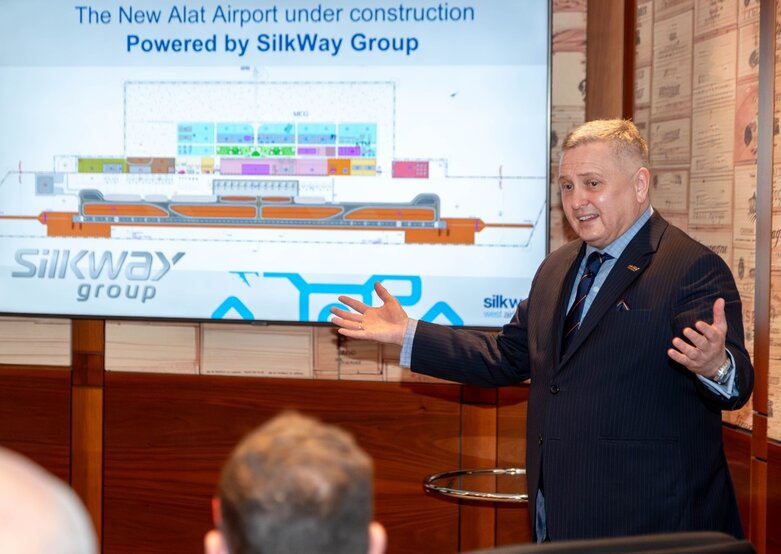
Wolfgang Meier’s core message at the German Air Cargo Association (acd) in Frankfurt last Tuesday (28OCT25), was that Baku is increasingly becoming a central hub for air freight and land transport between the Far East and Europe.
Wolfgang Meier in full action at the acd meeting – courtesy: acd
His participation at the acd event, attended by roughly 40 members of the air cargo industry, was like a homecoming for Wolfgang Meier. The 62-year-old hails from Frankfurt and is an enthusiastic supporter of the local first division soccer club, Eintracht Frankfurt. His professional career to date is impressive. After holding management positions at the former logistics player, Panalpina, and Russian carrier, AirBridge Cargo, he has been at the helm of Silk Way West Airlines since 01JAN18.
Azerbaijan benefits from traffic shifts His main message to the attendees was centered around the increasing shift in traffic flows between the Orient and the Occident, from the northern corridor via Russia and Belarus to the Middle Corridor across the Caucasus, Central Asia, and Anatolia. These rail and air freight routes south of Russia are fostering the rapid development of an economic area with nearly 110 million consumers, boosting the hunger for efficient transport solutions, Meier emphasized.
Azerbaijan, in particular, benefits from this development, as the core routes of the Middle Corridor intersect there.
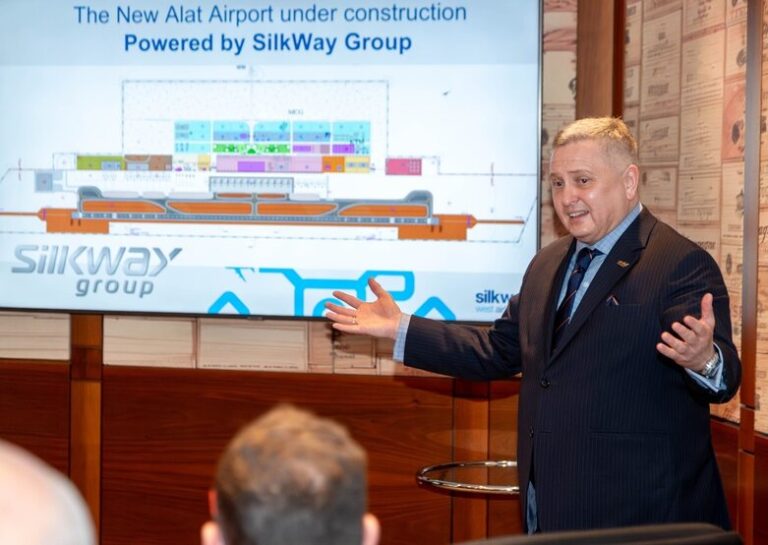
ALAT will drive economic development, predicts Meier Silk Way West responded very early to the apparent shift in traffic flows by growing its own cargo fleet and launching the ALAT Cargo project.
This foresight is evident in the construction of the airline’s new cargo hub, called ALAT Cargo Airport. It is owned and managed by Silk Way West, with dnata responsible for ground handling activities. The construction will cover an area of 750 hectares. ALAT Cargo Airport is located near the shores of the Caspian Sea, about a 1.5-hour drive south of Azerbaijan’s capital, Baku. Due to its advantageous geographical location, ALAT will become a multi-modal hub for air, surface, and sea transport, hence an attractive freight gateway for the entire greater region, enthused the manager. Initiated three years ago, the project is now taking shape. CargoForwarder Global recently outlined its current status.
Operational in the second half of 2026 Meier pointed out that the 4,000-meter runway is largely complete, while work on the buildings of the adjacent Cargo Village and logistics center is running according to plan. The first cargo aircraft is scheduled to land there in the second half of 2026. It doesn’t take much guessing that it will be a Silk Way West B777 freighter.
During the recent Caspian Air Cargo Symposium (22-24SEP25), the executive emphasized that environmental criteria were given high priority in the project. “We are building a green airport with solar panels on the roof of the facilities, providing power to run the e-vehicles used for ground processes.” He also confirmed that his airline would receive ten additional freighters by 2032, including four A350F alongside Boeing Triple Sevens. “We go for production freighters, not conversions, due to their higher efficiency, lower operational costs and fewer greenhouse gas emissions compared to P2F aircraft. In the recent past, we have seen a market trend in favor of production freighters,” Meier concluded.
Thinking beyond regional boundaries, Richter acd Vice President, Ingo Richter, emphasized that the Middle Corridor is animportant addition to existing and future trade routes: “It offers an alternative connection between Europe and Asia, ensuring long-term stability and diversification. Projects such as ALAT, exemplify that the industry must think beyond regional boundaries and seek new ways of collaboration,” the official echoed.
Silk Way West Airlines currently serves over 40 destinations in Asia, Europe, the Middle East, India, and North America. In addition, the cargo carrier offers the market charter options. In 2024, more than 500,000 tons of air cargo passed through its current Baku hub, Heydar Aliyev International Airport. Once ALAT Cargo Airport is fully operational, Silk Way West Airlines will move its entire traffic to its new gateway.
The Belgian Tulpin Group has been in the strawberry business for 44 years now. As a result, it has built up enormous expertise and made a name for itself as a major importer of these and other temperature-sensitive goods. Egypt is one of the main farming countries supplying European markets. There, the first strawberries will be harvested on 15NOV25 and flown on board of freighter aircraft to Ostend and Frankfurt Hahn, on behalf of importer, Tulpin. The upcoming season is reason enough for an interview with group chief, Alain Tulpin, about his expectations and why he avoids Heathrow as destination airport.
Logistics veteran Alain Tulpin knows the strawberry business in and out – photos: TulpionGroup.
CFG: Alain. You’ve just returned from a flight to Egypt, because the strawberry season is just around the corner. What are the harvest forecasts of local producers for the 2025/26 season?
AT: The forecasts are encouraging and a similar quantity to what was exported in 2024/25 can be expected. However, you always need to be cautious because the weather can negatively influence the quantities harvested. Also, after mid-January, it also depends on the situation in Morocco and Spain which, alongside Egypt, are also major exporters of strawberries to Europe. Last season they were late to the market, of which Egypt took advantage.
CFG: In 2024/25 your company, the Tulpin Group, imported 16,000 tons of strawberries by air; 95% of which came from Egypt and 5% from Jordan. What is your forecast for the coming season, and which role does Egyptair play in the supply of these perishables?
AT: As said, we expect to handle similar quantities in the months ahead, provided the weather does not affect the crop. Another point is the available transport capacity. Should U.S. President Trump impose extra fees on China, as originally announced but temporarily withdrawn after talking to Xi Jinping in South Korea on 29OCT, it might benefit our business indirectly since more widebody freighters might be available for lease because stiffer fees will most likely scale down transpacific cargo traffic between China and the U.S. During the previous season, this was disastrous as China took all widebodies for e-commerce reasons.
Additional capacity provided by large freighters would supplement Egyptair’s scheduled cargo flights taking off from Cairo to Ostend in Belgium and Hahn in Germany. If the market offers large main deck capacity, we will operate charters to Ostend Airport.
Strawberries are a sweet temptation.
CFG: Formerly, Egyptair Airbus A330 freighters used to land in Cologne/Bonn, but meanwhile they serve Frankfurt-Hahn and Ostend in Belgium. What’s behind this route swop?
AT: We quitCologne for two reasons: Firstly, because the quality of ground handling continuously deteriorated. This did not correspond with what perishable products need. Secondly, the local phytosanitary services at Cologne were available during weekdays only. This made product inspections at weekends by the authorities in charge completely impossible. So, we couldn’t obtain any clearance for the dispatch and onward transport of the strawberries.
CFG: Touching product quality: Do Hahn on the one hand and Ostend on the other, meet the packing and onforwarding requirements you expect?
AT: Both airports perform well. In Ostend, we cooperate with a local ground handler and some third-party service providers. Based on a concession, we established our own second line handling company in OCT24. It utilizes our own cold room of 4,200 ft², respectively 390 m².
CFG: Approximately 70% of the strawberries imported by the Tulpin Group are delivered to supermarkets in the UK. This brings up the question as to why Egyptair freighters land in Ostend and Hahn, and do not serve one of the UK airports directly?
AT: Flying from Cairo to the UK takes 45 minutes extra time in comparison to the two airports on the European mainland that we utilize. Also, there is hardly any cargo to Egypt on the way back from the UK, as Egyptair serves London daily with one widebody pax jetliner complemented by a narrowbody aircraft. Another important reason is that the ground handling of cargo at London Heathrow is a nightmare. In comparison, our Ostend and Hahn shipments reach London faster than strawberries that land at Heathrow, as we use the Eurotunnel for onforwarding them to the UK. These road feeder services are provided by our sister company, OSTENDFRESH. It runs a fleet of 45 refrigerated trailers with daily full truck services from mainland Europe to the UK, from 15NOV25 to 08MAR26, when the strawberry season in Egypt ends.
CFG: London announced that it will impose a 10% import fee on products from Egypt come January 2026. Would this affect the trade volumes in strawberries?
AT: Duties always affect sales, as both Spain and Morocco are exempt from these import fees. Consequently, the yields of the Egyptian growers will decline.
CFG: What percentage of your group’s turnover is accounted for by strawberries?
AT: Strawberries account for 60 % of our total turnover.
CFG: And finally: Do you personally still enjoy eating strawberries after having been in this business for many years?
AT: For sure, strawberries are a delicious fruit, sweet and low in calories, so a nice delicacy at any time of the year.
CFG: Alain, thank you very much for this interview.
Every week, CargoForwarder Global’s ‘Spotlight On…’ tells what it’s like to have a career in the air cargo industry by showcasing the experiences and opinions of an individual working in one of its many segments. Getting a shipment from A to B smoothly and without disruption requires diligent supervision and planning. An airline’s cargo agents are its eyes, brain, and interface – liaising with various stakeholders to ensure that shipments are processed efficiently and in compliance with regulations. This week, Quazi Mohammad Jalal Uddin (QU) takes us through his responsibilities and shares his views and advice for those looking to join the industry.
Air cargo, where teamwork, time, and precision all come together. Image: Quazi Mohammad Jalal Uddin
CFG: What is your current function and company? And what are your responsibilities?
QU: I am currently working as a Senior Cargo Agent with Emirates SkyCargo at Dhaka station (DAC). My main responsibilities include handling export and import operations, dangerous goods, and pharma acceptance, claims handling and safety coordination, and ensuring smooth daily operations in compliance with Emirates and IATA standards. I also support administrative and documentation work, assist the team during peak operations, and help in solving any on-spot challenges to maintain service quality and efficiency.
CFG: What does a normal day look like for you?
QU: Honestly, in air cargo, no two days are ever the same. My day starts early with a review of the flight schedule and pending shipments. I check on the export acceptance process, coordinate with the warehouse and ramp teams, and make sure shipments are handled safely and on time. During the day, I often deal with customer queries, system updates, and last-minute operational changes. Every day brings something new to learn – and that’s what I enjoy most.
CFG: How long have you been in the air cargo industry, and what brought you to it?
QU: I’ve been in this industry for over 10 years, all with Emirates SkyCargo. What brought me here was my deep interest in aviation and logistics – I always wanted to understand how global trade moves so precisely through the air. Over the years, I’ve grown to love the rhythm of cargo operations, where teamwork, time, and precision all come together to make things happen.
CFG: What do you enjoy most about your job?
QU: I enjoy the dynamic environment and the teamwork it demands. Every day is a mix of challenges and achievements. Solving operational issues on the spot gives me great satisfaction, and it feels rewarding to be part of an airline that maintains such high standards in safety and service. Also, the trust and support within our team make the work environment truly motivating.
CFG: Where do you see the greatest challenges in our industry?
QU: The main challenges are in meeting the growing demand while maintaining safety, efficiency, and sustainability. The rapid rise of e-commerce, pharma, and time-critical cargo means the industry must continuously adapt through technology and training.
I’m proud that Emirates SkyCargo has always been ahead in this journey – leading in digital transformation, product innovation, and strict safety compliance. The company’s continuous investment in people, systems, and infrastructure sets a strong example of how to face these challenges while maintaining service excellence.
CFG: What advice would you give to people looking to get into the air cargo industry?
QU: My advice would be to start with a strong focus on learning and discipline. Air cargo is not just about moving goods – it’s about responsibility and precision. For training, I’d recommend IATA courses in Dangerous Goods Regulations, Cargo Introductory, and Safety Management Systems. But most importantly, keep your curiosity alive and be ready to work as part of a team – that’s where real experience builds.
CFG: If the air cargo industry were a film/book, what would its title be?
QU: I’d call it “Sharing Culture – Globally.”
Because behind every shipment, there’s a team of people working silently around the clock to connect lives, businesses, and economies – and I’m proud to be a small part of that network.
Thank you very much, Quazi.
If you would like to share your personal air cargo story with our CargoForwarder Global readers, feel free to send your answers to the above questions to cargoforwarderglobal@kopfpilot.at We look forward to shining a spotlight on your job area, views, and experiences.