A study from the African Airlines Association reveals that the African aviation industry is still facing significant challenges to up its global competitiveness despite political, economic and infrastructural support in the recent past. Main stumbling blocks are excessive taxes and charges, combined with high fuel costs which negatively affect airlines, passengers, cargo transportation and economic growth, across the continent.
Civil aviation in Africa is still facing many political and structural hurdles, hurting its competitiveness – image: CFG
The overview presented by the Association, better known by its acronym: AFRAA, reveals that Sierra Leone is the most expensive country in terms of ticket taxes, landing and handling charges and fees. It is followed by Gabon and Nigeria. Fuel accounts for 40% of operating costs in Africa versus 25% globally. Air navigation charges amount to 12-15% in average, roughly 10% higher than in Europe, North America or the Far East. Maintenance, insurance, and capital costs are also 6-10% more expensive in comparison. These high costs erode airline profitability and inflate fares, pricing out potential travelers. Additionally, blocked funds – amounting to USD 919 million, or 70% of the global total – pose a significant financial strain, limiting African airlines’ ability to reinvest in growth.
Bright future for passenger traffic, but cargo falls back Africa’s aviation market is projected to more than double by 2043, reaching 345 million passengers annually, with an average growth rate of 3.7% over the next two decades. This forecast reflects the continent’s demographic and economic potential, with rising urbanization and trade integration driving passenger and cargo demand. Countries like Ethiopia and Rwanda have already capitalized on this trend, leveraging aviation as a strategic economic enabler. Investments in Ethiopian Airlines and Addis Ababa Bole International Airport, as well as RwandAir and Kigali’s airport, have transformed these nations into regional hubs, boosting tourism, air freight, trade, and investment. Yet, unlocking this potential continent-wide requires setting aside persistent barriers, urges AFRAA.
While passenger demand keeps growing – as shown by a year-to-date increase of 9% in Q1, 2025 – the cargo sector paints a less optimistic picture, with demand down 5.5% year-to-date, lagging behind global trends. This decline highlights structural challenges, including limited or even poor cargo infrastructure and high operational costs, that continue to impede Africa’s competitiveness in global trade.
African aviation needs to think big, AFRAA In order to take a U-turn and unlock Africa’s aviation potential, AFRAA tables priorities that policymakers and governments should consider: Governments are well-advised to recognize aviation’s strategic value such as has been done in Ethiopia and Rwanda (see above). This also includes a modern ground infrastructure, well-trained staff and a fee policy that does not deter airlines. Cost-efficient public-private partnerships exemplify scalable infrastructure that supports growth without burdening airlines or passengers. Aligning national policies with the African Continental Free Trade Area (AfCFTA), is another step to set barriers aside, improve connectivity and increase air traffic and trade.
Jumia opens e-commerce hub in Cairo Over in Cairo, a 27,000 m² warehouse was inaugurated to boost logistics. The new facility will enhance delivery efficiency, create 10,000 jobs and support Egypt’s role as a regional e-commerce hub. Operator is NYSE-listed Jumia, a leading e-commerce platform in Africa.
The facility serves as an integrated logistics center aimed at enhancing storage and distribution efficiency, especially in underserved areas such as Upper Egypt, a release explains. “We are proud to unveil this milestone investment, which reflects Jumia’s deep-rooted commitment to Egypt as a strategic market in our pan-African operations. This new facility not only improves how we serve millions of customers and sellers across the country, but also strengthens our support for local manufacturers, drives job creation, and advances Egypt’s digital economy. We see this warehouse as a launchpad for innovation and growth, not just in Egypt, but for the entire region,” Abdellatif Olama, CEO, Jumia Egypt stated.
Jumia operates across nine African countries and connects approximately 70,000 sellers with customers, its release reads.
Everyone knows what customs brokers do: they clear imports and exports and are responsible for checking goods. But the public is largely unaware of just how varied the job is and what professional qualifications are required to cope with the daily challenges. To take a closer look at this field of activity which is of immense importance for the functioning of global supply chains, CargoForwarder Global (CFG) spoke to two experts from CB Customs Broker: Dennis Griesam (DG), HR Manager, and Alla Franjkovic (AF), Marketing and Communications Manager.
CFG: Unlike freight forwarders, cargo agents or warehouse and logistics specialists, customs brokerage is not a recognized apprenticeship trade – at least not in Germany. So how do career entrants learn their professional ABC?
DG: In the public sector, German Customs offers structured training programs. These include a two-year traineeship for mid-level positions and dual study programs for higher-level roles.
In the private sector, there is no dedicated apprenticeship for customs. Most people enter the field through related vocational training, such as Management Assistant for Freight Forwarding and Logistics Services or Wholesale and Foreign Trade. They then build customs knowledge on the job. Customs training in the private sector usually takes place in companies like freight forwarders, logistics providers, or specialized customs agencies. Many people come from backgrounds in foreign trade, logistics, or general business administration and receive internal training when they switch to customs work.
There are also external options. Chambers of commerce, private training providers, and universities offer specialized courses and programs in foreign trade and customs.
Dennis Griesam, pictures: courtesy of CB Customs Brokers
CFG: Do EU laws not stipulate the same qualification requirements for customs agents in all countries within the union? Or does each country go its own way in this respect?
DG: While EU customs legislation provides a harmonized legal framework, the qualification requirements for customs agents are not fully standardized across all Member States. The Union Customs Code (UCC) sets out general conditions for customs representation, but it leaves room for national interpretation and implementation.
This means that individual countries can – and do – apply their own specific rules regarding the training, certification, or licensing of customs representatives. As a result, the qualifications and professional standards required to act as a customs agent can vary between EU Member States.
Alla Franjkovic of CB Customs Brokers.
CFG: Alla, you originally came from a racetrack and switched to logistics later, now working at CB Customs Broker. Why did you take this step, and what qualified you for the job?
AF: As a communications and marketing manager, I’ve always enjoyed the challenge of translating complex products and services into clear, compelling messages tailored to the right audience. I found my way into the logistics industry somewhat by chance but quickly developed a deep appreciation for its intricate global networks and vital role in keeping our world moving.
After starting my career initially in the sports and entertainment sector, I was ready for a new challenge and went on to work for several freight forwarding companies. This hands-on industry experience qualifies me to work as a marketeer for a customs broker, but certainly not to carry out customs clearances myself.
CFG: Dennis, our perception is that customs brokerage has a bureaucratic and somehow boring reputation. And if so, what should be done to overcome this prejudice to motivate young talent to enter the field of air freight customs clearance?
DG: Customs clearance might only be one step in the supply chain, but it is a critical one. It is not just about ticking boxes. Every declaration involves legal responsibility, accuracy, and up-to-date knowledge of complex regulations.
That also makes the job diverse. Our team handles everything from standard e-commerce imports to time-sensitive shipments of fresh goods or complex industrial freight. Whether it is machine parts or morning avocados for your local café, nothing crosses the border without proper clearance.
At CB Customs Broker, we turn that complexity into reliable and efficient processes. With digital tools and deep customs expertise, we help our clients keep goods moving. For people who like working with international companies, solving practical problems, and taking ownership, customs is anything but boring.
CFG: Alla, if you intend to attract a potential candidate for the job of customs specialist at CB Customs Broker: What are your arguments for convincing them to join your agency?
AF: We’re in a strong position as part of the Lufthansa Group. This gives us greater visibility and access to attractive benefits like travel discounts, training programs, and a wide international network.
We highlight these advantages at job fairs and online. On LinkedIn, we regularly share what makes our culture special: flat hierarchies, flexible working models, and a strong focus on digital customs solutions. Young talent also values our diverse team. We don’t just promote diversity, we live it.
CFG: Any aspect that you would warn them about?
DG: We work in logistics, an industry known for its fast pace and high level of responsibility. Since the pandemic, it has become clear, even to those outside the field, how essential and dynamic this sector is. This is especially true in e-commerce, where peak periods can bring added pressure.
Because of this, we operate 365 days a year, and weekend or evening shifts are part of the role. Precision is also crucial, as mistakes in customs declarations can have serious consequences.
We communicate these expectations openly, and applicants value this honesty. In return, they find a meaningful and varied role in an industry that keeps global trade moving. They also become part of a supportive and experienced team that always helps new colleagues settle in.
CFG: The customs brokerage task is extremely versatile. For which different kinds of activity do you need specialists who have exceptional know-how and vocational skills but possess an idea of the broader picture?
DG: We operate four business units: General Brokerage, Industry Brokerage, Courier Brokerage, and e-commerce Brokerage. This structure is intentional, as different industries and goods require different customs procedures. All our agents are trained in general customs clearance, and we also maintain specialized sub-teams. These focus on specific areas such as e-commerce, perishable goods or the particular needs of industrial clients. Some agents also specialize in specific transport modes or procedures, such as export declarations.
Our trainees go through comprehensive vocational training across all teams to build a solid understanding of the wider customs landscape. After successfully completing their training, they are placed in teams or sub-teams based on their strengths and interests. This targeted deployment supports our approach to developing ‘T-shaped’ professionals with both deep expertise and broad knowledge.
CFG: CB Customs Broker wants to further expand in the EU, thus enabling employees to switch to other branches to get acquainted with customs practices there and obtain a higher qualification. Might this be an additional recruitment tool for young talent?
DG: CB Customs Broker’s plan to expand within the EU definitely makes us more attractive as an employer. As mentioned earlier, the EU Customs Code provides a common legal basis, but every member state has its own procedures, forms, and practices. So, while the rules are largely the same, the way they are applied can vary a lot in day-to-day work.
Getting hands-on experience in other EU countries helps our team understand both the shared framework and the local differences. That mix is essential for efficient clearance, and it makes employees more flexible and better qualified.
It is also something many young professionals value. Working across borders gives them a broader perspective and real development opportunities.
Customs is never just about knowing the law. It is about knowing how to apply it in different contexts. That is why international experience is such a strong asset, both for our people and for us as a company.
CFG: Alla, Dennis, thank you for your time and these inputs.
CB Customs Broker in a nutshell
The company was incepted in 2006 and belongs to Lufthansa Cargo since 2018. It offers importers and exporters of air and ocean freight, rail transport, and road services, tailored solutions for all common customs procedures. Its customer portfolio consists of freight forwarders, integrators, courier services, online retailers and leading industrial companies. With around 80 specialized brokers in Frankfurt and a branch in Amsterdam Schiphol, the agent offers year-round customs clearance services.
The Scandinavian airline, SAS, will become a subsidiary of the Franco-Dutch airline, Air France-KLM. As announced in Paris on Friday (04JUL25), the latter will increase its minority stake in SAS from the current 19.9% to 60.5%. The transaction is expected to be completed in the second half of 2026. At the same time, Portugal’s state carrier, TAP, is about to be partially privatized. The government in Lisbon has decided to sell 49% of the airline. Spanish Air Europa is also up for sale, to which the owner family, Hidalgo, has attached a price tag of EUR 1 billion.
Sealing the deal: Anko van der Werff, CEO KLM (pictured left) and Air France-KLM helmsman, Benjamin Smith – courtesy: Air France-KLM
The consolidation wheel in European aviation is spinning faster than ever. This is demonstrated by the latest developments at SAS and the imminent partial sale of TAP, as well as the haggling over the sale price of Spanish Air Europa. In the end, alongside independent low-cost airlines such as Ryanair or Wizz Air, there will be three large groups that will be able to compete globally with U.S. and Far Eastern competitors for passengers and air freight.
SAS is on the upswing Firstly, the acquisition of SAS by Air France-KLM: In summer 2024, the Franco-Dutch carrier acquired a minority stake in SAS, which had been hit hard by the Covid pandemic and was under severe pressure on its domestic market. An extended codeshare and distribution agreement was agreed. This cooperation was later deepened when SAS joined the SkyTeam alliance. According to the Air France-KLM Executive Board, the now announced acquisition of the majority stake is spurred by the significant improvement of SAS’s latest financial and operational performance, the success of the commercial cooperation that commenced in mid-2024, as well as the Group’s confidence in the Scandinavian carrier’s long-term potential.
Denmark retains a blocking minority Through the acquisition, SAS will become a subsidiary of the Air France-KLM Group. It will allow Air France-KLM and SAS to fully unlock their synergy potential via a comprehensive integration in all areas of business, including its loyalty program, and will extend beyond commercial activities, emphasized Benjamin Smith, CEO of Air France-KLM. The Franco-Dutch Group will hold the majority of seats on the Nordic airline’s Board of Directors. The sellers of the shares are the capital investor Castlelake (32%) and Lind Invest (8.6%). The Danish state remains on board SAS with a 26.4% stake. The amount paid by Air France-KLM was not disclosed.
The battle for TAP has begun Meanwhile in Lisbon, 1,750 km south of Paris, the privatization of TAP, which has been under discussion for several years, has gained momentum. The parliamentary groups of the right-wing nationalist Portuguese party, Chega, and the Socialists have agreed to sell 49% of the shares in the state-owned airline. In doing so, they are opposing plans to sell the majority stake in TAP as favored by the previous government. The airline is of particular interest to investors due to its dense network between the Iberian Peninsula and Brazil, its most important market outside Europe.
According to reports in Diário de Notícias, the government is keen to attract a strategic partner capable of driving TAP’s long-term growth and sustainability roadmap, while ensuring that Lisbon remains a major transcontinental hub. Portugal’s policymakers also demand that the airline’s headquarters and hub remain in Lisbon to safeguard the country’s strategic connectivity and existing jobs. Since Madrid-based Iberia already belongs to the IAG Group, market experts believe that British Airways and Co. have little chance of buying into TAP. So, everything points to a bidding war between Air France-KLM and Lufthansa, as both have clearly signaled their interest in the Portuguese carrier.
The price tag is EUR 1,000,000,000 (sic!) This could also be the case with Spain’s Air Europa (IATA: UX). Although the IAG Group holds 20% in the airline, the EU competition watchdogs have prohibited IAG from taking a majority stake. The group would otherwise have a quasi-monopoly on the Spanish passenger and cargo market, argues Brussels. According to information obtained by CargoForwarder Global from internal circles, Air France-KLM has signaled its intention to buy the Spanish company for a price of between EUR 775 million and 800 million. Lufthansa, for its part, is said to have offered EUR 800 million for the takeover. The Hidalgo family, however, is insisting on EUR one billion.
The carrier is coveted because it operates a dense route network to Latin America, mostly to leisure destinations. But one thing can already be predicted with a high degree of certainty: If Lufthansa joins TAP, its chances with Air Europa are likely to be close to zero. Conversely, the same applies to Air France-KLM.
At their Hong Kong meeting held last week, TIACA honored Ostend-Bruges Airport, Fraunhofer Institute for Material Flow and Logistics and Goods2Load for their trailblazing sustainability efforts in 2024.
Ostend-Bruges Airport Wins 2025 TIACA Sustainability Award: “We prove that regional airports can lead the way,” stated CEO Nathan De Valck in his acceptance speech – courtesy: OST
The winner of the Corporate Award is Ostend-Bruges Airport because of its innovative biodiversity program, dubbed biOSTdiversity, which combines nature conservation with aviation safety. “This award reflects not only the success of biOSTdiversity, but also our broader, long-term commitment to sustainability,” stated CEO Nathan De Valck, who heads the airport since 01JUN25. “We’re proving that sustainability is not the exclusive domain of major international hubs. Regional airports can lead the way and show that meaningful impact can start at any scale.” The scheme not only restores habitats and promotes wildlife conservation but also offers residents and visitors the chance to observe these efforts firsthand—strengthening public pride in biodiversity and showcasing sustainable coexistence between nature and airport operations, the TIACA jurors argued.
A cornerstone of the airport’s decarbonization efforts is a massive new solar park, developed in partnership with EnergyVision. Once complete, it will be the largest in West Flanders and the second largest in Belgium. By 2026, it is expected to generate more than 37,000 MWh of green electricity annually. The first 10,000 MWh are already live and connected to the grid. This production enables the airport to rely on local renewable energy to meet its operational needs, significantly reducing its carbon footprint and strengthening its energy independence.
Fraunhofer Institute for Material Flow and Logistics (IML) was awarded first place in the Start-Up/Small Business category for its innovative Fraunhofer Institute for Material Flow and Logistics (IML) solution, which INSERT Description. It will receive a $10,000 cash prize.
Goods2Load, a smart B2B logistics platform designed to optimize load planning and freight matching, streamlining global trade and reducing empty space and waste in cargo shipments was awarded $2,500.
The finalists showcased their projects during TIACA’s Executive Summit 2025 in Hong Kong, where the final selection was made through a live audience vote.
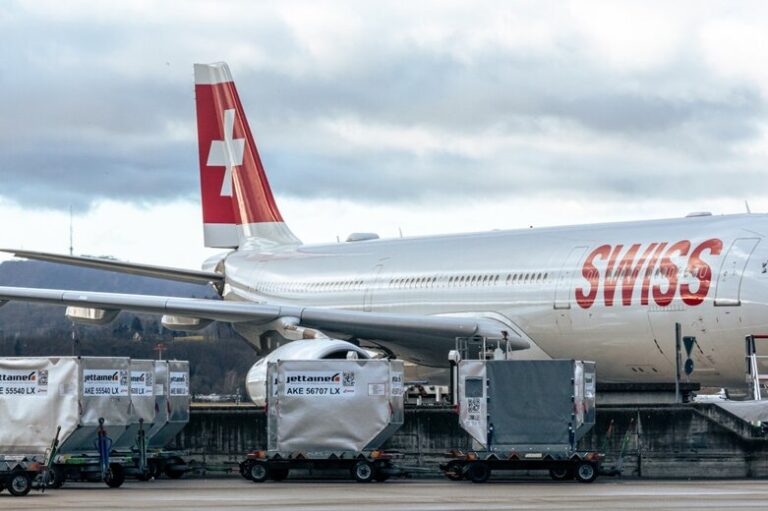
The Swiss cargo carrier has completed its rollover to a range of brand-new, lighter, and more sustainable containers. The new ULDs not only modernize the air freight division’s operational activities but also offer potential for fuel savings and CO2 emissions reduction, this way contributing to more sustainable cargo operations. With the support of Jettainer as a trusted supplier and partner, more than 3,300 old AKE and AKH containers have been replaced with new ones. This weight reduction translates into fuel savings of nearly 900 tons per year, and contributes to lowering greenhouse gas emissions of nearly 2,770 tons per year, advancing the air freight division’s goal to more sustainable cargo operations. In addition, Swiss WorldCargo has recently replaced over 1,500 old PMC and PAJ pallets with brand-new versions.
Swiss WorldCargo has introduced newer, lighter and more sustainable ULDs provided by partner Jettainer, replacing older equipment – picture: Swiss WorldCargo.
“We are very enthusiastic about our successful rollover to newer, lighter and more sustainable containers and pallets” said Miguel Seco, Head of Global Business Excellence at Swiss WorldCargo. “This completed transition marks not just the constant evolution of our cargo operations to keep delivering excellence to our customers with each shipment, but also our commitment to a future where efficiency and sustainability move forward together – lighter containers, heavier impact.”
Gert Pfeifer, General Manager DACH at Jettainer added to this: “ULDs are an essential element of aviation and therefore a lever for greater efficiency and sustainability that should not be underestimated. We are delighted to support Swiss WorldCargo on its path toward more sustainable cargo operations through the efficient management of a lighter ULD fleet.”
A coordinated raid by the European Public Prosecutor’s Office (EPPO) in Athens (Greece), Madrid (Spain), Paris (France) and Sofia (Bulgaria) has dealt a significant blow to criminal networks flooding the EU market with goods fraudulently imported from China, while evading custom duties and VAT. The criminal scheme, which involved the massive importation of garments, shoes, e-scoters, e-bikes and other goods, is believed to have caused an estimated damage of approximately €700 million.
Confiscated goods and banknotes following the ‘Calypso’ raid – courtesy of EPPO
The investigation carried out by the EPPO, code-named ‘Calypso’, spans 14 countries: Bulgaria, China, Czechia, Denmark, France, Germany, Greece, Hungary, Italy, Poland, Portugal, Slovakia, Slovenia and Spain. A total of 101 searches were conducted yesterday at the offices of customs brokers, companies controlled by the organized criminal groups under investigation, the premises of the suspects, and at the offices of tax advisers and representatives, lawyers, accountants and transport companies, in Bulgaria, Greece, France and Spain. Ten suspects were arrested, including two customs officers. In addition, firearms and cold weapons were found and seized in the houses of three of the suspects.
Law enforcement agents seized €5.8 million (of which €4.75 million in Greece and the remaining in France and Spain), in different currencies, including Hong Kong dollars, euros in digital wallets and cryptocurrencies. In addition, 7 133 e-bikes and 3 696 e-scooters were secured, as well as 480 containers for further checks and verification in the Port of Piraeus. Eleven properties located in Spain were also seized, as well as 27 vehicles and luxury items (bags, watches and jewelry). Freezing orders were also issued in Greece to seize real estate, boats and bank accounts.
At issue are several criminal networks, mainly controlled by Chinese nationals, that handle the full circuit of the goods imported from China into the EU market, including distribution to different Member States and sales to end customers, as well as money laundering and sending the profits back to China, while defrauding the payment of customs duties and committing large-scale VAT fraud.
The fraudulent scheme started with the import of the shipments into the EU through the port of Piraeus. In order to evade custom duties, the documents were falsified this way concealing the true value and nature of the merchandise. Part of the criminal gang were professional enablers operating at the customs entry point to facilitate the initial clearance, followed by the transportation of the merchandise by companies operating in Greece with a Greek VAT to a chain of buffer and shell companies responsible for distributing the goods and selling them on the black market. The transport documents were destroyed as soon as the goods had been delivered, and the merchandise was sold to end customers, as the final point of a highly concealed parallel economy.
After. the proceeds of the crime were transferred to China using different money laundering techniques, including providing money laundering services to other criminal organizations via trade-based underground banking systems.
Currently, Greece’s Independent Authority for Public Revenue (AADE) is actively supporting the EPPO to further evaluate the extent of the damage in evaded customs duties.
General Sales and Service Agent, ATC Aviation, has been appointed by Delta Cargo as their GSSA for the German market, effective 01JUL25. Previously, Delta’s sales team had marketed the underfloor capacity of passenger aircraft on routes from Germany to the USA on its own, while at the same time shipments trucked to Amsterdam or Paris CDG were marketed by SkyTeam partners Air France Cargo and KLM Cargo. The partial withdrawal of Delta from the joint venture agreement that included a variety of sales accords has caused irritation among the participants, insiders have confirmed to CargoForwarder Global. At the same time, they emphasized that Delta’s move does not represent a break in the transatlantic alliance, which has also included Virgin Atlantic since 2020.
Ingo Zimmer heads ATC Aviation – company courtesy
According to ATC, the partnership signals a new phase of growth for both companies, enhancing Delta’s sales and service capabilities in Germany. “This appointment is a testament to our team’s dedication and deep understanding of the regional market,” lauded Ingo Zimmer, CEO Aviation Services. “We are excited to represent Delta Cargo and are confident in our ability to grow their presence and performance across Germany.” With its extensive global network and innovative product offerings, Delta Cargo delivers world-class service on nearly 5,000 daily flights to approximately 300 destinations across six continents. In Germany the U.S. carrier serves Frankfurt, Munich, Düsseldorf, Berlin and Stuttgart.
1971 founded ATC Aviation plays in the global league of renown GSSA, representing dozens of cargo carriers, among them Ethiopian Cargo, Avianca Cargo, Cebu Pacific, ANA Cargo, Korean Air Cargo, Saudia Cargo among others.
At the association’s Executive Summit in Hong Kong, the President of United Cargo was formally inducted into the TIACA Hall of Fame on 26JUN25. Jan thus joins the list of high-ranking cargo managers whose names adorn the TIACA Roll of Honor. These include, among others, Issa Baluch, Larry Coyne, Des Vertannes, Bill Boesch, Klaus-Michael Kuehne, Ram Menen, Guenther Rohrmann, Joseph Suter, Fred Smith and the three GHL founders Adrian Dalsey, Larry Hillblom und Robert Lynn.
Jan Krems sits in the driver’s seat of United Cargo since 2015 – photo: credit United.
With Jan’s induction into the Hall of Fame, TIACA celebrated his remarkable achievements and his enduring contribution to the global air cargo industry. Under his direction, United Cargo has emerged as the largest U.S. combination carrier by air cargo volume – a testament to his strategic vision and relentless pursuit of excellence. His influence continues to shape the future of the air cargo industry in meaningful and lasting ways, heißt es in der Laudatio. Throughout his career, Jan has been a driving force for innovation, spearheading transformative initiatives and pioneering new solutions that have redefined the air cargo landscape. His leadership extends beyond operations – he has fostered a culture of empowerment, encouraged emerging talent, and remained a passionate advocate for industry advancement through his active participation in global forums and collaborative initiatives.
“Jan’s influence on our industry goes far beyond business results,” said Glyn Hughes, TIACA Director General. “He has inspired a generation of professionals with his forward-thinking mindset, collaborative spirit, and unwavering commitment to excellence. His induction into the Hall of Fame reflects not just his achievements, but the respect and admiration he’s earned throughout his remarkable career.”
In his acceptance speech, Jan Krems expressed his gratitude for the extraordinary privilege he was granted. “I am truly honored and deeply grateful to be inducted into the TIACA Hall of Fame. This recognition means a great deal to me — not only as a personal milestone after nearly 40 years in this fantastic industry, but because it reflects a journey built with many people, in many places, over many years.”
Together with Jan Krems, TIACA also honored Moritz Claussen of the booking portal cargo.one and Vitaly Smilianets of Awery Aviation Software at the association’s Executive Summit in Hong Kong for their innovative contributions to the digital transformation of the cargo industry.
TIACA honors Moritz Claussen (left) and Vitaly Smilianets (right) – courtesy: cargo.one & private
Moritz Claussen, co-founder of the booking portal cargo.one, is the first candidate to receive the TIACARising Star Award, launched this year. It recognizes outstanding individuals under the age of 35 who have demonstrated excellence, innovation, and impact in the air cargo and logistics sector. Candidates were nominated from across the industry and reviewed by the TIACA Board, which selected the winner based on the nominee’s tangible achievements and forward-thinking approach to industry challenges.
“Moritz brought a refreshing new approach to how air cargo is booked, marketed, and experienced,” said Steven Polmans, Chair of TIACA. “He exemplifies what this award is all about—a bold, innovative thinker who not only delivers results but also motivates others to think differently. His work at cargo.one has raised the bar for digital excellence in our industry.”
At the same event,Vitaly Smilianets, Founder and CEO of Awery Aviation Software, was named Inaugural Winner of the TIACA Inspirational Leader Award. This way, individuals are put in the limelight who have demonstrated outstanding leadership and vision while playing a key role in nurturing young talent and advancing the air cargo and logistics industry. Uniquely, the award is judged entirely by a panel of young professionals under 35, reflecting the voice of future industry leaders and highlighting the qualities that resonate most with emerging talent.
“Vitaly has not only built a successful business grounded in innovation and digital transformation, but he has done so while actively mentoring others, sharing his knowledge, and encouraging fresh perspectives,” applauded Steven Polmans, Chair of TIACA. “He embodies what this award stands for: inspiration, impact, and inclusive leadership.”
Smilianets founded Awery Aviation Software with a vision to digitally transform air cargo operations and has since led the company to become one of the most dynamic tech providers in the industry. Beyond his achievements in business, he is widely admired for his mentorship, authenticity, and advocacy for digitalization and transparency, is stated in a TIACA release.
The Mexican cargo airline, AeroUnion, has been renamed, given the brand of its Colombian parent company, Avianca. The rebranding of the freight carrier kicks off a new phase focused on fleet growth combined with regional and international network expansions.
Despite its name change, the company will maintain its independent operational and financial structure. However, its services will be aligned to those offered to customers by its parent company based on the highest standards in the industry, stresses a release.
AeroUnion has become Avianca Cargo México – photo: company courtesy
More A330F are to come Its change of identity goes hand in hand with the intent to grow its transport capacity. Following the introduction of an A330-200 P2F in mid-2024, a second freighter of this type was handed over to the airline on 20JUN25, boosting its capacity. The aircraft can accommodate 60+ tons per takeoff and fits oversized items on its main deck as well as temperature critical products due to an integrated cooling system. According to plans, announced earlier, three additional A330P2F are expected to join the fleet of the Mexico City-based carrier come 2026. “This fleet growth strengthens Mexico’s role as a strategic hub for the transportation of cargo to the United States, Colombia and other key markets in Latin America, Asia and Europe,” reads a company release. According to Avianca Cargo México, these steps forward will enable it to offer the market a more robust and efficient network, with access to more than 350 global destinations through commercial alliances and interline agreements. Industrial sectors such as automotive, pharmaceuticals and perishables are among the main beneficiaries of this new and updated operational scheme.
Robust value proposition “Serving our customers’ needs based on excellence, agility and reliability is part of this new launch that comes with key factors of our transformation. We are happy to present our new brand Avianca Cargo México, which comes with a robust value proposition and an expanded network to connect Mexico with the world,” emphasized Danilo Correa, CEO of Avianca Cargo México. Diogo Elias, CEO of Avianca Cargo added to this: “We celebrate the launch of Avianca Cargo México, which combines capacity, commercial alliances and interline agreements to expand global connectivity.” The renamed carrier will operate under a brand license granted to Aero Transporte de Carga Unión S.A., which will continue to operate as an independent Mexican legal entity, with its own technical, labor and administrative framework. Parent Avianca Cargo operates a fleet of six A330 freighter aircraft. Its route network connects 68+ destinations. The main deck capacity is complemented by the lower deck compartments of the Latin American carrier’s passenger fleet.
Avianca enlarges Latin American network On 16JUN25, Avianca started passenger flights between Bogotá and Cordoba in central Argentina, operating an A320neo jetliner thrice weekly. The route strengthens economic, cultural and touristic ties between both countries. It is part of the Colombian carrier’s strategy to grow its network in Latin America, offering travelers and cargo clients more options to explore the subcontinent and deepen existing business relationships or establish new connections.