DANX has officially opened its new 600 m² terminal in Latvia, designed to expand freight handling capabilities, accelerate delivery times, and lower CO2 emissions. The company relocated its operations to the outskirts of Riga, thus enabling a sixfold capacity expansion. With the new terminal, DANX is in a position to offer improved connectivity across Latvia, Lithuania, and Estonia. And more sustainable operations, too, since the move eliminates truck traffic from Riga’s city center, not only reducing carbon emissions but also cutting average final-mile delivery times by 30 minutes.
The terminal boasts an A+ Energy Performance Certificate and features sustainable design elements such as solar panel roofing and energy-efficient LED lighting, alongside streamlined loading and unloading processes to ensure fast turnaround times. Christian Steengaard, Baltics & Poland Managing Director, DANX, commented: “Demand for time-critical deliveries from the agricultural and automotive sectors across the Baltics has been growing for some time and we anticipate this will continue. DANX’s new facility exemplifies its commitment to the region as we continue to improve the speed, accuracy, and reliability of both our By:NIGHT and By:DAY services. This investment is also a tangible reflection of DANX’s drive towards a sustainable logistics landscape. We remain vigilant for further opportunities for improvements and have the potential to expand this new site by a further 1,500 m² as demand dictates.”
WCAworld unveiled its WCA eCommerce Solutions at the WCAworld Regional Conference in Miami, Florida. This is a new network uniting the WCA eCommerce network and the World Parcel Alliance under one brand. WCA eCommerce Solutions aims to seamlessly connect first, middle, and last-mile logistics for digital commerce, directly responding to member feedback and industry needs. Global eCommerce sales are forecasted to hit USD 6.88 trillion this year, bringing not only opportunities but also challenges for freight forwarders and couriers. WCA eCommerce Solutions provides a collaborative space for members to exchange ideas, expand their businesses, and stay ahead in delivering innovative logistics solutions for themselves and their clients. Strategic Partners are also welcome to join in discussing the best solutions for eCommerce. These carefully vetted vendors can help members to scale operations, resolve challenges, and implement tailored technology solutions. WCA eCommerce Solutions is designed to foster growth and innovation across the global eCommerce logistics community.
Dan March CEO of WCAworld, explained: “WCA eCommerce Solutions is a natural progression that has come from member-to-member interaction surrounding the growth of eCommerce and them wanting to be at the forefront of innovation and business growth in this area. Once again, we are proud that we can offer our members a solution that will lead to the continued growth of their businesses.”
HEX = Hellmann Express Airfreight – fast and seamless. Image: Hellmann
HEX stands for Hellmann Express Airfreight and is Hellmann Worldwide Logistics’ new digital express airfreight solution. It is due to launch in the U.S. and Canada later this month. A global platform for international door-to-door express shipments, HEX aims to leverage leading courier networks so as to centralize and streamline deliveries. “Unlike traditional air and road solutions, HEX emphasizes smart digital connectivity.The platform enhances and streamlines access to global express networks, providing an efficient, transparent and user-friendly service experience.” the press release explains. That service includes customs clearance through the express carriers, thus providing a clear USP particularly when it comes to imports to the U.S., in light of all the customs upheavals recently.
Aimed at small and medium-sized businesses with regular express shipping needs, HEX provides access to globally negotiated rates, eliminating the need for separate contracts with multiple providers. Developed with logistics software partner, Shipsy, the platform offers real-time tracking, analytics, and simplified booking and invoicing through a single digital interface. Following successful launches in Europe, Hellmann plans to expand HEX to 50 countries worldwide by the end of 2026.
Timo Schamber, Global Airfreight Vice President at Hellmann, stated: “HEX offers our customers an innovative solution that combines cost savings, reliability and excellent customer service. Our collaboration with Shipsy enables us to deliver a single platform that significantly simplifies and streamlines the entire shipping process. The cross-carrier customer service benefit is especially notable in the volatile and often fragmented courier and express services sector, where customers can use a single, dedicated contact person for all their needs.” Soham Chokshi, Shipsy’s Co-Founder and CEO, added: “At Shipsy, our core mission is to simplify and streamline global logistics. By integrating our capabilities into Hellmann’s Express product, HEX, we are not only enhancing visibility and control across the shipment lifecycle but also ensuring seamless coordination across multiple geographies and stakeholders.”
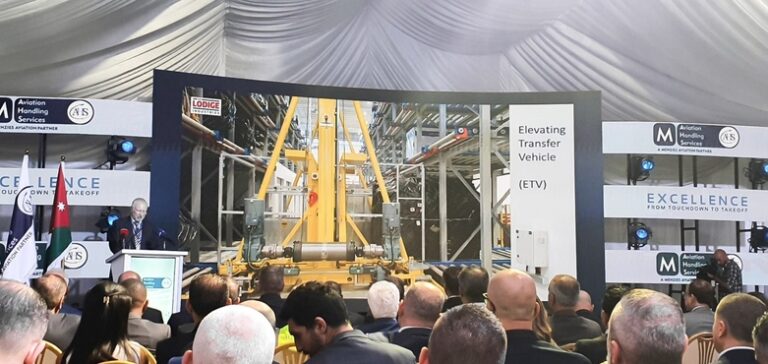
Opening ceremony at Queen Alia International Airport. Image: Lödige Industries
Amman’s Queen Alia International Airport (QAIA) now has an officially opened new cargo terminal featuring advanced automated cargo handling technology supplied by Lödige Industries for Aviation Handling Service (AHS), a Menzies Aviation partner. 8,000 m² in size, the facility boosts the airport’s cargo handling capacity to 60,000 tons per year. The recent inauguration ceremony for the terminal which is set to enhance Jordan’s role as a key logistics center in the Middle East, was attended by His Excellency Dr. Jaafer Hassan, Prime Minister of Jordan, along with other distinguished guests. Please view our report: Air France KLM Martinair Cargo stays ahead of the curve.
Thanks to state-of-the-art equipment, AHS/Menzies will be able to automate their cargo operations, offering customers efficient and reliable service to support long-term growth at QAIA. The facility is equipped with a fully automated storage system capable of handling 136 Unit Load Devices (ULDs) and features an Elevating Transfer Vehicle (ETV) for swift, efficient storage and retrieval. Additional features include ergonomic workstations (EWS) for building and breaking down cargo, storage racks that optimize shipping capacity, and a ULD control system integrated with Menzies’ latest Cargo Management System for seamless material flow and monitoring. Lödige Industries will continue to provide ongoing support and maintenance to ensure smooth and reliable operation of the system.
Dominique Ceulemans, Managing Director at AHS Jordan, revealed: “AHS Jordan’s mission is to transform the cargo terminal at Queen Alia International Airport into a leading hub for regional and international trade. To achieve this goal, we rely on advanced automated handling technologies from market leader, Lödige Industries, to streamline cargo processes, create a safe working environment and meet the growing demands of our customers now and in the future.” Guy Walker, Managing Director of Lödige Systems Middle East, commented: “It is a great honor for us to be the cargo handling technology partner for this ambitious project, and we are extremely proud to support AHS/Menzies in the Kingdom of Jordan in achieving their future goals and improving their cargo capacities.”
Holguin, Santa Clara, and Varadero are now within reach. Image: WestJet Cargo
With the completed integration of Sunwing Airlines into the WestJet Group, WestJet Cargo is now expanding its route network. Thanks to the addition of Sunwing’s 18 Boeing 737 aircraft, WestJet Cargo is in a position to offer greater freight capacity and new shipping options to important Caribbean markets. As part of this growth, WestJet Cargo is increasing cargo services to three Cuban cities: Holguin (HOG), Santa Clara (SNU), and Varadero (VRA). Each flight to these destinations can accommodate up to 2.5 tons of cargo. Building on its Toronto–Havana route which began in 2023, WestJet Cargo will now operate daily flights from Toronto (YYZ) to Varadero, four flights a week Toronto-Santa Clara, and three flights a week to Holguin. Montréal (YUL) will also see daily cargo flights to Varadero and four weekly flights to Holguin. This network expansion also includes more frequent cargo flights from Toronto to other popular destinations: daily service to Cancun (CUN), Montego Bay (MBJ), and Punta Cana (PUJ); three weekly flights to Puerto Plata (POP); and twice-weekly service to Liberia (LIR). Julius Mooney, Director of Commercial Cargo at WestJet, stated: “This aircraft capacity is a welcome addition, both for increased belly cargo throughput in Eastern Canada and for guest connectivity through WestJet Airlines. Canada is Cuba’s fourth largest trading partner, and this unique economic relationship has opened amazing opportunities for our clients and our business. We look forward to expanding across even more cargo destinations in the coming months.”
Chapman Freeborn and Optimus Logistics Group recently entered into a strategic partnership with three key goals: accelerating aircraft delivery and repositioning, lowering operational costs for customers, and further expanding Chapman Freeborn’s international footprint. They aim to simplify the current service to deliver a fully integrated aircraft relocation solution, bringing the costs down in the process. This collaboration aligns with Chapman Freeborn’s broader growth strategy, which includes restructuring its European cargo operations, appointing a general sales and service agent in Eastern Europe, and launching a dedicated European music and entertainment division. Optimus Logistics Group was established as a trucking provider in 2011, and has since grown to become a premier provider of aircraft ferry services. Under the leadership of Founder and President Marshall Frantz – who brings over two decades of experience and has managed assets exceeding USD 50 billion – the company has built a reputation for reliability and expertise in global aircraft logistics. David Selby, Commercial Manager – Flight Support, Chapman Freeborn, commented: “From permits to pilots, tracking to touchdown – our combined capabilities offer a superior service that is both dependable and economical. After working with Optimus Logistics Group on an ad-hoc basis since 2021, I look forward to strengthening this relationship as Chapman Freeborn continues to extend its global reach.” Marshall Frantz, President, Optimus Logistics Group, said: “By combining our specialist ferry capabilities with Chapman Freeborn’s fifty plus years’ experience and global network of charterers, we’re creating a new standard for aircraft repositioning – more efficient, safer, and more value-driven than ever before. Making this partnership official means we can now offer that same smooth experience to even more clients around the world.”
The DHL Group is focusing on growth regions empowering businesses operating across and with the Middle East. As part of the Group’s strategy for the next five years, the logistics giant intends to spend more than EUR 500 million in the Gulf region, predominantly in Saudi Arabia and the United Arab Emirates.
DHL truck at Dubai facility – courtesy: DHL
In a release, DHL states that the investment will significantly strengthen the region’s logistics backbone. It spans all four divisions – DHL Express, DHL Global Forwarding, DHL Supply Chain, and DHL eCommerce. By enhancing infrastructure, expanding networks and capacity, and elevating service capabilities, DHL aims to capitalize on growth opportunities from trade, ensuring support and resilience for customers as they navigate evolving market demands.
Wide range of services The four divisions offer customers a broad portfolio of logistics and transportation services. These include express parcel delivery, air, ocean, rail and road options, warehousing, fulfilment and distribution, customs brokerage and specialized operations for sectors such as life sciences, healthcare, battery logistics and e-commerce solutions.
“The region of the Gulf Cooperation Council (GCC) is rapidly emerging as a global logistics and innovation hub,” stressed John Pearson, CEO of DHL Express. “Our investment reflects the region’s increasing strategic importance in connecting Asia, Europe, and Africa, and our commitment to supporting its transformation into a catalyst for regional and global trade. DHL Express is seeing dynamic growth and export potential in the region’s e-commerce sector, for example, which is providing opportunities for entrepreneurs and smaller businesses to expand their offering to global markets.”
Local companies have mushroomed DHL has identified the Middle East as an emerging and vital trade hub, facilitating commerce between Asia, Europe, and the U.S., while serving increasingly as an air and ocean gateway to and from Africa. Management emphasizes the trend whereby, in addition to large multinationals, a growing number of medium-sized and smaller companies have mushroomed in the Gulf region, significantly expanding the market.
Hendrik Venter, CEO of DHL Supply Chain, Europe, Middle East & Africa, said, “DHL Supply Chain has actively expanded in Saudi Arabia and UAE, in recent years, recognizing the positive economic development, the increasing maturity and sophistication of supply chain operations in the region, and the growing demand for specialized, outsourced logistics support. With a strong focus on the energy sector, life sciences, healthcare, and technology, we are poised to take advantage of our contract logistics expertise to meet the unique needs of our customers and drive innovation in these critical areas.”
Reliability becomes a selling point in a volatile world The investments will focus on the following areas across DHL’s four business units:
Express: Investments will be made in hub and gateway facilities, as well as in enhancing aviation capacity to improve service efficiency and delivery speed.
Global Forwarding: The company will expand its overall presence in the region, invest in its fleet – including electric trucks – and pursue joint venture initiatives such as the recent joint venture with Etihad Rail to enhance connectivity and logistics capabilities.
Supply Chain: There will be an expansion of the contract logistics offer in both the UAE and KSA, which includes increasing warehousing capacity, upgrading equipment, and integrating advanced technology to optimize operations.
DHL eCommerce: The acquisition of the delivery provider, AJEX, in Saudi Arabia, will enhance DHL’s e-commerce capabilities, facilitating better last-mile delivery services in a rapidly growing market.
Sustainability remains an overarching goal Amadou Diallo, CEO of DHL Global Forwarding, Middle East & Africa, remarked: “This investment underscores our confidence in the Middle East’s economic trajectory, and our continued commitment to be ahead of the curve in digital capabilities and sustainable transportation for our customers. We also consistently aim to find entrepreneurial freight forwarding solutions that build supply chain resilience, keep their goods flowing, and help them to uncover growth opportunities in a world that is characterized by uncertainty and volatility.”
Touching on sustainability, DHL stresses that it keeps pushing alternative fuel solutions up front by investing in aviation fuels and biofuels for road and ocean freight, as well as solar panels supplying facilities with clean energy. This commitment ensures that supply chains become cleaner, and customers achieve their net zero ambitions, the release concludes.
The trend is obvious: human labor is increasingly being replaced by automated systems. At least when it comes to repetitive tasks, but also in the case of more complex work processes. FedEx recently began using an AI-driven sorting robot at its distribution center at Cologne-Bonn Airport. It is the first of its kind within the carrier’s European network.
FedEx sorting robot at work in CGN. More are to follow at airports serviced by the integrator – Company courtesy
The fact that the trial phase was successful is not explicitly stated in the integrator’s press release. However, this is to be assumed, otherwise the traditionally rather media-shy integrator would not issue a release on the subject.
Cologne is the largest of FedEx’s seven air freight locations in Germany and employs over 900 people. In view of the continuing high demand for labor and FedEx’s constant growth, none of them need fear that the sorting robot will take away their jobs.
Advanced sensor technology Provider of the robot is Dutch specialist, Hellebrekers B.V. For safety reasons, the machine used by FedEx is encased in a protective wire netting, allowing smaller parcels to be fed into the side of the cage. It supports the team and ensures that they can take on other and more complex tasks. According to FedEx, the robot is primarily used for sorting documents and smaller parcels with a maximum weight of 4 kg. In full operation, it can sort up to 1,000 shipments per hour and cover around 90 destinations simultaneously thanks to its advanced sensor technology.
“E-commerce is one of the growth drivers in our industry,” says Boris Stoffer, Managing Director Network Operations Germany for FedEx. “AI-supported technologies help us to better manage and handle our shipments and offer our customers an optimal service experience. This strengthens our competitiveness. Another positive effect is that our team members benefit from the use of modern technologies. The robotic arm relieves them physically by taking over repetitive, high-volume tasks.”
A testament to innovation “This robotic sorting system is a testament to FedEx’s commitment to innovation,” says Georgiana Constantin, Manager Planning & Engineering Innovation & Properties Design. “Our customers are our top priority, and innovation helps us to provide them with a first-class service.”
The U.S. parcel delivery service company jumped on the automation bandwagon at the beginning of this decade. Then, FedEx began installing four robotic arms at its hub in Memphis, Tennessee, to automate the sorting of small parcels. Further sorting robots followed in 2022, at the Guangzhou distribution and sorting center and its hub in Singapore. Meanwhile, the integrator has equipped 17 additional U.S. facilities with robot technology, including its facilities in Las Vegas, New York and Ohio.
Broad market perspective The use of sorting robots reflects broader industry trends. Logistics companies are optimizing their operational efficiency from warehouse management to last mile delivery. At the recent Air Cargo Europe in Munich, a Robot Dog was presented to the attendees, arousing great interest. It was developed by Boston Dynamics and is currently being tested by the Frankfurt Fraunhofer Institute for use in warehouses or on airport aprons. It can walk up and down stairs, recognize pallet systems and can be used for monitoring and surveillance tasks, reports Harald Sieke, Head of Aviation at the Fraunhofer Institute for Material Flow and Logistics. Prior to this, Fraunhofer engineers and technicians have developed a robot named evoBOT, that can perform multiple tasks at aprons or within distribution centers, which reduces the inhibition threshold for interaction between man and machine due to its cute look.
This Robot Dog was an eye-catcher at the Air Cargo Europe trade fair – photo: CFG/hs
According to database, Statista, the global market for warehouse automation is expected to exceed USD 51 billion by 2030. It is an AI-based segment with rapid growth in learning and a broad scope of applications. Its future in air freight and logistics has only just begun.
Each week, CargoForwarder Global’s ‘Spotlight On…’ showcases a particular individual and segment of the air cargo industry, thus building up a large catalogue of the many diverse careers it offers. Associations such as IATA play an essential part in shaping the industry and bringing it closer together. IATA aims to foster safety, efficiency, digital innovation, and sustainability, while supporting freight forwarders, airlines, and other stakeholders through accreditation, standards, and operational guidance. Patricia Varela (PV), Manager Cargo, Innovation and Efficiency at IATA, takes us through her responsibilities, views, and advice on forging a career within it.
Don’t be afraid to challenge existing processes and business models. Image: Patricia Varela
CFG: What is your current function and company? And what are your responsibilities?
PV: I work for the Cargo team at IATA, with a focus on innovation, efficiency, and sustainability topics.
CFG: What does a normal day look like for you?
PV: I doubt there is such a thing as a regular day for us. I am lucky to work with very different teams, inside and outside IATA, in very different topics: from technological and sustainable transformation in air cargo facilities and operations to waste reduction to emissions reporting across the supply chain. This means that a regular day involves regular interactions with the industry and close collaboration with colleagues in standard-setting and advocacy activities, as well as IATA projects.
CFG: How long have you been in the air cargo industry, and what brought you to it?
PV: I’ve been working in air cargo and logistics for almost 12 years, but my career journey started in a completely different area as I studied Journalism and worked for years in international news radio. After a master’s in international relations, I had the opportunity to do an internship in the Cargo team at IATA, and I was hooked. I moved to the shipper side for more than two years, working for the Corporate Supply Chain team for one of Gartner’s Supply Chain Top 25 companies, before coming back to IATA in 2018.
CFG: What do you enjoy most about your job?
PV: What I enjoy the most is the opportunity to regularly interact with the whole industry, from airlines to ground handlers to freight forwarders to shippers to regulators. Collaboration with all stakeholders is critical for our mission at IATA, and I appreciate the opportunity to get regular updates on how we can better serve the industry and what we can learn from each other.
CFG: What do you see as the greatest challenges in our industry?
PV: I think that our industry needs to continue working on what we do best: being adaptable. The last five years have been proof that we are extraordinarily resilient as an industry, and the years ahead will continue testing our capacity to adapt: increasing geopolitical instability, climate change disruptions, and rapid shifts in market demands will require us to be flexible and invest in digitalization, infrastructure, and people.
CFG: What advice would you give to people looking to enter into the air cargo industry? Any particular training they should aim for?
PV: I would advise them to come into the cargo industry with a willingness to learn, but not to be afraid to challenge existing processes and business models. My experience is that if you overcome the initial frustrations of joining an industry that can be, at times, difficult to navigate and stuck in legacy technology and processes, there are plenty of opportunities to drive transformation and make a change. Aspiring air cargo professionals, even those with a supply chain background, will benefit from taking the IATA Cargo Introductory Course or any other training in our portfolio. I would also advise them to join the Future Air Cargo Executives (FACE) program.
CFG: If the air cargo industry were a film/book, what would its title be?
PV: Maybe a good title would be “The Unseen Lifeline”. Our industry goes mostly unnoticed by the public, who often don’t realize what is going on behind the scenes (or under their aircraft seat). The time-sensitive medication that saved a loved one’s life, the emergency relief shipment that arrives a few hours after a catastrophe struck, the small company in a developing country that can sell their products around the globe: air cargo is working quietly so all those things happen, even in the most challenging of circumstances.
Thank you very much, Patricia.
If you would like to share your personal air cargo story with our CargoForwarder Global readers, feel free to send your answers to the above questions to cargoforwarderglobal@kopfpilot.at We look forward to shining a spotlight on your job area, views, and experiences.
“myCargo” has become one of the leading booking platforms in the industry since its launch in 2016. The tool allows 24/7 bookings instantly and includes a new allotment customization functionality, enabling spot bookings to contracted capacity, this way giving customers full control over their allotment bookings.
Thanks to the enhancement of the system, “myCargo has become an industrial benchmark and we stay ahead of the curve,” states Rahul Pathak, Director Germany & Austria Air France KLM Martinair Cargo. The recent update, announced on 25MAY25, was driven by the aim to simplify every step, from quotation and booking to tracking, allowing customers to tailor their allotment bookings, leading to a faster, more efficient process.
Improved functionality And these are the merits of the upgraded platform highlighted by the Commercial Department of the freight carrier: The tool enables the use of self-chosen AWB numbers to streamline operations and support internal consistency.
It allows origin and destination selection including routing requirements. Also, shippers can be selected in accordance with existing contracts. It simplifies the input of detailed cargo and ground handling information in accord with contractual agreements.
Transformation continues Meanwhile, 88% of all bookings are made through myCargo – an achievement that reflects both the platform’s capabilities and the degree of trust it has earned. “We consider this a strategic milestone in our transformation journey and clear confirmation from customers of the progress we’ve made,” states GertJan Roelands, SVP Commercial at Air France KLM Martinair Cargo. He adds to this that the transformation doesn’t stop here. To deliver more personalized and responsive service, the company is now launching CRM360, a global AI-powered service platform co-developed with Salesforce. Investments continue in AI-enabled solutions – such as chat, voice and priority models – providing customer service teams with cutting-edge tools, insight and expertise. “Our ambition is to offer a truly unique, next-level service experience in the industry – combining the best of human connection with technological excellence,” says Roelands. “Customer centricity is at the heart of our organization,” the executive concludes.
Rahul Pathak and his sales team will knock on the doors of many SMEs – photo: CFG/hs
New SME strategy At the recent Munich-held Air Cargo Europe, forwarding agents spoke of an outstanding performance of the booking tool myCargo, saving time and easing daily processes. An executive of a mid-sized German forwarding company told CargoForwarder that the platform, when compared to others, is “state-of-the art, specifically after its recent update.” Mid-sized agents is also the next keyword, highlighted by Rahul Pathak: “Paderborn, Münster, Osnabrück, Solingen – these cities that have between 100,000 and 300,000 inhabitants are home of hidden industrial heroes.” As example he mentioned Loedige of Paderborn (160,000 dweller), a specialist for industrial Automation, conveyor technology and intralogistics-systems.“They are the world market leaders in their sector, reason enough for us to travel to Paderborn to talk to them about a possible collaboration.”Immediately after he delivered this statement, on 11JUN25, Queen Alia International Airport in Amman announced that Lödige has equipped a new AHS/Menzies cargo terminal with state-of-the-art cargo handling technology, boosting Jordan’s logistics hub.
Substantial market share In Germany, the Franco-Dutch cargo carrier has a market share of 9% in terms of tonnage, the second highest in Germany after the top dog Lufthansa Cargo. In Austria it is 6-7%, reports Rahul. All shipments are trucked to Amsterdam or Paris or transported in the lower decks of the regional passenger fleet from Frankfurt, Munich, Vienna, Hamburg or Berlin to the airline’s intercontinental hubs. Most of the goods travel beyond either on board the Air France, KLM or Martinair fleet or they are transferred to long-haul services offered by partner Delta Air Lines, depending on route and capacity. The U.S. carrier and its European peer are operating as one across the North Atlantic, enabled by a strategic JV, based on metal neutrality and uniform rates.