Worldwide Flight Services (WFS), part of SATS, will open a major new multi-purpose cargo terminal at Lyon-Saint Exupéry Airport in summer 2026, under a 20-year lease. Situated in the CargoPort area, the 25,313m² facility will offer 19,133m² of warehouse space and 4,400m² of temperature-controlled storage, specifically designed for pharmaceuticals and perishables, supporting the region’s status as a global vaccine production hub. The terminal, located adjacent to the runway for efficient cargo handling, will also feature three office blocks, with two dedicated to customers, and 36 dock doors – including five for aircraft pallets.
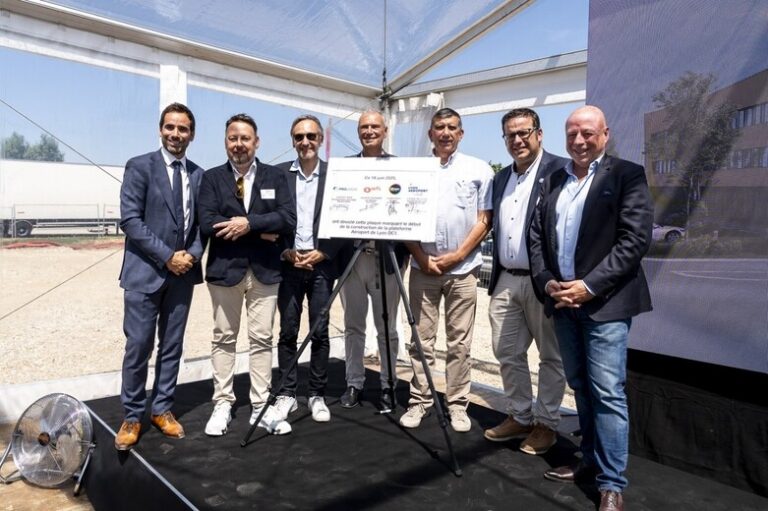
It is going to be big and bring jobs to the region. Image: WFS
Developed in partnership with Groupe em2c, Prologis, and Lyon Airport authority, the terminal will consolidate WFS’s operations in Lyon, create over 300 jobs, and “serve as a strategic anchor” for the company’s French and global network. Sustainability is a priority, with BREEAM certification, a photovoltaic roof, LED lighting, and EV charging stations planned. The new terminal aims to boost regional economic growth, streamline logistics, and reduce environmental impact.
Laurent Bernard, Vice-President of WFS France, said: “Aéroport de Lyon DC1 will become our second largest hub in France after Paris CDG for our French operations. Its strategic location and design will allow us to streamline cargo processing, especially for pharma shipments in the world’s leading vaccine-producing region. The new terminal will shorten turnaround times and increase our capacity in one of France’s most important logistics corridors, while reducing our carbon footprint with a modern building that has earned a BREEAM ‘Very Good’ classification, which measures the sustainability of buildings.”
Cédric Fechter, Chairman of the Management Board, Aéroports de Lyon, added: “This project perfectly illustrates VINCI Airports’ strategy for developing cargo activities and reaffirms the key role played by Aéroports de Lyon in the regional logistics chain [and] demonstrates our ability to bring together industry stakeholders around high-performing infrastructure that supports the attractiveness and competitiveness of the region.”
Vincent Sadé, Vice President and Head of Capital Deployment France at Prologis, commented: “The Lyon market is a highly strategic area for our Group. We are developing a facility designed to create lasting, tangible value for the entire region – by supporting job creation, boosting local investment, and incorporating high standards of environmental performance and energy efficiency.”
Yvan Patet, President of em2c Group, concluded: “This project illustrates what is possible when strategic consulting and support, technical execution, supply chain expertise, and local partnerships are aligned. This collaborative approach has now resulted in a solution tailored to the specific requirements of airfreight, regulatory complexity, and sustainable real estate.”
Since 10JUN25, Azul Brazilian Airline, has begun operating A330 aircraft from Madrid (MAD) and Porto (OPO), to destinations in Brazil. The start of the Madrid flights was celebrated by way of a Brazilian-themed launch event in the city, hosted by Global GSA Group. It is the exclusive General Sales Agent to Azul in Spain. The latest flight additions, operated by A330 aircraft, complement Azul’s existing European connections out of Lisbon (LIS) and Paris-Orly (ORY). They bring 13 additional weekly services and offer around 10 tons/60 m³ of cargo capacity per flight.
Celebrating a growing network as Azul launches Madrid and Porto flights. Image: Global GSA Group
Madrid sees five weekly departures to Viracopos (VCP) and three weekly flights to Recife (REC), while Porto counts three weekly flights to Viracopos and two to Recife. “These new connections between Spain and Portugal and Brazil further strengthen trade links between the regions,” the release underlines, emphasizing Global GSA Group’s “role as a trusted partner in global air cargo logistics.” Azul’s new connections come at a time when cargo demand between Europe and South America is growing – particularly with a focus on speed, agility and reliability.
Aytekin Saray, Chief Executive Officer of Global GSA Group, commented: “This development represents a key milestone in Azul’s international expansion. We are proud to strengthen Azul’s presence in Europe by delivering increased capacity and flexible solutions that benefit freight forwarders across the region. Madrid and Porto now join Lisbon and Paris as strategic gateways for South American cargo flows, offering even more seamless access to Brazil’s growing economy.”
Airbus employees no longer need to feel guilty about contributing to global warming through their aircraft’s CO2 emissions on business trips – provided they fly Air France on clearly defined routes and have booked the new ‘SAF Bundles’ product. The initiative is based on an agreement between the aircraft manufacturer and the airline, enabling Airbus managers to reduce the greenhouse gas footprint of their journey.
Even if the number of routes the scheme includes is currently very limited, the initiative is a starting signal and sets an example for other companies whose managers frequently need to take to the air for business purposes. The SAF Bundles product includes avoluntary contribution towards SAF and is directly embedded in the pax ticket. It is an option and not compulsory, Airbus and Air France unanimously stress. Precondition for the launch of the program was Airbus’ commitment to purchasing SAF options for its employees’ business trips by joining Air France-KLM’s “SAF Corporate” program, in this way facilitating the funding of SAF.
The joint initiative kicked off by Airbus and Air France might motivate other companies to follow suit – courtesy: ETSY.com.de
Will SAF Bundles become a trailblazer? Sébastien Guyot, Executive Vice President Global Sales at Air France-KLM, stated: “Reducing our CO2 emissions is a priority for our Group. Sustainable aviation fuel is essential to achieving our ambitions, and the contribution of our corporate customers, like Airbus, is crucial.” Raphaël Duflos, Vice President Corporate Services Procurement at Airbus, added: “We are proud to be pioneers in adopting the new ‘SAF Bundle’ offer following the rollout of the New Distribution Capability (NDC) with Air France. This demonstrates the importance of our strategic partnership with Air France on this key topic of decarbonizing business travel.”
Not all SAFs are the same Air France emphasizes that the kind of SAF chosen provides at least a 65% reduction in CO2 emissions over the fuel’s full lifecycle compared to fossil fuel. The Group has also implemented a strict procurement policy, sourcing only SAF that does not compete with food production, does not contribute to deforestation, and is not derived from palm oil. However, at least at the start of the program, the choice of flight routes remains very limited. It concerns connections between Airbus production sites such as Toulouse-Montreal or Hamburg-Shanghai, each with a transfer in Paris CDG.
Open Letter – EU policymakers are asked to secure SAF funding On the occasion of the 55th Paris Air Show (16-22JUN25), companies from across the aviation industry and energy value chains have called on European national governments to commit funding for an e-SAF pilot auction via a double-sided auction mechanism to kickstart the e-SAF industry in Europe. The letter is signed by 40 parties – including Airbus, Boeing, Air France KLM, IAG, and DHL. Coordinator is Germany-based SkyPower, that launched an action plan to push the decarbonization of the aviation industry up front by scaling e-SAF production. Hugo Duchemin of Paris-registered agency Comworxx, a member of SkyPower, submitted the open letter to CargoForwarder Global. Excerpts of the document are published below:
Honorable Minister, The EU has committed e-SAF production (sustainable aviation fuel produced from clean electricity) as a central lever for a lower emissions future, with ReFuelEU Aviation mandating increasing e-SAF blending from 2030 onwards. Amid Europe’s urgent pursuit of energy security, strengthening domestic industry against rising global competition, and fostering high-value job creation, e-SAF emerges as a strategic avenue for the EU to advance these objectives while securing global leadership in clean technology innovation.The 40+ signatories of this letter call on national governments to jointly commit funding to an e-SAF pilot tender, using a double-sided auction mechanism which could kickstart the market in time for the first e-SAF sub-mandate in 2030 and provide a cogent proof point for the EU. […] Funds committed by national governments would be disbursed from 2030 onwards, upon delivery of the first e-SAF volumes. Importantly, the tender can be structured to ensure that funding governments stand to benefit from accelerated access to e-SAF and from stimulation of domestic economies. This call for action should form part of a more comprehensive EU SAF strategy to deliver the ambitious ReFuelEU mandate for multiple SAF pathways (advanced biofuels and e-SAF) and ensure a competitive and sustainable European SAF industry. The commitment of funds to such a support mechanism would accelerate private sector action and investment towards scaling e-SAF production capacity to ensure funding countries can meet the sub mandates, as well as towards supporting Europe’s cleantech leadership on a global stage. The e-SAF ecosystem stands ready to grasp this rare opportunity to boost industrial competitiveness, energy resilience and clean transport […].
No airline or forwarding agent likes claims. This is because they are the result of irregularities in freight transportation, damaged shipments or even total losses. Often, they are costly and settling them is time consuming, since usually several parties are involved: airlines, ground handlers, road feeder companies or their partners, not to mention insurance firms. Yet, claims can also be a differentiating factor – if they are settled quickly, this can strengthen customer loyalty. Conversely, the opposite is true. Swiss WorldCargo has now launched a new online claims submission procedure aimed at speeding up and enhancing processes.
When asked about the innovation, the freight carrier first and foremost emphasizes that the new digital claims procedure is not intended to replace the existing personal, customer-centric approach, but rather to enhance it by removing friction from the initial stages of the process. Among other things, this is done via a new online form that standardizes the submission of claims, thus ensuring a uniform procedure for customers globally – regardless of station or time zone. Also, the tool increases transparency since the sender receives an instant confirmation after the claim has been filed, “which builds trust and reduces uncertainties,” stresses the carrier’s Claims department in a response to questions raised by CargoForwarder Global.
Swiss WorldCargo speeds up the transmission of claims from the sender to its Claims Department – courtesy: freeimages.com
Claims can have many causes and be very different The carrier’s Claims team further states: “We allow customers to send a Pre-Claim / Claim without having to previously register an account.” Although the reasons for claims can be very different, theyare handled centrally by Claims experts, the carrier assures. A further benefit of the new claims tool is internal efficiency improvement since manual e-mail handling is a thing of the past. This allows the dedicated Cargo Claims team to focus more on resolution quality and proactive communication, solving cases quickly and competently. This way, operational costs are minimized and the overall quality of the air cargo product is enhanced.
The human touch remains Despite offering claimants the digital submission of their cases if a shipment was damaged, got lost or was not flown as booked, Swiss WorldCargo points out that its team continues to manage each claim personally and that its members reach out to local stations when needed, therefore ensuring that the human touch remains central. The new system was launched on Wednesday (18JUN25) combined with the request to access a dedicated online form for Pre-Claims and Formal Claims – both providing a more efficient and user-friendly process, states Swiss WorldCargo.
Guiding customers These forms “guide our customers in a detailed way through the required fields to ensure our teams receive all the information they need to process their claim efficiently,” is stated in a release. Asked to illustrate the process by describing a typical claims example or two, Swiss WorldCargo sent CargoForwarder Global this reply: “We understand the importance of transparency, but we safeguard our customer’s privacy. Hence, the related internal processes and customer information are treated as confidential and cannot be shared externally.” In this respect, CargoForwarder Global would like to emphasize that it had requested that Swiss WorldCargo anonymize a given case, i.e. without specifically naming any people or companies involved.
CargoForwarder Global’s ‘Spotlight On…’ series highlights the very varied job areas within the air cargo industry. It is unthinkable, these days, to consider air cargo functioning without any kind of digital backbone. Technology plays a significant role in our industry – one that is constantly adapting to changing market requirements and regulations. Luis Leon, Senior Relationship Officer – Portfolio Management eCargo, at CHAMP Cargosystems S.A., talks about his role, experiences and the challenges the industry faces.
There are people behind each and every shipment. Image: Luis Leon
CFG: What is your current function and company? And what are your responsibilities? LL: As a Senior Relationship Officer at CHAMP, I manage the e-cargo portfolio of the reputable Traxon Global customs, security, and e-commerce products known as TGC, TGS, and TGE. Part of the product management strategy team, I play a pivotal role in building strong relationships that bring lasting partnerships.
CFG: What does a normal day look like for you? LL: I am not sure there is such a thing as a normal day [he laughs]. This is mainly due to the ever-changing daily challenges air cargo operations can bring, so some days are smooth as silk and others are long and challenging. Overall, I deal with customs authorities or customers who are inquiring if our products are connected to specific countries. I play a liaison role internally to bring marketing up to speed with what and where we are offering our services, and commercial teams who need knowledge support to secure a deal.
CFG: How long have you been in the air cargo industry, and what brought you to it? LL: I left a 15-year passenger operation role 5 years ago for the cargo industry in search of what and how things move around the world. I was always really fascinated by the supply chain and found the chance to join and participate.
CFG: What do you enjoy most about your job? LL: I really like the relationship-building aspect, because although all these pallets and containers and items move the world, there are people behind each and every one of those shipments, who need to still feel human and to know there is someone they can reach out to get some help. I also like being the internal point of contact for our marketing and commercial teams. I love helping them understand what we do and how we do it.
CFG: What do you see as the greatest challenges in our industry? LL: I think that modernization will be key to securing clean information, and what I mean by that, is moving away from old cargo messages such as CIMP and moving forward to more digital information that is clean and clear to all stakeholders. As an example, the move to the IATA initiative, ONE Record due to go live in January 2026, will be a game changer. Getting rid of paper air waybills and securing the information exchange to interested parties will be changed by this new initiative. Also more and more countries will be moving into requiring pre-load security clearance to ensure they know what is being loaded on the planes and what is coming into the country before it arrives. Using old CIMP messages is not really the right vehicle for the future since it is limited in how much information can actually be sent on them – we are talking about a 50-year-old message after all, that just does not make sense for how we are moving forward to gather and share all the necessary information.
CFG: What advice would you give to people looking to enter into the air cargo industry? Any particular training they should aim for? LL: I guess it just depends on what part of the business you want to work in: there is operations, there is commercial, there is flying the planes, and the IT side too. Really, it’s a big world out there, and I would really say: focus on getting exposure to different areas and then focusing on where you want to go after seeing which part interests you the most. Understanding the industry is essential to understanding where you want to work. Then, ultimately, it’s the training for that part that will help take your career off in the right direction.
CFG: If the air cargo industry were a film/book, what would its title be? LL: I would want to say it would be a Marvel movie with a big superhero, Cargoman, as the main character [he smiles], who can cause havoc on the world if he does not stop the bad guys or a global pandemic, who are trying to block or sabotage the supply chain.
Many thanks, Luis!
If you would like to share your personal air cargo story with our CargoForwarder Global readers, feel free to send your answers to the above questions to cargoforwarderglobal@kopfpilot.at We look forward to shining a spotlight on your job area, views, and experiences.
Our air cargo industry is changing in the midst of this current ‘Fourth Industrial Revolution’. Innovation, digitalization, sustainability, shifting market and skills requirements are all fuelling a wave of air cargo-focused start-ups. Whether they are providing technological solutions, introducing new business models, optimizing processes, enabling operational visibility and transparency through data, or leveraging the many opportunities that are arising through these changes, one thing is certain: these start-ups are disrupting the status quo for the better. And they deserve a platform. That is why CargoForwarder Global (CFG) is introducing a new, regular feature: “On the Starting Line…”. Each month, CFG will pass the mic to an industry-relevant start-up and allow them to introduce themselves in detail.
First up, is SkyForge (SF) – a boutique consultancy founded by Jelle Declerck (JS) and Mathieu Sérafimoff (MS), who both joined the industry more than ten years ago, and over time saw the need for consultancy that bridges the gap between boardroom strategy and operational reality – one “that is grounded in real-life experience, sharp strategy, and hands-on implementation,” as they tell CFG. “In a world where air cargo players are navigating rapid change, SkyForge offers something rare: a fresh perspective with feet firmly on the ground.”
Mathieu Sérafimoff (left) and Jelle Declerck bring a down-to-earth fresh perspective. Image: SkyForge
CFG: How did your start-up come by its name and who are its founders? SF: SkyForge is co-founded by Jelle Declerck and Mathieu Sérafimoff – two long-time colleagues with a shared vision of doing consultancy differently. The name “SkyForge” reflects our mission: to shape, develop and strengthen the future of air cargo – both in the sky and on the ground. “Forge” refers to building with intent, to sharpening tools, and to crafting strong foundations. We wanted a name that signals energy, action, and resilience — not something passive or abstract.
CFG. When did the idea for your start-up emerge and how did you source your team? How big is it and how do their skills relate to your business? JD: The idea for SkyForge took root in late 2023, during countless conversations about the disconnect we often saw between strategy and execution. Both Mathieu and I had been involved in commercial and operational transformations at scale, and we felt there was space for a consultancy that could do more than just advise. For now, we are the core team – with complementary profiles: I bring the commercial and strategic lens; Mathieu brings deep operational and regulatory expertise. Around us, we are building a flexible network of trusted collaborators.
CFG: When did you or are you planning to launch officially? MS: We officially launched SkyForge during Air Cargo Europe (ACE) 2025, using the event as a springboard to introduce the brand, meet partners, and activate our initial projects. It was a deliberate move – to launch not in silence, but in dialogue with the industry.
CFG: Where are your headquarters located and what is your international scope? JD: SkyForge is based in Belgium, but our scope is international. We are already active in airport and operator projects across Europe, and open to working globally where our hybrid model of strategic and operational support can add value.
CFG: What air cargo industry problem is your start-up trying to solve and why is it important? MS: We’re tackling the gap between what gets decided in the boardroom and what happens on the ground. Too often, commercial or operational strategies falter because there’s no bridge between vision and reality. That’s where we step in – not just with advice, but with the sleeves rolled up to make sure transformation actually happens. In an industry facing digitalization, regulatory shifts, and market realignment, that follow-through is critical.
CFG: Who are your target customers? JD: Our clients range from airports, ground handling agents, and logistics companies, to public and private stakeholders working on infrastructure, efficiency, or network growth. What they share is a need for alignment between strategy and execution – and that’s where we bring the most value. Our model is flexible by design: we tailor our involvement to the complexity of the challenge and the maturity of the organization.
CFG: What market research did you use to determine your company’s mission? What did it show? MS: Our research came from years of lived experience. We’ve seen where strategies fail, where teams lose alignment, and where external consultants often fall short. We also spent months speaking with industry peers, stakeholders, and decision-makers – all of whom confirmed the need for consultancy that’s both credible and embedded. The mission became clear: help the sector evolve, without losing grip on the realities that drive day-to-day performance.
CFG: Who are your main competitors and what is your unique value proposition? JD: We don’t see ourselves as competing directly with traditional consultancies – in fact, we often complement them. While many firms focus on high-level strategy or niche expertise, SkyForge excels at connecting the dots between vision and execution. We bring industry insight, operational credibility, and the ability to mobilize action on the ground. That makes us a valuable partner – whether embedded within a larger transformation project or supporting clients directly. Our size also works to our advantage: we’re agile, focused, and fully hands-on.
CFG: What have been your greatest achievements or challenges so far? MS: Launching SkyForge at ACE 2025 and immediately securing international opportunities was a major milestone. The challenge, as with any start-up, is managing momentum while delivering at a high level from day one. We’re learning fast, staying flexible, and focusing on building trust with every assignment.
CFG: What are the next steps for your company? JD: We’re finalizing our website and expanding our partner network. More importantly, we’re actively scaling our client base through high-impact projects and referrals. As we grow, we want to stay true to our hands-on DNA – growing smart, not just fast.
CFG: How would you describe your company culture in just one word? MS: Committed. To the work, to the people, and to making a real difference in a sector we know and love.
CFG: Where can readers find out more about you? JD: Our website www.sky-forge.aero will go live soon. In the meantime, we welcome conversations and connections via LinkedIn or directly by email. We’re always happy to talk – whether it’s about collaboration or just sharing ideas over a coffee.Thank you, Jelle Declerck and Mathieu Sérafimoff, for these insights into your start-up, and CargoForwarder Global wishes you every success going forward.
… and they will come, assures CEO Jost Lammers in an exclusive interview with CargoForwarder Global. Most likely in the e-commerce sector on routes from China to the Bavarian metropolis. So far, however, most consignments are still being transported in the lower deck compartments of passenger aircraft.
The figures are impressive: 360 intercontinental flights per week are listed in the airport’s traffic statistics. This allows for a very large number of shipments to be transported to and from Munich in the lower decks of passenger aircraft. Since 16JUN25, Cathay joins the list, serving Munich (MUC) four times a week with an A350-900. This is the airline’s second destination in Germany after Frankfurt. Its ground handling partner is LUG aircargo handling GmbH. CEO Lammers also announced that Vietnam Airlines will increase flights from Hanoi and Ho Chi Minh City from 4/7 to 5/7, operating B787-800 aircraft.
Without the contribution of air freight, many passenger routes would not be profitable, states Jost Lammer, CEO Munich Airport – credit MUC
Leader of the pack Compared to other German airports, MUC is on the rise in terms of air freight. From January to May 2025, the volume grew by 8.8%, to a cumulative 130,000 tons. In contrast, the other German airports recorded an overall decline in shipments of -1%. It is worth mentioning that the Munich statistics only show the actual freight flown. All shipments contributed by road feeder services are not included. If also counted, MUC would significantly increase its throughput statistics – by +250,000 tons per year. In the interview, CEO Lammers pointed out that air freight makes a substantial contribution to the sales generated by passenger flights. Depending on carrier and route, this is between 10% to 20%. In other words: without a basic contribution from air freight, some sectors could not operate profitably. Southern Germany, with the metropolitan areas of Munich, Nuremberg and Ingolstadt, is a huge market with a large catchment area that includes parts of neighboring Austria, the Czech Republic and Hungary, he emphasizes.
Attractive location This economic factor has motivated integrators such as DHL, UPS and FedEx to integrate Munich into their European and intercontinental network. Based on growth forecasts, DHL has invested EUR 150 million in the construction of a new distribution center at the airport. The building has a floor space of 19,000 m², while its previous hall only offered 1,500 m². The integrator serves MUC twice daily by freighter. This is also spurring on the competition. FedEx and UPS have knocked on Lammers’ door and expressed their demand for additional space. “That speaks for the attractiveness of our location,” says the airport boss. However, Express does not lead the ranking of flown freight. According to Head of Cargo, Markus Heinelt, general cargo is still in pole position. Final question to Mr. Lammers: Has Trump’s customs confusion left its mark on the air freight players using MUC? “We are not yet registering any negative effects on U.S. traffic – neither in terms of passenger numbers nor cargo volumes,” is his answer.
Bryan Bedford, President Trump’s nominee for heading the U.S. Federal Aviation Administration (FAA), never obtained a valid pilot’s license for commercial aircraft. This fact contradicts his multiple claims and assertions. Instead, he only possesses a private pilot’s license. The swindle was now revealed by the magazine POLITICO, following thorough research. Until his hearing last week, before a chamber in Washington, he claimed to be holder of a license allowing him to fly commercial passenger or cargo aircraft.
What at first glance appears to be a trivial matter, should be an alarm signal for U.S. aviation and its supervisory authority, the FAA. With a boss who had presumably wittingly falsified his bio as CEO of Republic Airways, in which he describes himself as a pilot holding a “commercial” rating, the authority will be further damaged should Trump not drop him last minute. If Bedford should be confirmed, it would further drag down the reputation of the FAA, following the controversial dismissal of hundreds of aviation experts decreed by Elon Musk’s Department of Government Efficiency (DOGE).
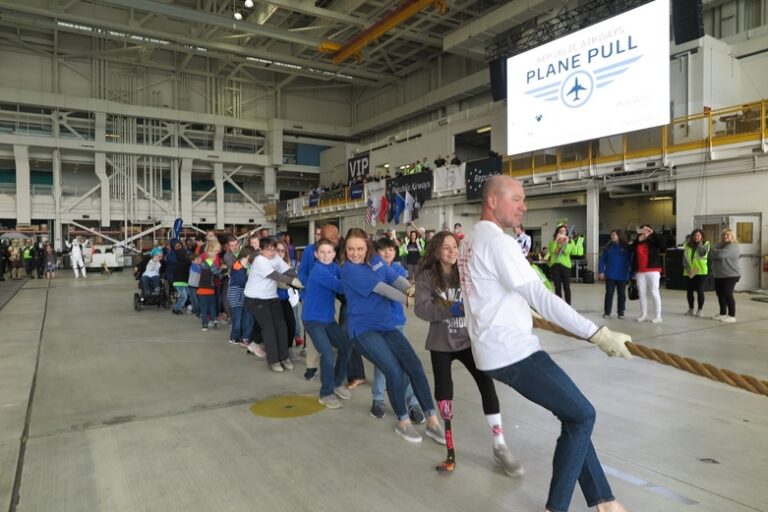
Bryan Bedford (forefront) at a Plane Pull event at Republic Airways – company courtesy
MAX 9 issues also cause headaches for the regulator Yet regardless of this latest turmoil, the FAA has been the source of negative headlines for years. For example, it mandated the certification process for the Boeing 737 MAX to the plane maker, in this way becoming dependent on the judgement of Boeing’s own engineers and technicians. No surprise that they confirmed that the jetliner meets all safety requirements demanded by the regulatory bodies. A decision with fatal consequences, as evidenced by two crashes involving MAX 9 jetliners operated by the Indonesian budget carrier, Lion Air, and Ethiopian Airlines. Investigations proved that the crashes were tied to a design flaw involving the Maneuvering Characteristics Augmentation System (MCAS) of the B737 MAX 9 series. As a result, all MAXs were grounded and technically updated. It is debatable if the MCAS malfunction had been discovered by independent FAA experts before Boeing was handed out the airworthiness certificate for the aircraft.
Questionable outsourcing practice Following minor incidents, FAA received the next alarm signal from Alaska Airlines, after a door plug on one of its B737 MAX 9 jetliners was blown off during flight, causing the aircraft to descend uncontrollably. Fortunately, none of the 177 passengers and crew were harmed. The primary cause was the absence of four bolts that are crucial for securing the door plug. Investigators indicated that the bolts were removed during the manufacturing process and not reinstalled. The plane maker admitted that there were quality control problems with the MAX 9 production during the manufacturing process at its Renton plant. Regulator FAA, which is responsible for ensuring aviation safety but had outsourced the authorization process to the frame maker, remained silent on the matter. The black streak in U.S. aviation reached its negative peak on 29JAN25, when an American Airlines passenger plane and a “Black Hawk” military helicopter collided near Ronald Reagan Airport in Washington, causing 67 victims.
Trump loyalty comes first In light of these events, thinning out the authority’s workforce and appointing a man to the agency’s top position who has obviously falsified his own CV, smacks of obstructionism. Once again, the case shows that when it comes to filling top positions in authorities, it is not the candidate’s qualifications that count, but his or her loyalty to Trump. When asked by POLITICO about Bedford’s credibility gap, the Department of Transportation (DOT), which is responsible for the FAA, defended him. “Bryan never misrepresented his credential; it was an administrative error that was immediately corrected,” DOT said in a statement. The agency did not respond to questions about what the “error” was or how it had been fixed. In addition, DOT said that Bedford has never claimed to be a “commercial airline pilot” but that he had passed “written and oral exams” needed to be licensed to fly commercially. This contrasts his bio and assertions maintained until the recent hearing of the Senate Commerce Committee. POLITICO emphasizes that records examined by them prove that he never held any commercial license. Nor could any evidence be found in the FAA registry that houses data on pilot’s licenses. In the meantime, Indianapolis-headquartered Republic Airways has deleted the word “commercial” in Bedford’s file. Now it reads: [… ] “he holds multi-engine and instrument pilot ratings.”
U.S. Transportation Secretary Sean Duffy, courtesy: Gvmt
Duffy advocates return to duty-free system in aviation Over at Paris, U.S. Secretary of Transportation, Sean Duffy called for the reintroduction of duty-free trade in civil aviation during his appearance at the Paris Air Show. He thus opposed the 10% tariffs imposed by U.S. President Donald Trump on most imports of aircraft components and parts, vital for Boeing and other aircraft manufacturers. In doing so, Duffy supported demands of the U.S. aviation industry to return to the duty-free system agreed in1979. The politician pointed out that U.S. companies had an annual trade surplus of USD 75 billion due to exports of aircraft components. Reciprocal measures taken by countries affected by the import tariffs could lead to severe financial disadvantages harming the competitiveness of the U.S. aviation industry, Duffy hinted in Paris.
Dronamics, recognized as the world’s first cargo drone airline (since it was officially designated IATA and ICAO codes in 2023), has been selected for an equity investment of up to EUR 30 million through the European Innovation Council’s (EIC) Strategic Technologies for Europe Platform (STEP). It is currently the only company in Europe designing, manufacturing, and operating long-range, high-payload cargo drones and has often been featured in CargoForwarder Global since its launch in 2014. Over the past few years, it has signed partnership agreements with e.g. Qatar Cargo and Sovereign Speed, to speed up deliveries for time-critical shipments. The first successful commercial test flights took place in 2023. Things have been a little quiet since then. Nevertheless, the EIC’s evaluation, conducted by an independent panel of experts, highlighted Dronamics’ technology as having strong potential for both societal and economic impact, supporting the EU’s goals for growth and regional development. Managed by the European Commission, EIC’s STEP initiative offers investments of between EUR 10 million to EUR 30 million with the aim of attracting additional private capital and support funding rounds of EUR 50 to EUR 150 million and more, and thus help push transformative European innovations. Dronamics has been put forward to receive up to the maximum funding amount of EUR 30 million, pending final due diligence by the EIC Fund.
Svilen Rangelov, Co-Founder and CEO of Dronamics, said: “As the only European company to repeatedly build, test and fly large cargo drones made entirely in Europe, we have proven we can reduce strategic dependencies and strengthen the EU’s tech sovereignty. With this decision doubling down on its previous investment in 2024, the EIC is clearly demonstrating Europe’s commitment to taking a proactive role in securing its technological future. It has never been a better time to build a large cargo drone in Europe.”
The transport logistic/Air Cargo Europe is always a place for big announcements, and PACTL has been particularly busy in this regard (see also Heiner Siegmund’s article this week: time:matters expands ground handling network).
Not only did it sign MoUs with Lufthansa Cargo Servicios Logísticos De México and Ethiopian Airlines Group, to strengthen trade links between China (Shanghai), Mexico, and Africa. It also revealed the initiatives it is taking to upgrade PACTL West terminal (which handled 1 million tons in 2024), with AI-driven technologies and automation so as to enhance throughput efficiency, capacity, and sustainability. And, last but not least, on 12JUN25, Cargo iQ announced that Shanghai Pudong International Airport Cargo Terminal CO., ltd (PACTL) had joined the association as its newest member. PACTL, which serves over 70 airlines and 300+ forwarders, will adopt Cargo iQ’s quality management system and performance monitoring tools to align and enhance its processes. In doing so, PACTL will be able to better identify and reduce any inefficiencies, resulting in better service reliability and greater shipment visibility as cargo passes through its facilities – be it perishables, pharmaceuticals, e-commerce or other commodities. Customers will benefit from optimized supply chain management and transparent quality metrics.
Marie Seco-Köppen, Executive Director, Cargo iQ, predicted: “I foresee that both PACTL and the wider Cargo iQ membership will benefit from this addition. By joining Cargo iQ, PACTL is demonstrating its commitment to operational excellence and customer satisfaction; it can use the performance management standards across the airlines they serve and regulate their own performance through transparent metrics.” Carsten Hernig, Deputy General Manager VP Sales & Marketing and Production, PACTL, confirmed: “Joining Cargo iQ marks a significant milestone in our ongoing journey toward greater transparency, efficiency, and collaboration across the global air cargo industry. As a neutral cargo terminal operator, we are proud to align with international standards that promote measurable quality and accountability. This membership not only strengthens our service commitment to our customers and partners but also empowers us to contribute more actively to shaping a smarter and more connected airfreight future.”