Home Blog Page 89

Qatar Airways Cargo #1 and still growing

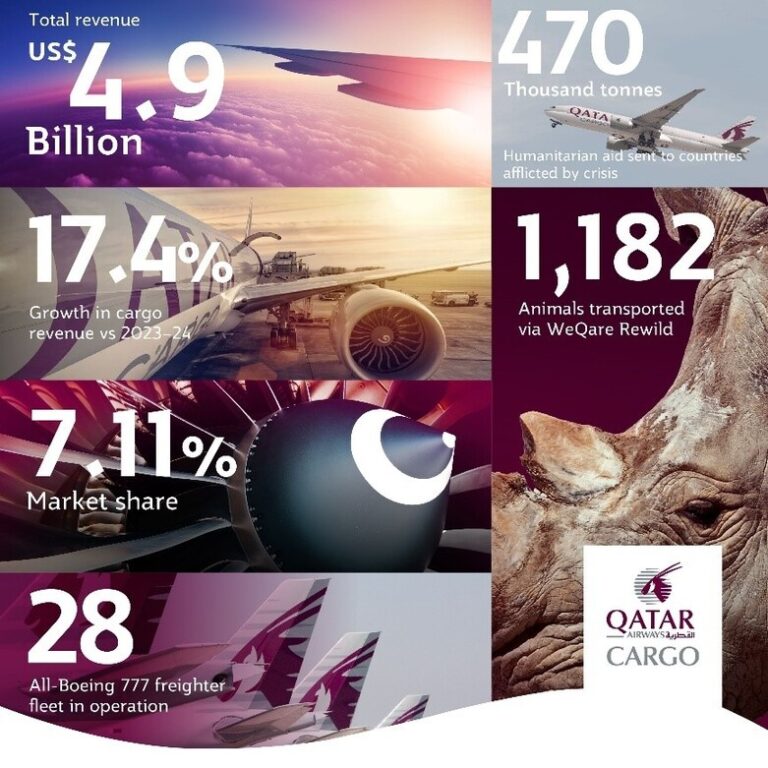
Qatar Airways Cargo announced another record-breaking annual result – its best since the pandemic, revealing a 17.4% growth in cargo revenue and registering 1.5 million tons of transported chargeable weight. It continues to hold 7.11% of the global air cargo market, serving 60+ freighter with its fleet of 28 Boeing 777 freighters, and a belly-capacity network to 160 passenger destinations. New freighter services were launched to Abu Dhabi, Sharjah, Vienna, Kuala Lumpur, and London, and frequencies to China and Hong Kong increased. The cargo carrier says its success is due to “a bold strategy, relentless innovation, and unmatched operational reliability” and underlines the importance of “impact”. It cites a cargo uplift of 470,000 kg of humanitarian aid over the year, delivered free of charge under its WeQare program in partnership with UNHCR, Airlink and other global NGOs. Its WeQare “Rewild the Planet” chapter also saw 1182 animals being carried at no cost, on behalf of United for Wildlife and Animal Defenders International, among others. “Special cases included 47 ring-tailed and brown lemurs, 155 radiated tortoises, 757 spider tortoises and seven lions.”
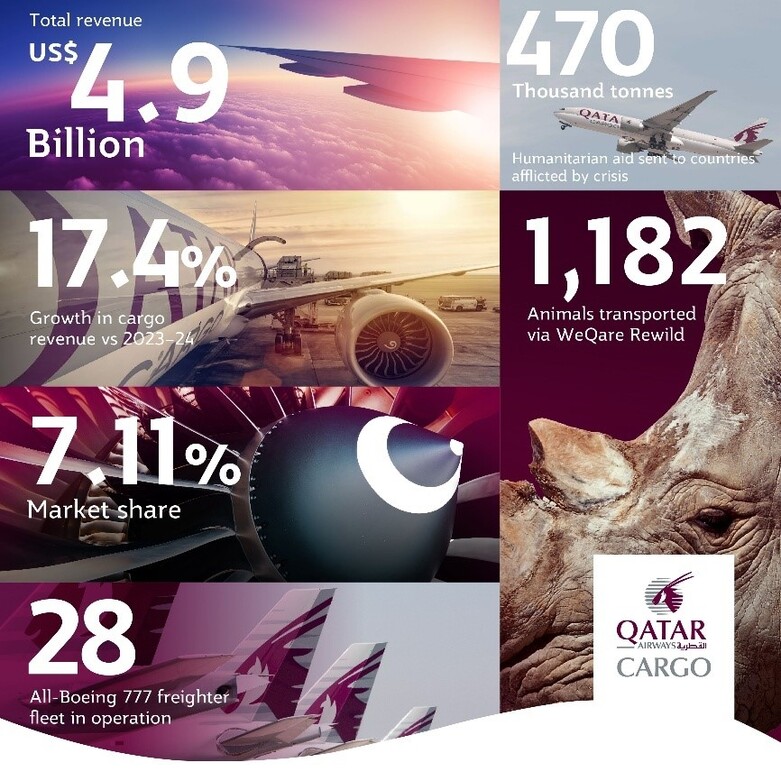
The cargo airline publishes impressive results. Image: Qatar Airways Cargo

Product innovation played a key role: Qatar Airways Cargo launched its AirPlus Solutions: Q-Climate, Q-Plus, and Q-Prime, and a unique Aerospace product catering to aviation, defense, and space cargo. TechLift was launched, tailored to the semiconductor industry, and the carrier relaunched its Live product together with the inauguration of the world’s largest Animal Center at Doha hub. (CFG reported)

Digital Lounge e-bookings increased to 36% in MAR25, and Qatar Airways Cargo became the first cargo airline to enable interline partners to book online. Partnerships with Octoloop by Cargo Flash in India, Wiremind Cargo where it was the first carrier to go live on CARGOSTACK, and UNISYS Cargo Portal Service, were major digital milestones.

Mark Drusch, Chief Officer Cargo, emphasized: “Reaching the top is hard. Staying there takes vision, precision, improvement and teamwork. We’ve executed relentlessly and the results speak for themselves. Our agility in adapting to shifting market conditions, a focus on investing in digitalization, deeper data-driven analyses, and best-in-class reliability is what has attributed to our success. I’m incredibly proud of the Qatar Airways Cargo team, our partners and customers who continue to make us the benchmark in air cargo. We’re not here to follow trends – we’re here to set them. Qatar Airways Cargo will continue to lead through performance, foresight, and purpose. New products and digital innovation are already in the pipeline. This is what Leading Global Trade looks like.”
Lufthansa Cargo automates email booking requests with AI

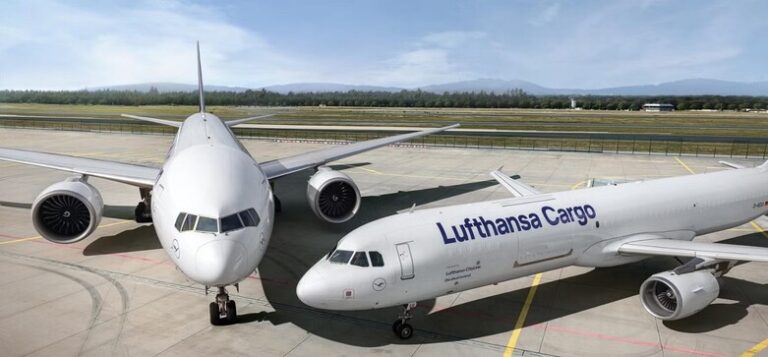
Lufthansa Cargo has begun using an internally developed AI-based software solution to handle those booking requests that still come in via unstructured emails. Its new bot and AI function has improved the efficiency and speed at which the corresponding shipments can be properly booked in the system. It would appear that this currently only applies to general cargo booking requests, since the release states: “The expansion of the new booking process to other product groups is already in preparation.” Thanks to AI and robotic process automation (RPA), emails can be scanned, routing requests quickly processed, and customers given a fully automated and instant booking confirmation.

The airline joins a growing number of companies putting AI to good use. Image: Lufthansa Cargo

The airline reveals that it has been operating its own ‘AI & Automation Community’ since roughly a year, where experts evaluate and implement potential automation projects. Ten projects have been launched either as pilots or meanwhile fully implemented since the community began. Among them, “an intelligent software solution for customer relationship management that automatically forwards enquiries to the relevant department or makes automated rebookings in the event of unforeseen disruptions during transport.

Urte Wirtz, Head of Global Sales & Product Management at Lufthansa Cargo, revealed: “The majority of direct booking requests are already submitted via our website or booking platforms. Nevertheless, our sales teams still receive numerous enquiries in unstructured emails in which shipment data is listed in plain text or other file formats. Until now, these had to be transferred manually into our system. Automating this process and entering the data simultaneously into our booking system saves time, particularly at the interface between our employees and our customers. Our forwarders also benefit from automated booking confirmations and faster processing. This increases efficiency and reduces the error rate of incorrectly transferred data on both sides. [..]. With this new project, we have introduced another time-saving process at the interface with our customers. With fewer manual tasks, our sales teams in particular have more time for personal dialogue with our customers. This once again demonstrates that we are actively driving the digitalization of the air freight industry and embracing new technologies.”

Jasmin Kaiser, CIO of Lufthansa Cargo, said: “The technological possibilities offered by AI and RPA ideally complement our digital portfolio. Combined with our core applications, such as the revamped booking platform, they offer a wide range of automation potential that we can implement much faster and more efficiently than just a few years ago.”

ECS Group and Global GSA Group launch ‘Impact Week’

Employees are being encouraged to participate in the companies’ first Impact Week, 16-20JUN25. Intended as an annual event, it forms part of the Charity Program, launched in JAN23, which grants all staff one paid day per month to volunteer for a cause of their choice. An internal digital platform offers a selection of more than 5,000 activities and 11,000 charities worldwide, covering child protection, education, environmental conservation, and aid for those in need. It also suggests challenges to promote well-being, diversity, and environmental awareness, and allows users to track their impact and engage with colleagues’ efforts through a live news feed. To date, employees have participated in a wide range of voluntary activities, from collecting essentials for people in need, supporting humanitarian logistics with Aviation Sans Frontières, mentoring youth, helping in community kitchens, and assisting at children’s homes and rehabilitation centers.

Making an Impact for the greater good. Image: Lemon Queen

Aytekin Saray, Chief Executive Officer of Global GSA Group, stated: “Our entire group – all entities and all employees – is encouraged to participate in Impact Week on a voluntary basis. Whether they donate an hour of their time, a day or even longer (naturally in coordination with their management to ensure day-to-day operations are not disrupted), is up to them. The important thing is that we get everyone on board and inspired by the many participation options in our digital platform. Not that these are by any means exhaustive. Our employees can also suggest new initiatives and integrate them into the platform, thus also opening them up to their colleagues.”

Jean Ceccaldi, Chief Executive Officer of ECS Group, explained: “Over the past two years since the official launch of our Charity Program, our employees have been involved in an impressively varied range of volunteering activities […] and in those two years, ECS Group has grown and seen many new colleagues join the company. The idea of Impact Week, therefore, is to raise internal awareness of our Charity Program, make it more tangible, inspire participation, and to give guidance on how to get involved. We want to foster a spirit of solidarity and collective action. I am pleased to report that our charity initiatives are not limited to within our companies, but that some of our customers also volunteer together with us. Last year, for instance, AVS in Thailand and Thai VietJet Air cooperated to provide essential supplies (including a large donation of milk), to communities affected by severe flooding in Northern Thailand, impacting over 8,000 families. We are also planning joint initiatives with other airline partners as part of our upcoming Impact Week, including a collaboration with Corsair through Aviation Sans Frontières, for example.

WestJet Cargo offers daily Dreamliner to Japan

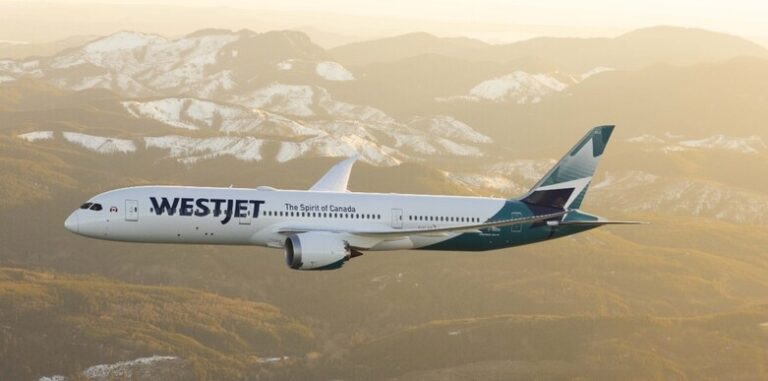
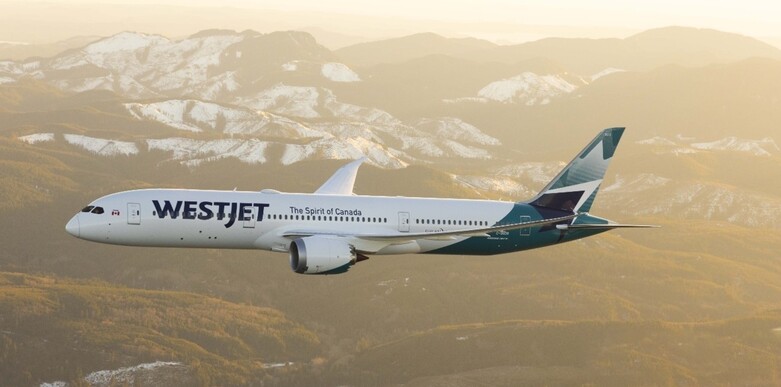
WestJet Cargo has increased its trans-Pacific capabilities by introducing a daily, year-round service between Calgary and Tokyo Narita International Airport. It deploys a Boeing 787 Dreamliner on the route, which offers a cargo capacity of up to 22 tons and 80 cubic meters each way. This latest expansion provides a dependable and regular service between North America and Asia, and strengthens two-way trade. Japan exports industrial, automotive, electronic, and high-tech goods to and across Canada, the U.S., Mexico, and Europe via WestJet’s network. Canadian perishables, meat, seafood, and general freight travel in the opposite direction, reaching Japan more quickly and efficiently. Freight forwarders and logistics providers can easily book shipments through digital partners: CargoAi, WebCargo, and cargo.one.

Daily B787 Dreamliner service augments Canada-Japan-connection. Image: WestJet

The cargo expansion complements WestJet’s daily year-round passenger service to Tokyo and its broadened codeshare with Japan Airlines, providing smooth onward connectivity to Osaka and Nagoya, and reinforcing Calgary’s growing role in global trade and logistics,” the release states.

Julius Mooney, Director of Commercial at WestJet Cargo, said: “Expanding our cargo capacity to Japan through daily Dreamliner service is a pivotal step forward for WestJet Cargo. This route enables Canadian exporters and global shippers to move high-value and time-sensitive goods with speed and reliability, while also strengthening Western Canada’s role as a key gateway to Asia.”

Girteka places Europe’s largest 2025 order of Volvo Trucks

Lithuanian transport and logistics company, Girteka, has secured Europe’s largest truck deal of 2025 by ordering 2,000 new heavy-duty vehicles from Volvo Trucks. This massive purchase, to be delivered throughout the year, is central to Girteka’s strategy of maintaining a modern, efficient fleet capable of meeting evolving customer demands. The new fleet will enhance reliability and flexibility, particularly for time-sensitive and temperature-controlled cargo.

Cleaner, more comfortable, and efficient. Image: Girteka

Despite a 16.6% drop in heavy truck registrations across major EU markets in Q1 2025, Girteka’s investment underlines its commitment to providing stable, flexible road transport solutions. The deal is supported by Volvo Financial Services and includes Volvo Blue service contracts, ensuring optimal vehicle performance and uptime.

Drivers benefit from upgraded comfort and safety in the new Volvo FH and FH Aero models. Features like electric parking coolers and improved cab aerodynamics (capable of boosting fuel efficiency by up to 5%), are complemented by Volvo’s Camera Monitor System, enhancing visibility and reducing accident risks. Each truck is digitally connected, enabling proactive maintenance and faster response to issues, fostering a safer, more reliable driving experience.

Girteka runs one of the largest asset-based logistics networks in Europe, and this fleet renewal will help the company maintain and scale its service in key sectors, including food & beverage, FMCG/retail and high-value goods,” the release explains.

Roger Alm, President Volvo Trucks, underlined: “These trucks represent the latest in performance, fuel efficiency and safety. We are excited to see them support one of Europe’s largest transport companies.”

Edvardas Liachovičius, CEO of Girteka Group, explained: “Every delivery matters to our customers and us. It means every truck needs to perform. This renewal gives us the efficiency and reliability we need to keep our promises today and tomorrow, staying ahead in the market. Our customers rely on us to deliver on time, across borders, and in perfect condition. With this investment, we’re reinforcing that promise with the most modern and efficient fleet.”

Royal Air Maroc Cargo’s strategic outlook

What is Royal Air Maroc Cargo’s vision for the next five years, CargoForwarder Global wanted to know. In an exclusive interview, Yassine Berrada, Vice President Cargo at Royal Air Maroc, outlines the company’s ambitious plans for the coming half-decade and beyond, highlights fleet expansion, enhanced global connectivity, a steadfast commitment to sustainability and digital innovation, and shares the secret to success in air cargo.

Yassine Berrada, Vice President Cargo at Royal Air Maroc. Image: Royal Air Maroc

Royal Air Maroc Cargo’s vision for the next five years is anchored in fleet growth, with plans to benefit from the acquisition of widebody aircraft and the addition of at least one all-cargo narrowbody by late 2026, Yassine Berrada states in response to CargoForwarder Global’s opening question regarding the airline’s 5-year plan. This move is expected to support the company’s long-term goal of quadrupling its fleet by 2037.

Casablanca’s geographical advantage
In addition, the company is focusing on strengthening its role as a key logistics bridge between Africa and the rest of the world. “We aim to enhance connectivity between Africa and Europe, the Americas, and Asia, through the inauguration of new lanes such as Boston, Guangzhou, and New Delhi,” Yassine Berrada says. The recent reopening of the Casablanca-São Paulo route is a case in point, re-establishing Morocco as a strategic transit point. “Morocco is a pivotal gateway to the rest of the world, with the near proximity it has with Western Europe and Western Africa, as well as the 7-hour flight to North America. With the recent reopening of the Casablanca-São Paulo route, Morocco regains its rightful place as a first leg to Europe and Asia with the direct connection to Beijing,” he explains. CargoForwarder Global asks what motivated the recent expansion of routes to São Paulo, Toronto, and Beijing, and if there are plans to add more destinations in the near future? “Those routes are traditional destinations for Royal Air Maroc. Covid-19 stopped our expansion at the time, but now the company is deploying a strong commercial strategy with new route openings as one of its key pillars. Routes are studied for both passenger and cargo strong potential,” he replies.

Key industries and commodities
Its strategic positioning makes Casablanca a vital node for global trade, benefiting industries and regions across multiple continents. The city’s Mohammed V International Airport is already one of the busiest in Africa and is set to further expand as construction launches in JUN25 on a USD 1.5 billion passenger terminal in preparation for Morocco’s co-hosting of the FIFA World Cup in 2030. Yassine Berada reveals that, on the cargo side, the industries and commodities that are currently particularly strong into/out of Casablanca, are automotive and aeronautic parts, fresh agricultural products, and personal effects.

Sustainability…
Sustainability is a cornerstone of Royal Air Maroc Cargo’s strategy, CargoForwarder Global learns. “Royal Air Maroc deploys a strong sustainability strategy in terms of eco-friendly power generation, through the installation of photovoltaic panels all over the Casablanca Hub, and the use of electric vehicles for our day-to-day transportation needs,” Yassine Berrada shares. The airline has also joined the IATA Eco Hub, participating in initiatives such as IATA CORSIA Connect, IATA CO2 Connect, and IATA Track Zero, which support compliance with international carbon offsetting standards and accurate emission calculations. Environmental Stewardship is important, too. Royal Air Maroc Cargo actively participates in the IATA Illegal Wildlife Trade (IWT) program and is currently preparing for the IENVA Environmental Assessment, with an audit scheduled mid-2025.

… and digital innovation
On the digital front, partnerships with cargo.one and CHAMP Cargosystems have significantly improved operational efficiency and customer experience. “Digitalization is a path that all the industry’s front-runners have adopted and continue to deploy each year. Our partnerships are only an example of the company’s commitment toward offering our customers a seamless experience whether during booking, tracking, delivery, or claims follow-up,” says Yassine Berrada. He adds: “CHAMP Cargosystems is now our HUB operators’ best friend. It enables them to keep a detailed view over what we already have stored and each package arriving and departing our facilities.”

Challenges and a competitive edge
Expanding a global cargo network is not without challenges. “We mainly rely on the widebody passenger aircraft the company acquires at a steady pace, thus opening new cargo routes is an organic action taken and prepared for by the Cargo Division,” Yassine Berrada notes. “Commercial efforts are consistently deployed to meet new customers and retain existing ones by offering them a seamless experience.”

When asked about competition and how the airline plans to compete with other major cargo carriers in Africa and beyond, Yassine Berrada is candid: “Royal Air Maroc Cargo is part of the most ambitious airline in Africa; the only way forward for us is to develop our network and set new goals each couple of years. Competition is also doing a great job, and this can only be good news for our customers and our continent, but the momentum Royal Air Maroc has currently, is simply unprecedented.”

The secret to success
And finally, what does Yassine Berrada believe the secret to success in air cargo is? His belief is clear: “Customer experience. And a strong sense of partnership between the airline and the customers,” he says, going on to add efficient operations and motivated, skilled teams into the success equation.

Thank you, Yassine Berrada, for your answers.

Spotlight on… Ghariba Ahmed Suleiman, Business Dev. Manager, Cargo & Logistics, KSIADC

Every Sunday, CargoForwarder Global’s ‘Spotlight On…’ highlights a different segment of the air cargo industry to show how varied its many career options are. It takes vision, investment, and innovation to ensure efficient and functioning trade lanes and a relevant air cargo industry also in the future. One country and company involved in precisely that goal, is Saudi Arabia with its Vision 2030, and the King Salman International Airport Development Company (KSIADC) tasked with transforming the airport into a global hub for transportation, trade, and tourism. This week, Ghariba Ahmed Suleiman (GS), Business Dev. Manager, Cargo & Logistics at KSIADC, describes her role and shares her thoughts and advice on the air cargo industry.

I strongly encourage young women to explore the air cargo industry. Image: Ghariba Ahmed Suleiman

CFG: What is your current function and company? And what are your responsibilities?

GS: I drive Business Development efforts at King Salman International Airport Development Company (KSIADC), focusing on Cargo & Logistics; to strategically position the airport as a world-class logistics hub, in support of Saudi Vision 2030. Through my work, I contribute directly to national goals such as economic diversification, increasing non-oil exports, and elevating Saudi Arabia into the top 10 global logistics centers by 2030.

CFG: What does a normal day look like for you?

GS: There’s no such thing as a typical day – and that’s what I love about it. Some days are spent in a more corporate environment, other days, I’m out on site visits, immersed in the operational side of things. It’s an exciting mix that keeps me engaged – from boardrooms to construction zones – and I get to meet and interact with new people almost every day.

As a new mom, I’m also learning how to navigate the balance between personal and professional life. Some days are smooth; others are a juggle – but both worlds bring their own rewards and challenges. It’s made me more focused, resilient, and deeply appreciative of the support systems around me.

CFG: How long have you been in the air cargo industry, and what brought you to it?

GS: I’ve been in the air cargo and logistics space for over a decade now. What drew me in was the fast pace and global nature of the work – it’s an industry that keeps you on your toes and constantly learning. Plus, it really makes you appreciate how the world moves behind the scenes.

CFG: What do you enjoy most about your job?

GS: Honestly, it’s the people and the big-picture thinking. I love connecting dots – whether that’s bringing stakeholders together, identifying new business opportunities, or helping turn a vision into reality. And I’m lucky to work in a space that’s evolving and full of potential.

At KSIA, I have the privilege of contributing to projects that go beyond operational importance to carry national strategic significance. For example, developing our smart logistics zone not only attracts foreign investment but also strengthens Riyadh’s position as a global gateway – both of which are key pillars of Vision 2030.

CFG: What do you see as the greatest challenges in our industry?

GS: Another major challenge – and opportunity – lies in reshaping perceptions of roles within this industry. At KSIA, we are actively championing diversity and encouraging women to pursue careers in cargo and logistics. Breaking stereotypes and fostering more inclusive workplaces is not just a social imperative, but also a key driver of innovation and a catalyst for unlocking untapped talent.

CFG: What advice would you give to people looking to enter into the air cargo industry? Any particular training they should aim for?

GS: Be curious and open to learning – this industry is full of niche areas, so the more you explore, the better. But just as important is networking and getting exposure through internships, events, or even LinkedIn conversations. It’s a small industry, and relationships go a long way.

I also strongly encourage young women to explore this field. We are seeing an increasing number of women taking on roles in cargo operations, data analytics, and commercial leadership – supported by private sector initiatives and national employment programs. The opportunities are real, and the future is full of possibilities.

CFG: If the air cargo industry were a film/book, what would its title be?

GS: “Behind the Scenes: The Invisible Network that Moves the World” — because that’s really what air cargo is. It’s often overlooked, but it plays such a vital role in the way our world operates.

Many thanks, Ghariba!

If you would like to share your personal air cargo story with our CargoForwarder Global readers, feel free to send your answers to the above questions to cargoforwarderglobal@kopfpilot.at We look forward to shining a spotlight on your job area, views, and experiences.

Airbus completes first A350F wingset in Broughton

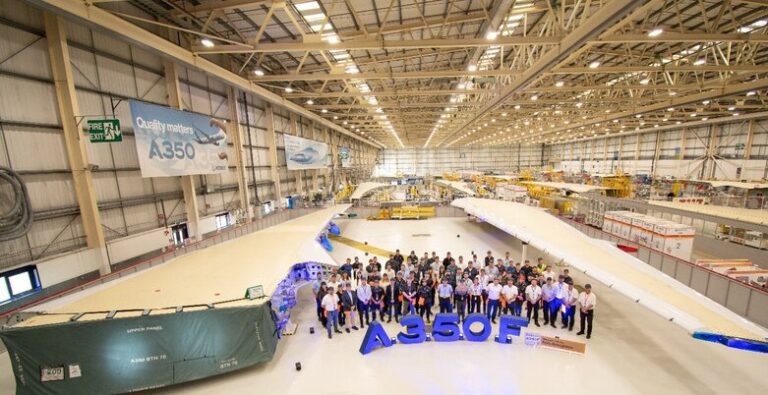
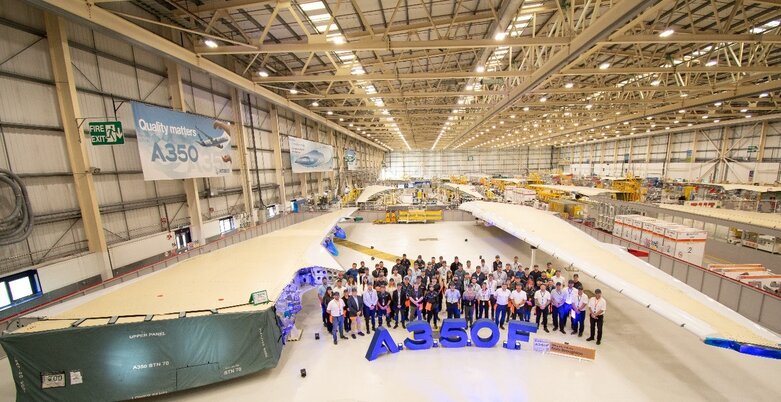
Broughton, a small town in Wales, hosted a big day last week – at least for the employees at the local Airbus plant. It is the European group’s center of excellence for the construction of wings. On 30MAY25, the first ever finished set of wings for the future A350 freighter was presented to the public, framed with dignity by 70+ employees. Many pairs of wings will follow, as airline orders for the freighter have picked up speed.

Presentation of the first set of A350F wings at Broughton – Courtesy: Airbus

To date, 63 firm airline orders have been signed. Among them are the usual suspects such as Etihad Cargo, Silk Way West, AF-KLM Cargo, Cathay Cargo, Turkish Cargo, but also U.S. lessor, Air Lease Corporation, and the air freight division of French shipping colossus, CMA CGM.

On the occasion of the presentation, Head of Widebody Wings at Airbus Broughton, Paul Kilmister, said, “This is a proud moment for everyone at Broughton, completing the first ever A350F wingset. With almost 1,400 orders for the A350, including 63 A350F, Broughton will continue to play a critical role in the future of the program, supporting Airbus’ growth in passenger and freight markets.”

Multiple delays
The construction of the large freighter was first announced in 2021, and its entry into service was scheduled for 2025. Due to supply chain hiccups, the maiden flight was then postponed to 2026. As the problems have not been completely resolved despite some improvements to the processes, particularly at major supplier, Spirit Aero Systems, delivery of the first A350F is now scheduled for 2027. However, Airbus has not yet officially confirmed this timing.

Unique XL cargo hatch
The A350F is a derivative of the A350-1000 passenger version, with a shortened fuselage between the cockpit section and the wings, to optimize the aircraft’s center of gravity. It is equipped with an XL cargo door measuring 3.8m (height) and 3.05m (width). In comparison, the dimensions of the competitor model Boeing 777-8F are 3.72m x 3.05m. “As the next generation of engines will probably be even larger than today’s motors, they will also fit into our A350F for maintenance and repair purposes as well as fast deliveries to customer airlines,” says Crawford Hamilton, Airbus’ Head of Freighter Sales. Unlike the 747-8F from competitor Boeing, the cockpit section cannot be lifted so that nose door loading of long and bulky cargo such as oil drill equipment is not possible. However, the proportion of this type of special cargo is less than one percent, so Airbus has dispensed with the technical option of nose-door loading.

Attractive performance offerings
Currently, Airbus is building two A350F test aircraft which will undergo flight tests throughout 2026 and 2027. The Broughton manufactured wings will soon be transported by BelugaXL freighters to Bremen, Germany, for final equipping before being sent to Toulouse to be attached to the fuselage of the first test aircraft.

According to Airbus, these are the most important performance parameters:

  • 20% lower fuel burn and CO2 emissions compared to current in-service freighter aircraft.
  • Optimized loading capacity due to the enlarged cargo door.
  • A nonstop range of up to 8,700 km when fully loaded with 111 tons of freight.

“The A350F is poised to shape the future of air freight, offering operators a more efficient, and versatile solution for decades to come,” reads an Airbus marketing brochure. The European frame maker notes that many cargo operators will look to replace their aging McDonnell Douglas MD-11F over the next decade. In combination with stiffer environmental regulations imposed by many states, it will increase the sales of the A350F and its competitor, Boeing’s 777-8F.

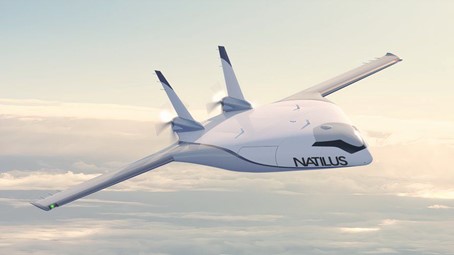
Illustration of Nautilus’ BWB freighter version “Horizon” – image: Natilus

Kuehne+Nagel eyes BWB freighter
The Switzerland-based logistics giant has announced a strategic partnership with U.S. startup Natilus, which aims to produce Blended Wing-Body passenger and cargo aircraft (BWB). Through their collaboration, the two companies intend to explore the possibilities of deploying such aircraft in the air cargo sector. According to Natilus, a freighter version of its BWB Horizon model could fly autonomously and would offer the market a payload of up to 3.8 tons. It is scheduled to take to the skies in the early phase of the next decade.

Boeing loses ground in China

Chinese airlines have not placed any major orders with Boeing since 2017. Last year, the U.S. manufacturer delivered 56 jetliners to Chinese airlines, and 18 in the first quarter of 2025. Meanwhile, the production of aircraft made by Chinese newcomer, COMAC, is also becoming more expensive as around 50% of the aircraft parts required to build the C909 and C919 series are provided by US suppliers.

The data is already showing first effects: the production rate of both COMAC series halved by 50% in the first four months of this year, from 14 to a mere 7 aircraft. This is a major setback for the Chinese bearer of hope, which is seeking to secure an increasing market share as the third largest producer of civil passenger aircraft alongside Airbus and Boeing, followed by freighter derivatives.

Bizarre dispute
Now, a further problem has thrown a spanner into the works: The tariff dispute between the two countries, triggered by Trump, has also made aircraft components considerably more expensive. In an escalation cascade, Trump trumpeted that he would impose tariffs of up to 245% on Chinese products. Beijing’s leaders responded by announcing tough countermeasures. In the meantime, the U.S. government has reduced its tariffs on Chinese imports to 30%, while China is imposing a fee of 10% on U.S. imports instead of the formerly announced 125%. However, this is a temporary freeze until mid-AUG25. Until then, both sides intend to reach a longer-term settlement. Whether this will happen remains to be seen.

Uncertainty is poison for aviation
In any case, the latest tariff conflict has led to enormous uncertainty among aircraft manufacturers and in the entire aviation industry. The U.S. is the top external supplier of China’s aircraft industry, accounting for more than 50% of the total value of parts and components imported by manufacturers and users. Meanwhile, the tariff dispute has led to parts shortages at COMAC’s production sites, including at their local suppliers. This has already slowed down the production rate of newbuilds and prolongs the maintenance cycles of aircraft in service, aviation analysts from China International Capital Corporation (CICC) state in a study.

Boeing Chief Kelly Ortberg admits that his company is facing problems in China – courtesy: Boeing

The delay rate is growing
The CICC analysts added to this that tight supply chains and tariff pressures mean that the aircraft delivery delay rate will stagnate at around 25% from 2025 to 2027. They estimate that around 15% of Airbus aircraft deliveries to Chinese airlines are delayed, with the rate of Boeing jetliners climbing to as high as 40%.

Against the backdrop of the customs dispute, some Chinese airlines have now refused to take delivery of previously ordered Boeing aircraft. The manufacturer’s CEO, Robert Kelly Ortberg confirmed this last week to the South China Morning Post.

As Bloomberg reports, the government in Beijing has now asked Chinese airlines to stop ordering aircraft and aircraft parts from Boeing due to the simmering trade dispute between both countries.

According to Boeing’s website, at the end of APR25, 128 of Boeing’s 6,282 unfilled commercial plane orders were destined for China. The frame maker delivered 56 aircraft to Chinese buyers last year and 18 in the first quarter of this year. However, the last time Chinese airlines placed a large order for Boeing jets was in 2017, with European rival, Airbus, being the preferred supplier in the years since.

Argentina: End of the handling monopoly

It is just a brief, official note released from the Air Transport Division of the Argentine Ministry of Economy, which reads: “Handyway Cargo S.A. is hereby authorized to offer ground operations and handling services at Argentine airports.” This authorization marks the end of Intercargo’s decade-long state monopoly.

Ezeiza Airport in Buenos Aires is certainly the most attractive place in Argentina for Handyway’s ground handling services  –  courtesy: EZE.

Javier Milei, the man in the casa Rosada and whose political symbol is a chainsaw, is further reducing the governmental field of influence by pushing back state activities in the aviation sector in favor of private investors. This is evidenced in the Boletín Oficial de la Republica Argentina under file number 2025-12-APN-SSTA#MEC and signed by Hernán Adrian Gómez, the Under-Secretary of State. In this case, the beneficiary is Handyway Cargo S.A., which the Milei regime has allowed to run the operational and ground handling business at roughly a dozen Argentinian airports. Among them, the country’s number one airport: Ezeiza in Buenos Aires, Rosario International, and Aeropuerto Pajas Blancas in Córdoba. “This new entitlement is possible thanks to the deregulation and opening of the airline industry that has been taking place since December 2023, in the country, in order to generate greater competitiveness in the sector, more supply and investment in the industry,” reasons Under-State Secretary Gómez in an official statement published last week.

Handling contract without tender
This decree paves the way for the ultra-liberal head of government and self-confessed Trump and Musk supporter, Milei, to cripple Intercargo which is owned 80% by the Ministry of Economy and 20% by the Ministry of Defense, and favor its private rival, Handyway, without any previous tender procedure.

Market experts are critical of whether the state-owned company, Intercargo, will be able to keep its head above Rio de la Plata’s water and generate new business that compensates for the expected major loss of market share. This would probably only be possible through a radical austerity program in which many employees would lose their jobs, and well-paid labor contracts would have to be renegotiated to drive costs down.

Broad product portfolio
Handyway Cargo has been in the airport business for more than 20 years and, in addition to Argentina, is also active in the neighboring countries of Paraguay and Uruguay. It offers customers a wide range of services from ramp handling to road feeder services and courier and express options. The core business, however, is the handling, throughput, and if necessary, storage of pharmaceuticals, perishables, dangerous goods, valuables, and standard cargo shipments. Handyway’s regular customers include the Latin American airlines, LATAM and its cargo division LATAM Cargo, Avianca/Avianca Cargo, and the private low-cost company, Flybondy. Founded in 2018, it has become the second-largest airline in the gaucho state after the flag carrier, Aerolíneas Argentinas.

Growing resistance
The flag carrier is another hot candidate standing on Milei’s privatization list. The government claims that Aerolíneas is too expensive, inefficient, and not restructurable. However, so far the plans have failed because the Chamber of Deputies has successfully refused to approve Milei’s intent. This is also because an alliance has been formed that completely rejects the privatization scheme. This pact includes the majority of the Deputies sitting in the Chamber of Commerce, almost all of Aerolíneas’ pilots and the vast majority of the airline’s 10,400 employees.