Home Blog Page 104

TIACA’s Sustainability Awards again sponsored by CHAMP

Chris McDermott, CEO at CHAMP, confirms his company’s ongoing support for a greener air cargo industry – credit: Champ

Same procedure as every year, Miss Sophie! And why not, if it works well and is worthwhile? Talk is of TIACA’s Sustainability Awards, now heading into their 6th consecutive year, and – as with every passing year – once more sponsored by CHAMP Cargosystems. In fact, the software expert has this time confirmed that it will remain the exclusive sponsor all the way through to 2029, thus offering welcome continuity and stability for what has – to date – been an inspiring highlight at TIACA’s Executive Summits. This announcement last week also heralded the start of the application period (which runs until 30APR25) for all those hoping to win either the Corporate Prize (awarded to ‘an established corporation, international organization’ or well-known cargo community scholar) or one of the Start-Up and Small Business Prizes (The main winner takes home USD 10,000 and each of the two runners-up receives USD 2,500.) Following evaluation by a panel of industry experts, shortlisted companies/organizations or individuals are invited to present their sustainability solutions/projects at the TIACA Executive Summit in Hong Kong, which is scheduled for 24-26JUN25. The audience then participates in the final voting and the winners are announced that same day.

Steven Polmans, TIACA Chair, stated: “We are thrilled to have CHAMP Cargosystems continue their support of the annual Sustainability awards. This continued partnership underscores our strong commitment to driving environmental responsibility and innovation within our industry.”

Chris McDermott, CEO at CHAMP Cargosystems, agreed: “It’s a pleasure to continue our sponsorship of the TIACA Sustainability Awards, an initiative we have supported for over six years. Forging a sustainable future for air cargo is a crucial priority that can only be achieved through shared values, strong partnerships, and continuous innovation. We look forward to seeing this year’s entries and creating a more sustainable air cargo industry.”

TIACA’s Director General, Glyn Huhges, lauded: “The continued cooperation between TIACA and CHAMP Cargosystems shows a strong commitment to a sustainable air cargo industry. We look forward to seeing the innovations that the industry is working on that will impact our industry and push us toward a more sustainable future.”
Silk Way West Airlines presents B777 simulator to NAA

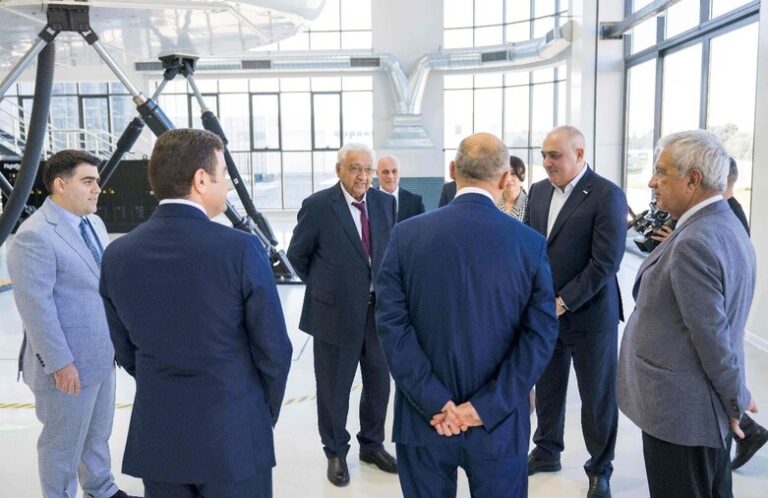
Silk Way West Airlines recently transferred its state-of-the-art Boeing 777 Full-Flight Simulator (FFS) to Azerbaijan’s National Aviation Academy (NAA), thus bolstering the country’s status as a prominent aviation training center. The handover ceremony, held on 10MAR25, was attended by key figures from the aviation industry and government. The advanced simulator, manufactured by L3Harris Commercial Aviation Solutions, incorporates three Boeing 777 variants: the 777-F, 777-200LR, and 777-300ER. It offers an immersive training environment with cutting-edge visualization and flight simulation technologies, enabling a comprehensive range of pilot assessments and certification programs that adhere to international aviation standards. The European Aviation Safety Agency (EASA) carried out a strict audit on the FFS in FEB25, and is expected to issue certification if successful, which will then be passed to local authorities for recognition. Once this accreditation is complete, Azerbaijan will gain international recognition and be able to offer training also to international carriers operating Boeing 777 aircraft. As it is, Silk Way West Airlines and Azerbaijan Airlines pilots will no longer have to travel abroad for their training, therefore saving time and expenses, and improving convenience.

Greater efficiency when it comes to pilot training in Azerbaijan. Image: Silk Way West Airlines

NAA’s training facility manages simulator bookings, and offers technical support, and simulator maintenance. This initiative aligns with the growing worldwide demand for Boeing 777 pilots and shows Silk Way West Airlines’ commitment to advancing aviation training. The project not only benefits local aviation professionals but also positions Azerbaijan as a regional hub for pilot education, attracting trainees from neighboring countries and solidifying its role in international aviation training.

The National Aviation Academy Rector, Prof. Arif Pashayev, underlined: “The simulator will not only play a crucial role in training students at the Academy in the relevant discipline, but will also serve as a key asset in the training of pilots and aviators from Silk Way West Airlines, Azerbaijan Airlines, and other carriers operating Boeing 777 aircraft worldwide. It will enhance their skills and ensure compliance with the highest aviation safety standards.”

Zaur Akhundov, President of Silk Way Group, declared: “This initiative reflects our commitment to fostering aviation excellence both in Azerbaijan and globally. By equipping the National Aviation Academy with state-of-the-art training capabilities, we are investing in the future of aviation professionals and strengthening Azerbaijan’s role in international pilot education. This simulator will serve not only our pilots but also the global aviation community, setting a new benchmark in training quality and accessibility.”

Duvenbeck launches MAN eTGX electric truck operations

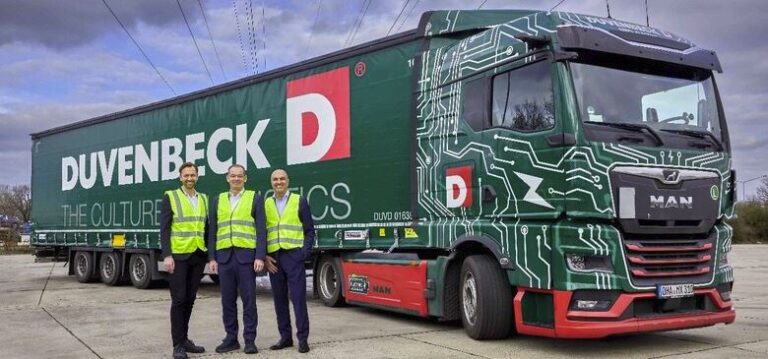
On 11MAR25, the Duvenbeck Group launched regular operations with MAN’s new eTGX Ultra Low Liner electric truck on the route linking Duvenbeck’s Herne logistics warehouse and Volkswagen’s Wolfsburg factory. Duvenbeck is among the pioneers of this electric truck, and the initiative is part of Volkswagen’s ‘goTOzero impact logistics’ program, which is focused on climate-friendly logistics. The use of electric trucks is one important step towards reducing long-term CO2 emissions in road transport. And this is the first truck of what is planned to eventually become a fleet of 120, according to the Letter of Intent signed by Duvenbeck and MAN. Currently, the single electric truck charges at public infrastructure along its route and at Duvenbeck’s Herne facility. Plans are in place to establish charging infrastructure at Duvenbeck’s Peine site later this year. The single eTGX electric truck which sets off from the Herne handling center, carrying a full truck-load consolidation of parts from various suppliers to the Wolfsburg factory, currently travels a distance of 317 kilometers each way. Simon Motter, Head of Volkswagen Group Logistics, confirmed: “This means that the first BEV Lowliners with a loading height of three meters are running over a medium distance in our regional forwarding network for materials logistics and are proving their cost-effectiveness and suitability for everyday use.”

(From left): Simon Motter & Christian Vollmer, Volkswagen, Hakan Bicil, CEO of Duvenbeck Group. Image: MAN

Hakan Bicil, CEO of Duvenbeck, stated: “The increasing use of electric trucks such as the MAN eTGX, forms a major part of Duvenbeck’s corporate strategy of implementing both sustainable and efficient logistics solutions. We will have 15 MAN eTGX Ultra Low Liner trucks in our fleet by the end of this month. The experience that we are gaining on the route day by day is playing an active part in helping us to further develop and promote sustainable logistics.”

Bryan Bedford is a hot candidate for heading the FAA

The current CEO of Republic Airways leads the list of several candidates for the position of chief of the Federal Aviation Administration (FAA). If he is appointed, a conflict of interest threatens, because as CEO of the airline, his goal is to maximize profits. The primary task of the FAA chief, however, is to do everything possible to ensure air traffic safety, which would result in higher costs for airlines. Several crashes in recent weeks have clearly demonstrated how precarious the security situation in the United States is, partly due to a shortage of security professionals.

“Trust, respect and care for one another” are guiding principles of Republic Airways and its CEO, Bryan Bedford. Guidelines he’ll need if heading the FAA  –  picture: company courtesy:

The FAA position has been vacant since January 20, when FAA Administrator Mike Whitaker stepped down a little more than one year into a five-year term when Trump took office.

Bedford, a pilot and industry veteran of more than 30 years, previously headed two other carriers and oversaw a significant expansion of Republic Airways.

Indiana-based Republic is one of the biggest regional airlines in North America, operating a fleet of more than 200 Embraer aircraft with 900 daily flights in the United States and Canada. The flights operate under airline partner brands American Eagle, Delta Connection and United Express.

Transportation Secretary Sean Duffy said on Tuesday (11MAR25) that he intends to ask Congress for tens of billions of dollars to overhaul the nation’s aging air traffic control system and has taken steps to boost staffing. The FAA is about 3,500 air traffic controllers short of targeted staffing levels and in many places, controllers are working six days a week with mandatory overtime. Last week, the FAA said it plans to permanently restrict helicopter operations near Reagan National Airport for security reasons. On 29JAN25, a mid-air collision between an American Airlines regional jet and Army Black Hawk helicopter near Washington Reagan National Airport killed 67 people, raising serious questions about aviation safety.

Other recent incidents include fatal crashes of small planes in Alaska and Philadelphia, the crash of a regional Delta jet that flipped upside down upon landing in Toronto. Currently, the FAA is headed on an interim basis by Deputy Administrator Chris Rocheleau.

Andreas Spies to head ACS’ time critical services

Global aircraft charter broker, Air Charter Service (ACS), announced this week that it has appointed Andreas Spies as its new Head of Time Critical Services. Spies has a communication background, having begun his career in PR around 18 years ago as well as becoming a freelance On Board Courier (OBC), before joining Air Charter Service in MAR18. At ACS, he started out as an OBC and Time Critical Agent, working his way up to OBC Operations Manager in MAR19, and then Director Operations in APR21. Spies is now the new CEO of the company’s time critical services in EMEA and APAC, and is based in the company’s Frankfurt office.

Dan Morgan-Evans, Group Cargo Director for ACS Time Critical’s parent company, Air Charter Service, commented: “Andreas joined us seven years ago after more than a decade of onboard courier experience and has helped to build up the team to the size it is today. His leadership and qualities have shone through in this time, and the natural next step is to promote him to CEO of time critical services for Europe, Middle East, Africa and Asia Pacific.”

Andreas Spies stated: “I’m excited to get started and especially looking forward to overseeing the growth of the regions, and expanding the team we have here in Frankfurt to be able to cope with the expected increase in demand going forward. My focus will be the further development of both our OBC and Next Flight Out (NFO) offerings, with NFO experiencing exciting growth last year. I will also be working in close conjunction with Robert Alleman, who was recently appointed CEO of time critical services in the Americas, based in Houston.”

Airships – a straight line to success?

When CargoForwarder Global reported on the Airship panel at the Dubai Expo 2020 back on 11NOV21, there was an optimistic view that ‘huge progress’ was happening and there could be as many as 400+ airships in the sky by 2030***. We are now just 5 years shy of that deadline, and the vision seems to be increasingly ambitious. Nevertheless, according to a 360iResearch paper from 31OCT24, the Airships Market (estimated at USD 733.88 million in 2024) is forecasted to grow at a CAGR of 7.71%, to USD 1,147.35 million by 2030. And a recent USD 50 million hybrid airship order by Straightline Aviation for AT² Aerospace Z1 airships, is another milestone towards that 2030 success achievement.

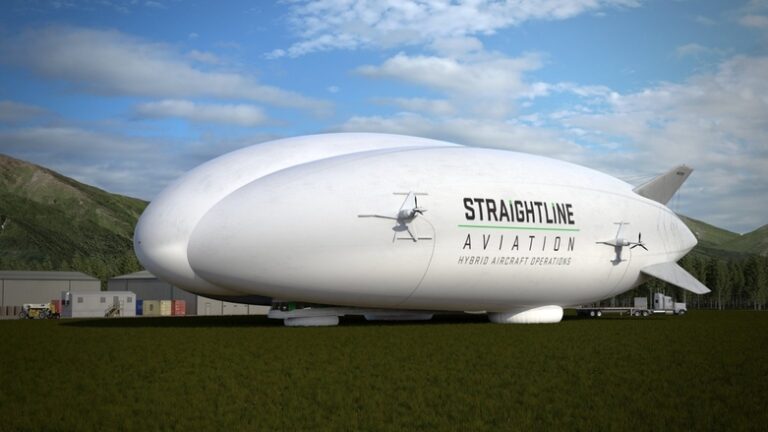
Preparing to deploy the Z1 in humanitarian/remote logistics come 2028. Image: Straightline Aviation

As Mark Dorey, CEO of Straightline Aviation, commented during the order signing: “This is a defining moment for Straightline Aviation and the global logistics industry. The Z1 is a game-changer, offering a flexible, cost-efficient, sustainable solution for delivering goods and services to remote communities where traditional transport is impractical or environmentally disruptive. The Z1 has multiple applications across numerous regions of the world, including cargo delivery, oil, gas and mining operations support and, crucially, the delivery of humanitarian aid. Our partnership with AT² Aerospace combines unrivalled airship operations experience with extensive technical expertise and ensures we are at the forefront of this new era of aviation.” In a recent Telegraph article, he lauded the adaptability of the Z1, likening it to a ‘flying truck’ and explained that its landing system is unique in that it can descend on practically any kind of surface including lakes, snowfields or forest clearings. It therefore lends itself to deployment in regions that are often inaccessible due to icy road surfaces, for example.

USD 50 million order placed
Shropshire, UK-based Straightline Aviation’s focus on humanitarian missions and remote logistics led it to place a USD 50 million order for a Z1 hybrid airship with the Californian Lockheed Martin spin-off, AT² Aerospace. Upon delivery of its first Z1 (one of a potential fleet of around 12 at a later stage) in 2028, it will be used for cargo projects in Brazil, Alaska and northern Canada. Mike Kendrick, Chairman and Co-Founder of Straightline Aviation, explained the company’s decision: “With decades of experience in airship operations, we understand exactly what it takes to deliver reliable, efficient and sustainable transport solutions. The Z1 hybrid airship is the culmination of years of innovation, and our team’s expertise ensures we can maximise its potential to meet our clients’ needs. Whether it’s remote logistics or humanitarian aid, this aircraft gives us an unprecedented capability to operate in areas where traditional aviation simply cannot.” And not only at a fraction of the cost of conventional air cargo, but also with far lower fuel consumption and emissions.

Another step forward for AT² Aerospace
AT² Aerospace CEO, Dr. Bob Boyd, also declared: “This is a seminal moment in sustainable aviation. Our hybrid airships will transform cargo transport by providing an environmentally responsible solution while maintaining operational efficiency. We are excited to partner with Straightline Aviation to deliver this landmark order.” And not just Straightline Aviation which has partly followed through on its 06JUN23 Letter of Intent that, at the time, foresaw a purchase of three hybrid airships with options on a further 12 to be delivered within the first three years of production, and wherein it would act as the lead customer of the Z1. Now, in 2025, its order follows hot on the heels of that of another key customer. On 27FEB25, Arctic Airships, a leading provider of sustainable remote logistics in Alaska, placed a significant purchase order for 2 hybrid airships along with an option for 18 additional airships. The purchase order amount remains undisclosed in this case.

A significant shift towards alternative sustainable aviation
Though airships still rarely feature at mainstream air cargo events, there is much going on in the retro-futuristic niche market that is looking to muscle in on the air cargo industry. 2025 should have been a breakthrough year for companies such as Hybrid Air Vehicles (HAV) and Flying Whales, which were both hoping to then be off the ground. Various challenges stretching from lifting gas choices and buoyancy control, through to bureaucracy, for example, have meant a shift in planning. HAV now aims to deliver its hybrid-electric Airlander 10 in 2028, offering a 90% reduction in emissions compared to conventional aircraft – and intends to go all electric (and thus emission-free) just two year later. Flying Whales was originally planning to fly its first 60-ton payload airship freighter this year, but has been delayed by problems in sourcing a production site, and is therefore now aiming for 2027, with commercial flights beginning in 2029. Likewise, over at H2 Clipper, “the world’s first point-to-point hydrogen delivery system, the pipeline-in-the-sky™”, its prototype flight should get off the ground next year, in preparation for commercial operations beginning in 2029.

Not only do these and similar airship companies that have emerged in Europe, America, and Russia in the past decade, envisage more environmentally sound cargo alternatives, but they expect to be around 70% cheaper than traditional air cargo solutions, today – and they offer manifold cargo and, above all, humanitarian transport solutions. The path is not quite as straightforward as originally planned, but it will be interesting to revisit this topic in 5 years from now.

***Title: Airships: The Big Revival 100 years later? Published 11NOV2021 in our portal

Assembly of the A350F has begun

The first components for the new Airbus A350F freighter have arrived at the manufacturer’s factory in Hamburg. This is section 19, which is located at the end of the fuselage and is connected to the rear of the aircraft. The structural element was manufactured at the Airbus plant in Getafe, Spain, and flown to Hamburg on board an Airbus Beluga freighter.

The first section of the A350F has been delivered to the Airbus plant in Hamburg for assembly of the freighter – courtesy: Airbus

This means that the freighter is finally gaining speed following a series of delays. However, its entry into service will not happen before Q3 of 2027. Airbus announced at the presentation of its 2024 annual results, as the production of a new aircraft variant involves ongoing safety and performance checks during production, as well as extensive flight, instrument and material tests in different weather conditions and climatic regions, as demanded by EASA, FAA and other regulators. Initially the freighter was scheduled to enter service in 2026, but this plan was postponed. Airbus had cited supply chain issues, specifically related to aircraft parts provided by manufacturer Spirit AeroSystems of Wichita, Kansas.

Extremely large hatch
The Airbus A350F is based on the A350-1000 and has a maximum take-off weight of 319 tons. To optimize the aircraft’s center of gravity, the fuselage section in front of the wings is slightly shortened compared to the passenger version A350-1000. With a cargo hatch of 4445mm (width) and 4305mm (height) the hatch surpasses the nose and side doors of the B747-400F, and it is 15% wider than the door of Boeing’s Triple Seven freighter. These dimensions allow for the loading of oversized and bulky items such as aircraft turbines without the need for disassembly. This sets a new standard in the freighter market, states Airbus.

All animals fit in, except for giraffes
Thanks to the altitude of the main deck compartment (183 cm / 6,000 feet) live animals like cows, horses or other large quadrupeds can be easily accommodated. The aircraft is powered by the Rolls Royce built Trent XWB-97, reducing fuel burn by 40% compared to competitive models and lowering noise emissions by 30 db, according to a performance overview from the manufacturer. The freighter can accommodate 111 tons per flight and offers a range of 8,700 km (4,700 nm) allowing nonstop services between Frankfurt and Delhi or Paris-Atlanta, for instance.

50% market share targeted
The A350F and its passenger sister, the A350-1000, share 100% commonality in engine spares and tooling which enables operators to optimize their maintenance efforts and cut down inventory costs. With 99% commonality in airframe tools and 98% in spares, the need for additional investment is significantly minimized. This extensive commonality simplifies fleet management and enhances profitability, enabling airlines to make the most of their existing resources while maintaining a streamlined, cost-effective operation across the A350 family, applauds Airbus. “In the medium term, we want to achieve a global market share of at least 50 percent for large freighters in the A350F category,” a leading Airbus representative told CargoForwarder Global.

Recently, however, Air France-KLM reduced its firm order of formerly eight A350F to six. This decision was taken following a strategic review of its cargo fleet, explains management. The missing capacity of around 220 tons is to be compensated for by the growth of the passenger widebody fleet, which can accommodate containers and pallets in its lower deck compartments.

“Paladin” to revolutionize transport on seashores

0

This is what the U.S. manufacturer Regent (Regional Electric Ground Effect Nautical Transport) claims in an announcement published last week. The company has just presented a prototype of its e-powered sea glider called Paladin, following successful completions of first test runs with passengers on board. The order book, worth more than USD 9 billion and listing customers from all over the world, gives the Rhode Island-based developer and manufacturer high hopes for the market success of its product.

REGENT’s “Paladin” in action – illustration: company courtesy

Coastal residents, for example in the Atlantic parts of the USA, will probably soon have to get used to the sight of a new vehicle: an airplane and ship hybrid. It is an eye-catching, high-speed means of transport with a length of 17 meters and a 20-meter wingspan. Owing to these dimensions, it is the largest-ever, all-electric flying machine, and represents a novel mode of transportation. It operates at low altitude between nine and eighteen meters above water, traversing the sea in one of three modes: hull, hydrofoil, or flight in ground effect. According to manufacturer, REGENT, it can operate 300km (180 miles) on a single charge, is powered by twelve turbofans, and reaches a flight velocity of 300 km/h. REGENT has raised more than USD 90 million from investors including Japan Airlines, 8090 Industries, Founders Fund, and Lockheed Martin.

Passenger and freighter version
Manufacturer REGENT is extremely optimistic about the market prospects for its sea glider. There is a great demand from travelers and sightseers, exploring coastal regions. The situation is similar when it comes to supplying residents with freight and mail. Because of these two focal points of use, there will be two versions of the vehicle: one for passengers and another for freight. According to the manufacturer, the vehicle, maneuvered by two crew members, can accommodate 12 passengers, while the freight version allows for loads of up to 1,600 kg per trip.  

In good seamanship tradition, REGENT christened the vessel “Paladin” before lowering the vehicle into the waters of Narragansett Bay, Rhode Island, to commence sea trials. These follow months of rigorous sub-system testing of the critical onboard systems, including motors, batteries, electronics, mechanical systems, and vehicle control software.

Transforming or spreading the mobility range
“Stepping off the dock and onto the sea glider prototype for the first time, was surreal” said Mike Klinker, Co-Founder and CTO of REGENT. “I felt honored to be in the cockpit as she left the dock for the first time and started sea trials. This was the first voyage of a vessel that is destined to transform mobility — the era of sea gliders has begun.”

In JAN25, REGENT broke ground on a 24,000 m2 manufacturing facility in Rhode Island, expected to come online in 2026. In FEB25, REGENT signed an agreement with Strategic Development Fund (SDF), an Abu Dhabi-based investment company and part of EDGE Group, to establish a joint venture that will bring sea glider manufacturing capabilities, maintenance services, and crew training to the UAE.

Certification process is underway
“Sea trials are just the beginning,” said Billy Thalheimer, REGENT Co-Founder and CEO. “This is a true testament to the dedication of our world-class team and partners across the globe, that we’ve accomplished this historic milestone in just four years since our founding. Today, we’re one step closer to meeting what we have now validated as massive global market demand for sea gliders.”

Concurrent to the construction of the vehicle, REGENT has advanced its maritime certification process with the U.S. Coast Guard and with maritime regulators in key markets around the world. This is done in compliance with the regulations of the maritime classification society, Lloyd’s Register.

Spotlight on… Veena Dudhia, Pilot Manager, One Air Ltd

0

CargoForwarder Global’s ‘Spotlight On…’ brings a different air cargo function to the fore each week, showcasing the huge variety of careers that this industry offers. Looking at air cargo freighter operations, there is far more to logistics than the visible front end of load sheets, ground handling, and containers. Each flight requires a crew, and therefore within every well-managed airline, there is at least one person who is responsible for planning and liaising with pilots to ensure smooth, uninterrupted flight operations. This week, Veena Dudhia (VD) takes us behind the scenes at One Air, in her function as Pilot Manager, and gives her views on the industry’s challenges and needs.

There’s never a quiet moment in pilot management. Image: Veena Dudhia

CFG: What is your current function and company? And what are your responsibilities?

VD: I am the Pilot Manager at One Air. My role is dynamic and revolves around managing our growing pilot community, ensuring their welfare, and providing ongoing support. I serve as the first point of contact for any issues that arise and focus on maintaining clear and consistent engagement with our pilots.

Additionally, I work closely with multiple departments across the business and play an active role in decision-making processes that impact our pilot community. Simply put – if it affects our pilots, I’m involved. With 80+ pilots and counting, there’s never a quiet moment!

CFG: What does a normal day look like for you?

VD: Fast-paced! Some days, I’m focused on pilot welfare and engagement, other days, I’m working on strategy, training, or regulatory matters. Since One Air is a new and growing airline, there’s a continuous need for forward-thinking and adaptability. Every decision we make reflects our company values, helping create an environment where pilots feel valued – and that makes all the difference.

CFG: How long have you been in the air cargo industry, and what brought you to it?

VD: I’ve been in the aviation industry for over 20 years, primarily in passenger operations. My journey into air cargo began three years ago, when I joined One Air from its very inception. I was headhunted for the Pilot Manager role due to my previous experience in crew management.

The opportunity to be part of building a new airline from the ground up was something I couldn’t pass up. Watching One Air grow and evolve has been an exciting and rewarding experience.

CFG: What do you enjoy most about your job?

VD: The people. I love being part of a team where everyone is passionate about what they do. One Air has a close-knit, family-like culture – something you don’t always find in larger airlines. Plus, being involved in decisions that genuinely make a difference for our pilots is incredibly rewarding.

CFG: What do you see as the greatest challenges in our industry?

VD: One of the biggest challenges right now is attracting and retaining top pilots in an increasingly competitive market. As a fast-growing airline, we’re always looking for ways to stand out and ensure we offer the best opportunities for our crew.

Geopolitical airspace restrictions are another major factor, as they can change rapidly and impact global operations. Adapting to these shifts while keeping our routes efficient is crucial.

Finally, as One Air continues to expand, developing our operational capability remains a top priority. Growth comes with challenges, but we’re focused on building a strong, sustainable foundation to support our pilots and operations long-term.

CFG: What advice would you give to people looking to enter into the air cargo industry? Any particular training they should aim for?

VD: Communication is key. This industry is built on relationships, whether it’s pilots, ground staff, or operations teams. Having a background in crew management, operations, or aviation safety is a great starting point. Most importantly being safety focused is essential. Things move fast, and flexibility is everything.

CFG: If the air cargo industry were a film/book, what would its title be?

VD: If it were based on One Air, I’d call it “Adventures of the Queen of the Skies” – after all, we are one of the few airlines still flying the iconic Boeing 747, and it’s incredible to see her in action!

Thank you for those insights, Veena!

If you would like to share your personal air cargo story with our CargoForwarder Global readers, feel free to send your answers to the above questions to cargoforwarderglobal@kopfpilot.at We look forward to shining a spotlight on your job area, views, and experiences.

Diamond secures Volocopter’s survival

Austrian-based Diamond Aircraft has taken over financially troubled eVTOL startup, Volocopter. Diamond has been owned since 2017 by the multi-billion-dollar Chinese company, Wanfeng; a supplier of auto parts, aerospace components, and industrial equipment. The publicly listed company confirmed the purchase in a regulatory filing. Yet significant security concerns remain.

Volocopter becomes part of the Chinese-Austrian group of Wanfeng / Diamond Aircraft,  picture: Courtesy Volocopter

Volocopter from Bruchsal in southwest Germany, was just a few meters away from crossing the finish line to begin commercial flight operations when its futuristic project, an electrically powered vertical take-off and landing aircraft (eVTOL), ran out of money. Its certification by the European Union Aviation Safety Agency (EASA) was repeatedly delayed, despite more than 2,000 successful test flights and an advanced certification process. So, investors lost their patience and were no longer willing to provide additional funding for the company. They included highly solvent enterprises such as the organizer of the Saudi Arabian futuristic city, Neom, Mercedes-Benz, Intel, and the Chinese car manufacturer, Geely. While running out of cash, Volocopter filed a lawsuit with the responsible Karlsruhe District Court on 26DEC24, and has since attempted to tap into new sources of funding to continue developing its eVTOL until it reaches series production. All attempts thus far, however, have not born fruit.

10 million for a startup worth 1.5 billion
At the end of last week, Wanfeng subsidiary, Diamond Aircraft acquired the German newcomer for €10 million. The takeover includes fixed assets such as tools and semi-finished products, patents for aircraft and drone systems, trademark rights, and employee contracts. According to reports, the book value of these assets is approximately €42 million. In a financing round in 2022, the company was valued at €1.5 billion.

The bottom line is that the Volocopter deal arranged by Diamond/Wanfeng is a bargain in terms of its real value. 

Well connected to China’s Communist Party
But who is the mastermind of this Chinese company? It is Ailian Chen, one of China’s most influential entrepreneurs. In her youth, she drove tractors; today, the 67-year-old is a billionaire. Her husband, Wu Liangding, founded the Wanfeng Auto Holding Group. Chen helped build the company and turned it into a global player. Her influence extends to the very top of the Chinese Communist Party. Chen herself was a party representative to the 17th National Congress of the Communist Party of China and a deputy to the 12th National People’s Congress. Wanfeng has its own party committee, which is officially committed to strengthening the company’s development and the Chinese Communist Party.

The deal is difficult to stop
Politicians in Berlin should be aware of these connections. The Ministry of Economic Affairs must now review the planned takeover of Volocopter by Wanfeng subsidiary, Diamond Aircraft, to determine if it would give a Chinese company access to advanced European technology. Should there be serious security concerns, the ministry could prohibit the sale. This is questionable, however, because Diamond is the official buyer and though this is a company that belongs to Wanfeng, it is based in EU member state, Austria. Should politicians stop the takeover, Volocopter would bite the dust, which is also not an acceptable solution.

Transfer of technology expected
Hence, the upcoming sale of the startup is one of a series of similar cases. For roughly a decade, Chinese companies have been purposefully acquiring European newcomers operating in the aviation and high-tech sectors, to get hold of their advanced knowhow. Tobias Wahl, insolvency administrator and partner at Anchor law firm, highlighted this aspect in a statement: “Volocopter’s expertise and its highly motivated team have consistently set benchmarks in the eVTOL industry.” He did not mention the threat of technology transfer. Instead, Bin Chen, Chairman of Daimond Aircraft Group, emphasized the European aspect of the takeover probably as a tranquilizer to calm critics: “The future of aviation is shaped by visionaries. Diamond’s broad portfolio is further strengthened by Volocopter, the VoloCity, and future models. Together, we are creating the foundation to further develop sustainable air mobility and strengthen Europe as an innovation hub in aviation.”

Too ambitious, too little money; the concept was ahead of its time
To reassure the remaining employees of the eVTOL company, a statement reads: “The reorganization of Volocopter will broaden its aircraft and business portfolio into the field of electric urban air transportation, while enabling Volocopter to reduce costs, retain a highly motivated and skilled workforce, and focus on achieving its certification milestones by 2025. The VoloCity, along with its next-generation variants and other models, will continue to evolve successfully over the long term, contributing significantly to the sustainable growth of the aviation industry.”

The startup’s VoloCity’s air taxis are conceived to fly emission-free in lower airspace, bypassing traffic jams to connect airports or other transportation hubs with city centers within minutes. This will enable seamless, faster, and more convenient options than those offered by existing transit choices.

Besides transporting people and smaller freight consignments, Volocopter’s future parent company, Diamond Aircraft, also utilizes its aircraft for surveillance purposes to detect forest fires or get an overview of inundations. Various armed forces have purchased Diamond aircraft for reconnaissance missions.

The best-known private owner of a Diamond DA62 is probably the future German Chancellor, Friedrich Merz.

According to an investigation by the newspaper ‘Welt am Sonntag’, Diamond aircraft parts are said to have also reached Russian aircraft manufacturers via China. This would be a criminal offense if finally proven, because aircraft parts stand high on the West’s sanctions list against the Putin regime.