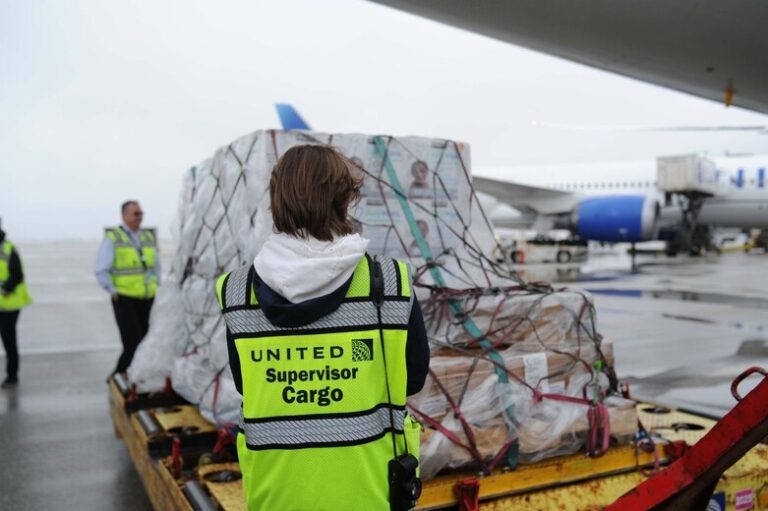
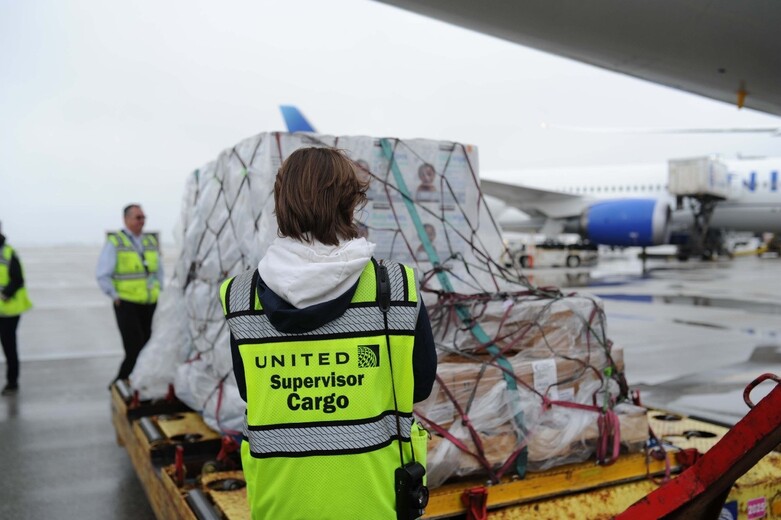
On 10APR26, a United Airlines Boeing 787 Dreamliner carrying emergency essentials in the form of generators, baby wipes, and other hygiene supplies and goods that had been donated to Good360, departed from Chicago O’Hare International Airport (ORD) for Kahului Airport (OGG). The relief supplies flight was a tripartite project between United Cargo, the humanitarian aid organization; Airlink Inc., and the U.S.-based NPO, Good360. The three companies had come together to help the many victims of the Kona Low storms across Maui and Oahu in Hawaii. Over 10,000 residents have been displaced from their homes which had either been destroyed or damaged in the relentless storms, resulting in devastating flash floods and landslides. They are in need of relief supplies and aid to prevent further fall-out, as the weather situation continues to disrupt power, housing, and access to services.
Bringing much-needed supplies to thousands of storm victims. Image: United Airlines
Chris Busch, United Managing Director – Cargo, Americas, explained: “When disaster hits, the speed at which emergency aid supplies are brought in, is crucial to mitigating further consequences. Our long-standing partnership with Airlink Inc. means that we now have a well-orchestrated response process whenever crisis occurs. United Airlines ensures that the cargo capacity is made available and supplies are quickly built up, cleared for transport, and loaded. ‘Good leads the way’ – never more so when we can actively contribute to helping people in need. It was our duty and honor to support Good360 and Airlink Inc. in the Kona Low response operations.”
Paloma Adams-Allen, Airlink President & CEO, said: “This is the power of aviation and partnership, personified. These critical shipments are reaching families in Hawaii faster and more efficiently thanks to United generously airlifting the cargo we coordinated with Good360. We are proud to provide vital supplies for communities during these historic floods, and remain in constant communication with our trusted partners on the grounds and in the air, ready to prepare and assist in the next disaster.”
A representative from Good360 added: “This shipment of generators and baby wipes will make a tangible difference for affected families in the coming days,”. “We are connecting local nonprofits with the products they know their communities need most, ensuring the right resources reach the right people at the right time.”
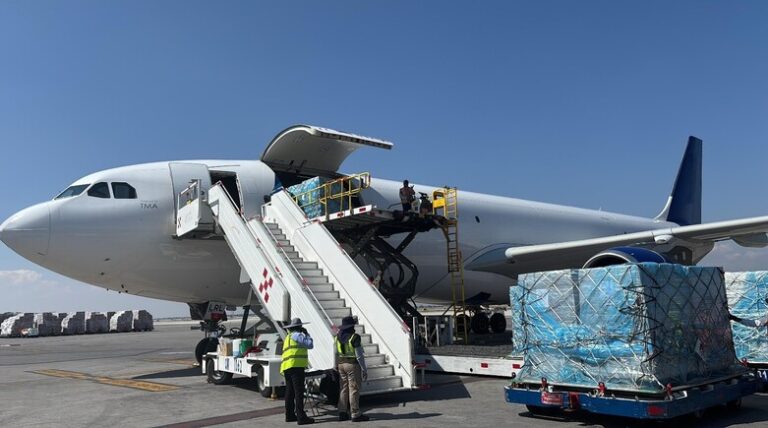
But which spice was it? The Air Charter Service press release doesn’t say, though it does include a fun pun reference to itself as being “the seasoned professionals.” The details are that ACS transported several tons of seasoning to Managua on board of an A330-200F. It was an emergency operation to avoid a factory shutdown of a Mexican meat products manufacturer in Nicaragua – could this be the one that Mexico’s largest beef producer, SuKarne, opened back in 2011, following a USD 100 million investment? Either way, a standard Mexican-style seasoning blend for beef products typically includes chili powder, cumin, garlic powder, onion powder, Mexican oregano, salt, pepper, and sometimes achiote or paprika, so any or all those could have been on the flight.
Seasoned professionals loading urgently needed seasoning. Image: Air Charter Service
Luis Canales-Tough, Cargo Director of ACS Mexico, commented: “The client originally approached us for our next flight out (NFO) service, to move around 18 tons of the condiment, used at a meat products manufacturing plant in Managua, to avoid the production line shutting down. After discussing the potential closure with the customer we advised that, due to the infrequency of scheduled flights from Mexico to Nicaragua, a charter carrying 51 tons on one flight could be a better solution and would still get there in time, which they agreed to. We worked closely with the airline and the national authorities in Nicaragua to obtain the necessary permits, and were able to accelerate the process by getting a letter of urgency from the consignee. The customer had never chartered before, so we then talked them through the correct customs procedures to ensure everything ran smoothly. To make sure the operation went without a hitch, we offered to accompany the shipment down to Managua. The cargo arrived in time to stop the factory in Nicaragua having to shut down its production line.”
Taiwan is the heart of the world’s semiconductor production, and CargoLand by LGG is keen to position itself as the heart of Europe’s cargo transits. Thus, the CargoLand team set off on a ‘high-level mission’ to Taipei on 24MAR26, to demonstrate its capabilities in ensuring the high-quality handling of what is a delicate commodity sector, with the aim of becoming the preferred gateway for Taiwan. “CargoLand by LGG is uniquely positioned to support these flows through secure handling, shipment visibility, and integrated logistics processes. Existing partnerships and ongoing cargo activity already provide a tangible operational foundation, enabling future growth to build on proven capabilities rather than starting from scratch,” the release emphasizes. The team met with public authorities, airlines, and logistics stakeholders, in Taipei, where CargoLand focused in particular on its solutions for semiconductors, high-tech goods, and ensuring resilient supply chains. It presented its cargo-first model and long-term development vision, and reported on its growth trend, citing 1.32 million tons handled in 2025 – an increase of 14%. “CargoLand combines scale with a 100% freighter-focused approach. Its operational framework, built around flexibility, speed, and control, offers a strong match for industries such as semiconductors, pharmaceuticals, and advanced manufacturing, where precision and predictability are critical,” the release states.
Creating a professional gateway for a highly sensitive commodity. Image: CargoLand by LGG
Frédéric Brun, VP Sales & Marketing at CargoLand by LGG, said: “Taiwan is a key market for the future of high-value air cargo, particularly in sectors such as semiconductors and advanced technology. Our objective is to build long-term, structured relationships with airlines, forwarders, and institutional stakeholders, and to demonstrate that CargoLand can offer a reliable, scalable, and performance-driven gateway into Europe. With our cargo-focused model and continued infrastructure and digital investments, we are positioning CargoLand as a reference platform for the next generation of strategic supply chains.”
The world’s largest network of independent freight forwarders’ charitable function, the WCAworld Foundation rallied together to arrange relief aid for the many Sri Lankan communities affected by Cyclone Ditwah in NOV25. The storm unleashed severe flooding and landslides leading to people being displacement across the island, and leaving communities in crisis. True to its mission, the Foundation harnessed funds raised through its global network of logistics professionals, to support a locally managed relief operation, partnering directly with WCAworld member, Freight Links International (FLI) in Colombo. In this way, 100% of all donations went straight to frontline needs. “Freight Links International played a central role in the execution of the project, leveraging its local expertise, logistics infrastructure, and established community relationships to coordinate procurement, transportation, and final-mile distribution of relief supplies. Their on-the-ground presence enabled rapid mobilization and ensured that aid reached even the most difficult-to-access areas, despite damaged infrastructure and challenging conditions,” the release states.
School children in Mannar District, whose homes and schools suffered damage. Image: WCAworld
Relief targeted two severely impacted regions. In Kegalle District, where landslides claimed lives and demolished homes, families received vital household essentials: cooking utensils, furniture, and food staples. These supplies helped survivors restore basic living conditions, allowing them to rebuild daily routines amid the rubble. In Mannar District, school children were supported. Donations provided school kits, backpacks, and footwear vouchers, so that children could return to education and some semblance of normality.
“All distributions were carried out in close coordination with local community leaders, including religious and educational representatives, ensuring that assistance was delivered transparently and to those most in need. This collaborative approach, supported by Freight Links’ local knowledge and operational oversight, was key to the effectiveness of the response,” the release continues emphasizing the success of the action, and stressing that continued support is required as recovery efforts are ongoing.
The GSSA contract was signed on 04FEB26 at airBaltic’s new and modern home base facility in one of the region’s largest cargo hubs at Riga Airport in Latvia. The Baltic Cargo Center, which opened last year, can handle up to 45,000 tons of cargo per year, and offers specialized facilities for temperature-sensitive, high-value goods, and live animals. Since 06MAR26, the airline’s flights from the UK to Riga (RIX) as well as Tallinn (TLL), are now under commercial cargo management of ECS Group’s UK subsidiary, Globe Air Cargo UK. They currently include 17 weekly flights from London-Gatwick (LGW) to Riga (RIX) and Tallinn (TLL). Onn 02JUN26, Aberdeen-Riga will be served twice per week, and from 13DEC26, Manchester-Riga flights will recommence. Globe Air Cargo UK will ensure that the load factors on airBaltic’s A220-330 fleet are optimized – predominantly with mail and e-commerce and general cargo.
Globe Air Cargo is new GSSA to airBaltic in UK. Image: Air Baltic
Jean Ceccaldi, Chief Executive Officer of ECS Group, announced: “This new GSSA contract with airBaltic offers a true win-win situation. It opens up cargo capacities to key destinations in Europe and, in particular, the Baltic regions, which were previously not served from the UK. […] At the same time, airBaltic stands to benefit from Globe Air Cargo UK’s digital framework when it comes to simple and efficient booking processes, or AI-supported shipment documentation, for example.”
Steve Hughes, Managing Director Globe Air Cargo UK, added: “In the seven years that airBaltic has been serving the UK, we have built up a strong personal relationship, managing its handling, supporting growth, promoting its product and providing high load factors and strong revenues out of the UK. We thank Ilja Seliverstovs, Irina Podzuka and Vladislavs Pecevics for the trust and faith they now place in Globe Air Cargo to represent them as GSSA in the UK. We aim to build on this excellent rapport and leverage digital efficiencies, going forward.”
Ilja Seliverstovs, Vice President Cargo at airBaltic, stated: “At airBaltic, we are on a mission to position Latvia as a key strategic logistics gateway in Northern Europe and have invested not only in the youngest and greenest fleet in Europe, but also a new modern cargo handling facility in Riga. Our partnership with Globe Air Cargo UK now adds the much-needed people factor into this success equation. The team’s expertise will help redirect the focus onto our cargo business once more and enable airBaltic to grow as intended.”
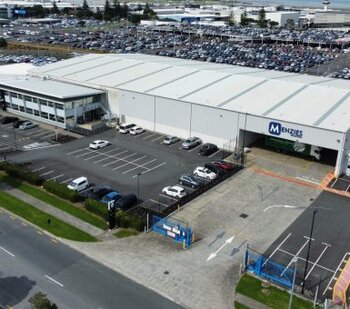
Menzies Aviation has opened Auckland Airport’s first dedicated airside cargo terminal in New Zealand, doubling its operating space within the Cargo Precinct. As the country’s main air freight hub handling 89% of international cargo (over 168,000 tons yearly), the new 32,000 m² facility offers direct airside access and modern handling facilities for 18 airline partners.
Menzies Aviation expands air cargo services in New Zealand. Image: Menzies
Developed together with Auckland Airport under a 15-year deal, the site is equipped with Menzies’ MACH system and Nallian’s Truck Visit Management for efficient operations both airside and landside. It is aiming for IATA CEIV Pharma certification by the end of this year, and will specialize in pharmaceuticals, e-commerce, perishables, and general freight.
The expansion supports booming exports, with fresh produce air freight up 34% recently including a 175% avocado surge and 53% more cherries (2,888 tons). This positions Auckland as Menzies’ primary New Zealand cargo gateway during the airport’s 60th anniversary.
Beau Paine, Executive Vice President Cargo, Menzies Aviation, said: “The facility relocation and expansion in Auckland was critical for our continued growth in the Oceania region. We are proud of the collaboration and overall delivery of the project, led by Traci Cox and Kayla Moa. These new facilities will elevate the handling experience for our partner airlines and the freight forwarder market. Menzies remains committed to being the cargo provider of choice through operational excellence, reliability and innovation.”
Mark Thomson, Chief Commercial Officer, Auckland Airport, commented: “Auckland Airport is delighted to support Menzies Aviation’s cargo terminal move to the Cargo Precinct. This development is expected to deliver significant operational efficiencies as a result of the dedicated airside road, enabling the fast, efficient and secure movement of time‑critical cargo between the facility and the aprons. The relocation of Menzies operations to the new cargo precinct is a key step in our long‑term plan to centralize cargo operations to a dedicated cargo precinct away from passenger-centric activities. We thank the Menzies management and operations team for their positive engagement throughout the process to achieve this fantastic outcome.”
While Lufthansa captured headlines in April 2026 with its centenary celebrations and the opening of Terminal 3 at Frankfurt Airport, a quieter but strategically significant development unfolded in Madrid.
Iberia, part of International Airlines Group (IAG), and CFM International announced the launch of a new maintenance facility for LEAP engines at Madrid-Barajas Airport. The move coincides with Amparo Moraleda’s appointment as Chair of Boeing’s Board, reinforcing Spain’s growing presence in the aerospace sector.
Madrid Barajas Airport benefits from a new MRO facility – photo: CFG/ct
Madrid is unlikely to challenge Frankfurt’s position as Europe’s leading cargo hub. But it will take a piece of the power behind it, because Madrid is turning into a global aircraft engine maintenance hub.
The agreement grants Iberia a CFM Premier MRO (Maintenance, Repair and Overhaul) license covering both LEAP-1A and LEAP-1B engines. These engines are widely used across Airbus and Boeing aircraft. The airline is pursuing high-return investments and diversification amid geopolitical volatility and rising fuel costs.
With approximately 4,600 aircraft worldwide operating LEAP engines, demand for maintenance capacity remains high. CFM International has already established six specialized centers for LEAP engine maintenance, and the addition of Madrid expands that network further.
Iberia’s MRO division at La Muñoza spans around 220,000 m² across five hangars – four are located in Madrid and one is in Barcelona. The new capability will support IAG airlines – including British Airways, Aer Lingus, Vueling, and Iberia – as well as third-party carriers operating LEAP-powered fleets.
In addition to the agreement with CFM, La Muñoza will take on training for heavy maintenance of the Airbus A350 starting next October. This aircraft type plays a central role in the long-haul fleets of International Airlines Group.
The site will also support the transition of Vueling from a pure Airbus-based fleet toward Boeing aircraft, further reinforcing Madrid’s role within both Airbus and Boeing ecosystems.
Moving up the aerospace value chain This expansion reflects a broader shift in Spain’s role within aviation. Historically focused on component manufacturing, the country is moving into higher-value segments such as maintenance and lifecycle support.
By servicing both Airbus and Boeing platforms, Madrid is positioning itself within a critical layer of the global aviation system – keeping aircraft operational in a market where availability is increasingly constrained.
Growing influence within Airbus Amparo Moraleda is set to become Chair of Airbus in October 2026. For the first time in the company’s history, its leadership will not be dominated by France and Germany, but by Spain. The announcement has been positively welcomed by the local industrial sector, which understands the political and industrial weight of this appointment, as well as its potential influence on future aircraft programs, supply chain decisions, and defense and logistics platforms.
Moraleda brings extensive board-level experience across different industries, with a particularly strong background in technology, innovation, and international management. According to the Spanish newspaper, ABC, internal sources also highlight that the appointment reflects Spain’s strategic position within Airbus, together with the industrial footprint of Airbus’ Spanish subsidiary, which produces key structural components, hosts military aircraft assembly, and includes major R&D and engineering centers.
The real power shift in air cargo Madrid’s MRO expansion will not redirect cargo flows directly, but it will increase usable aircraft capacity and reduce disruptions.
For forwarders such as DHL and Kuehne+Nagel, it will mean better capacity planning, fewer last-minute reallocations, and improved rate stability. This will translate into more stable operations and fewer network disruptions.
DSV is structurally positioned to benefit the most as it doesn’t own planes, and monetizes volatility rather than being constrained by it. Its operations are based on multi-layer procurement, combining local, regional, and global sourcing of capacity. Spain’s MRO expansion will reinforce its strengths by adding more routing flexibility, greater pricing leverage, and less dependence on any single hub.
Lufthansa Cargo, while not a forwarder, will directly be affected as a capacity provider, shifting part of the technical dependence away from Germany.
The link between where aircraft are maintained and where cargo must flow will become weaker, benefiting forwarders more than airlines or airports.
Even if Frankfurt is not always the most efficient routing option, it is often used because aircraft require maintenance and access to parts, minimizing downtime.
Airlines will gain efficiency as routing constraints tied to maintenance weaken. They will no longer be able to anchor traffic around maintenance bases. The same applies to airports, including Frankfurt, if aircraft can be serviced elsewhere.
Sweet spot Spain Cargo will not move out of Frankfurt, or Germany. The airport’s geographic centrality in Europe ensures the shortest average trucking distances, supported by massive infrastructure such as Cargo City North and South, as well as strong intercontinental connectivity – particularly on high-profit Asia–Europe lanes. Airlines do not relocate easily, which further reinforces Frankfurt’s structural position.
The global shortage of maintenance capacity and engine bottlenecks is reflected in turnaround times that can stretch from weeks to months, with LEAP engines being a known bottleneck. Spain is inserting itself directly into this bottleneck, becoming relevant in a segment where Germany has strong engineering capabilities but does not dominate.
Madrid will handle more technical stops and maintenance-linked flows, attract Latin America–Europe cargo – where it is already strong – and act as a relief valve when Northern hubs are congested.
A shift toward deconcentration The real threat to Frankfurt is not displacement. It is deconcentration.
Madrid is taking away part of the dependence on Frankfurt in keeping aircraft operational. And that matters.
When you sit down with your cup of coffee or tea and swipe through the articles in your air cargo publication of choice, do you ever stop to think about how these news outlets make money? If and how journalists are paid for their input? Week after week, press releases are sent out, companies are interviewed, and stories put together to inform and entertain readers – often those employed by the company being portrayed*. The short answer to the first question is: free publications rely on advertising and sponsorship to keep running. However, financial input is only part of the transaction – and the Return on Investment encompasses a great deal more.
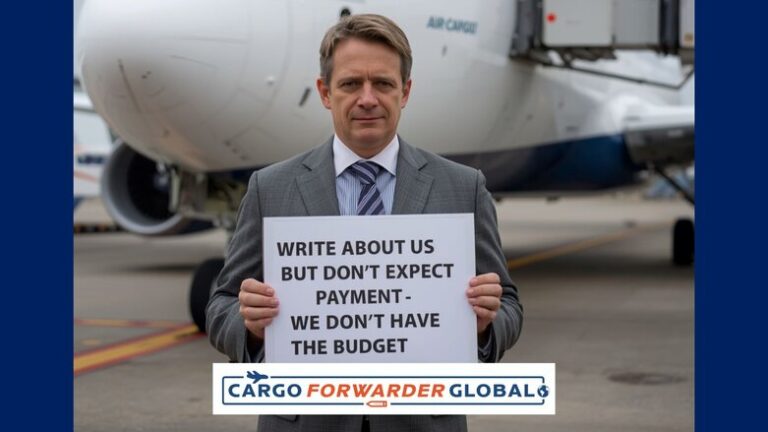
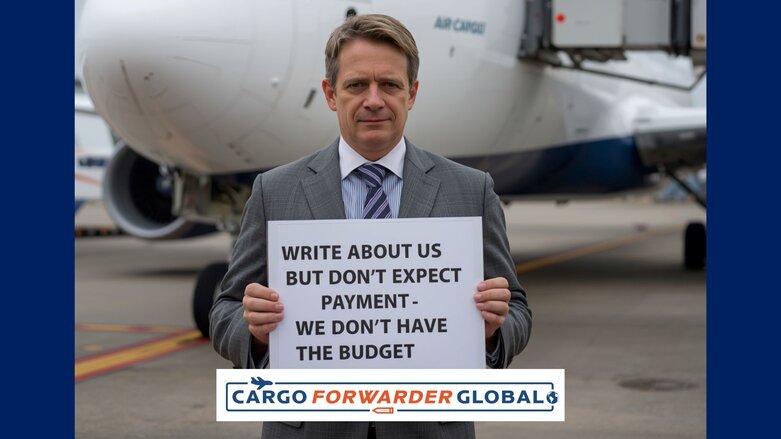
A little respect can go a long way. Image: Canva Magic Media AI/CFG
How we disseminate and consume information has changed a lot with the rise of social media. Yet, even in times where so many people share so much on LinkedIn, industry-specific publications still matter – whether they are print or, as in the case of CargoForwarder Global, entirely digital news outlets. For air cargo, logistics, and aviation companies, buying advertising in relevant titles – and sponsoring journalists to attend press days or company-specific events – isn’t just about being seen; it’s about being understood, trusted, and talked about in the right circles.
Reaching the right people Trade magazines, online portals, and industry newsletters are where your real audience already spends time: air cargo managers, network planners, GSA executives, freight forwarders, ground handlers, airport decision-makers, air cargo software providers, ULD managers, etc. In CargoForwarder Global’s case, the full pallet [pun intended!] of air cargo stakeholders can be found among our readers. So, when you advertise there, you’re not broadcasting to the masses; you’re talking directly to people who actually shape and move the air cargo industry, and who decide on their industry-specific business partners.
Credibility through association And because your ad sits alongside editorial content that those readers trust, it benefits from the publication’s reputation and gains a credibility boost. Sponsoring journalists to attend press days or site visits at your hub, warehouse, or special cargo facilities, then enhances that further, giving you face‑to‑face access to the people shaping the stories that will influence the publication’s readers. Readers often place greater trust in editorial articles than in paid placements, so combining both – ads plus earned coverage – creates a ‘double validation’ effect. For air cargo companies launching a new belly‑cargo alliance, opening a new animal center, or repositioning around sustainability or digitalization, that kind of dual‑channel presence can ensure that the message is well and truly heard.
Building real relationships with journalists Offering journalists a realistic press‑day package – covering flights, hotels, and access to your operations – says more about your company than a press release ever can. It shows that you respect the journalists’ time and talent, and it gives them a chance to see your cargo hub, handling processes, or new equipment in person. When reporters can walk through a facility, talk to ground staff, and ask questions on the spot, they tend to produce deeper, more accurate coverage that reflects the realities of your business, rather than just the bare outline that a generic press release conveys. And, over time, these interactions build rapport; journalists are more likely to return to you as a source, give you a fair hearing during industry debates, and write with a little more empathy when crises hit.
Shaping the story Press days give you a rare chance to control the environment in which stories are formed – without crossing the line into editorial interference. You can coordinate a clear agenda, pair journalists with the right technical or commercial experts, and guide them through key projects: a new cold‑chain setup, a ramp‑handling automation rollout, or a new warehouse facility, for example. When journalists experience the operation themselves, misunderstandings are avoided, they’re less likely to rely on rumors and more likely to portray your business in a way that aligns with your strategy.
Brand building that lasts In an industry where trust is earned over years and reputations are built on reliability, advertising in key publications and sponsoring journalist visits are long‑term investments, not short‑term campaigns. Being visible over time in the outlets your peers read, helps keep your company in people’s minds when RFPs are being drafted, communities are being formed, or capacity‑sharing discussions are underway. When a journalist recognizes your name from repeated coverage and has previously toured your operation, they’re more likely to reach out during industry debates, regulatory changes, or crisis moments to get your perspective. That consistency builds a narrative around your brand that’s hard to match with occasional one‑off campaigns or social‑media bursts alone.
Quite aside from the fact that, these days, no company can afford to sit on its laurels, nor instruct its customers on its brilliance, as that old style of marketing no longer works. Customers and other stakeholders in the air cargo ecosystem are the ones judging a company’s performance and worth, nowadays. (And journalists, too, may struggle to remain impartial if the relationship between company and publication is heavily one-sided. Hence, the question of whether your company is a ‘free publicity’ scrounger? And how well does that sit with your company values, I wonder?)
Oh, but ‘Compliance’! One company recently told CargoForwarder Global that they no longer pay transport for journalists to attend their event as this contravenes compliance regulations. Whether that is a genuine issue or simply a cover-up for cost-cutting decisions or a lack of budget, remains unclear – particularly given that other subsidiaries of the same group obviously have no such concern. CargoForwarder Global subsequently discussed the issue of compliance with the press department of a different company at a fully paid press event and carried out further research. The result: Sponsoring journalists or advertising in publications does not usually break compliance regulations such as anti‑bribery laws, internal codes of conduct, or corporate governance policies. In practice, covering reasonable travel and accommodation for journalists to attend press days is generally seen as a legitimate communications expense aimed at facilitating accurate reporting, and is therefore not bribery. Most compliance frameworks focus on whether a benefit is intended to influence a decision or secure an unfair advantage. Press coverage decisions are typically editorial, not procurement‑related – and journalists are neither regulators, government officials, nor key public-sector decision-makers. Not to mention: CargoForwarder Global always comes to its own conclusions and cannot be bought, anyway.
That said, it is important for the company inviting, to ensure complete transparency. Clear internal policies and documentation should register that the press sponsorship is free of any expectation of favorable editorial treatment. Handled correctly (in other words, with openness, consistency, and respect for editorial independence), advertising and sponsorships pose no corporate compliance problem, whatsoever.
Support the flow of credible information At the end of the day, while the return on media‑investment may not necessarily be in immediate leads, it does pay off in relationships, exposure and opportunities. And we all talk of an air cargo eco-system, that this is a people-industry and one where we all work together towards a common goal. Supporting air cargo publications (and CargoForwarder Global very clearly means publications, plural – as we have great respect for our peers running other air cargo news outlets) is another aspect of that eco-system. When you invest in ads or sponsor journalists to attend your own company events, you’re not just buying exposure; you are also helping to sustain the flow of credible information that the whole industry depends on.
If you’d like to actively participate in keeping independent air cargo journalism alive and well, CargoForwarder Global’s Media Kit can be found here.
*It gets interesting when employees first learn about changes in their company through the press, however, since it says quite a bit about how well the company’s internal communication channels function.
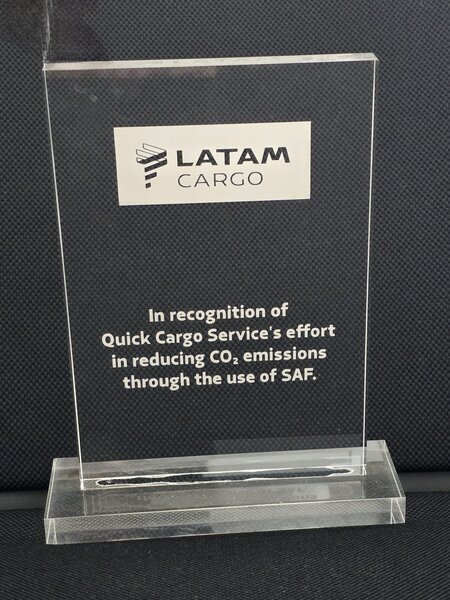
LATAM Cargo Group has awarded logistics provider, Quick Cargo Service (QCS), a prize for its commitment to climate protection. Specifically, QCS has financed a large allocation of Sustainable Aviation Fuel, which LATAM Cargo blends with Jet A-1 kerosene on flights carrying QCS shipments. This is already the second time the Frankfurt-based agent has received an award from the South American cargo carrier for its environmental commitment.
This award has been on display at QCS headquarters in Mörfelden near Frankfurt since early APR26 – courtesy: QCS
In this case, the airline is crediting the contribution of 24,000 liters of SAF for flights between Europe and Brazil through the book & claim tool. Quick Cargo’s initiative demonstrates its commitment to decarbonizing air cargo transportation through the use of alternative fuels, which reduces greenhouse gas emissions by up to 75% compared to conventional Jet A-1 fuel. This was equivalent to avoiding emissions of 55.8 metric tons of CO2, of which 46 tons of CO2e were flight-related emissions, according to a press release issued by LATAM Cargo. It equals 7% of the emissions generated by the joint operation over the projected 21-week period. A year ago, the logistics provider had already financed larger quantities of SAF, aimed at reducing its own carbon footprint when transporting air freight consignments aboard LATAM aircraft across the South Atlantic.
Major customer “When it comes to shipment volumes on the FRA-GRU route, we are one of LATAM Cargo’s top three agents in the German market, despite fierce competition from the big boys,” says QCS CEO, Stefan Haltmayer. There were weeks when QCS even ranked first, the executive told CargoForwarder Global. This was confirmed upon inquiry by Jorge Carretero, Sales Director for Central Europe at LATAM Cargo. “The shipment volumes brought in by QCS have grown significantly in recent times,” which has contributed to strengthening the existing partnership.
LATAM is the top freight carrier between Europe and South America The South American airline operates the route daily using B777 passenger aircraft, which offer abundant space in the jetliner’s lower decks. There are also flights from Madrid and Lisbon taking off to Sao Paulo and other destinations in Brazil and beyond. “In contrast to the passenger services, our freighters fly from Frankfurt to Viracopos,” notes the manager.
So far, it has primarily been large logistics companies that have entered into SAF agreements with airlines to reduce their carbon footprint. This was most recently the case with DHL and IAG Cargo.
Often, these contracts are co-financed by small and medium-sized agents, which take on quotas from large orders and pay for these volumes out of their own pockets.
Pioneering step This keeps the cost burden manageable for the individual players. After all, SAF costs four to five times as much as traditional jet fuel.
While Quick Cargo Service is not a pioneer, it is one of the first medium-sized companies to have booked an SAF quota on its own account without relying on a major agent, as evidenced by its partnership with LATAM Cargo.
In this case, the SAF used is produced from alternative feedstocks, such as animal fats. Given its limited global availability, broader adoption requires mechanisms that translate customer climate commitments into concrete, verifiable, and traceable solutions. The collaboration exemplifies that LATAM Cargo acts as an enabler, allowing international logistics partners like QCS to meet climate commitments through a traceable, verifiable, and measurable process, states the carrier.
Without collective efforts – no climate protection “This agreement with Quick Cargo Service demonstrates that decarbonization is not an individual effort, but a shared commitment: when we work alongside our customers to reduce carbon intensity, we accelerate tangible and measurable transformation across the logistics value chain,” said Cristina Oñate, Vice President of Sustainability and Product at LATAM Cargo Group.
Speaking on behalf of Quick Cargo Service, Patrick Eberhard, Head of Product Management replied: “Quick Cargo Service GmbH is proud to work closely with LATAM Cargo in supporting the development and use of Sustainable Aviation Fuel. Initiatives like this demonstrate how collaboration across the air cargo value chain can help reduce emissions and move our industry toward a more sustainable future.”
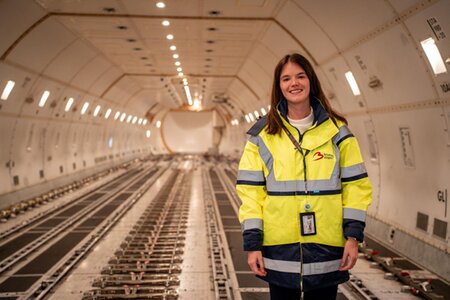
Every week, CargoForwarder Global’s ‘Spotlight On…’ highlights the many different paths into and across the air cargo industry. An airport’s air cargo volumes and attractiveness to air freight operators is largely dependent on what it offers by way of infrastructure – from warehouse space through to office facilities, cargo community systems and networks, customs processing, road and rail connections, etc. The stronger the focus on providing that infrastructure for air cargo, the better it works. Brussels Airport Company regularly punches above its weight in number of cargo fields – particularly high-value, time-critical segments such as vaccines and life-sciences, which has earned it a reputation as Europe’s ‘pharmaceutical gateway’. This week, Birthe Deckers (BD), Business Analyst – Cargo & Logistics at Brussels Airport Company, talks us through her work and shares views and advice on forging a career in the air cargo industry.
Air cargo – a combination of indispensability and invisibility. Image: Birthe Deckers
CFG: What is your current function and company? And what are your responsibilities?
BD: I work as a Business Analyst at Brussels Airport within the Cargo & Logistics Management Department, a role I have held since February 2024.
My main responsibility is to analyze and visualize data from various cargo‑related sources to provide insights into market performance and operational efficiency. I translate complex data into clear, meaningful information that supports decision‑making opportunities to optimize processes.
I work closely with internal colleagues to discuss findings and improve workflows, and I regularly present insights to external stakeholders during cargo clusters and steering groups.
In addition, I collaborate with IT specialists to automate manual reporting and data processes, improving efficiency, reliability, and data accessibility across the organization.
CFG: What does a normal day look like for you?
BD: There are very few standard working days in air cargo, and my role is no exception. I usually start the day with a clear plan, based on ongoing analyses or projects, but priorities often evolve as ad-hoc questions arise from colleagues across the organization.
Responding to these requests frequently involves quick analyses or clarifications based on available data. This balance between structured planning and adapting to changing priorities reflects well the dynamic and fast-paced nature of the air cargo industry.
CFG: How long have you been in the air cargo industry, and what brought you to it?
BD: My interest in aviation started at a young age and strongly influenced both my studies and career choices. During my education in Logistics Management, a turning point came in 2017, when I attended an Air Cargo Belgium event on the recommendation of a lecturer. That experience confirmed my interest in air cargo, and I soon joined the Young Airfreight Network (YAN).
Alongside my studies, I gained practical experience through roles at DHL Global Forwarding Brussels, Caterpillar Distribution Services Europe, and TUI fly Belgium, as well as an airfreight internship at DHL Global Forwarding in Dubai.
My first full‑time role was at Nallian, an IT company specialized in digital air cargo solutions, where I worked closely with a wide range of industry stakeholders and gained a strong end‑to‑end understanding of the cargo ecosystem.
In parallel, YAN has played an important role in my professional development. I have been actively involved since 2017, joined the organizing committee in 2022, and became a member of the YAN Management Team in September 2025. Through this role, and through my position at Brussels Airport, I collaborate closely with Air Cargo Belgium to support initiatives for young professionals in the cargo community.
CFG: What do you enjoy most about your job?
BD: What I enjoy most is the unique airport environment. Whether in the passenger terminal or the cargo zone, it truly feels like a city of its own, built on strong collaboration and a close‑knit community.
This becomes especially visible during moments of disruption, when all stakeholders work together to ensure that critical goods reach their destination quickly and safely. Although my role as a Business Analyst is mainly behind the scenes, I find it particularly rewarding to see how data‑driven insights translate into concrete solutions and tangible value for our customers.
CFG: Where do you see the greatest challenges in our industry?
BD: The greatest challenge lies in finding the right balance in an industry that is unpredictable, capital‑intensive, and heavily regulated, while expectations continue to rise. Air cargo is already becoming faster and more sustainable, all while coping with volatile demand, high costs and strict compliance requirements. Successfully managing these competing demands will require close cooperation across the entire supply chain.
CFG: What advice would you give to people looking to get into the air cargo industry?
BD: Passion and genuine interest are essential, as air cargo is a fast‑paced environment where adaptability is key. The ability to work under time pressure, prioritize effectively, and make decisions with limited information is a major asset.
From a training perspective, backgrounds in logistics, supply chain, aviation, or data analysis are valuable, especially when combined with hands‑on operational experience. Industry‑specific courses such as IATA cargo or Dangerous Goods training can also be a strong advantage.
Above all, curiosity, resilience, and a willingness to learn continuously are crucial for building a long-term career in air cargo.
CFG: If the air cargo industry were a film/book, what would its title be?
BD: ‘The Invisible Lifeline’. When people look up to the sky, they usually think it is a plane with passengers. Air cargo operates largely behind the scenes, yet plays a vital role in keeping the world running by transporting critical goods across continents at speed.
It becomes most visible when disruption occurs, and its importance suddenly becomes clear.
That combination of indispensability and invisibility makes The Invisible Lifeline a fitting title for the industry.
Many thanks, Birthe!
If you would like to share your personal air cargo story with our CargoForwarder Global readers, feel free to send your answers to the above questions to cargoforwarderglobal@kopfpilot.at We look forward to shining a spotlight on your job area, views, and experiences.