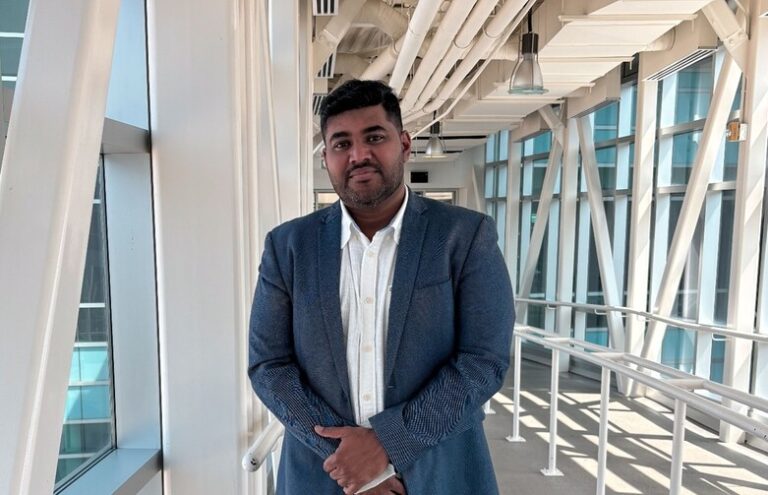
Sabir Ebrahim was appointed Head of Cargo Operations at WestJet Cargo on 01JUN25. 100 days in and his mission to ensure optimum efficiency and operational excellence is well on its way. “It’s not just about efficiency; it’s about translating commercial needs into operational excellence while upholding the highest standards of safety and security, and ensuring continued successful partnerships with our service providers,” he explains his new responsibilities in a recent press release, which describes him as collaborative, driven and people focused. His function covers cargo operations, safety, and security compliance. Together with colleagues and service partners, he and his team work on efficiency improvements along the operational process.
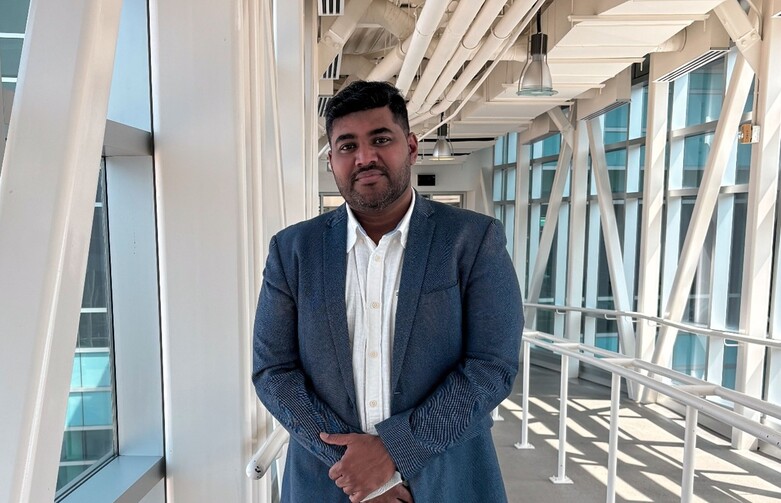
100 days in and Sabir Ebrahim is impressed with his team. Image: WestJet
Julius Mooney, WestJet Cargo’s Director – Cargo Commercial, underlined: “Sabir’s extensive cargo experience in pricing and operations, and his passion for detail and numbers are a perfect blend for WestJet Cargo to achieve maximum efficiency. He combines the operational and commercial aspects of running a cargo airline and sees the entire picture. His fresh perspectives on the finer details of our safety, security, ramp and warehouse operations are already directly shaping our next steps as we work to optimize processes to meet our commercial goals.”
Sabir Ebrahim outlined: “My primary goal for the first few months was to truly immerse myself in the operational rhythm, connect with internal stakeholders and engage closely with our service partners who are crucial to WestJet Cargo’s success. I spent time listening to understand their challenges and successes. It has been an incredible journey so far, and I am particularly thankful to my highly knowledgeable team for the seamless transition into my new role. By building strong internal and external relationships and gaining deep insight into our current processes and partnerships, we can identify opportunities where we can work together to enhance operational efficiency and uphold our commitment to excellence. The foundation is already laid: the strength and professionalism of our team is our greatest asset. Their commitment is exceptional.”
Since 01SEP25, Carina Tüllmann has moved from being the Open Logistics Foundation (OLF)’s Chief Operating Officer (COO) to become its new Chief Commercial Officer (CCO). In other words, her role has expanded from communications and community management, to include human resources development and business development within the Foundation. The move is part of OLF’s strategy to grow and professionally shape the organization. She joins the existing leadership team of Andreas Nettsträter (CEO) and Thorsten Hülsmann (CFO). Tüllmann is one of the original members of the Dortmund-based European organization. “In her new role, Tüllmann will intensify dialogue with the member companies and the open-source community. The focus will be on active community management, the expansion of international networks, and the continuous integration of new partners to advance open-source solutions across company boundaries. In her previous role as COO, she accompanied numerous central projects: from the digital consignment note (eCMR) to the initiation of new Working Groups, such as the one on decarbonization of logistics,” the release details.
Carina Tüllmann becomes new CCO of the Open Logistics Foundation. Image: OLF
Carina Tüllmann explained: “I am convinced that we need to rethink communications in the open-source world. It is not the individual solution that is at the forefront, but the collective process, the people behind it and the open discourse. My goal is to make this dynamic visible both within the industry and beyond. Openness, trust and genuine participation are the keys to the digital transformation of our industry. The role of CCO gives me the opportunity to anchor these values even more firmly in the community and throughout the entire network.”
Each week, CargoForwarder Global’s ‘Spotlight On…’ looks at a particular segment of the air cargo industry through the eyes of an individual working there. It is difficult to imagine the industry at a time when there was no digital backbone to it – when not just AWBs were purely physical documents, but also flight planning, loading, and the admin relating to all other processes was carried out manually, on paper. Digitalization began in earnest in the late 1970s and early 1980s, though at very different speeds across the industry – leading to the highly complex and fragmented tech maelstrom that it finds itself in today. Yet, the opportunities that advanced tech now offers, have the potential to finally bring about the vision behind Unisys’ portmanteau which name derived from the words ‘united’, ‘information’ and ‘systems’. Its Director for Travel and Transportation Solutions, Sabari Ramnath, takes us through his working day, and shares his views and advice.
An industry that truly drives outcomes. Image: Sabari Ramnath
CFG: What is your current function and company? And what are your responsibilities?
SR: I am a Director for Travel and Transportation Solutions at Unisys. My role is to lead strategic development, address industry/client challenges, and transform them into practical, technology-driven solutions.
CFG: What does a normal day look like for you?
SR: My normal day begins with a plan. Over time, I’ve learned that my energy follows a ‘V’ pattern – high in the morning, dipping in the afternoon, and rising again in the evening. So, I shape my schedule around it: strategic work in the morning, lighter tasks in the afternoon, and key meetings in the evening. This rhythm keeps me productive without burnout. For me, it’s not about doing more, but about doing things at the right time.
CFG: How long have you been in the air cargo industry, and what brought you to it?
SR: I’ve been in the air cargo tech industry for 20 years, and it has been a journey of constant learning and growth. What brought me here is the curiosity to know how air cargo moves goods, connects economies, and enables trade. But what keeps me here is the opportunity to shape meaningful change in an industry that truly drives outcomes.
CFG: What do you enjoy most about your job?
SR: What I enjoy most about my job is the journey of problem-solving and discovery. When a client faces a challenge and I provide a solution that not only works but also excites them, it’s the most rewarding feeling. For me, every day is about discovery – waking up to ask what new problem can I solve, what new insight can I learn? By night, if I’ve answered those questions, the day has been worthwhile. This cycle of solving, learning, and creating value is what I enjoy most – it transforms work into purpose.
CFG: Where do you see the greatest challenges in our industry?
SR: The greatest challenge we face today is enabling seamless collaboration across this highly diverse ecosystem. Every shipment is a relay of responsibility – handed from one party to another, across borders, systems, and compliance frameworks. When these links are strong, the chain moves cargo efficiently. But when even one link is weak, the results are delay, cost escalation, and customer dissatisfaction.
What makes this challenge even more pressing is the pace of global trade and the rising expectations of customers. Shippers want transparency, regulators demand compliance, and markets expect agility. Meeting these demands requires us to break down silos, embrace data standardization, and foster trust between stakeholders who often compete but must also collaborate.
If we can solve this challenge – if we can unite in diversity – the payoff is transformative: faster flows, reduced waste, higher profitability, and most importantly, a stronger value proposition for the customer.
CFG: What advice would you give to people looking to get into the air cargo industry?
SR: My advice: start small, stay hungry, love more. Every role, big or small, teaches you how this global air cargo runs. Stay curious, invest in learning – regulations, digital tools, or trade practices – and above all, bring passion to the table. Passion fuels perseverance, and perseverance is what turns a job in air cargo into a lifelong career.
CFG: If the air cargo industry were a film/book, what would its title be?
SR: I would name it Rush Hour: like the movie, this industry is fast, unpredictable, and full of drama – yet when diverse partners collaborate, chaos transforms into seamless action and shared success.
Thank you very much, Sabari!
If you would like to share your personal air cargo story with our CargoForwarder Global readers, feel free to send your answers to the above questions to cargoforwarderglobal@kopfpilot.at We look forward to shining a spotlight on your job area, views, and experiences.
The introduction of sustainable aviation fuel in air transport is progressing slowly. It lacks sufficient quantities and prices remain 4 to 5 times higher per liter than traditional Jet-A1 fuel. A campaign presented by Lufthansa Cargo at the ACCF conference, aims to help SAF achieve a breakthrough.
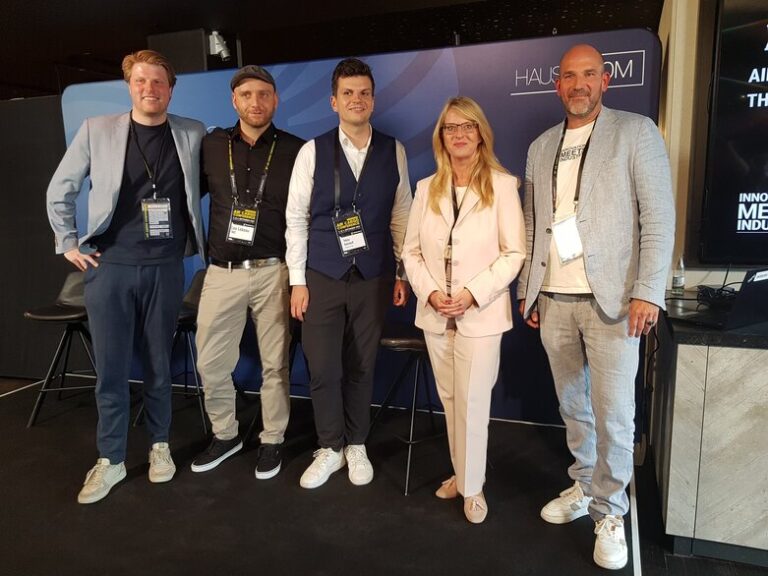
They advocated for greater efforts to protect the climate, (l > r): Moritz Tölke, Sovereign Speed / Leo Labau, T World Services / Tobias Bohnhoff, shipzero / Bettina Petzold, Lufthansa Cargo / moderator Hendrik Bender, Haus61 GmbH – picture: CFG/hs
The price examples are impressive because they show little difference. Consumers have to pay €2.50 for a mango harvested in India and sold in a German supermarket, with transport expenditures included in the price. The same mango, if flown on board an SAF-powered aircraft, would cost €2.82 – just 32 euro cents more in comparison. For a 5 kg shipment of salmon flown from Stockholm to Tokyo, the end consumer in Japan pays €150.00, compared to €156.60 if the aircraft is SAF powered.
0.17 euros more And a third example: a smartphone manufactured in China and flown from Shanghai to Frankfurt has a price tag of €1,200.00 when sold in a store, including transport costs. If SAF were used as energy, it would cost €1,200.17, i.e. neglectable 17 euro cents more.
An 8-page catalog published by Lufthansa Cargo and handed out at Frankfurt’s ACCF, shows impressive examples of how low the surcharge for a wide range of items would be if SAF had powered the aircraft engines instead of Jet-A1 fuel.
Without environmental targets, no change When asked about the credibility of IATA’s goal to make air travel CO2-neutral by 2050, Bettina Petzold, Head of Corporate Responsibility at Lufthansa Cargo, replied that the aim is challenging, but without setting targets, there is not enough pressure for change. She reminded the audience that her carrier just signed a deal with Chinese e-tailer, Shein.
The MoU, signed on 19AUG25, includes a scheme to scale up the use of sustainable aviation fuel on Lufthansa Cargo flights for Shein deliveries. It is part of the company’s target to achieve a 50% reduction in CO2 emissions by 2030. The strategy also includes modernizing the fleet and offsetting greenhouse gas emissions through tree planting campaigns.
Sovereign Speed favors HVO100 Reducing or even avoiding greenhouse CO2 emissions at road feeder services across Europe, is also a core target of logistics provider, Sovereign Speed, as Moritz Tölke, Director of Strategic Customer Green Projects, confirmed. During the panel on sustainability, he pointed out that this goal cannot be achieved without collaboration. Transformative thinking is needed, not just transactional thinking, the manager emphasized. “Our most successful projects are those that are planned together with logistics service providers and shippers, where everyone pulls together, is willing to break new ground operationally, and is prepared to take risks.”
In full swing “HVO100 use is no longer tested in a pilot phase but is now in regular operation surpassing more than 1 million liters. This was only achieved because we collaborated with several customers to establish the process and obtain the certifications needed.” The usage of this fuel is in full swing, thanks to those Sovereign customers who are willing to break new ground. “We can organize trucks, but operational processes need a charging infrastructure, awareness, and the will to implement them.”
The HVO100 mentioned by Moritz is an alternative diesel fuel produced from renewable sources such as used cooking oils and animal fats. Compared to fossil diesel, it is more climate friendly. The acronym stands for ‘hydrotreated vegetable oil’.
Europe, once an economic powerhouse, is falling further behind in global competition. Germany, formerly the driving force within the block, has run out of steam. This development is due to a combination of unfavorable external geopolitical factors and market shifts, but also caused by self-inflicted bureaucratic and regulatory obstacles. Most panelists consented to this rather sobering status, whether they were managers of cargo airlines, airports, handling agents or independent market analysts.
Commerzbank market analyst Vincent Stamer delivered a multi-faceted outlook for the European economy with challenges and opportunities – photo: CFG/hs
Vincent Stamer, Senior Economist at Commerzbank AG, is one of the latter. He delivered a comprehensive forecast titled ‘The Future of European Trade’. His main message in a nutshell: Europe is falling back. Other economies have overtaken the EU, because they offer a favorable working climate in combination with attractive market conditions supported by their governments.
Shifting of supply chains This is illustrated by the price-adjusted trade flows between JAN-MAY25 and JAN-MAY23, measured in euros. While in Europe, exports shrank by about EUR 75 billion, Asia (without China but including India) reports a growth of nearly EUR 400 billion during the same period. Both the U.S. and Latin America achieved a modest growth of their exports, reaching nearly EUR 30 billion. Leader of the pack is China, with exports surpassing EUR 250 billion. Stamer’s conclusion: world trade is increasingly shifting towards the APAC region, and so are international supply chains. This is consistent with WorldACD’s AUG25 market analysis: “There is a clear shift from ‘China/HK to USA’ markets to ‘China/HK to Europe’ markets, as the impacts of this year’s new U.S. trade and tariff policies continue to reverberate around the world.”
Hardest hit by this development is the German automotive industry which has lost its position as a leading car manufacturer in many markets, to Chinese competitors. This also applies to most EU member states, as demonstrated by the purchasing behavior of car buyers in Spain, Belgium, France, and Italy.
The tariffs imposed by Trump are another obstacle for companies that manufacture their goods in Europe and sell them on the important foreign market of the U.S. Stamer’s summary of ‘The Future of Europe’s Trade’ is as follows:
Challenging outlook Due to unfavorable demographic trends, there will be a shift from an export-oriented economy to imports, as the age pyramid in Europe means that fewer productive workers will be available. Consumers will reduce their spending, especially in Italy and France, where the debts of both countries are likely to have an impact on pension levels. Finally, products from China and Southeast Asia will continue to increase competition for European manufacturers. All in all, the outlook for Europe is challenging.
Finally, the optimistic message But there is one hopeful development: New trade partners will emerge – such as India or Brazil – offering the European industry alternative market options. While analyst Stamer emphasized this point at the ACCF meeting, after years of negotiations, the EU Commission has given the green light to the Mercosur Agreement which includes Brazil, Argentina, Uruguay, and Paraguay on the Latin American side. If the EU member states also approve the package, it would create the world’s largest free trade zone, which would have a positive impact on the exchange of goods and stimulate new bilateral trade flows. Added to this is the Comprehensive Economic and Trade Agreement (CETA) between the EU and Canada, which has been in place since 2017. A free trade agreement between the EU and India is also set to follow this year. Trade between these trading partners is not affected by Trump’s tariff policy, which is also good news in these uncertain times.
The sheer volume of emails received makes it clear: invitations to cargo and logistics conferences have now reached tsunami-like proportions. The abundance of offers alone makes it difficult to choose which events are a must and which should be dumped directly into the waste bin. Not only industry experts are constantly facing these decisions but also the trade media. Among the multitude of events, the Air Cargo Conference, organized by the Air Cargo Community Frankfurt, now stands out clearly due to its wealth of topics and networking opportunities. For CargoForwarder Global (CFG), participation in last week’s anniversary event was therefore a matter of fact.
CFG has compiled a series of articles on the event. Here is PART 1.
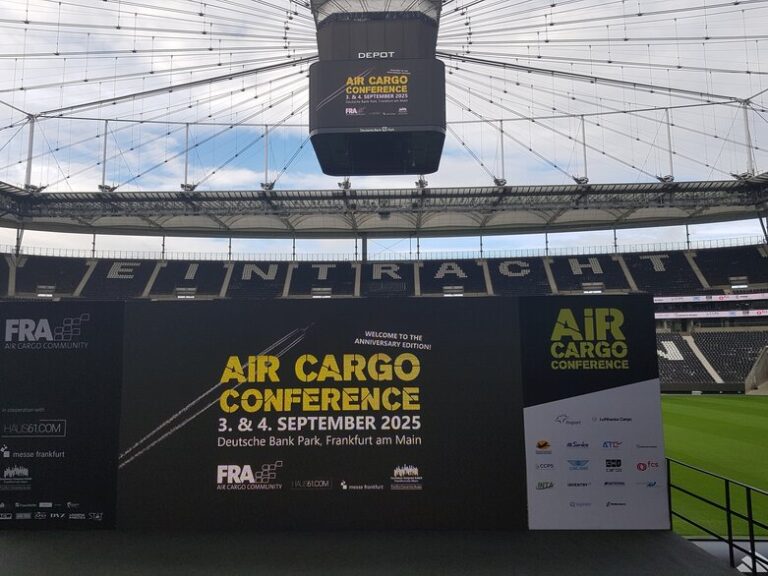
This year’s ACCF conference was held at the stadium of Eintracht Frankfurt soccer club. An unusual venue for an air freight conference – photo: CFG/hs
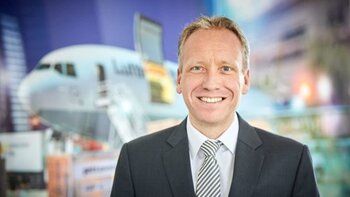
New technologies and creative approaches The ACCF has become a must-attend event for industry and is probably the second most important in Europe after the bi-annual Air Cargo Europe conference in Munich. This was emphasized in a statement delivered by Frank Bauer, Chief Operating Officer, Lufthansa Cargo, who points out the special value of the Frankfurt gathering for the cargo and logistics industry: “Since its founding more than ten years ago, the Air Cargo Community Frankfurt has pursued the goal of sustainably strengthening Frankfurt as an air freight hub. The intensive exchange between the more than 400 participants and the resulting ideas and initiatives impressively demonstrate how vibrant and effective this community is. Innovation plays a key role in this: In an industry that is rapidly digitizing and facing global challenges, new technologies and creative approaches are crucial for future viability and competitiveness. That’s why I was particularly pleased about the Innovation Pitch as part of the Lufthansa Cargo Innovation Award – because it is precisely formats like this that create space for fresh ideas and promote young entrepreneurs who actively contribute to the further development of air freight with their initiatives.”
Two stages combined with an exhibition area For the first time, there were two separate stages for keynotes, presentations, and discussions. Also, there was an exhibition area where companies such as Wallenborn Transports S.A., ATC Aviation Services, time:matters GmbH, Loedige, webcargo and some others, as well as charity organizations such as Cargo Human Care, could present themselves to the audience and draw attention to their special services. However, not all messages were positive; experts also gave critical assessments concerning the economic perspectives of most EU countries.
All e-Com parcels arriving PACTL’s warehouse in Shanghai are X-rayed before loaded on board an aircraft – company courtesy
PACTL delivered e-commerce insights Unsurprisingly, most of the experts emphasized that e-commerce, as the current main driver of air freight volumes, will become even more important in the future. This was confirmed by Carsten Hernig, Managing Director of ground handling agent, PACTL, who delivered an overview of the processes at Shanghai Airport for this product segment. Following their arrival at PACTL’s warehouse by truck, all parcels are x-rayed since, unlike in Europe or North America, there are no regulated agents in China. Hernig emphasized that the data quality is very high. Batteries and cosmetics are often safety-relevant, which is why compliance with regulations is essential. Whereas freighters used to be the preferred means of transport in the past, Chinese e-commerce exporters are increasingly relying on the belly-hold capacity of passenger airlines as their route network is larger in comparison.
The future is e-commerce! When asked how e-commerce demand will change in the near future, Carsten replied: “That’s difficult to predict, but the trend is steadily upward. This year alone, we had an incredible tonnage in August, which is normally the weakest month, indicating unabated growth for this commodity.”
In conclusion, Murat Odabas, Managing Director of CB Customs Broker GmbH, explained: “We continue to see significant differences in the interpretation of EU-wide regulations by different countries and even customs offices. What works at one airport may not work at another nearby.”
These differing, sometimes very lax interpretations of EU regulations by member states and local authorities are a constant annoyance for those who consistently comply with legal requirements. In this case, compliance with the law translates into competitive disadvantages for law-abiding companies and airports.
Exactly 406 participants, a kaleidoscope of intriguing air freight and logistics topics, and plenty of networking opportunities: the 10th Air Cargo Community Conference, which took place on 03-04SEP25 in the Deutsche Bank suite at Champions League contender, Eintracht Frankfurt’s soccer stadium, was worth attending. Those who missed it will regret their absence given the wealth of exciting impulses delivered by speakers and representatives of the cargo industry.
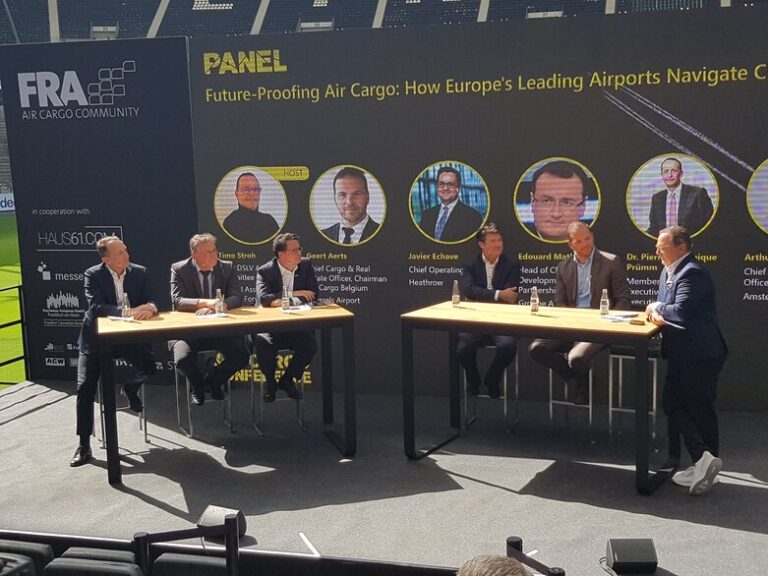
Lineup of cargo executives from Europe’s leading freight hubs (l > r): Dominique Prümm, Fraport / Edouard Mathieu, ADP / Javier Echave, LHR / Arthur Reijnhart, AMS / Geert Aerts, BRU / moderator Timo Stroh – photo: CFG/hs
Fashion illustrates the fundamental changes in trade Glyn Hughes, Director General TIACA, started off the first day of the event with these keynote remarks: “Trade patterns have shifted. Global manufacturers, who benefitted from liberal economic practices for many decades, are meanwhile suffering increasingly from trade restrictions and relocations of production. This is exemplified by the evolution of fashion which changed from High Street pedestrian shopping facilities to online platforms like Temu or Shein.”
Line-up of key cargo airports The panel, “Strategic Challenges and Opportunities in Air Freight”, brilliantly moderated by Timo Stroh, Managing Director of Becon Projects GmbH, picked up on Glyn’s introductory remarks. Together on stage with him, were top executives from the leading European cargo airports AMS, LHR, FRA, CDG, and BRU, which accounted for 52% of all shipments loaded or unloaded at European airports in 2024.
Stroh emphasized right at the start that he wouldn’t focus on the unfavorable global economic climate. “Lamenting is not part of my genes,” he exclaimed. Instead, by looking forward and identifying opportunities for the industry this panel should concentrate on, he set the guidelines for the panelists. The first speaker Timo addressed, was Edouard Mathieu, General Manager of Real Estate Development at Aeroports de Paris Airport.
ADP announced investment shift In terms of growth opportunities for the members of the Aeroports de Paris Group, especially Paris Charles de Gaulle (CDG) and Orly (ORY), these are “above all, e-commerce that is outpacing other commodities.But what we also need is public acceptance of our business. So far, this has been lacking,” Edouard stressed. He also announced major investments in the airports’ cargo infrastructure. Originally, these had been primarily designed to support the exports business. However, with the ever-increasing growth of e-commerce, the tide has turned and import shipments have become more important, which has shifted investment decisions in favor of incoming goods.
AMS focuses on belly freight According to Arthur Reijnhart, Chief Commercial Officer of Amsterdam Airport, Schiphol’s air cargo future “is bright and full of opportunities.” He pointed out that after years of almost unlimited growth in passenger and cargo traffic,Amsterdam has entered a phase of consolidation due to slot restrictions, regulatory hurdles, and social resistance. To overcome stagnation, management has set up a ‘belly-first’ program. The network offered out of Amsterdam comprises around 300 destinations. “If the bellies of passenger aircraft are not filled with cargo, we lose traffic, since cargo is a major contributor to passenger airlines’ revenues,” Arthur reminded. Consequently, Schiphol will invest EUR 6 billion by 2029, to improve the infrastructure for ground processes.
Building alliances is key, says Aerts Geert Aerts, Chief Cargo & Real Estate Officer at Brussels Airport Company, pointed out that pharma/life science in combination with perishables, will remain the main drivers of freight growth. That said, working in alliances is rewarding for all participants. In this respect, he lauded the airport’s close partnership with Air Cargo Belgium that comprises 165 member companies. In addition to digitalizing and streamlining processes, investing in people and implementing best practices is crucial to attracting young talent to the industry. “As an industry, we ought to speak with one voice if we want to be heard,” Geert urged. And he warned airports and the entire industry that, as EU-based players, “we need to be careful not to fall behind in global competition.”
FRA presented an ambitious masterplan Dominique Prümm, Executive Board Member for Aviation and Infrastructure at Fraport, reminded that Frankfurt is the number one cargo airport in Europe. “And we are determined to maintain the leading position, supported and enabled by a comprehensive master plan.” This project was explained in more detail in another panel by Alexander Laukenmann, Senior Executive Aviation, Fraport. The manager expects air freight at FRA to grow by 50% come 2040, due to infrastructural expansion in combination with traffic growth. In addition to freighters, passenger traffic is expected to play a major part in this development. By 2040, FRA will handle 90 million passengers annually, Alexander stated – an increase of almost 30 million compared to the 62 million counted in 2024. FRA expects Passenger Terminal 3 to be a major enabler for this growth. It will be operational in early 2026, “according to schedule and in compliance with the original price tag,” he assured.
LHR’s ‘bellies first’ strategy In his remarks, Javier Echave, Chief Operating Officer Heathrow Airport, stressed the complex role of airports which extends far beyond air traffic. “London Heathrow is not just an airport, but a service company,” he explained. Although growth is driven by passenger traffic, cargo continues to make an important contribution to revenue. Exactly one third of all exports leaving the UK by air are handled at LHR, which corresponds to a belly cargo ratio of 95%. “Similar to the team of Champions League contender, Eintracht Frankfurt, Heathrow employees have a winning mentality and a positive ‘we can do it’ attitude,” he stressed. This could serve as an example for others, was his indirect message to the ACCF attendees.
Fraport’s executive Prümm sends Berlin policymakers a wakeup call. Rounding up the topic, Fraport executive, Dominique Pruemm outlined the outstanding economic importance of the global connectivity that airports offer. This said, he issued an urgent wake-up call to German politicians to acknowledge and appreciate the significant economic role and service rendered by airports. “We are amid the third consecutive year of economic recession in Germany. But we feel no support from politicians. Those responsible do not seem to understand that connectivity is an important part of the economy and a major supporter of public welfare.”
Prümm would like to see less indifference from the federal government in Berlin toward the concerns of the aviation industry, and a change of heart with the aim of providing political support for aviation matters.
Sad decline of a once leading industry It remains to be seen whether the Berlin government will respond to his appeal. However, as things stand, the chances are rather slim. In the country of aviation pioneers like Hugo Junkers, Claude Dornier, Otto Linienthal, Willy Messerschmitt or Ernst Heinkel, aviation tends to play a rather minor role – one that has lost its former significance and role model function of yesteryear.
Farnborough Airport-based i6Group and Liège Airport (LGG) have signed a landmark 15-year partnership agreement to pioneer integrated digital aviation fuel management solutions. The scheme will cover the full fueling lifecycle from livestock management and automated reconciliation to paperless into-plane fueling. It will include live resource tracking and auditable data for every event (delivering 24/7 operational visibility), and will support Liège Airport’s ambitions for sustainable, data-driven cargo growth.
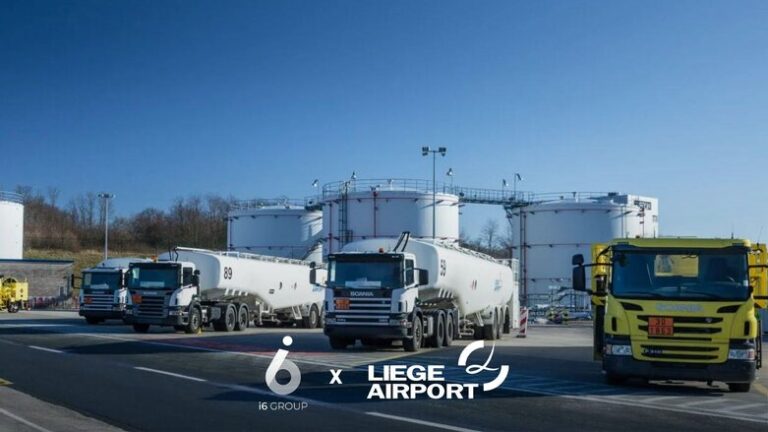
Traditional tank trucks are part of the integrated digital aviation fuel management solution standing on the joint agenda of i6Group and its partner Liège Airport – photo: LGG/i6Group
Liège selected i6 for its fully integrated digital fuel management solution. The decision was driven by i6’s ability to deliver real-time automation, precise data capture, robust reporting capabilities, and round-the-clock global support. The cooperation agreement follows a thorough evaluation process in which the offers of various providers were closely examined. i6 claims that a one-minute delay forcing an aircraft to stay on the ground longer than needed, costs the operator around USD 100 in additional spending caused by avoidable fuel burn, crew hour costs, further delays caused by missed slot connections – and increases greenhouse gas emissions.
Smart fuel supplies vs old school practices Due to these factors, the pressure on fuel providers to deliver kerosene to airlines and airports safely, accurately and on time, is immense.
However, in everyday practice, deliveries are often still old school, as evidenced by the fact that many ground fueling operations still rely on paper tickets, verbal dispatching, and legacy systems. These processes slow down reconciliation, increase the risk of errors, and make it hard to respond when plans change in real time.
The result? Airlines looking for operational efficiency are increasingly choosing partners who can keep pace with their own digital transformation.
And this is precisely what “Cargoland” Liège Airport has done in its partnership with i6. By collaborating, both players are eager to set a new standard for digital aviation fuel management, enabling airlines, cargo operators, and fuel suppliers to benefit from real-time operational data, automated workflows, and enhanced compliance and environmental performance. “Liège is a linchpin in the global air cargo network, and our partnership with i6 Group will help us set new standards for operational transparency, efficiency, and sustainability,” said Christian Delcourt, Head of Communications at LGG. “Digitizing our fuel operations is central to our long-term vision for a connected, resilient, and eco-conscious airport.”
Paperless technology With over 1 million tons of air freight handled annually, Liège Airport’s continuous investment in innovation and digital infrastructure has made it a preferred partner for global logistics integrators and e-commerce players. In a joint release, both partners stress that their collaboration will lead to smarter fuel supplies and strengthen Liège’s commitment to operational excellence and environmental stewardship – delivering measurable reductions in manual workload, carbon emissions, and fuel wastage through the adoption of cloud-based, paperless technology.
“We’re delighted to work with Liège Airport on this industry-leading project,” exclaimed Steve Uhrmacher, CEO at i6 Group. “Our technology is proven at over 200 airports worldwide, but partnering with one of the world’s largest freight airports allows us to deliver impact at a truly global scale. Together, we will demonstrate how data-driven operations can underpin both business growth and climate responsibility.”
As part of i6 Group’s customer feedback campaign, a cluster of trees is planted for every completed response. So far, 700 trees have been planted as result of the campaign, helping grow an i6 forest in partnership with Ecologi. The UK-based platform supports and motivates businesses to measure and reduce their emissions, restore the planet, and report their progress for every step they take towards net-zero.
Furetank promotes transition to biofuel Further north, in the maritime sector, Swedish shipping company, Furetank has taken steps to accelerate the transition to fossil-free ocean transports by stimulating the use of renewable fuels. The step is in line with the FuelEU Maritime regulation. The schemerequires commercial vessels within the EU to gradually reduce greenhouse gas emissions, starting with 2% during 2025–2029 (compared with 2020 levels). By 2050, emissions must be reduced by 80%. Those who fail to meet EU demands will otherwise face heavy penalties. The idea is to make it costly for companies that emit large amounts of greenhouse gases, and profitable for those who transition. In this way, the regulation aims to stimulate the use of renewable fuels.
Biomethane powered vessel operated by Furetank – company courtesy
For Furetank management, this is good news and an opportunity to fully leverage its investments in climate-saving technology. Thanks to the company’s Vinga series of in-house designed dual fuel tankers, powered by liquefied methane, the transition to biofuel can be made without delay or technical modification. Now that the incentives and business models are in place for the more expensive biofuel, Furetank has chosen to move far ahead of EU requirements.
“We have long awaited and prepared for this much-anticipated shift. We have secured a contract for large-scale deliveries of mass-balanced biomethane, which will power all of our Vinga vessels trading in the EU throughout 2025. This gives us the opportunity to trade surplus emission reductions — both for ourselves and for others,” said Viktoria Höglund, CEO of the new company called CO2mpliance.
Launching an emissions trading company Since Furetank has already done the groundwork to establish a framework for the new trading system, CO2mpliance will also handle compliance with the FuelEU regulation on behalf of other shipping companies. Customers will include both operators moving ahead of EU requirements with a surplus to sell, and those unable to reduce emissions from their fleets fast enough and therefore needing to buy.
“Furetank has a tradition of creating its own functions demanded by the market. For example, we have our in-house chartering department, which also serves other shipping companies. Now we are taking the same step into this new market created by the EU. We have the entire chain of expertise required to conduct the transactions and administration, in line with the new regulation and the specific conditions of shipping,” stated Ms. Höglund.
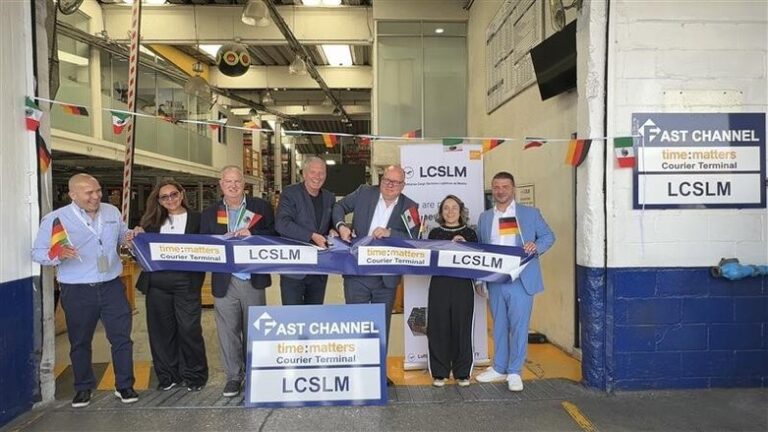
Despite Trump’s constant tariff threats, Mexico is one of Latin America’s economic hotspots – and that also benefits air freight. Now, Lufthansa subsidiary, time:matters – the specialist for urgent high-performance logistics solutions – has inaugurated two new Courier Terminals there: at Mexico City International Airport (MEX), and Felipe Ángeles International Airport (NLU). The latter, located about 35 km north of the Mexican capital city, has been in operation since 2022 and is used by most cargo airlines serving Mexico.
Ribbon cutting at MEX Airport (L > R): Erwin Arizmendi, LCSLM / Rosario Vázquez, LCSLM / Jeff Daniel, time:matters Americas / Frank Nozinsky, LCSLM / Stefan Fölsing, time:matters Courier Terminals; Erika Tamayo, LCSLM / Francesco Serio, time:matters Courier Terminals – Courtesy: time:matters
With its dual presence in Mexico, time:matters is strengthening its global footprint. Including the two new Mexican stations, the list of Courier Terminals operated by time:matters has grown to five. Its other service terminals are at the airports in Frankfurt, Munich, and Shanghai. The two new offshoots were realized in cooperation with the local subsidiary, Lufthansa Cargo Servicios Logísticos de México (LCSLM). They offer the market improved connectivity between Latin America, Europe, and Asia. Key industries benefiting from these developments are automotive, semiconductors, and companies that are part of the rapidly growing life sciences industry in the central American country. time:matters points to a USP: due to the practical integration of Lufthansa Cargo Servicios Logísticos de México into daily operations, fast and efficient handling services of time-critical shipments are enabled, performed by experienced employees. Currently, Lufthansa operates 14 flights per week to Mexico, seven passenger services to MEX and seven cargo flights to NLU.
Tailored to the needs of key industries This combination of qualified personnel and dedicated processes reduces processing times for import and export shipments from an average of six hours to three hours, ensuring greater speed, quality control and faster distribution, thus benefiting the company’s customers. In addition to special processing and personalized data flows to customs agents and recipients, the service offering also includes 24/7/365 operational readiness.
The terminals are tailored to the needs of industries such as automotive, semiconductors, and life sciences, and handle replacement and service parts, medical devices, high-value goods, and hazardous materials. The facilities deliver a fast throughput of imports and rapid processing of export shipments, as well as offering special documentation services. All Courier Terminals operated by time:matters are characterized by their high operational reliability, which should now also apply to the two facilities established in Mexico.
Strategically important hub Stefan Fölsing, Managing Director of time:matters Courier Terminals, emphasizes this point: “The new terminals in Mexico add a strategically important hub to our network in Latin America. Thanks to dedicated handling processes and personalized control, we ensure faster and more reliable processing for products in key industries.”
Frank Nozinsky, Managing Director of Lufthansa Cargo Servicios Logísticos de México, adds: “We are delighted to be partnering with time:matters to offer our customers even faster handling services for time-critical and sensitive shipments in MEX and NLU.”
In an interview with CargoForwarder conducted at Air Cargo Europe in early JUN25, CEO von Strassen had already vaguely indicated that a network expansion was imminent. However, the manager did not mention specifics and that two new stations were listed in his company’s expansion strategy.
Maastricht Aachen Airport (MST)’s air freight volumes are booming. In the first half of this year, its tonnage grew 15% compared to the same period in 2024. The upswing is thanks to new and additional flights serving MST, which is conveniently located at the tri-border area connecting the Netherlands, Germany, and Belgium.
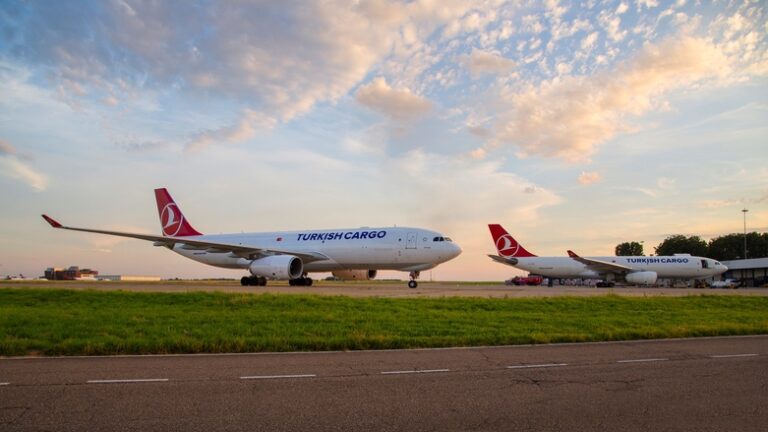
After a break, TK Cargo is back in MST – courtesy: Airport
My Freighter and… As MST management reports, Turkish Cargo and My Freighter have added three weekly flights to their schedule following a new traffic agreement signed by the airport and the two carriers. As of 01SEP25, Uzbek cargo airline, My Freighter, will operate a new, twice-weekly Boeing 767-300 full freighter service connecting Shanghai, Tashkent, Almaty, and the Netherlands. It will mainly transport e-commerce items, automotive products, general cargo, and flowers.
… Turkish Cargo increase scheduled flights Turkish Cargo will add another flight connecting Quito, Bogota, Miami, Istanbul, and the Netherlands to its existing twice-weekly services operated with a Boeing 777 freighter. According to the sales team, the key products filling the main decks of the freighter aircraft on this sector will be flowers, fruits, vegetables and agrarian produce next to general cargo. In addition to scheduled services, the increase in cargo volumes at MST, compared to the same period last year, is driven in part by a series of Atlas Air charter flights, the arrival of Ethiopian Cargo, and the return of Turkish Cargo after a short absence. “With the addition of My Freighter and the expansion of Turkish Cargo services, we expect this upward trend to continue for the rest of the year,” stated Dean Boljuncic, Head of Commercial Development, Maastricht Aachen Airport. In a release, the executive praised the airport’s one-stop-shop strategy, ample ground handling capacity, tailored services offered airlines by the employees, their flexibility and high professionality. “We are proud of our team that makes this growth possible, providing added value to our customers through fast and flexible handling of their shipments.”
AEO certificate speeds up customs procedures “Our speed is further enhanced by our Authorized Economic Operator (AEO) certification, which guarantees quick and secure customs clearance,” explains Boljuncic. AEO is an EU status that recognizes companies as particularly reliable and secure for the international supply chain, resulting in benefits such as simplified customs procedures and increased security. It is part of the EU Customs Security Initiative and is recognized by authorities throughout the EU. Earlier this summer, Ethiopian Airlines signed a new contract with MST and operates a twice weekly service with a Boeing 777F, carrying both perishables and general cargo. The airline connects Hong Kong, Addis Ababa, and Maastricht.