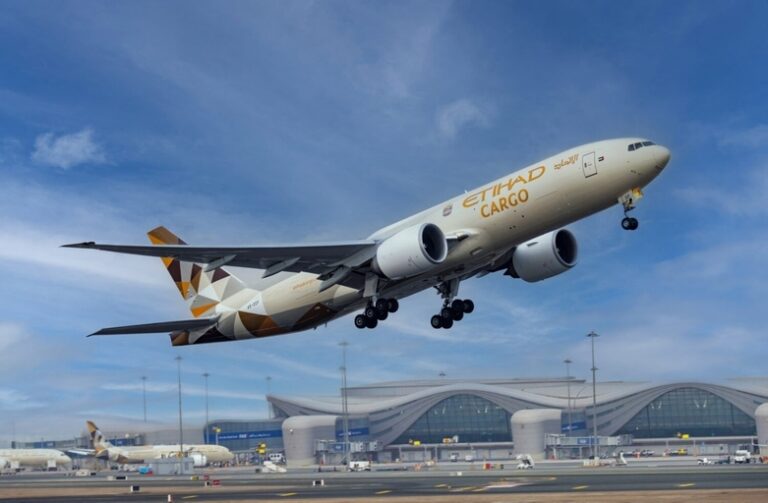
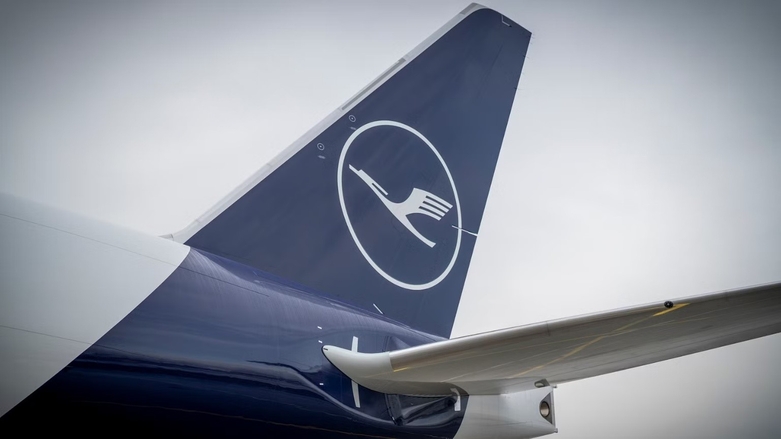
A dedicated Atlas Air B777F for Etihad Cargo. Image: Atlas Air
Thirteen years after their first partnership agreement, which saw Atlas Air provide flight services for the UAE-headquartered airline, the two carriers have now announced another long-term agreement. This time, Atlas Air will operate a newly delivered and now Etihad Cargo-dedicated Boeing 777 freighter. The move results from increased customer demand for general air cargo, e-commerce, automotive, pharmaceuticals and perishable products across Asia, the Middle East, and Europe, and Etihad Cargo’s ambition to serve these segments. The Atlas Air freighter, which began flying on behalf of Etihad Cargo this month already, links the UAE capital with Hong Kong and Madrid to begin with. The press release suggests that more destinations will follow. The freighter can uplift a payload of up to 103 tons and is both fuel efficient and low in noise emissions.
Michael Steen, Chief Executive Officer, Atlas Air Worldwide, said: “We are pleased to again partner with Etihad Cargo, one of the industry’s most respected carriers. This partnership reflects our strong value proposition and the trust we’ve built with customers over time. We are pleased to tailor this long-term dedicated capacity solution to help Etihad capture growth opportunities. With our global scale and flexible, agile network, Atlas Air is enabling Etihad to expand their operations and serve their customers with confidence, […] is proud to be a trusted partner of choice, and we look forward to supporting Etihad’s continued success.”
Stanislas Brun, Chief Cargo Officer, Etihad Airways, stated: “Etihad Cargo’s expanded collaboration with Atlas Air represents a strategic step in scaling capacity and extending our global reach. With Etihad Airways’ passenger fleet continuing to grow, it is essential that our freighter fleet expands in parallel to sustain this momentum and deliver end-to-end network connectivity. By aligning growth across both passenger and freighter operations, Etihad Cargo reinforces its ability to meet evolving customer demand, strengthen high-volume trade lanes, and introduce greater flexibility across key markets. This additional capacity further enhances the reliability and agility of our services, ensuring the delivery of seamless and efficient cargo solutions worldwide.”
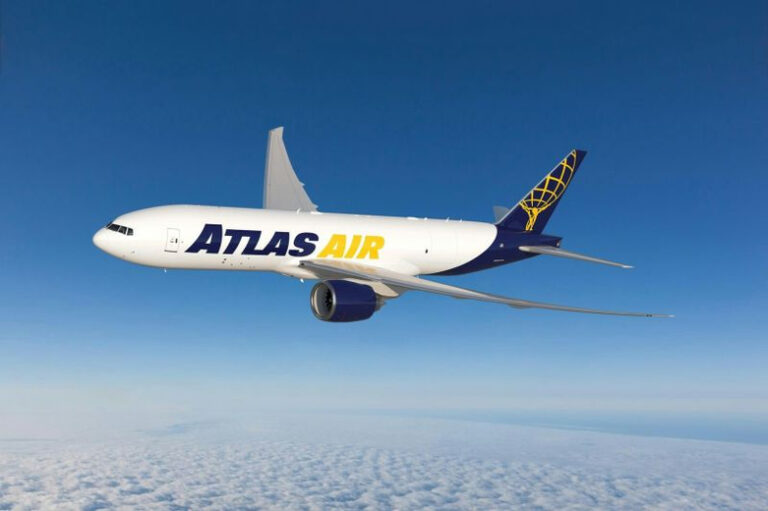
Atlas Air flies a new B777-200F exclusively for DSV. Image: Atlas Air
DSV’s partnership with Atlas Air dates back to the days of Panalpina in the early 2010s when Atlas Air flew Boeing 747 freighters on key routes such as Hong Kong to Huntsville – something that continued when DSV took over in 2019. Now, Atlas Air has entered into a long-term agreement to operate one of its newly delivered 777-200Fs exclusively for DSV. This arrangement allows DSV to manage freight capacity and utilize Atlas Air’s global operating capabilities, air traffic rights, and operational flexibility. The services will support DSV’s operations in Asia, Europe, and the United States, including a connection between its hub in Huntsville, Alabama (HSV), and Luxembourg (LUX), a key trade route for the company. The 777F is expected to strengthen DSV’s network in major international markets with its extended range, high payload capacity, improved fuel efficiency, and reduced emissions.
Michael Steen, Chief Executive Officer, Atlas Air Worldwide,commented: “This new long-term agreement demonstrates the strategic value Atlas Air delivers to the global supply chain. With the leading fleet of large widebody freighters, an extensive operating footprint and comprehensive traffic rights, we have expertise in tailoring dedicated solutions that enable our customers to serve demand where they see it. We appreciate the trust DSV places in Atlas Air and look forward to continuing to provide them with high-quality service and supporting DSV’s growth.” Stefan Krikken, Senior Vice President, DSV, added: “Our agreement with Atlas Air marks an important step in growing and strengthening DSV’s international operations. The addition of a 777 freighter allows us to further enhance service to our customers, with greater control over capacity, schedules, and connectivity. The Huntsville–Luxembourg corridor is a vital trade lane for us, and this new program ensures we can continue to deliver consistent, high-quality performance across key transcontinental routes.”
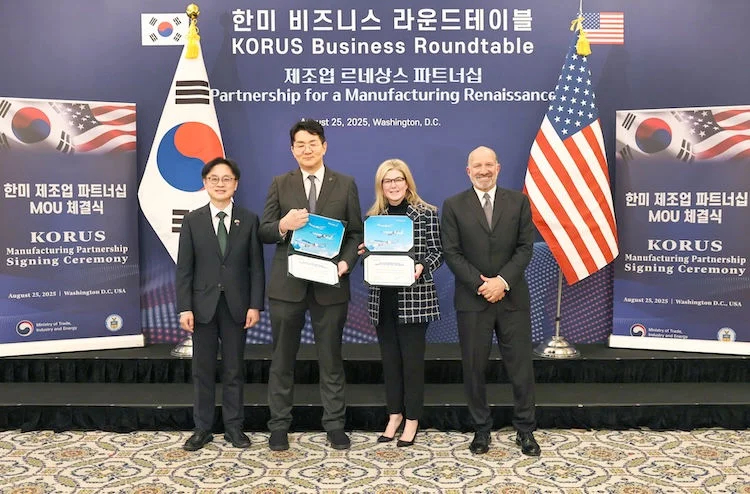
From left: Jungkwan Kim, Minister of Trade, Industry and Energy, Republic of Korea / Walter Cho, Chairman and CEO of Korean Air and Hanjin Group / Stephanie Pope, President and CEO of Boeing Commercial Airplanes / Howard Lutnick, U.S. Secretary of Commerce at the signing ceremony on August 25. Image: Korean Air
On 25AUG25, Korean Air signed a landmark agreement to purchase 103 next-generation Boeing aircraft in a deal valued at approximately USD 50 billion, marking the largest purchase in the airline’s history. The aircraft shopping list includes 20 Boeing 777-9s, 25 Boeing 787-10s, 50 Boeing 737-10s, and eight Boeing 777-8F freighters. It is the first time that the airline has committed to the world’s largest and most efficient twin-engine cargo aircraft. The order will complement Korean Air’s cargo fleet of twelve 777-200Fs, seven 747-8Fs, and four 747-400ERFs.
Scheduled to enter service from around 2028, the phased delivery of these new freighters will enable Korean Air to absorb capacity increases in a measured way, supporting stable growth as it integrates with Asiana Airlines’ cargo operations. The fleet modernization will strengthen Korean Air’s competitive position in global air cargo markets by offering greater cargo volumes, lower costs and emissions, and expanded reach on key trade corridors.
“Korean Air has a long history of fostering close ties between the two countries [US and Korea], beginning with the opening of its first U.S. cargo route (Seoul – Tokyo – Los Angeles) in April 1971 and its first passenger route (Seoul – Tokyo – Honolulu – Los Angeles) in April 1972. This cooperation continues today through its trans-Pacific joint venture with Delta Air Lines,” the release states, going on to confirm that “Korean Air will continue to serve as a vital bridge between the two countries.”
Walter Cho, chairman and CEO of Korean Air, announced: “This agreement with our long-standing partners, Boeing and GE, marks a pivotal moment for Korean Air. Acquiring these next-generation aircraft is the core of our fleet modernization strategy, delivering significant gains in fuel efficiency and enhancing the passenger experience across our global network. This investment is also a critical enabler for our future as a merged airline with Asiana, to ensure that our combined carrier is one of the most competitive airlines in the industry.” Stephanie Pope, President and CEO of Boeing Commercial Airplanes, stated: “We are honored to strengthen our partnership with Korean Air through this landmark agreement, which reflects the value and capabilities of Boeing’s market-leading airplane family. As Korean Air transitions to a larger unified carrier, we are committed to supporting the airline’s growth with one of the world’s most efficient fleets.”
Optimizing its digital services. Image: Lufthansa Cargo
Nothing ages as quickly as IT and therefore it is par for the course that cargo carriers work on their digital service channels every now and again. Lufthansa Cargo is one of them. It recently announced that it has enhanced its digital platform to ensure an improved user experience. According to the airline, its digital offering is now more intuitive, clearer and requires fewer clicks – across the entire shipment booking and tracking journey. The improvements all resulted from feedback from its customers and in close cooperation with them during development. As a result, the general cargo eBooking process is now faster as there are less steps involved. “Customers can now book their general cargo shipments in around half the time it previously took. The new function for saving recent searches can even reduce the booking process to just 30 seconds,” the release emphasizes. Routing options are displayed more clearly as are other information sources such as relevant station information. “The integration of additional services, such as CO2 offsetting, is already in the planning stage,” it reveals.
“eTracking” has also been given a makeover with a new interface design to facilitate shipment tracking. The new version should now be available to users, as it was planned for the end of August: Also, users can opt for proactive email notifications whilst the shipment is on route, should anything not travel according to plan.
Lufthansa Cargo points out, in its release, that it is among the few airlines that allow online bookings of dangerous goods shipments – something it introduced in Spring of this year. “In May, the company also developed an AI solution that processes booking enquiries by email faster and more securely. Numerous other innovations are already being implemented to continuously improve customer experience,” it states. Marcel Kling, Head of Digital Sales at Lufthansa Cargo, explained: “Our new booking process delivers exactly what our customers wanted: fewer clicks, a clear overview, shorter processes and faster communication. It not only makes bookings easier, but also significantly more effective. And we are not stopping there: we are continuing to invest in innovation and focus specifically on AI to accelerate processes, increase transparency and improve service. This puts our customers at the center of everything we do – today and in the future.”
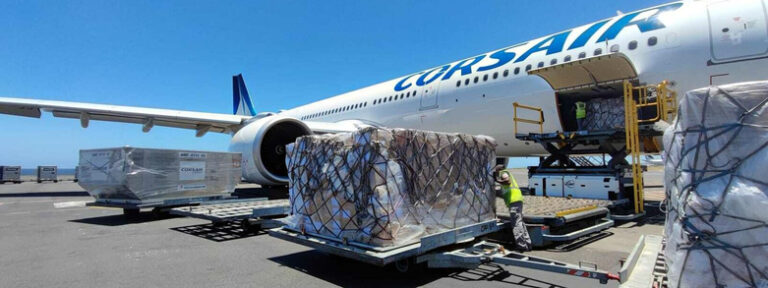
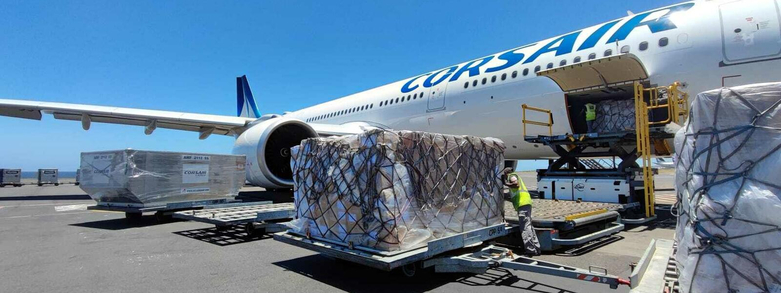
40 years of trust and successful business. Image: Corsair
4 decades is an impressive innings when it comes to cargo partnerships. Next year, ECS Group and the French long-haul airline, Corsair, will celebrate just that. They recently launched a countdown to 2026, when they will celebrate their business anniversary which began in 1986. “A Legacy of Innovation, Trust, and Digital Transformation,” the release underlines, going on to state that: “This long-term alliance has not only withstood the test of time but has redefined what a cargo partnership can achieve in the digital era.” And the fact that they have both adapted digital tools is the basis for their ongoing cooperation. The release talks of a “fully integrated digital alliance” and highlights ECS Group’s Pathfinder platform which Corsair relies on to develop and implement its cargo modernization strategy. “Pathfinder has improved transparency and customer satisfaction, reduced manual tracking queries by over 30%, and enhanced shipment resolution times by 25%. With Corsair’s recent fleet modernization and expansion into Africa and the French Overseas Islands, ECS Group’s scalable digital systems have ensured seamless regional integration.”
And here is more to come – both physically, with the opening of new stations planned, as well as digitally, since Pathfinder is being improved to include AI-driven insights and integrated CO₂ reporting in future, alongside other digital developments. The release is clear in its message: “the 40th anniversary celebration in 2026 [will] not just [be] a milestone, but a bold statement of future ambitions.”
Jean Ceccaldi, CEO of ECS Group, commented: “In a world of constant change, very few business relationships remain as resilient and forward-looking as ours with Corsair. We began with shared value, now we share a strategic vision. As we approach this 40-year milestone, we’re not just celebrating longevity; we’re celebrating our joint ability to adapt, innovate, and lead.” Adrien Chauvière, Head of Cargo at Corsair, added: “ECS Group has been a driving force in helping us evolve our cargo business for the digital age. Their agility, innovation, and deep understanding of our operations have made them an essential part of our success story. This upcoming milestone reflects the strength of a future-focused alliance.”
Global GSA Group has achieved a significant milestone by attaining ISO 27001 certification for its IT operations, setting a new standard in cybersecurity within the air cargo and logistics sector. ISO 27001 is internationally recognized as the gold standard for information security management, attesting to the company’s rigorous adherence to robust technical and organizational controls, such as risk assessment, data protection, access management, and business continuity planning. This certification not only assures airline and logistics partners that their sensitive data and operations are securely managed but also strengthens Global GSA Group’s alignment with the strict requirements of GDPR and other global data protection regulations. Cybersecurity is a growing concern in the air cargo industry, and partners are increasingly seeking evidence of operational resilience and strong defense against evolving threats. The ISO certification process required a thorough review and strengthening of IT policies, transparency practices, and accountability measures for personal data handling. The fact that Global GSA Group went through the auditing process successfully, demonstrates its proactive stance toward safeguarding confidential information. In addition to ISO 27001, the group is also committed to continuous improvement by regularly undergoing SOC 2 Type 2 audits. These further validate the effectiveness of its security protocols and the reliability of its digital infrastructure. Aytekin Saray, CEO of Global GSA Group, summed up: “ISO 27001 certification is a promise to our customers and partners that we are fully committed to protecting their data and ensuring operational resilience. We believe that robust information security is fundamental to building long-term relationships and supporting the growth of our clients’ businesses.”
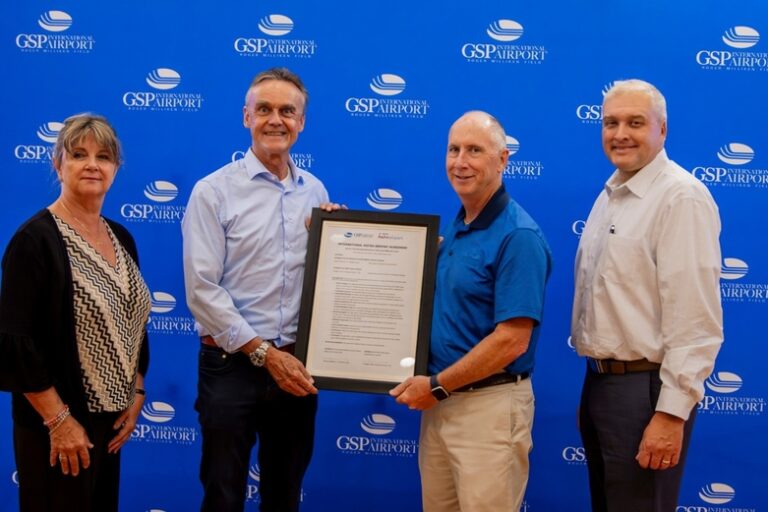
Greenville-Spartanburg Airport (GSP) and TRIWO Hahn Airport have signed a partnership agreement aimed at enhancing cargo and passenger activities at both locations. The accord was triggered by an evening meeting between senior managers from both airports on the sidelines of the Air Cargo Europe conference in Munich (02-05JUN25). There, both parties concluded that they have a lot in common. This was followed by familiarization visits to explore business opportunities, prompting the decision to cooperate closely.
Rüdiger Franke, CEO of TRIWO Hahn Airport, is not only an experienced aviation manager, but also extremely polite. When asked which side initiated the collaboration, he let his colleagues from Greenville-Spartanburg take the lead. “GSP’s core business is the import of air freight, but now they also want to boost exports eying supply chains linking our two airports,” says Franke. GSP traditionally lacks export volumes, sharply contrasting import flows.
In recent years, GSP has become a main address for automotive parts flown in from Europe to be assembled to finished products in the local car production plants. What began small with an investment from BMW around three decades ago, has now reached enormous proportions. With annual sales of over USD 27 billion, the automotive industry has become an essential part of South Carolina’s economy. In addition to BMW, Volvo, Mercedes-Benz and others have set up production facilities there, as have key suppliers.
L > R: Isabella Zoerner (Senior Manager Cargo and Pax Sales, HHN), Ruediger Franke (CEO TRIWO HHN), David Edwards (President and CEO, GSP Airport District), Kevin Howell (Executive VP/COO, GSP Airport District) following the signing of the partnership agreement in South Carolina – Courtesy: GSP
South Carolina has become a hotbed of car production In a nutshell: It is a success story that companies and South Carolina’s policymakers can be proud of. Today, more than 75,000 employees work in the automotive industry. Between 2017 and 2023, 19,500 new jobs were created in this sector, and USD 13.9 billion was invested by car makers and their suppliers during the same period.
Tariffs jeopardize transatlantic trade and the flow of goods Meanwhile, however, due to Trump’s erratic tariff policy, dark clouds are shading import volumes. Since 21AUG25, Washington demands tariffs of 15% for cars and car parts originating in the EU and destined for the US. Conversely, the EU does not impose special tariffs on vehicles manufactured in the US and sold in one of the 27 member states. It remains to be seen what impact the Trump administration’s tariff policy will have. U.S. consumers will probably foot the bill, as companies will pass on the additional costs to customers by increasing their sale prices.
Facing similar opportunities and challenges Back to GSP and HHN: In an initial step, both airports plan to identify cargo opportunities and push new activities forward. “GSP and HHN have worked together on numerous successful air cargo projects over the years. Our teams were recently able to meet face-to-face and found that we share similar challenges and opportunities. Agreeing to work together for the betterment of our airports and regions is an exciting next step in our relationship. We look forward to working with our new European airport partners,” said Dave Edwards, President and CEO of the GSP Airport District. However, shortly before signing the agreement, Hahn suffered a setback. Magma Aviation relocated its five weekly cargo flights between Hahn and Greenville-Spartanburg to Liège to avoid split operations. Belgium, not an industrial giant itself, attracts freight traffic because of user-friendly customs practices, 24/7/365 operations, and because no air traffic control fees are levied (https://cargoforwarder.eu/2025/08/17/german-aviation-has-got-the-blues/) The Magma loss was partially compensated be two additional cargo flights operated by Silk Way West Airlines which have increased their weekly Hahn services from six to eight.
Similar operational conditions Like Greenville-Spartanburg, Hahn Airport is also open 24 hours a day and there are no slot restrictions. Its runway length is 12,647 feet and 105,000 tons of cargo are handled annually (GSP = 60,000 t). “This collaboration is a testament to our shared vision for growth and innovation. By combining our strengths and sharing best practices, we can create new opportunities for both passenger and cargo traffic between our regions and customers. We look forward to a fruitful and long-lasting relationship that benefits both airports and our respective regions,” stated Hahn executive, Ruediger Franke, while signing the partnership agreement.
HHN-BLR – an almost unknown partnership The GSP pact is already the second agreement of this kind for HHN Airport, following its collaboration with Bengaluru, agreed in OCT24. On Hahn’s initiative, the Indian airport attended this year’s Air Cargo Europe/transport logistics trade show for the first time. “Among other things, together with our colleagues from Bengaluru, we are currently discussing occasional cargo flights connecting our two airports,” hints Franke. The intention is mainly driven by industrial giant Bosch’s strong presence in the capital of the Indian state of Karnataka. Bengaluru hosts Bosch’s corporate Indian HQ, and the tech group and automotive supplier is currently building a smart campus in its Adugodi district. Once completed, it will offer a future workplace for around 10,000 employees. Smart service options will ensure that it is efficient to operate, and it will be safe, sustainable, and comfortable, lauds Bosch.
Each week, CargoForwarder Global’s ‘Spotlight On…’ highlights a different segment of the air cargo industry. In such a fragmented industry with so many different companies and functions involved in transporting cargo from A to Z, having a central contact and community ally is essential. Air Cargo Belgium is one such organization. It serves as an ambassador for the Belgian air cargo sector, advocating for the cargo community at Brussels Airport to ensure that it can work efficiently and safely, and that it remains an attractive and competitive player in the global network. This week, we hear from Nathan Goethals, Project Manager at Air Cargo Belgium, about his role, opinions and advice to those looking to join the air cargo industry.
Our office is the meeting point of the community. Image:Nathan Goethals
CFG: What is your current function and company? And what are your responsibilities? NG: I’m a Project Manager at Air Cargo Belgium. I work on some of our larger projects, help roll out the new strategy for the coming years and support our team. A big part of my job is interacting with customs authorities, but I’m just as often in touch with ground handlers, forwarders, and airlines. I like to say our office is the meeting point of the community — the door’s always open, and the coffee is (usually) good — if our machine isn’t broken because of my overconsumption!
CFG: What does a normal day look like for you? NG: If you’re looking for a normal 9-to-5 with predictable days, then air cargo probably isn’t for you. Of course, we have projects that need structure and follow-up, but there’s always an ‘emergency’ or a last-minute change of plans just around the corner. One moment I’m knee-deep in customs procedures or very specific documentation, the next I’m in operational discussions with a handling agent, or working on a more strategic level. No two days are the same. I’m always running around or on the phone with people — and that’s what keeps it fun for me.
CFG: How long have you been in the air cargo industry, and what brought you to it? NG: I’ve been in logistics my whole career, even though I’m still quite young. There’s no big dramatic story of how I ended up in air cargo — a little over three years ago, I just felt ready for a change, and it turned out to be the best professional decision I’ve made so far. I don’t see myself leaving the industry anytime soon. The mix of a dynamic, international environment, the ever-busy operations, the smell of kerosene and the chance to work with so many interesting people is quite addictive.
CFG: What do you enjoy most about your job? NG: What I enjoy most is the mix. I get to challenge myself with complex topics, while being surrounded by very smart people I can constantly learn from. There are several professionals I’ve met whom I deeply appreciate. At the same time, I have the freedom to shape projects and take on real responsibility, which makes the work exciting. I like being a sponge — soaking up knowledge — but it’s just as rewarding when I can actually make a difference for colleagues or community partners, whether on a personal level or for the bigger picture.
CFG: Where do you see the greatest challenges in our industry? NG: There are quite a few challenges, but from my perspective the biggest ones are around changing regulations — especially in customs, e-commerce, and sustainability. Air cargo is such a fast-moving, operational industry that most professionals are fully focused on day-to-day work. But the regulatory side is complex, constantly evolving, and has a huge impact. Just in customs, we’re talking about regulations such as the proposed EU flat fee for e-commerce shipments, MASP-C, the EU Customs Authority and Data Hub. That’s where organizations like Air Cargo Belgium play an important role: helping our members ‘translate’ what’s coming, guiding them through the changes, and keeping an overview of what’s happening globally.
CFG: What advice would you give to people looking to get into the air cargo industry? NG: My best advice is to be a sponge — get out there, meet people, and learn from their experience. The air cargo industry is full of professionals with years of knowledge. When I first joined, I was glad to find open and supportive professionals. If you listen and actively engage with others, you’ll quickly find out which training programs are most valuable. At Air Cargo Belgium, for example, we aim to enroll all current and new employees in the IATA Cargo Introductory Course, after which they can pursue additional programs tailored to their specialization. There are many excellent training opportunities out there, but the best guidance often comes directly from the professionals you look up to — they’ll help you find the right path.
CFG: If the air cargo industry were a film/book, what would its title be? NG: “Everything, Everywhere, All the Time.” No explanation needed, in my opinion.
Indeed! Thank you, Nathan.
If you would like to share your personal air cargo story with our CargoForwarder Global readers, feel free to send your answers to the above questions to cargoforwarderglobal@kopfpilot.at We look forward to shining a spotlight on your job area, views, and experiences.
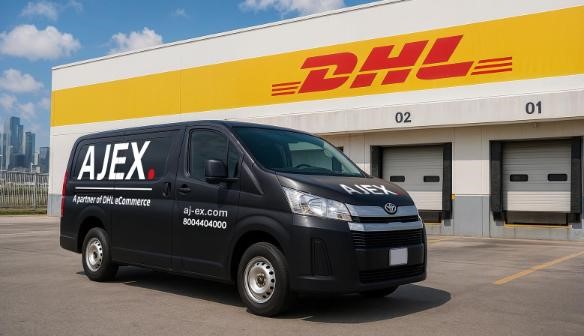
DHL’s business unit, eCommerce, has acquired a minority stake in Saudi Arabian logistics company, AJEX. The move marks a significant milestone in DHL’s expansion into the rapidly growing Saudi Arabian parcel market, and leverages AJEX expansion across the Middle East. Simultaneously, DHL has prolonged its collaboration with Canada’s freight carrier Cargojet.
AJEX started its operations in 2021 and has rapidly emerged as a leading regional and domestic parcel provider with a network of over 60 facilities, 1,200 vehicles and a team of 2,000 employees. Specializing in GCC e-commerce distribution and industrial solutions, AJEX offers a full suite of customer-centric services from express distribution, e-commerce solutions, road, air and ocean freight, warehousing, cold chain, to healthcare solutions. The regional expertise ofAJEX combined with the international reach and operational know-how of DHL eCommerce, will benefit customers around the Gulfregion. They are being offered enhanced and tailored delivery services, stated DHL eCommerce in a release.
DHL and AJEX aim to grow jointly in the six states belonging to the Gulf Cooperation Council – picture: DHL
AJEX’s new ownership structure is kept in the drawer “As part of our Strategy 2030 ‘Accelerate Sustainable Growth’, DHL Group is investing EUR 500 million in high-potential markets like Saudi Arabia,” said Pablo Ciano, CEO of DHL eCommerce. “The customer-centric approach and strong regional presence of AJEX, combined with DHL’s global expertise, will enable us to deliver reliable, affordable, and sustainable parcel solutions across the region.” Questions concerning DHL’s financial commitment to AJEX and which ownership share they were able to secure through the investment, remained unanswered by DHL Communications. All Mohammed Albayati, Group CEO of AJEX said is that “the acquisition of a minority stake by DHL eCommerce in AJEX marks a major milestone in our growth. A testament to the market credibility we have earned. Thanks to the speed and precision of our services, we are now ready to enter the next phase of growth. For our customers across Saudi Arabia and the Middle East region, this means access to faster, smarter, and more innovative delivery services, powering the region’s fast-growing e-commerce markets.”
DHL will get a board seat Their now signed strategic partnership enables DHL eCommerce and AJEX to capitalize on the anticipated double-digit growth in Saudi Arabia’s e-commerce sector, as well as across the broader Middle East region. In addition to its home turf, Saudi Arabia, Riyadh-based AJEX runs stations in the United Arab Emirates (UAE) and Bahrain. As result of the investment, DHL eCommerce will have representation on the AJEX management board. It also holds the option to increase its stake to a majority position in the future. DHL eCommerce, along with the business units DHL Express, DHL Supply Chain, and DHL Global Forwarding, are now present in the country. Going forward, AJEX will be branded as ‘AJEX, a partner of DHL eCommerce’.
Cargojet and DHL prolong collaboration Around 10,200 km west of Riyadh, in Mississauga near Toronto, Canadian freight carrier, Cargojet, and DHL Network have agreed to continue their cooperation until 31MAR33, with the option of further extensions. “Cargojet is an important strategic partner that offers high quality, capacity, and flexibility to DHL Express, operating key routes for us to Canada, Mexico, and Latin America. We are pleased to extend our long-standing relationship with Cargojet and look forward to future expansion that will mutually benefit both organizations,” Travis Cobb, Executive Vice President of Global Operations and Aviation, DHL Express, commented on the deal. The relationship commenced exactly 20 years ago. Since then, both companies successively expanded their collaboration to include ACMI, CMI, charter flights, and dry lease aircraft, thus supporting DHL’s global logistics network. Cargojet currently operates a fleet of Boeing 767 and Boeing 757 freighters to meet DHL’s air transport needs.
Now that the summer holidays are over, the air cargo industry is once again heading into serious conference season from SEP25 on. The next three months are full of events happening across the world. One of the last to happen this year, is TIACA’s now annual Air Cargo Forum (ACF) taking place 03-06NOV25 at the Yas Island Arena in Abu Dhabi (AUH). It will be the first time the ACF is held in its second home base, following last year’s decision to alternate between Miami (MIA) and the UAE capital. TIACA recently published some of the many panel topics that will be on offer. This is what you can expect, if you’re still undecided about joining the 2000+ air cargo crowd there.
CargoForwarder Global signed up early for the event – all smug with WIZZ flights booked well in advance until that moment when the airline decided, this summer, to focus wholly on its European market and promptly pulled its UAE frequencies… No big loss for the air cargo industry in this case, but a brief inconvenience all the same until alternative flights were found. What does impact air cargo in the UAE and how AUH is carving its place in the global air cargo hub network, will naturally be one of the topics of discussion at the ACF. In one of the Oasis-Side Chats (nothing to do with a band revival, and everything to do with symbolism: fertile ideas in a desert environment): Stanislas Brun, Chief Cargo Officer, Etihad Cargo will reveal the airline’s plans for developing Abu Dhabi into a logistics hub.
A new landmark for TIACA’s ACF. Image: TIACA
Middle East as a Global Gateway Not just AUH, but the Middle East as a whole is seeing incredible growth, thus “The Middle East as a Global Gateway” is another panel discussion, no doubt highlighting the significant infrastructure investments being made across hubs like Abu Dhabi, Dubai, and Riyadh, and the region’s increasing role as a critical cargo bridge between Asia, Africa, and Europe. Middle Eastern hubs are positioning themselves as multimodal, digitally advanced, and sustainability-focused logistics centers. Questions of interest could be: if trade flows continue to shift eastward, will this region redefine old patterns of global connectivity? And how resilient can these new freight corridors be amid ongoing geopolitical uncertainty?
Digitalization in Air Cargo A staple of all conferences over the past years is the ongoing digital transformation of the air cargo industry. It has long struggled with fragmented systems, slow adoption of technology, and insufficient transparency compared with other parts of the global supply chain. Yet, there are plenty of stars on the horizon and the ACF 2025 sessions will explore how advanced tools ranging from digital booking platforms to predictive analytics and blockchain can unlock major gains in efficiency, visibility, and resilience. With automation, robotics, and other potential arising from AI, change can come that will both solve and stimulate processes around another rapidly growing area: that of e-commerce. Discussions at ACF 2025 will dig into what e-commerce shippers now expect from supply chain partners – likely more transparency, better data integration, and seamless end-to-end delivery. Can the industry scale quickly enough to keep pace with double-digit e-commerce demand, given ongoing capacity restraints and infrastructure bottlenecks? What do the panelists think?
Workforce challenges Digitalization and automation are just one half of the equation – alongside innovation, which will also have its own panel focus. Equally pressing are the workforce challenges facing our industry. The demand for skilled professionals continues to grow, but recruiting and retaining talent is difficult. Attrition rates are heightened by long hours, intense competition, and generational shifts in workplace expectations. Questions that might be answered in the Workforce Challenges panel and during networking, could be: how can companies make the air cargo sector more attractive to emerging talent? What new training methods and educational partnerships will prepare workers for a digital, data-driven future? Or as automation and robotics become more prominent, how do businesses strike a balance between technology and the need to preserve human expertise?
Aviation Net Zero The forum will also dedicate attention to the air cargo industry’s sustainability commitments – particularly the industry-wide goal of reaching net zero carbon emissions by 2050. Achieving this will largely hinge on the scalability of sustainable aviation fuels (SAFs), operational efficiencies, and breakthrough technologies. But the road ahead is anything but straightforward. Can SAF adoption realistically grow without substantial incentives? Or are mandatory regulation and stronger carbon policies necessary? Is the sector moving fast enough to align with broader climate goals, or are aspirations outpacing practical progress?
Where are we heading? The “Industry Trends and Outlook” panel will discuss the future of the industry and what can be expected going forward. Possible questions to be answered could be: How are macroeconomic factors, shifts in trade patterns, and volatile fuel prices reshaping long-term planning? How can the industry adapt to shifting supply chains, particularly with manufacturers diversifying beyond China? To what extent will geopolitical fragmentation influence demand corridors? And is the sector resilient enough to handle cycles of demand uncertainty – as seen during the pandemic and economic downturns?
TIACA’s verdicts Steven Polmans says: “This year’s program reflects the breadth and depth of the issues shaping our industry. From digital innovation to workforce development, ACF 2025 will bring the right people into the right conversations at the right time.” Particularly poignant – it will be his final ACF as TIACA Chair and one time slot will see him reflect on his 6 years as chair of the board, before he then hands over to Roos Bakker. Glyn Hughes, Director General, comments: “Bringing the Forum to Middle East offers a unique opportunity to connect global leaders with one of the fastest-growing air cargo ecosystems. We look forward to insightful discussions that will shape the industry’s future.”
Indeed! CargoForwarder Global will be there to listen, learn, and report. Will you?