Robert Koppy, Austria Sales Manager, Chapman Freeborn. Image: Chapman Freeborn
Following the strategic restructuring of its European cargo operations, which saw the launch of a European music and entertainment division (Chapman Freeborn’s European cargo operations, the launch of a European music and entertainment division at the end of last year (CFG reported), new European team managers and the opening of a new French operations base, Chapman Freeborn has now signed a new strategic partnership with SkyXS Aircargo Service Network (SkyXS). The general sales and service agent (GSSA) will support the air charter specialist in its cargo, passenger, and on-board courier (OBC) services across Eastern Europe and the Balkan peninsula. SkyXS is already well established in twelve12 Central and Eastern European countries and draws from almost three decades’ worth of GSSA experience.
Robert Koppy, Austria Sales Manager, Chapman Freeborn, said: “SkyXS Aircargo’s extensive contacts in the region perfectly complement Chapman Freeborn’s experience delivering a robust and versatile suite of air charter solutions tailored to clients’ specific needs, no matter how complex. Demand for both cargo and passenger charters across Eastern Europe and the Balkans has continued to grow steadily over the last year. I look forward to working closely with colleagues from SkyXS as Chapman Freeborn capitalizes on this growth, diversifies its sales base, and continues to steadily expand across Europe.”
Israeli AI-powered platform, Monada.AI, has integrated CargoAi’s CargoCONNECT Quote & Book API to offer even faster quoting & booking to its users. The platform which says it is “transforming how logistics companies sell freight,” by largely automating freight sales, has not opted for these CargoCONNECT features so that Monada users can gain instant access to real-time airfreight capacity. Over 105 airlines are active on CargoAi. Through this strategic partnership, Monada users will experience far simpler and faster booking processing and gain greater transparency on their shipments’ progress. As it is an API integration, Monada users will be able to carry out air cargo bookings without having to leave their own platform – a convenient solution that does away with the time-consuming manual processes of the past.
Monada.AI gains speed through CargoAi’s CargoCONNECT features. Image: CargoAi
The unified interface provides real-time visibility into freight schedules, capacity, and pricing, allowing users to make faster, smarter decisions. By automating the end-to-end workflow, the integration reduces operational friction and accelerates the speed-to-book, which is critical in today’s fast-paced logistics environment.
Shahar, CEO of Monada.ai, said: “At Monada.ai, we are redefining how freight forwarders sell—turning scattered data and manual processes into clear, actionable workflows. Integrating CargoAi’s Quote & Book API allows us to deliver a powerful, AI-enhanced user experience that makes air cargo booking seamless and smart.”
Matt Petot, CEO of CargoAi, commented: “This partnership with Monada.ai exemplifies our mission to digitize every layer of airfreight procurement. Through our CargoCONNECT APIs, we’re unlocking new possibilities for logistics players to optimize operations and scale efficiently.”
A loss of slots is looming for AMS Airport. This could affect 22,000 flights per year. This highly controversial traffic cut was the subject of a court hearing in Haarlem. The judge responsible at the North Holland District Court indicated that the downsizing of flights would bring much needed relief from aircraft noise for local residents. Conversely, airlines could live with some traffic restrictions, he argued. This assessment was vehemently contradicted by airline representatives.
Meanwhile two court hearings are over and in both cases the stakes were high. But the judicial controversy is more than just about slots. It also concerns the self-image of an entire nation. For centuries, merchants, seafarers and traders, alongside hydraulic engineers and flower growers, shaped the collective self-image of the Dutch people. As shown by the paramount role of the port of Rotterdam, which is more than just a harbor: it is a symbol and an identification mark for an entire nation. That also applies to Schiphol Airport, which is much younger than its water counterpart, but connects the nation with the entire world, filling most Dutch people with pride.
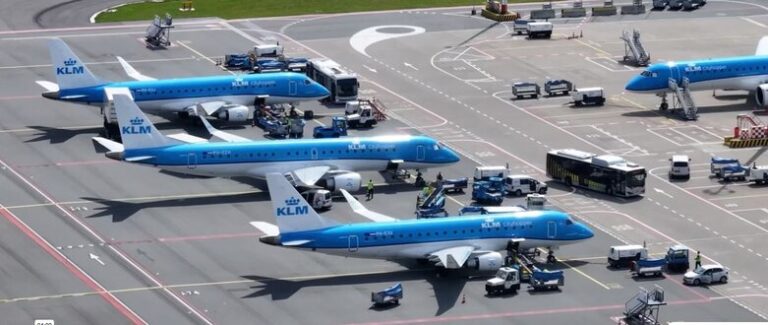
Home carrier KLM droht der Verlust von 4600 Slots in AMS pro Jahr – company courtesy.
KLM would suffer most Now Schiphol’s traffic shall be cut, from an annual 500,000 departures and arrivals down to 478,000. This is to reduce noise emissions in the neighborhood, Barry Madlener, Minister of Infrastructure and Water Management, reasons. A step comparable to the closure of the Waalhaven or Eemhaven in Rotterdam, which would probably cause an uproar throughout the country. If the government in The Hague gets its way with this scheme, home carrier KLM would be the most affected party, as it would probably lose 4,600 take-off and landing rights. This would cost the carrier around half a million passengers, a large amount of freight tonnage, and would tear a hole in the airline’s budget, its representatives argued in court. According to court reporter, Ashwant Nandram from the Volkskrant newspaper, the lawyers, called in by KLM and some other airlines, accused the government of botched work since the government presented a scheme based on calculations that were compiled superficially and carelessly. Significant factors have not been considered or played too small a role in coming to a fair conclusion. As an example, the lawyers mentioned the upcoming fleet renovation at KLM, in which older and therefore noisy aircraft will be replaced by modern, quiet jetliners. The airline’s legal consultants claimed that this aspect was not adequately taken into account by the government in their slot cutting scheme.
The positions remain entrenched According to correspondent Nandram, the response to this from the state attorney general who represents state interests, was remarkably sharp. It is understandable that the airlines ‘are not happy’, but the public interest is served by traffic shrinkage, emphasized the judge, referring to those living near Schiphol who constantly suffer from noise pollution. In his concluding remarks, he regretted that up to this point the airlines didn’t show any sign of understanding and willingness to reach a compromise pleasing both sides. The state’s representatives reminded that the airline’s appeal to the court was premature. Their point: The Dutch government has not yet formally taken a binding decision if its intention to cutting 22,000 slots per year is the very last word. This will be announced on 08MAY25 – at the latest. Immediately afterwards, both airlines and noise opponents can appeal the decision before the Supreme Court of The Netherlands. Hence, both parties are likely to face each other again in court. So, please stay tuned!
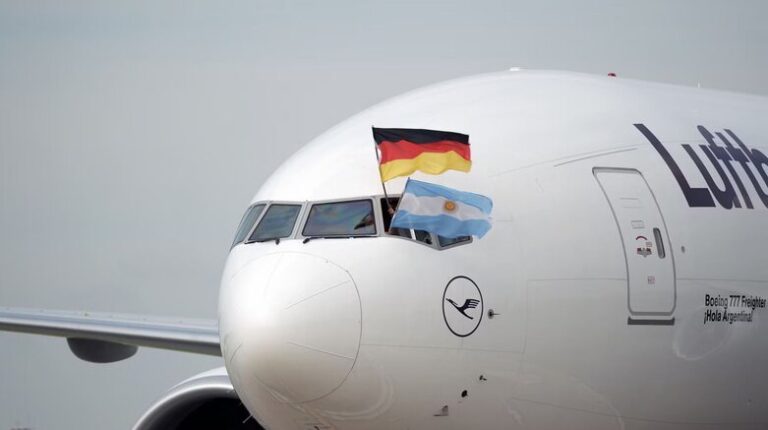
This is what the freight carrier has christened its newest B777F fleet member, registered D-ALFL, thus honoring Argentina’s role as a key market within the airline’s global network. The naming of the aircraft is part of the “Say hello to the world” concept designed as a gesture of courtesy to countries served by Lufthansa Cargo. In parallel to this event held in Buenos Aires, Avianca Cargo and Angolan carrier, TAAG Cargo signed a partnership agreement in Brazil.
Lufthansa Cargo has been connecting Frankfurt with Buenos Aires for 55 years, initially offering cargo capacity in the lower decks of the carrier’s passenger fleet. Freighter flights followed years later. Currently, Lufthansa Cargo operates two weekly B777F rotations, each with stopovers in Viracopos, Brazil, and Montevideo, Uruguay. In addition, the market has access to abundant lower deck cargo capacity on board of the daily flights between Frankfurt and Buenos Aires. These are part of the 20 weekly rotations from Frankfurt, supplemented by three rotations per week from Munich to destinations in South America, mainly Brazil.
Since last week, a Lufthansa Cargo B777F is a flying Argentinian Ambassador – courtesy: LH Cargo
Mercosur treaty is expected to boost cargo volumes Argentina with its strong agricultural sector but also its thriving energy and raw materials market, will remain an important economic pillar in the Latin American trade network, despite increasing global uncertainties. Trade between the EU and South America, and therefore the volume of air freight, is likely to increase significantly once the Mercosur treaty is sealed, which is expected to happen before the end of this year. Once this has been accomplished, the largest free trade zone in the world will be established, spanning across the Atlantic and affecting more than 700 million people.
Win-win While European companies will be able to sell their products more cheaply in the Mercosur countries, with their inhabitants benefitting from lower import prices, Brazil, Argentina, Uruguay and Paraguay will gain access to Europe’s large food market which should boost their exports. In addition, both trading partners become less dependent on China and the USA, and can establish more advantageous trade links with other regions of the world such as Africa, India or Southeast Asia. “South America is and will continue to be an important growth market for Lufthansa Cargo. Especially in the perishables industry, we have built strong partnerships with our customers over the last three decades. With the christening of our latest freighter, we are emphasizing our commitment to Argentina and, in line with our motto of ‘enabling global business’, are also committing to this market and our customers,” said Ashwin Bhat, CEO of Lufthansa Cargo, during the christening ceremony at Buenos Aires Airport.
TAAG Cargo and Avianca Cargo sign win-win agreement At the same time, two and a half hours further north, in São Paulo, leading managers of Avianca Cargo and TAAG Cargo signed a Special Prorate Agreement (SPA). Though this strategic move, both carriers aim to strengthen their cargo operations and widen market access across the Atlantic. The collaboration offers their customers a broader network, better connectivity, and preferential rates, helping to drive business growth and open new international trade routes. Through this partnership, TAAG will expand its presence beyond São Paulo, gaining access to key South American destinations such as Bogotá in Colombia, Santiago in Chile, Lima in Peru, Montevideo in Uruguay, and Quito in Ecuador, by co-loading freight shipments on board of its Latin American partner’s fleet. Conversely, Avianca Cargo gains a strong foothold in the Angolan market including the neighboring south African countries. While Avianca does not offer flights between South America and Africa, TAAG serves Luanda-São Paulo, operating multiple passenger B777 flights.
CargoForwarder Global’s ‘Spotlight On…’ takes a look at the many different people and functions that make up the air cargo industry. In recent years, there has been a growing focus on bringing digital procurement to life for the thousands of small and medium-sized (SMB) forwarders across the world: an important element of industry digitalization efforts. One person in that function is George Britton (GB), VP Sales SMB at cargo.one. This week, he talks about his responsibilities, how he came to the air cargo industry, and gives advice to those looking to enter it.
It’s a privilege to be part of an exciting era in air cargo. Image: cargo.one
CFG: What is your current function and company? And what are your responsibilities? GB: I’m the VP Sales SMB at cargo.one, which is the leading digital platform for booking and managing air freight capacity. My main responsibility is to lead our SMB (small and medium business) sales team, helping freight forwarders access the best digital tools to quote, book, and manage air cargo shipments more efficiently. I focus on building and scaling a high-performing team, setting our Go To Market strategy, and ensuring we deliver ever-more value to our customers – helping them win more business and operate more smoothly in a rapidly changing industry. I’m also passionate about hiring and developing talent, so I spend a lot of time coaching, listening, and empowering my team to take ownership of their work and bring their best ideas forward.
CFG: What does a normal day look like for you? (Or is there such a thing?) GB: I’d love to say there’s a “normal” day, but in reality, every day brings something new! My mornings usually start with a strong coffee and a quick catch-up with my team – sometimes virtually, sometimes in person. I spend a good chunk of my day connecting with freight forwarders, understanding their challenges, and showing them how cargo.one can make their lives easier. There’s always a mix of internal meetings, customer calls, and strategy sessions. I make it a point to carve out time to listen to my team’s feedback and ideas; some of our best innovations have come from these conversations. And, of course, I try to squeeze in a walk with my dog – often my best thinking time! The pace is fast, but that’s what keeps it exciting. No two days are ever quite the same, and I wouldn’t have it any other way.
CFG: How long have you been in the air cargo industry, and what brought you to it? GB: I’m relatively new to the air cargo industry – I joined cargo.one in early 2025. My background is in sales leadership across several tech-driven industries, from SaaS to fintech and HR tech. It was the sheer scale and impact of the industry that drew me to air cargo, combined with the huge opportunity for digital transformation. After my very first conversation with the cargo.one founders, I was hooked. I could see how much potential there is to bring the kind of digital tools and customer-centric thinking I’ve seen succeed elsewhere into an industry that’s only just beginning its digital journey. The people I’ve met so far across the industry are some of the most hard-working, passionate, and inspiring I’ve ever collaborated with. It’s a privilege to be part of this exciting era.
CFG: What do you enjoy most about your job? GB: Without a doubt, it’s the people. I’ve been blown away by the calibre and dedication of the “Cargonauts” at cargo.one and the whole freight forwarding community. There’s a real sense of camaraderie and shared purpose. I love building and motivating teams, and nothing beats seeing someone on my team grow, take on new challenges, and succeed. I also get a real buzz from helping our freight forwarder customers achieve those “wow moments” when they realise how much easier and faster their work will be with the right digital tools. Having worked in industries that are a bit further along in their digital transformation, I’m passionate about bringing those lessons to air cargo and delivering positive, tangible outcomes for our customers.
CFG: Where do you see the greatest challenges in our industry? GB: A significant challenge remains the pace of digital adoption. Air cargo is a global, complex industry, but in many ways, it’s still reliant on manual processes and legacy systems. Freight forwarders are under pressure to deliver faster, more transparent, and more reliable services, but they often lack the digital tools that are standard in other sectors. There’s also a talent crunch – attracting and retaining people who are comfortable with both the operational and digital sides of the business. But I see these challenges as huge opportunities. The appetite for change is there, and platforms like cargo.one are making it easier for forwarders to embrace new ways of working. The key is to keep listening to customers, iterating quickly, and making sure the technology genuinely serves real-world forwarding needs.
CFG: What advice would you give to people looking to get into the air cargo industry? Any particular training they should aim for? GB: My advice would be: jump in with both feet! The air cargo industry is full of opportunity, especially for people who are curious, adaptable, and eager to learn. Don’t be put off if you don’t have a traditional logistics background – skills from other industries, especially around digital tools and customer experience, are increasingly valuable. In terms of training, I’d recommend getting a solid grounding in the basics of air freight, including regulations around dangerous goods (IATA offers excellent courses), and staying up to date with the latest digital platforms and trends. But above all, focus on building relationships and listening – some of the best ideas and career opportunities come from the people you meet along the way.
CFG: If the air cargo industry were a film/book, what would its title be? GB: Great question! I’d call it “Look at Life: The High-Flying Transformation.” The industry is at a fascinating crossroads – steeped in legacy but on the cusp of a digital revolution. It’s a story of hard work, resilience, and innovation, with a cast of characters who are as inspiring as they are determined. There are challenges, of course, but also huge opportunities for those willing to embrace change and help shape the future. And, just like any good story, there are plenty of plot twists and moments of triumph along the way.
Thank you for your answers, George!
If you would like to share your personal air cargo story with our CargoForwarder Global readers, feel free to send your answers to the above questions to cargoforwarderglobal@kopfpilot.at We look forward to shining a spotlight on your job area, views, and experiences.
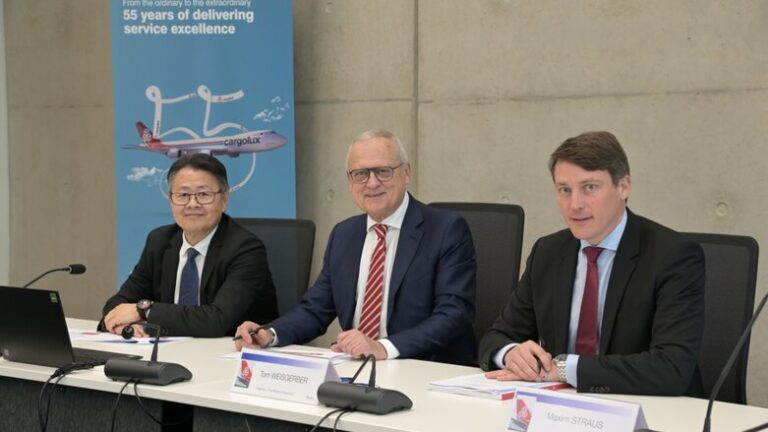
The Luxembourg-based cargo airline (CV) generated a profit after tax of USD 448 million in the past financial year (vs USD 286 million in 2023) and revenues of USD 3.3 billion (2023: 297 billion). “It is by far the best annual result since the cargo boom in the corona years and one of the strongest annual results since the airline was founded 55 years ago,” exclaimed Tom Weisgerber, Chairman of the Board of Directors, at the presentation of the figures last Wednesday (23APR25) in Luxembourg.
The result is particularly remarkable because the geopolitical tensions and the numerous regional crises (Middle East, Russian war on Ukraine, Houthi attacks) plunged global trade flows into turbulence. They also led to cost increases, efficiency declines and lowered customer confidence in air transport, CV’s Executive Board members admitted.
Presented CV’s 2024 annual results (l > r): Richard Forson, President + CEO, Tom Weisgerber, Chairman of the Board, Maxim Straus, CFO – courtesy Cargolux
Capacity goes where the market is However, these challenges were more than compensated for by the steep increase in e-commerce shipments, which led to a shift in transport capacity from other markets to East Asia. This commodity re-shaped global demand and disrupted traditional seasonal trends, making forecasts less predictable. In parallel, charter operations experienced a record demand, increasing the airline’s 2024 annual results. At the annual press conference, Richard Forson, President & CEO of Cargolux spoke of an “exceptional result” achieved in 2024. “Our agile approach to business, and our people’s commitment to service excellence enabled Cargolux to swiftly adapt to changing market dynamics, securing yet another remarkable year,” stated the executive.
Rough ride ahead The executive was cautiously optimistic about the current financial year, while at the same time pointing to increased risks for the air freight business, caused for example by Trump’s import tariffs. They are expected to negatively affect demand for air cargo capacity and disrupt traditional trade lanes. At the same time, the increasing focus on sustainability and the introduction of regulatory changes also put pressure on the aviation sector. “The measures effective in the European Union will impact the cost of operations and will also benefit non-EU carriers, who are not subject to such regulations in their home countries. Authorities and industry players must work together to find suitable and viable solutions to ensure a sustainable future for the industry,” is stated in a CV release. The Cargolux fleet comprises 30 B747-8Fs and B747-400Fs with four of the latter operated by Milan Malpensa-based subsidiary, Cargolux Italia. The Boeing jumbos serve 75 destinations on scheduled flights. A fleet revamp is not planned until 2028. The Cargolux Executive Board hopes that the outstanding customs issues between the USA and Europe will long have been resolved by then.
In the midst of an industry already suffering a skilled labor shortage and struggling to attract talent, the revelation that “59% of air cargo workers have considered leaving the industry,” in a recent research paper put out by IBS Software, is alarming. As is the fact that one in four of those surveyed have considered leaving due to burnout or work-related stress. And 42% are frustrated with outdated technology. CargoForwarder Global (CFG) wanted to know from Radhesh Menon (RM), Head of Cargo & Logistics at IBS Software about why IBS had commissioned the research and what it will now do with the results.
Radhesh Menon, Head of Cargo & Logistics at IBS Software. Image: IBS Software
CFG: What motivated IBS to research this topic and what was the instruction? RM: Anyone working in or with the air cargo industry is aware of the current workforce issues plaguing the sector. Coupled with the unavoidable uncertainty of global policies, it’s safe to say that working in air cargo right now is stressful. It’s difficult to ignore the changing geopolitical climate and the direct impact of this on the air cargo industry, and as this continues to evolve, we felt it was important to understand how the sector could attract, retain and secure skilled staff. We wanted to understand the factors behind frustrations in the working environment and what learnings we could take from employees’ experiences.
CFG: Were the results as expected? What was surprising? What was hopeful? RM: Despite knowing of the talent shortage and the people issues affecting the air cargo industry, I was still shocked to see that over half (59%) of our respondents were considering leaving the sector. That said, there were results that we expected, like the fact that outdated technology is a key cause of frustration for the sector, as well as the unpredictable global climate. What was really positive, was the fact that nearly half (49%) cited passion for aviation and transportation as the reason why they were attracted to the industry, and their job role. You can invest in the right tools, and transform your employee experience to retain skilled staff, but you cannot force interest, so it is great that throughout all frustrations, the air cargo industry is still able to instill the same levels of passion with its employees as has been the case before.
CFG: Where was the survey carried out? How many people participated from which countries? RM: The survey was open for respondents working in the air cargo sector globally. The majority of people were based in Europe, but we had participants from the EMEA, APAC and America regions contribute to the survey too.
CFG: What air cargo segments participated? GHAs, airlines, etc.? RM: A variety of air cargo roles participated in this survey, covering a cross section of roles from operational staff to middle management and those working in technical areas. We felt it was important to capture the opinions of staff at all levels, with varied day-to-day experiences.
CFG: What BDPs does IBS have that it can share with the industry when it comes to attracting and retaining its own staff? RM: When it comes to attracting and retaining our own staff, we place a great deal of emphasis on cultivating a culture of innovation, appreciation and continuous improvement. Another fundamental aspect is for employees to be able to access the best tools and practices aligned to their job and develop a sense of pride by being part of a smart workforce. Building a fair and supportive working environment for employees at every level and location is crucial to providing a great employee experience, and is why we have consistently been certified as a ‘Great Place to Work’.
CFG: Where do you see the industry in 5 years’ time, based on this information? RM: There are a couple of distinct possibilities here. In five years’ time, the role of digital enablement of core business processes is going to be fundamental – being ‘digital first’ will be a given, similar to digitally innovative industries like banking. Automation of repetitive and non-value adding activities would be another key area where the air cargo industry could definitely benefit from the adoption of AI driven practices. While optimizing operations, these AI tools would make work more rewarding and less cumbersome. Through the adoption of next generation practices like IATA’s ONE Record, there could be a significant upgrade in the industry’s capability to generate and share quality data. Achievement of these practices would, importantly, attract a younger, more digitally savvy workforce, bringing new ideas and with it, driving cultural change, making the industry more innovative and responsive. While challenges like policy volatility and global disruptions will persist, companies that invest in digital transformation and talent development will lead the charge into a smarter, more resilient future. The other possibility is that the industry continues to be allergic to the change required to move forward and miss out on a generation of new talent that will help drive this change. Ideally, we learn from the findings of our research, and shift the change resistant mindset in the air cargo industry, for a digitally positive future.
CFG: What will IBS now do with the results of the survey? RM: These results bring insights for our customers, but also for ourselves. Even as an IT provider, IBS Software must continue to look ahead of the curve and insist on recruiting, nurturing and retaining the talent of tomorrow. We can see that for our customers, this talent stagnation can have long-term effects on the progression of air cargo, and even the aviation sector as a whole. The results will be used, not as a simple red flag, but as a driver to affect meaningful change across the industry, and understand the wider, human related impacts of increased digitalization.
CFG: Where are concrete examples of how IBS solutions can prevent burnout at work? Or what are its suggestions for improvement here? RM: Preventing burnout at work requires a balance of many factors like manageable workloads, clear communication, and supportive leadership. HR-related best practice methods, which could include encouraging regular breaks, flexible schedules, and providing mental health support can aid in improving employee well-being. Burn-out occurs when employees feel underutilized, overworked, and even become disconnected or apathetic about the work they do. In particular, it is important to ensure that employees feel that they are part of transformation initiatives and that their needs are also being addressed as part of these initiatives. It is critical that these are not just ‘top-down’ strategic goals, they must address the real day to day issues that employees face as part of their daily jobs that drive transformation initiatives. Therefore, investing in training, recognizing talent and achievements, and making employees part of the development process can assist employees to stay engaged, motivated, and resilient in fast-paced, high-pressure environments. Encouraging the passion that drove them to the industry, and the importance of their role within the organization is also key in helping employees feel recognized, and reminding employers of the need for a culture of appreciation.
CFG: What percentage of the industry is still not digital or not up-to-date? What is the average set-up at an average air cargo service provider? RM: Our findings showed that 42% of air cargo workers cited inadequate IT systems as a key challenge facing their organization. And beyond cost, the strongest barrier to updating technology within the sector was a resistance to change, reported by 53% of our respondents. That said, it’s clear there’s a backlog of digitalization felt by air cargo workers. If you were to map out the different business areas and the level of digitalization in each of them, there has been some level of improvement in the sales and commercial functions over the past couple of years – particularly over COVID. But as we move progressively forward in the shipment lifecycle through handling operations and to back-office functions, we can see significant opportunities for upgrading the level of digital enablement. In terms of average length of implementation, it depends on factors including the scope of the implementation and the degree of complexity of the IT landscape that we are embedding our solutions. We work closely with customers to define the most optimal path for the project by considering all these factors and effectively balancing aspects like time to benefit realization (ROI), risk and the degree of change management that it involves. This then drives the timeframe and can range for those that want more instant an implementation to those who need a gradual integration.
CFG: What training support do you suggest when it comes to IT implementation? RM: As with training for any new technology, the core purpose of the implementation is just as important as knowing how to correctly use it. Learning a new technology is learning a new skill. If your team doesn’t understand why the training is happening, it’s likely that the implementation and integration of the desired upskilling will fail. The training plan is embedded into all of our implementation plans, as well as ongoing engagements post implementation – which includes specific training courses for business users, system administrators and technical staff. We also work with our customers to provide them with additional training aids such as automated computer-based training, embedded tutorials etc. as per their needs. So internal communication, on the need for learning and development of digital solutions, is as crucial in IT implementation as the actual data/solution integration itself.
CFG: Any other message that you would like to share? RM: The next generation of IT professionals will have many choices when choosing an industry or even a specific company. The job market is just as competitive from the recruitment side, as it is for those being recruited. The question we should all be prepared to ask ourselves is: why would an individual who is used to a digitally native experience in their normal life – from online shopping to social interactions – be happy to take a position in our industry? Do we have the right work practices that they would find exciting and value adding? The answers to these questions should be quite obvious as this survey clearly shows us. If we want to ensure the longevity and evolution of our industry, and attract skilled, smart employees, we must insist on plowing ahead with digitalization in air cargo.
German aircraft converter, Elbe Flugzeugwerke (EFW) has received a large order from Confity Capital Partners (Confity) to retrofit A330 aircraft. When asked about the number of aircraft, EFW’s Head of Communications, Anke Lemke, did not give a specific figure but told CFG that it was a two-digit number. According to her, this applies to both A330 variants, i.e. A30-200P2F and A30-300P2F.
Confity Capital Partners (Confity) is a Financial Advisory & Growth Equity firm based in Dubai, with offices in Singapore, New Delhi, London, Virginia and Florida. The company’s website reveals little about specific projects or investment plans, only naming Stellar Aviation Solutions and the Indian service provider, Mardamed, as partners, with the latter active in the healthcare and medical sector.
Anke Lemke, EFW head of Corporate Communications speaks of a “two digit P2F order for A330 aircraft placed by Confity Capital Partners.” – courtesy EFW
Targeting the Indian cargo market Now EFW has become their third partner since the conversion order is part of a broader collaboration between Confity and EFW. It is aimed at bringing EFW’s widebody Airbus P2F solution to operators in India, in support of the sub-continent’s fast-growing freight market, as well as to global customers in other emerging markets. The strategic push into India follows EFW’s introduction of its standard body A321P2F and A320P2F freighter aircraft to the Subcontinent’s market in 2022.
The freighters will be operated on behalf of Jet Freight Logistics Practically, the A330P2F conversions commissioned by Confity will start before the end of this year and will be carried out at EFW’s facility in Dresden, Germany, as well as its partner conversion sites across the globe. The launch customer will be Jet Freight Logistics, a listed Mumbai-based forwarding agent with extensive experience spanning over four decades. Jet Freight Logistics will also be the first Indian cargo player to operate the widebody Airbus P2F.
Supporting the upward momentum “Driven by e-commerce, domestic consumption, rising exports and infrastructure improvements, India’s air cargo market is expected to grow rapidly and hit record volumes in the years to come. Our Airbus P2F programs can serve as a strong enabler in this trajectory, helping Indian operators and the cargo market maintain their upward momentum with proven aircraft freighter solutions,” stated Lee London, SVP Marketing & Sales, EFW. The A330P2F program comes in two variants – the A330-200P2F and the A330-300P2F – both of which are equipped with advanced technology that offer airlines impressive operational and economic benefits, EFW emphasizes in a release.
Looking beyond this project “From a broader view, having EFW experts partner with us on this project is a major technical risk reduction as they have proven their capabilities. We can also say we are already looking beyond this project and have additional plans for cooperation in the near future,” said Amit Baum, Senior Partner at Confity. The A330-200P2F can carry a gross payload of up to 60 tons for over 7,700 km, while the A330-300P2F offers a gross payload of up to 62 tons and a containerized volume of up to ~18,581ft3 / ~526m3. this corresponds to 23% more cargo volume than other freighter aircraft in the same class can uplift. Dresden, Saxony-based Elbe Flugzeugwerke (EFW) isa joint venture between Singaporean ST Engineering and frame maker Airbus. It combines various aviation and technology activities under a single roof: development and manufacturing of fiber-reinforced composite components for aircraft structures and interiors of the entire Airbus family, P2F conversions of single aisle and widebody Airbus aircraft, and maintenance, repair and engineering services in the context of certification and approval. The company has a workforce of 2,100 employees and achieved EUR 650 million in revenue in fiscal 2024.
By creating a Global Cargo Joint Business, the three cargo airlines are bundling their forces aimed at enhancing existing service levels for customers and partners in the global air cargo market. The companies praise their intend as a “significant milestone” (QR Cargo), a ‘testament’ (IAG Cargo) and a “defining moment” (MASkargo). Now, the plans still have to be implemented.
Qatar Airways Cargo, IAG Cargo and MASkargo Announce Intention to Launch a Global Cargo Joint Business
It is a strategic cooperation, so short of a merger. Hence, a threshold that lies below the bar for possible interference of competition authorities. In their identical press releases, the three freight carriers name as their primary goal to benefit customers significantly by combining their expertise, infrastructural abilities and assets. Their announcements further read: “A streamlined product offering, enhanced connectivity, faster transit times, and new routing opportunities across their combined extensive networks will deliver greater value and service flexibility to customers worldwide. In parallel, the parties are jointly working at developing industry-leading harmonized safety and security standards for their customers.”
Acting according to the Olympic motto: faster, higher, stronger. By pooling their resources, QR Cargo, IAG Cargo and MASkargo plan to build a connected and agile cargo network that will address the evolving needs of global trade and logistics, the trio promises.
Mark Drusch, Chief Officer Cargo at Qatar Airways Cargo commented: “This agreement will bring together three strong players to offer unparalleled service and global connectivity, reinforcing our commitment to customer satisfaction and operational excellence.”
David Shepherd, Chief Executive Officer at IAG Cargo stated: “This joint business not only unlocks choice and opportunities for our customers but also enhances connectivity for the businesses and industries they serve, further strengthening the role air cargo plays in facilitating global trade.”
Mark Jason Thomas, Chief Executive Officer at MASkargo added to this: “By leveraging our combined strengths and expertise, we will provide enhanced service offerings, expanded global reach, and cutting-edge solutions that address the evolving needs of the global market, ensuring greater efficiency and connectivity for our partners and customers.”
Additional allies could jump in At first glance, the three airlines’ announcement to kick off a Global Cargo Joint Business sounds like a bombshell. However, this is probably only the case for those who were completely surprised by the plans. It has been apparent for some time that the three players are intensifying their cooperation step by step. Only the timing and the number of participants was open until now.
The trio could also have started as a quartet or quintet, with the South American LATAM Cargo as an additional member or RwandAir Cargo from East Africa. QR Cargo is one of the major shareholders of both parent companies.
Starting point is still open By historical standards and compared to SkyTeam Cargo and the former WOW Cargo alliance with LH, JAL, SQ and SAS, the new cargo union is likely to be the largest cargo club ever.
The carriers leave open, when exactly their collaboration will practically begin. Although the time issue might be a decisive factor for shippers and forwarders for planning their businesses concerning routing availabilities, connectivity options and capacity management issues. There does not appear to be a central unit for coordinating such issues. A reference to these points does not exist on the carriers’ websites. Hence, many questions still need to be answered.
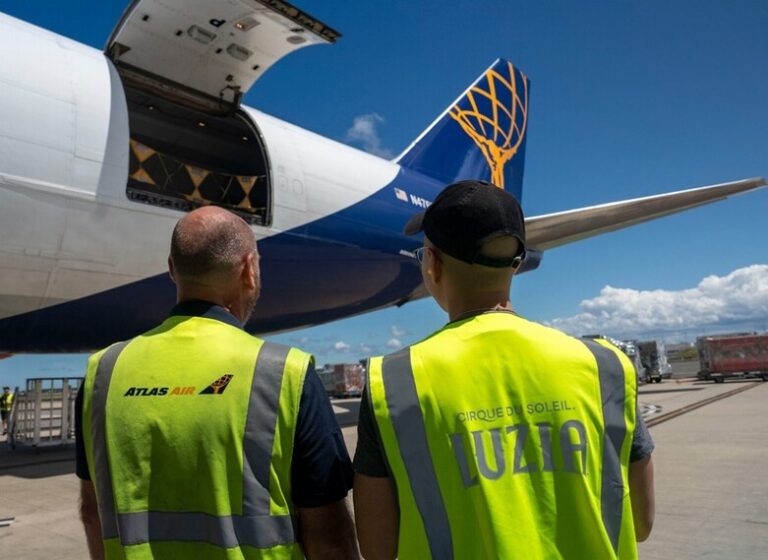
Some partnerships are special, especially when they include cargo designed to fascinate and entertain international audiences. Mention the Cirque du Soleil and a great many people around the world immediately think of awe-inspiring acrobats jumping and abseiling through the air. Air acrobatics of a different kind took place prior to this year’s planned shows, and that’s because, instead of travelling 60 days via ocean freight, the circus’ unique treasures were carried as air cargo for the first time since 201, cutting the total transport time down to just 7 days. Atlas Air Worldwide had the honor as Cirque du Soleil’s logistics partner, of airlifting its latest ‘LUZIA’ show from Sydney, Australia, to New York, US, in time for its North American tour which began on 06MAR25. Among the roughly 7000 pieces that usually fill around 19 US semi-trucks, were Cirque du Soleil’s custom-designed sets which include a one-of-a-kind rain curtain and ‘sun’, 20-foot-long, 4,500-kilogram treadmills converted from mine conveyors, and other specialized lighting, sound, and water equipment. Two Boeing 747-400 freighters were deployed to transport the unusual commodities, and a video was made to mark the occasion(see below). The entire operation’s success was down to meticulous planning in advance to ensure tight schedules were adhered to, and all shipments were transported securely and with care.
Richard Broekman, Chief Commercial Officer, Atlas Air Worldwide, stated: “As a trusted leader in aviation logistics, we are proud to have supported Cirque du Soleil in bringing LUZIA to North America. From massive stage elements to intricate performance equipment, our expertise enabled the safe and timely delivery of this extraordinary production. This partnership highlights our commitment to excellence, allowing spectacular shows like LUZIA to inspire audiences across the globe.”
Duncan Fisher, Chief Show Operations Officer at Cirque du Soleil, said: “Moving this show required immense planning. This wasn’t just logistics – it enabled dreams to take flight. Everything must function like clockwork, just as our artists work in perfect harmony to create an unforgettable experience. We are thrilled to partner with Atlas on this journey, ensuring our equipment arrived safely and on time for our New York premiere.”