Kale’s GALAXY system is deployed at over 120 international airport cargo stations, and that list is about to include one more – namely Mexico’s busiest air hub, Mexico City Airport. México Cargo Handling (MCH) and Kale Info Solutions announced their partnership on 17MAR25. The software solutions provider will implement its GALAXY air cargo community system and thus streamline and digitize all operations and cargo handling processes at the airport. The goal is to minimize risk of errors in shipment data as it passes along the cargo journey, and to improve process efficiency. It will also greatly reduce the amount of paper needed. In fact, Kale was commended by the United Nations both in 2017 and 2019, for the fact that its systems annually reduce up to around an estimated 10 million paper copies of documents at airports. Instead of paper processes, cargo employees including warehouse operators, use hand-held devices to log and transfer data in the cloud-based system. Kale’s commitment to sustainable cargo community solutions looks to make the entire cargo handling process paperless. Furthermore, GALAXY streamlines export, import, and transit operations by digitizing all shipment data and providing authorized users real-time data transparency.
Amar More, Kale Info Solutions President, Mathilde de Rocquigny, México Cargo Handling CEO. Image: Meantime Communications
Mathilde de Rocquigny, CEO of México Cargo Handling, explained: “At Mexico Cargo Handling, we are looking at digital innovation to provide better value to our customers. We are happy to partner with Kale on creating the right digital infrastructure at our facilities to become more efficient, sustainable, and provide better visibility to our customers.”
Amar More, President of Kale Info Solutions, declared: “We are delighted to work with Mexico City International Airport. Our team is geared up to deliver the best-in-class to the airport. Enhancing customer experience, building operational excellence, and free-up talent from routine support tasks to focus on higher value activities around transformation and innovation is the fundamental requirement of every airport cargo ground handler worldwide.”
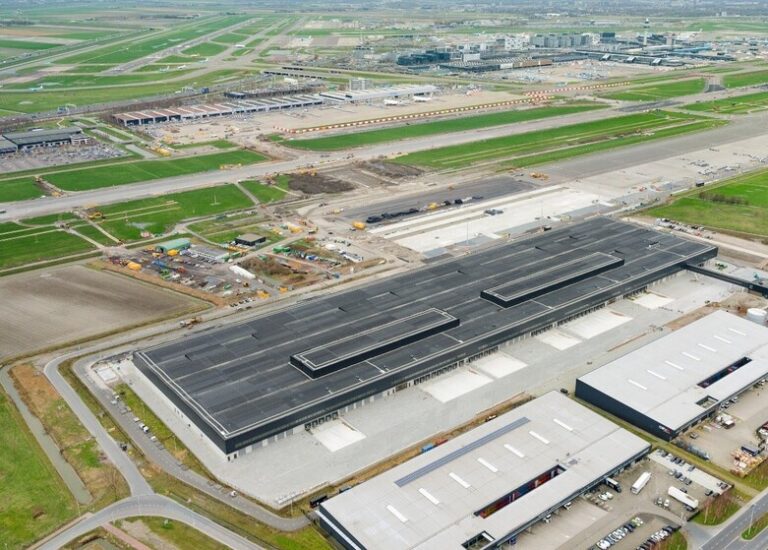
dnata has chosen Nallian’s Truck Visit Management solution for implementation at the ground handling service provider’s new, automated Cargo City Amsterdam facility at Schiphol Airport. More than 850,000 tons of cargo can be processed here each year, so digital solutions are crucial in managing smooth operations. Nallian’s advanced system will streamline landside operations by integrating slot scheduling with automated access control and call-forwarding, allowing dnata to efficiently communicate with trucking companies and forwarders to coordinate pick-ups and drop-offs and avoid truck congestion or delays. The solution will also integrate with Hermes’ Cargo Management System and Lödige’s Terminal Management System, enabling end-to-end process automation and enhanced operational efficiency. By providing real-time data on truck arrivals, freight status (including security, customs, and payment), and shipment details, dnata will be able to optimize staff planning, dock door usage, and the preparation of goods. This increased visibility will result in priority service for customers, shorter dock turnaround times, and greater predictability in operations.
Smooth operations in AMS thanks to Nallian’s Truck Visit Management solution. Image: dnata
The project is a collaborative effort involving dnata, Nallian, BeCon projects, Hermes, Lödige, and community initiatives such as E-Link and Smartloxs. The new facility and its integrated technology solution are expected to become operational by the middle of this year.
Tony Davies, Director of Operations at dnata, commented: “We are set to redefine the standards of cargo handling at dnata Cargo City Amsterdam. Nallian’s innovative system will support us in streamlining processes and enhancing control and visibility across our operations. With our new, future-proof digital infrastructure, we are in the perfect position to meet the evolving demands of the air cargo industry and continue delivering exceptional service to our customers.”
Jean Verheyen, CEO at Nallian, added: “We are very excited to work with dnata on this innovative project. The new, automated warehouse is an example for the industry and this project demonstrates our product and team’s ability to optimize complex landside management processes. dnata has a clear ambition to drive efficiency through technology and we’re proud to work with them and raise the bar for modern cargo handling.”
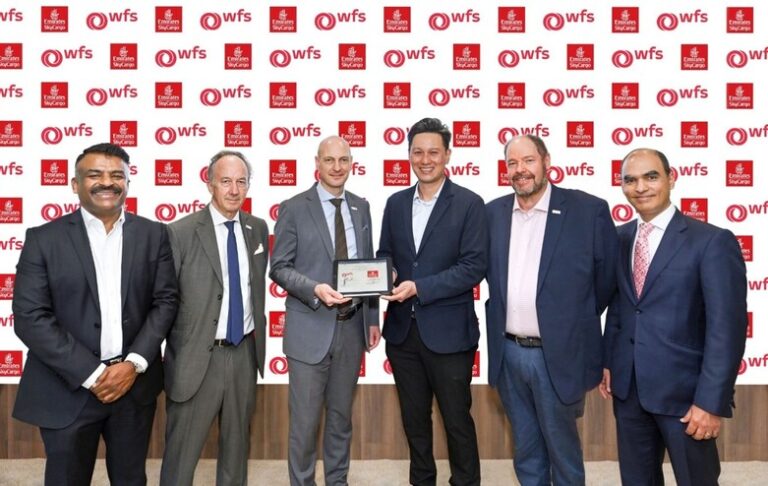
In securing a five-year cargo handling contract at Frankfurt Airport – Europe’s busiest airfreight hub – the SATS subsidiary, Worldwide Flight Services (WFS), has turbocharged its global alliance with Emirates SkyCargo. The latest addition brings the total number of Emirates SkyCargo gateways that are being served by WFS to 21 and is a further feather in WFS’ cap as it continues to strengthen its presence across Europe. Frankfurt is a critical gateway for Emirates’ European cargo network. More than 1,400 tons are handled each week, transported on board of its six freighter and 21 passenger flights. Aside from general cargo, WFS will also deal with pharmaceuticals, machinery, and time-sensitive cargo, making use of state-of-the-art infrastructure at Frankfurt Airport.
John Batten, CEO Gateway Services, Europe, Middle East, Africa & Asia (EMEAA) at WFS, detailed: “At Frankfurt Airport, our team is focused on implementing the operational excellence and specialized handling capabilities that Emirates requires. Our significant investment in pharmaceutical handling capabilities at Frankfurt, combined with our proven expertise in managing time-sensitive cargo, positions us to deliver the efficient, secure, and reliable services that Emirates and their customers expect at this important European hub.”
Robert Fordree, Emirates SkyCargo’s Senior Vice President of Operations Worldwide stated: “With six scheduled freighters and 21 passenger flights per week, Frankfurt is an anchor of our European network. As one of the world’s most important financial hubs, we move significant volume in and out the market, including specialist products such as pharmaceuticals, automobiles and machinery. By expanding our global partnership with WFS to Frankfurt, we will enhance our existing operations and ensure we can deliver goods quickly, reliably and efficiently, strengthening trade links between Germany’s vibrant business community and the wider world.”
Polish General Sales and Services Agent (GSSA), 4R CARGO, recently celebrated the opening of its new office in Bratislava. The GGSA is focused on expanding its network across Central Eastern Europe, hence its latest dedicated team in Slovakia. Founded in 2021 and headquartered in Warsaw, the independent GSSA has grown both its presence which includes three other dedicated office locations aside from Bratislava, as well as its team. It has tripled the number of employees in just 18 months. Combined, its management team brings 25 years of regional freight expertise. 4RCARGO offers tailored air cargo solutions. Its services include rapid 12-hour quotation follow-ups for large shipments of more than 1,000 kilos, as well as direct trucking from manufacturing sites to streamline UK-bound cargo. Focused on becoming the region’s top GSSA by 2025, 4RCargo emphasizes hands-on customer support, innovation, and resilience, bridging airlines and forwarders with personalized logistics strategies.
Matthew Taylor, Business Development Director, 4RCargo and team celebrate Bratislava opening. Image: Meantime Communications
Matthew Taylor, Business Development Director, 4RCargo, said: “Our regional expertise and hands-on approach means we can support customers with a very personal service across Central Eastern Europe. We are driven by finding innovative solutions based on our deep understanding of the area we operate in, and our vision is to become the number one GSSA serving Central Eastern Europe.”
TCE, or ‘Total Cargo Expertise’, is a pioneering service solution founded six years ago in response to increasing demands for security, compliance, and efficiency in air cargo. Relevant operational processes can be outsourced so that airlines and GSAs can fully focus on their core business. TCE was the first independent company to offer airlines and GSAs involved in air cargo a holistic pallet of services all relating to air cargo safety, security, and quality. Since 2019, it has been growing its customer portfolio of airlines, GSAs and air cargo logistics providers. On average, the expert TCE team completes over 80 supplier and process audits and supervises around 225 cargo aircraft on site every year. More than 105,000 AWBs are processed annually for customs in 27 countries across 5 continents. The team also declares over 4,000 flights per year, supervising circa 86,000 AWBs and an annual average of 160,000 tons of cargo being moved through its 230+ contracted and audited handling agents at more than 230 airports around the globe. In those six years, TCE-supervised shipments have reached 380 different destinations. Over the past three years, the team has branched out from general cargo to also ensure the safe and stress-free transport for over 6,200 animals, more than 850 tons of pharmaceuticals, and 82,000 tons of flowers and other perishables.
Sarah Scheibe, Managing Director of TCE. Image: TCE
Based at Frankfurt/Main Airport, TCE provides 24/7/365 support in many operational air cargo processes such as supplier/handling management, customs reporting (ICS/ACE/AMS), security filing (PLACI/ACAS/ICS2), regulatory compliance, audits, risk assessments and quality assurance, training and certification support, sensitive cargo management, load plan creation and loading compliance, contract management, claim management, and cargo charter coordination. Some functions are offered both on-site at hub stations, and remotely.
Sarah Scheibe, Managing Director of TCE, explained: “TCE was designed to eliminate major obstacles in air cargo management. Increasing cargo volumes make managing flows more complex. Add to this the risk of cargo security incidents through certain commodities, mishandling or theft and damage, and constantly evolving customs regulations, and airlines are often faced with a lack of internal resources and expertise to cope with these challenges. With TCE, we seek to solve these problems, taking away the risk of cargo or customs non-compliance, ensuring proper handling of sensitive cargo, and minimizing errors and delays through careful handling and loading supervision.”
A strong digital focus and now also ISO 27001-certified. Image: ECS Group
ECS Group has achieved ISO 27001 certification for its IT services, as it continues to focus on information security and operational efficiency. The globally recognized standard confirms that the company’s IT infrastructure adheres to rigorous security protocols and offers enhanced data protection, compliance, and performance across its network. By implementing ISO 27001, ECS Group aligns with GDPR requirements through strict access controls, regular risk assessments, and adherence to EU privacy standards, safeguarding sensitive information against evolving threats. All stations across its network adopt and apply the Group IT solutions and the ECS IT Security Policy, thus maintaining the same security standards and reinforcing ECS Group’s role as a trusted partner for airlines and logistics providers looking for robust cybersecurity measures. The certification validates the company’s adoption of industry-leading technical and organizational practices, including comprehensive access management, data integrity safeguards, and business continuity planning. Reliable digital tools mean minimized system downtime, and swift incident resolution, all of which are critical factors in maintaining seamless operations and ensuring customer data is uncompromised. Alongside its ISO 27001 achievement, ECS Group also subjects itself to regular SOC 2 Type 2 audits, to verify that its security controls remain relevant and effective.
This milestone reflects the company’s strategic focus on continuous improvement and innovation. By prioritizing internationally recognized standards, ECS Group not only strengthens its cybersecurity posture but also empowers partners worldwide with forward-thinking, resilient IT systems tailored to meet the demands of a rapidly evolving industry. The group is committed to continuous improvement and innovative digital solutions to provide the best service to its partners and customers.
Jean Ceccaldi, CEO of ECS Group, commented: “More and more airlines are requiring their partners to demonstrate compliance with ISO 27001 and other security frameworks. Our certification provides immediate assurance to clients and partners that we take information security seriously – and that we’re fully equipped to meet their expectations.”
Aerios, CargoTech member and air cargo charter software provider, has partnered with Texas-based carrier, GTA Air. Following so close on the heels of its collaboration with Canadian operator, Cargojet, Aerios thus proves that its app covers all kings of airline models, whether they deploy wide or narrowbody aircraft, and offers a standardized yet flexible digital solution for the cargo charter sector. GTA Air, which specializes in U.S. domestic on-demand charters, now utilizes Aerios’ Carrier App to streamline its quotation process, and has already achieved 66% reduction in quote generation time, greatly increasing its chances of conversion, compared to its competitors. The platform enables rapid over-the-phone quoting and improved accuracy by syncing with real-time flight data, ensuring quotes account for live wind conditions and aircraft capabilities.
66% reduction in quote time thanks to Aerios’ Carrier App. Image: Lemon Queen
The partnership was facilitated through Aerios’ Alpha Program, which offers early access to innovative carriers, allowing them to influence platform development. Aerios emphasizes its software’s adaptability, proven effective for both regional operators and international cargo leaders. As Aerios broadens its network, it aims to bridge carriers, brokers, and charter specialists via its integrated system.
Ben Gunderman, President at GTA Air Inc. revealed: “Aerios has fundamentally changed how we quote ‘GO NOW!’ trips. In this business, being fast isn’t a luxury – it’s a necessity. We’re now able to turn quotes around in record time, confident they are accurate and competitive. It’s a massive advantage in the time-critical US charter market.”
Simon Watson, Founder and CEO of Aerios, reported: “Every second matters when you’re competing in the U.S. domestic on-demand market, so helping reduce the quoting time by several minutes can have a large commercial impact and help increase the chance of conversion. Working with the team at GTA Air has been fantastic. Their team has put our system through its paces and proven it works just as well for smaller, fast-moving operators as it does for major intercontinental wide-body carriers. It’s an exciting validation of the system’s flexibility and positive real-world impact on speed.”
For the lobby organization Board of Airline Representatives in Germany (BARIG), the role of cargo in air transportation has long played only second or even third fiddle. This is likely to change soon. With Thilo Schäfer from Condor Cargo and Jorge Carretero from LATAM Cargo, two experts have joined the Air Cargo Committee of the association. The two managers will position air freight issues much more prominently on the organization’s schedule.
(LTR): Thilo Schäfer, Director Cargo Condor, Michael Hoppe, BARIG Chairman and Executive Director, Jorge Carretero, Sales Director Central Europe LATAM Cargo. Photo: courtesy BARIG e.V.
No sooner had they been appointed, than the trio demanded a U-turn in Germany’s aviation policy. Their claims in a nutshell: The air traffic decline in Germany needs to be stopped by setting aside bureaucratic hurdles and lower costs. This is stated by BARIG Chairman Michael, while pointing at the Berlin politicians. “In contrast to Europe or even worldwide,air traffic in Germany has still not fully recovered after the pandemic. The reason is obvious: Skyrocketing production costs for aviation in general, which also severely hamper cargo business. It is the upcoming German government’s responsibility to significantly and sustainably reduce cost pressure, consequently and fast. Otherwise, it will not be possible to bring Germany back to the top positions in Europe and globally, as an aviation and business location,” BARIG Chief Hoppe warned.
Unhealthy cost-structure According to a recent report by the German Aerospace Center (DLR), local airport costs have risen by 39% across Europe since 2019, due to higher fees payable by airlines. Yet, in Germany, the increase is a whopping 70%!
Meanwhile, even the Lufthansa Group wants to grow primarily through its subsidiaries in Austria (AUA), Switzerland (Swiss) and Italy (ITA), and less through its core brand, Lufthansa Airlines. On the domestic market, the costs are too high due to taxes and fees, but also due to continuous strike action by unions, exclaimed Group CEO, Carsten Spohr in mid-MAR25, at his company’s annual press conference. Group subsidiary, Lufthansa Cargo, is similarly affected by the skyrocketing costs in its home market, apart from ticket taxes.
Thilo Schäfer, Director Cargo at leisure carrier, Condor, also demands Berlin politicians to take a U-turn: “Germany may continue being a key European hub for global air freight. However, this position has come under severe pressure. This makes it even more important to actively develop the framework conditions in Germany to strengthen its competitiveness in the European market. Together with the BARIG Air Cargo Committee, we want to drive forward future-oriented topics such as automation, digitalization, and the optimization of processes. Digitalization like IATA’s ONE Record initiative is key for transporting air cargo in time, in budget, and in quality. We need to digitalize our processes with all stakeholders involved – meaning airlines, airports, handling agents, and authorities.”
Strengthening hub performance And LATAM Cargo’s Jorge Carretero adds to this: “Logistics and air freight in Germany are currently being confronted with many issues and challenges that will determine future developments. In order to create the best possible processes and framework conditions, we develop innovative and practicable solutions in the committee with the expertise of our international community. Our aim is to ensure an efficient, modern, and competitive air cargo infrastructure for Germany. It is important to have resilient supply chains. By exchanging knowledge and experiences – not just within our airline community, but also with the responsible airport departments and with innovative stakeholders from the cargo industry – we can strengthen and improve air cargo hub performances.”
New thinking is needed Ultimately, the future German government coalition of Conservatives and Social Democrats needs to establish a new approach to aviation policy. The sector must no longer be seen as a dairy cow, but as an industry of paramount importance for imports and exports, the maintenance of supply chains, a guardian of air security and a provider of thousands of qualified jobs. Without this paradigm shift, the exodus of airlines will continue.
In a first step, the future coalition of Conservatives and Social Democrats has announced that it will reverse the increase in air traffic tax decided in 2024. In addition, the national blending quota is to be abolished. It stipulates a certain proportion of SAF in order to reduce CO2 emissions.
CargoForwarder Global’s ‘Spotlight On…’ series illustrates the wide range of careers that exist within the air cargo industry. A relatively new area that existed pre-pandemic, but really gained traction during it, is that of online booking platforms. As the air cargo industry advances on its digital transformation journey, third party digital marketplaces are providing opportunities for greater market reach and simpler transaction processes, and are developing their products to best serve both freight forwarders and their airline partners. Julien Triay (JT), Commercial Vice President for Airlines and Payments at WebCargo by Freightos, takes us through his responsibilities, experiences and thoughts on the industry.
Interviewed on a Friday, joined the industry the following Monday! Image: Julien Triay
CFG: What is your current function and company? And what are your responsibilities?
JT: I am the Commercial Vice President for Airlines and Payments at WebCargo. My primary responsibility is to bring new carriers onto the WebCargo platform for eBookings. However, WebCargo is much more than just a booking solution. Together with my team, we showcase the full range of our offerings: Interlines, Payment Collection/Checkout, Dynamic pricing, Trucking, and our Sales Portal.
Additionally, I lead the commercial development of WebCargoPay, which enables non-IATA/CASS freight forwarders to book directly with our airline partners.
CFG: What does a normal day look like for you?
JT: I try to start my day early to get ahead of any issues that might have occurred overnight in the western U.S. or Asia – it’s important to resolve those before everyone else starts their day. I usually have several internal meetings with colleagues across different departments, as well as calls with potential or existing customers to present our solutions.
If there’s one routine I try to protect, it’s my lunch around 12:30 – although living in Spain, that’s not always easy!
CFG: How long have you been in the air cargo industry, and what brought you to it?
JT: WebCargo was actually my first job after business school, and I’ve now been here for over 12 years. I started in January 2013.
At the time, it was a tough job market – Spain was still deep in the subprime crisis, with unemployment at 25%. Just before I was about to leave Barcelona, I replied to a job posting. The next day, Manel Galindo, WebCargo’s founder, got back to me. We interviewed on Friday, and I started on Monday. I’ll never forget that moment.
CFG: What do you enjoy most about your job?
JT: No two days are the same – that’s part of the beauty of it. I also love that we’re helping to transform an industry and improving the daily lives of so many people. Feeling like your work has a positive impact is incredibly rewarding.
CFG: What do you see as the greatest challenges in our industry?
JT: One of the biggest challenges is the number of stakeholders involved. From a digitalization perspective, each organization has its own systems and standards, so getting them to “talk” to each other is incredibly complex.
And of course, change management is a challenge on its own – changing habits or systems is never easy.
CFG: What advice would you give to people looking to enter into the air cargo industry? Any particular training they should aim for?
JT: First: they’ll love it! You’ll never get bored, and you’ll work with truly amazing people.
In terms of preparation, I’d talk less about specific training and more about the mindset. Being close to your customer is essential – customer centricity is key in this industry. That’s where they should focus.
CFG: If the air cargo industry were a film/book, what would its title be?
JT: I’ll go with an easy one: Mission: Impossible.
Many thanks for your answers, Julien!
If you would like to share your personal air cargo story with our CargoForwarder Global readers, feel free to send your answers to the above questions to cargoforwarderglobal@kopfpilot.at We look forward to shining a spotlight on your job area, views, and experiences.
Cargo veteran, Nouri Neller will become Managing Director of consolidator, IGLU Air Cargo GmbH. The 56-year-old was unanimously appointed by the five advisory board members, for the IGLU management position, prevailing over four other candidates. His first day at the office of the company which is based near Frankfurt Airport, will be 05MAY25.
Nouri Neller will head consolidator IGLU Air Cargo, photo: private
Karl Eduard Günther Gasthuber’s days at the helm of the non-profit alliance, IGLU Air Cargo, are numbered. He has been there since 01NOV2006, and will soon hand over responsibilities to his successor, Nouri Neller. The two will work together for a few more weeks to familiarize Nouri with the organization, its business model and the associated member firms, before Gasthuber retires in summer.
Booking platforms have increased the competition Founded by logistics veteran, Dieter Haltmayer, IGLU Air Cargo has now been in business for 23 years. Not only do the balance sheets bear witness to the consolidator’s economic success, but a lot of dust has also accumulated. What impetus does IGLU Air Cargo require and where is there an urgent need for action? CargoForwarder Global (CFG) put these questions to Nouri Neller (NN).
CFG: What will be your first activities when you start at IGLU come 05MAY25?
NN: I will start with a trial phase, also supported by my colleague, Gasthuber, in order to develop a deeper understanding of the business model and the respective roles of the member companies.
Selling IGLU positively
CFG: And after that?
NN: Then, my team and I will primarily focus on selling our services internally, followed by external activities to make airlines or GSAs even more aware of us. The emergence of digital booking platforms has increased competition, which we want to counter with our successful consolidation model. However, this is only possible if the stakeholders support this approach through their daily business practices. That fact is that we need to sell the IGLU product positively, both internally and externally, and convince the market of our services. This includes an update of the IT system to become more agile.
CFG: The basic problem with alliances is the mistrust between the members, as was the case with the air freight alliance, WOW. At IGLU, too, some member companies fear losing sensitive data to competitors through the consolidation of shipments. How do you deal with this?
Quick Cargo Services has added two branches to its pan-European network – photo: CFG/hs
NN: By maintaining the multi-master principle. This means that the shipment data remains with the sender, without others being able to take a look at it.
IGLU expects a long-term commitment On the occasion of Neller’s nomination, CargoForwarder Global (CFG) spoke to IGLU Advisory Board member, Stephan Haltmayer (SH) about the upcoming change.
CFG: What makes Neller stand out and why did the IGLU Advisory Board choose him out of the five candidates?
SH: He has an excellent network in the local cargo industry, knows the Frankfurt air freight market well through previous professional activities, and makes a very dynamic impression in his appearance, which is very important in business negotiations. We hope that his appointment will enable us to fill the management position on a long-term basis. In our discussions, we did not get the impression that Nouri Neller sees his role as IGLU Managing Director as a career springboard.
CFG: The prime interest of the 24 IGLU member companies is to achieve price advantages by consolidating their shipments on certain routes. On other trade lanes, they act as competitors, caring about their own business. Strengthening cooperation between the members and connecting more routes to the IGLU network is likely to be a mammoth task for Neller.
SH: We trust him to be able to make a difference there. He has to act neutrally in order to gain the trust of the shareholders and still provide new impetus so that IGLU continues to develop. Admittedly, this is a balancing act, but our impression is that he will master the exercise.
CFG: IGLU hardly ever makes an appearance at public events. Shouldn’t the alliance change course to become better known, which might help when discussing rates with airlines?
SH: I agree. We could raise greater awareness among market participants.
CFG: Let’s talk briefly about your company, Quick Cargo Services. You opened a new station last week. Where?
SH: In Mirano, near beautiful Venice. We obtained the license to run our own business in Italy just days ago. Shortly before this, we opened a branch in Sofia, Bulgaria. We are now represented in 14 European countries with 35 offices. This makes us the largest owner-managed European freight forwarder.