Jettainer’s Chief Executive Officer, Thomas Sonntag, has stepped down after 5 years at the helm of the company, and will be leaving the Lufthansa Group at his own accord at the end of this month. Taking his place, already with effect of 01JUN24, is Lufthansa Cargo’s ex-Vice President Global Fulfillment Management, Dr Jan-Wilhelm Breithaupt.
From Lufthansa Cargo across the road to Jettainer. Image: Jettainer
For Breithaupt, the new role is the fourth Group subsidiary in his career, having joined Lufthansa Group back in 2001, initially with Lufthansa Technik, before moving on to the mother ship, Lufthansa Passenger, and from there to Lufthansa Cargo in 2010. He has spent the past 14 years overseeing a number of projects within the cargo airline’s handling operations, including digital topics such as the eAWB. He also represented Lufthansa Cargo in International Air Transport Association (IATA)’s ONE Record project together with Digital Test Field Air Cargo.
Thomas Sonntag stated: “Jettainer will be well-positioned for success under Dr Breithaupt’s leadership. I am very pleased to hand over to an industry leader with deep expertise in ULD management from the customer’s perspective. His professional focus on digitalization and customer service will ensure Jettainer continues its path of sustainable growth.”
Dr Breithaupt added: “I appreciate Thomas Sonntag’s dedication and success in growing Jettainer during challenging times for the aviation industry. I wish him the very best in his future endeavors. I am honored to take on this role and look forward to leading Jettainer into its next phase of innovation and excellence. Together with a great global team and international partners, we will continue to drive forward digital transformation and enhance our services for our global customers.”
We could kick-off a philosophical discussion, here, about whether something truly exists if it is not talked about. And that question could include the aspects of who defines what is published, how, where, which angle, and what bias – if any? When is communication marketing and when is it journalism? Communication, in all its forms, is a crucial element of the air cargo industry and could be used to much more effect by most of its stakeholders than it currently is. That is why – in the spirit of democratic communication – CargoForwarder Global has chosen to ‘Spotlight On’ Charlotte Goldstone (CG), News Reporter over at The Loadstar, this week. She takes us through her first impressions of the industry, her daily work, and has advice for those looking to join the industry.
“A great way to learn and have fun at the same time.” Image: Charlotte Goldstone
CFG: What is your current function? And what are your responsibilities? CG: I am a News Reporter for the online supply-chain-news publication ‘The Loadstar’. I source, research, write and edit daily news stories that relate to supply chain and logistics news across all modes of transport.
CFG: What does a normal day look like for you? Or is there such a thing? CG: Because my role is dictated by the ever-changing news cycle, no two days are the same! There’s usually a coffee-fueled news frenzy in the morning where the team is sourcing their daily stories — contacting people for comments and often writing up in an hour or two. Daily news can range anywhere from reporting on the impact of new regulations, to detailing a high-stakes court case. The afternoon is (mostly) a lot more chilled out and gives us time to look for tomorrow’s story by chatting to industry stakeholders, conducting interviews and scouring the web for company updates. I’ve also just started hosting a new podcast for The Loadstar, so a lot of my time recently has been used learning how to operate recording equipment and editing software – it’s a lot of fun!
CFG: How long have you been in the air cargo industry, and what brought you to it? CG: I’ve been in the industry about seven months – so not very long at all! I finished university and knew that I wanted to write, and I wanted to travel. This seemed a bit unattainable as a first job — I know many people often dream of combining work and travel but don’t get there until many years into their career, if at all. So, when I saw a job advertised that encompassed ‘global travel’ and the opportunity to ‘write daily breaking news’, it seemed like a dream come true. I didn’t know anything about supply chains or air cargo when I joined, as is the case with many people outside the industry, but there’s been so much to learn, and it’s been extremely eye-opening.
CFG: What do you enjoy most about your job? CG: The best part of my job is the travel opportunities – I still can’t believe I get to go to the places I’ve dreamed of going, let alone get paid for it! I’ve been working at The Loadstar for less than a year and I’ve already been sent to Brussels, Abu Dhabi, Hong Kong and Doha. I think one of the best parts about working abroad is that you meet a plethora of people from all over the globe and from all different companies and sectors – it’s a great way to learn and have fun at the same time! Even when I’m back in the UK and in the office, it’s such an exciting field to be in because supply chain dynamics change so rapidly that you are always being kept on your toes. You can never get bored!
CFG: Where do you see the greatest challenges in our industry? CG: From the short time that I’ve been here, it’s clear that people are really keen to on-board new talent and new technology, but at the rate the ‘outside world’ is changing, I would say there needs to be faster adoption of modern methods across the supply chain – way easier said than done. Adopting new ways of doing things is a huge challenge because the world is so reliant on its supply chains that the tried-and-tested methods can feel safer, but the sheer scale of global disruption we are seeing now is really forcing stakeholders to adapt and change. I think the next few years of scaling up and changing systems are going to be a real up-hill battle.
CFG: What advice would you give to people looking to get into the air cargo industry? Any particular training they should aim for? CG: I studied English Language at university and had zero intention of joining logistics (I didn’t even really know what it was). So, while it’s good to have specific training if you know what you want to do, because the industry is so broad there is probably a job for you in logistics no matter what your skillset. The best way to learn, as I did, is to be thrown in at the deep end. Networking – on LinkedIn for example – is a great way to see what jobs are out there. And don’t be afraid to ask questions! From personal experience, everyone is very keen to welcome and nurture new talent.
CFG: If the air cargo industry were a film/book, what would its title be? CG: If this is based off existing titles – I think ‘Everything Everywhere All at Once’ is quite fitting. In the literal sense that air cargo sees everything being transported everywhere all the time, but also because working in this industry, you can go everywhere and experience everything (and you quite often have to do lots of jobs ‘all at once’ too!).
Many thanks, Charlotte, for your impressions.
If you would like to share your personal air cargo story with our CargoForwarder Global readers, feel free to send your answers to the above questions to cargoforwarderglobal@kopfpilot.at We look forward to shining a spotlight on your job area, views, and experiences.
Currently, they are still just models in combination with concept studies presented by start-ups and niche providers at congresses or air shows,. However, the age of H2 powered smaller cargo aircraft is coming closer. This was proven at the International Air Show ILA Berlin, where a new generation of smaller freighters was presented by their developers. CargoForwarder Global showcases some of the latest and also stunning projects displayed there.
Johannes Garbino-Anton is co-founder and CEO of NEX.Aero – photo: CFG/hs
The White Whales are coming The eVTOL is not yet flying. However, a prototype with a wingspan of 4 meters is to be presented by the end of this year, announces producer, NEX Aero GmbH. Following successful certification, this precursor is to be replaced by a prototype twice as large with twice the load capacity. According to the manufacturer, the initially planned prototype can carry 180 kg and fly over a distance of 450 km. Unlike the Black Swan drone from supplier Dronamics, it does not require an airfield for operation as it can take off and land vertically. This makes the White Whale suitable for point-to-point traffic, emphasizes Johannes Garbino-Anton, co-founder and CEO of eVTOL operator, NEX.Aero: “We only need an area of 20 x 20 meters to take off or land. Logistics centers around airports or in the vicinity of cities are suitable for this.” This results in high deployment options for the aircraft, and no investment in ground infrastructure is required. Another advantage: feeder transports from manufacturers to airports or in the opposite direction after shipments arrive at airports, are no longer required. This customer-centric deployment option fundamentally distinguishes the White Whale from those aerial service providers whose business model is based on the use of airports.
NEX-Aero estimates that the freighter will commence commercial ops at the end of 2027 or beginning of 2028 – image: company courtesy
A freighter made by printers The H2 powered eVTOL is being built in the middle of Berlin, near the historic and now decommissioned Tempelhof airfield. Five 3D printers are located in the Ullsteinhaus there. They were in constant operation for two months until the carbon fiber fuselage and the main components of the aircraft were ready. “The White Whale is the world’s largest aircraft ever printed on a 3D printer,” says Johannes Garbino-Anton, not without pride. It is also an innovative novelty in this respect. As soon as the hybrid product – half aircraft, half drone – has completed its first flight tests at the national test airfield in Cochstedt at the end of 2024 or in Q1 2025, NEX will apply for EASA type certification. The manufacturer estimates that it will take 2.5 years before this is granted. NEX then intends to start constructing a passenger version for 4 passengers. “The pioneering experiences we gain with the freighter will be incorporated there and accelerate the passenger project,” the executive states. During takeoff and landing, electric propulsion will power the props, while hydrogen will be used during forward flight. “H2 allows for longer ranges and higher payload,” emphasizes the company. The motors are supplied by a Czech manufacturer with whom NEX cooperates closely. The aircraft is operated remotely by a specially trained pilot.
The first users are already determined The main financier of the project is a tech investor from Berlin, who has invested 3.5 million euros. This has secured the development and construction of the White Whale, assures Manager Garbino-Anton. Asked about users, he says that there are already three launching customers, including a freight forwarding company, an operator of offshore wind farms, and an operator of ground-based ILS landing systems at airports that can be precisely surveyed from the air. According to Mr. Garbino-Anton, NEX is aiming to break even in 2028/29.
Perhaps the small players of today will be the big ones of tomorrow? A promising example appears to be the iViation’s autonomously operating freighter. The unmanned aircraft has a range of 2,000 km and offers a payload of up to 500 kg. This aircraft is targeting the rapidly growing market for parts logistics and express. Players such as Siemens and Thyssenkrupp are reducing local spare parts storage capacities, replacing them with 24/7 air freight services.
iViation has identified 60 potential customers such as FedEx, DHL or UPS, who are looking for flexible, small, short-haul capacity offerings given that many regions of the world are not properly connected to express parcel and parts logistics.
Connecting the unconnected. Image: iViation freighter
iViation management expects rapid certification of its aircraft The company has embarked on the fast lane to shorten the usually very long official certification and approval procedures. 90% of the required flight tests and checks are carried out using simulation in a closed test system with automated certification documentation. This saves time and expenditures. The autonomously flying drones consist of converted, approved small aircraft in which the weight distribution has also been taken into account. Only a flight computer and several redundant sensors have been added so that certification can be made considerably easier as time progresses. Currently, the aircraft still fly with conventional engines, but these can also be replaced on a modular basis in the future. This will speed up lengthy approval procedures.
First flight is scheduled for 2028 According to Lufthansa pilot and iViation Co-Founder, Rolf Bauer, the next step after approval will be to convert the propulsion system to hydrogen. There are already concepts for this in his company’s filing cabinet. As far as the timeline is concerned, the initial flight of the freighter is scheduled for 2028. Series production is set to begin a year later, following the delivery of iViation’s cargo aircraft right after. There are also plans for 2029 and the decade beyond for a larger version capable of transporting up to 3 tons. Overall, the company has a family concept in mind to cover different market requirements.
Mainly driven by the fast-growing e-commerce market, the need for efficient integrated air cargo systems is huge since air solutions can significantly reduce delivery times and costs per unit. Aircraft designer, Apus Zero Emissions GmbH, based in eastern Germany, has also been guided by this insight. In a neighboring hall on the exhibition ground, Dutch newcomer, Speeder Systems B.V., presented its maritime transport vehicles designed for marine logistics and surveillance tasks.
Robert Adams sees great market opportunities for the APUS i-5 – image: courtesy APUS
Apus is currently developing a cargo aircraft, branded APUS i-5, which can carry up to 1,770 kg over distances of almost 1,500 km. It is an unmanned aircraft that will be propelled by hydrogen-based powertrains and – similar to the iViation aircraft – is expected to be put in service before this decades ends, confirms Robert Adam, Head of Propulsion Systems Engineering. He sees a growing economic need for smaller freighters with a medium range, especially for connections between the mainland and offshore islands, such as in Norway or coastal regions in the UK. Governments are heavily subsidizing similar air services, putting a lot of pressure on the operators to fly CO2-neutral, says the manager. Starting from these initial commercial applications, the range of use cases for the APUS i-5 Hydrogen will gradually grow and include the e-commerce sector, states Mr. Adam. He sees another possible application: operating at night from airports silenced by curfews. Due to the very low noise emissions of the nine-bladed propellers built by provider, Rolls Royce, the freighter is usable at airports with night flight bans. As an example, the executive cites the nightly transportation of express goods from curfew-crippled Hamburg to London Heathrow; a route with plenty of demand for such shipments.
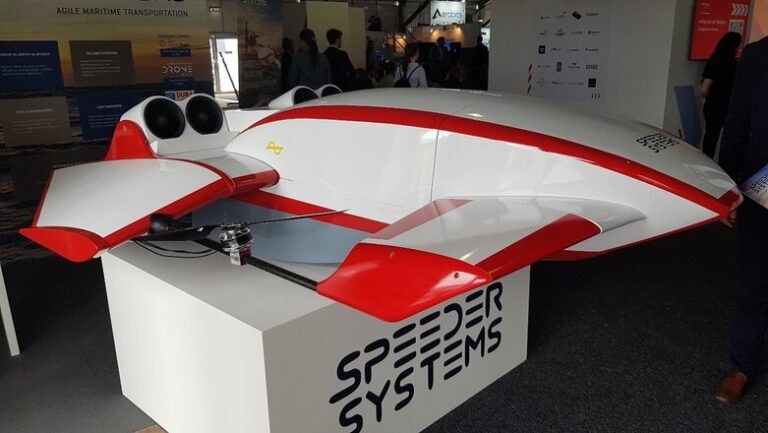
Prototype of maritime Speeder Systems vehicle displayed at ILA Berlin – photo: CFG/hs
Speeder Systems The maritime speeder is much further along in development than the aforementioned projects. It is designed for logistics and inspection/ surveillance operations at sea and is classified as a Type B Wing in Ground Effect Vehicle with VTOL capability. Built by Speeder Systems B.V. in the Netherlands, the maritime vehicle’s electric propulsion creates 60% lower emissions compared to vessels or even 99% fewer greenhouse gases than manned helicopters. According to manager Erdem Kazakli, it achieves a velocity of 140 km/h while transporting 25 kg over a distance of 90 km, and 17 kg can be carried as far as 150 km. It is steered remotely, fully electric, and privately financed. In operation, it hovers above the water surface, gliding on an air cushion to maximize efficiency or avoid high waves. Seen this way, it is a blend of naval and aerial vehicles. Manager Kazankli states that the Speeder Systems will be operational by Q2, 2025, so in about one year from now. Supporting oil rigs in the Caribbeans with tools and spare parts or offshore windfarms in the North Sea, are just two areas of applications. Its modular design enables the Speeder to be transported at the back of a van to any shore or beach, and can be set up in just 20 minutes. He says that the vehicles can only be leased, they are not for sale.
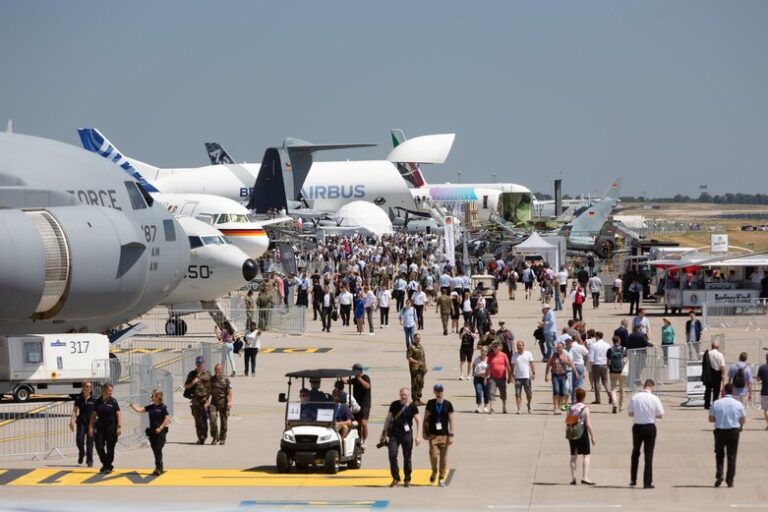
This year’s biennial air show, ILA Berlin, was an event of superlatives. Around 600 exhibitors from 31 countries ran stands, booths, or entire halls, as in the case of Airbus, Diehl or European defense giant, MBDA. In addition to the many presentations and panel discussions, the daily air shows also provided numerous visual highlights for exhibitors and, at the weekend [08. – 09. June 2024], for the general public. They came in large numbers, the organizer speaks of 95,000 attendees, attracted by the fascination of aviation.The next ILA Berlin takes place from 10. – 14. June 2026.
The organizers of Messe Berlin placed the event focus on innovation, new technology, and sustainability. Three hot topics offering many takeaways and thus making it a trade show well worth attending. Mario Tobias, CEO of Messe Berlin, highlighted this in his summary: “This year, ILA Berlin has grown and become more international, underlining its role as Europe’s leading innovative trade fair for the aerospace industry. We welcomed exhibitors from all over the world – both long-standing partners and those new to the show or back after a long break. ILA mirrors the entire range of products of the industry and its value chain and is the ideal platform for dialogue and finding out about the latest trends in aviation and technical innovations.”
The use of H2 must be embedded in an overarching concept Speaking of trends, ILA showcased remarkable concepts and projects aimed at replacing fossil fuel by green hydrogen in order to decarbonize the aviation sector. This is not just about the fuel as an energy source for aircraft, but a complete package that must be taken into consideration. During a panel, Nicole Dreyer-Langlet, VP Technical & Engineering Germany and Member of the Board of Management at Airbus, made clear what this entails: “In addition to the future fueling of aircraft with H2, it is also about fast refueling times, the storage of sufficient quantities of hydrogen at airports, the transfer of specialist knowledge to ground handling personnel, and high investments by all stakeholders in the conversion from fossil fuel to climate-neutral fuels.” To this end, the manager announced that Airbus will be setting up demonstrations in Scandinavia, New Zealand, Singapore, Paris, and Stuttgart, to impart knowledge and skills to staff on how to handle green hydrogen properly and safely. Ms. Dreyer-Langlet also confirmed that a first H2 powered Airbus jetliner will be airborne by 2035. This is an important statement, as there were indications in the ILA run-up that Airbus could postpone this date by several years.
Full house – aviation aficionados crowded on the apron and within the pavilions of the Berlin-held aviation shows – photo: courtesy ILA
ILA gives talent a forum On the last day of the exhibition, the focus was on the Talent Hub. It was aimed at bringing gifted people of all ages and backgrounds together with representatives of the industry. 40 exhibitors from all sectors of the aviation industry took part in the Talent Hub. Around 1,500 participants attended, including students and school children, but also career changers and experienced professionals looking for new challenges and job opportunities. The Talent Shop is noteworthy because when it comes to attracting young talent, aviation is in fierce competition with IT companies, automotive manufacturers, and the pharmaceutical industry, to name just three examples. A study by Maastricht University in the Netherlands, found that only 1.7% of the students surveyed could imagine working for an aerospace company one day. In contrast, 7.3% were interested in a future job in the IT sector, and 6.1% in the automotive industry.
Air freight was part of ILA Even though the military presence was significantly higher than at previous events due to the Russian war against Ukraine, air freight topics were also at the forefront. This was primarily in connection with the overarching aspect of decarbonization and the net zero goal of airlines and their associations come 2050. CargoForwarder Global has picked out three sustainable concepts and products exhibited at the ILA, as examples that have the potential to become trendsetters, and illustrated them in separate articles in this week’s issue.
That was the provocative question posed at the meeting of the German Air Cargo Association (acd) on the eve of the ILA trade show in Berlin (04JUN24). The result of the experts’ contributions is summarized here: Innovative forms of propulsion in aviation and therefore also cargo transportation are very much on the advance. This is evidenced by numerous encouraging and technically demanding projects, some of which are already close to market introduction.
Noteworthy is that mainly SMEs attract attention by announcing or even introducing exciting innovations. One such example is the pioneering U.S. company, Eviation Alice, that offers the market an all-electric aircraft with a range of 800 km when fully loaded, and an uplift capacity of 1.1 tons. DHL has ordered 12 units of the Alice series, the first of which is due to be delivered this year. Another customer is U.K.-based regional aircraft lessor, MONTE, which has also placed an order for 30 of Eviation’s all-electric commuter aircraft.
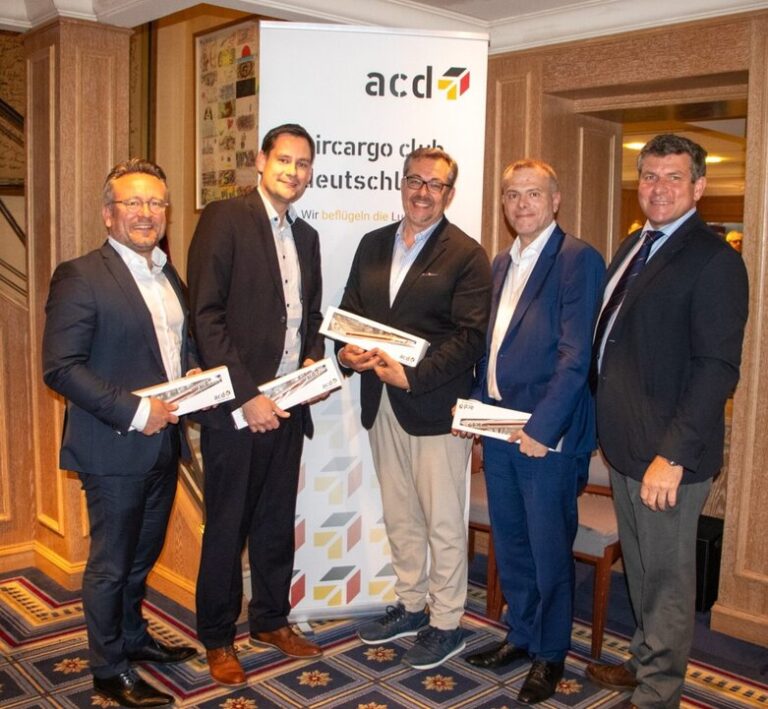
L to R: André Steinau, MD GP Joule Hydrogen / Hauke Peer Luedders, Head of Fuel Cell Propulsion Airbus / Mathias Jakobi, Aera Manager Central Europe IATA / Engelbert Redel, Senior Consultant Marsh Advisory / Christopher Stoller, acd President – Image: Janin Detjen – MaR Berlin
The e-solution But are electrically powered aircraft the key to decarbonizing aviation? An exciting question that was debated by the experts at the acd meeting in many ways. The common consensus: they can fill a niche by covering shorter routes, i.e. as feeders. For long-haul air traffic, they are not economically viable due to the high battery weight, emphasized Hauke Peer Luedders, Head of Fuel Cell Propulsion Airbus.
SAF needs a level playing field Which leads to the topic of SAF: Suitable, but clearly way too expensive compared to carbon-based Jet-A1 fuel. The dollar or euro ratio remains at 1 (Jet-A1) to 4 (SAF) per liter. Since there is an ample feedstock for this energy source, SAF is a very suitable fuel for accelerating decarbonization in the mid-term. It is also beneficial that the required ground infrastructure is already in place. However, without tax incentives or regulatory support by the legislator, SAF utilization will remain very limited, predicted Engelbert Redel, Senior Consultant Marsh Advisory. Above all, a level playing field must be established for SAF on a global scale, i.e. binding refueling quotas, as national solo efforts would do little to help and instead could distort competition. “Today, there are between 22,000 and 25,000 commercial aircraft registered worldwide, of which around 2,000 are full freighters. In 2050, there will probably be 50,000 aircraft, with a freighter share of about 3,000. But all new aircraft delivered today will still be flying in 20- or 30-years’ time, which is why the rapid scaling of SAF production is essential to reduce greenhouse gas emissions,” emphasized Mathias Jakobi, Aera Manager Central Europe IATA. When asked by CargoForwarder Global, the official pointed out that IATA’s 2050 net zero target is an ‘aspirational goal’ and by no means carved in stone.
H2 needs fueling stations at 150 airports That leaves hydrogen as the most important propulsion system for decarbonizing aviation, at least on long-haul routes – also due to the high energy efficiency of the gas. “For the market breakthrough of hydrogen-based air operation, we need 150 airports that offer H2 refueling stations,” Airbus manager, Lüdders pointed out, referring to the ground infrastructure aspect. As already announced, his company will first build a passenger aircraft powered by hydrogen. Only after this evolutionary step would an H2 freighter be conceivable, he emphasized. André Steinau, MD GP Joule Hydrogen, pointed out that H2-powered trucks are particularly suitable for feeding shipments between suppliers and central airports, in this way lowering greenhouse gas emissions on roads. Hydrogen trucks, operating point to point, can easily replace diesel vehicles on routes with high cargo volumes. Founded in 2009 in North Frisia, his company’s goal is to supply industry, transportation and society with 100% renewable energy. To this end, GP Joule also operates various wind farms.
Future energy winners The experts agreed that even small steps are valuable when it comes to reducing CO2 emissions. Examples here are: the Shark Skin developed by Lufthansa Technik to improve the air flow of jetliners; more direct flight routes from A to B without detours; or further improved flight characteristics of newly developed aircraft. As far as the production of green energy is concerned, the winners will be countries where solar panels achieve high levels of efficiency, as well as coastal regions in Spain, Ireland or Chile, where wind turbines are permanently in operation. Consultant Engelbert Redel pointed out that there is no single path to climate neutrality in aviation, but that technological diversity is required. “The best and most efficient system will win in the end; we need this technological openness,” he said, indirectly addressing policy makers.
None of them showed up And yet no policy makers were present. They were criticized very heavily at the acd meeting. Air traffic is over-regulated and bureaucratized was a core point of criticism. For populist or electoral reasons, targets were being set that were simply not achievable by the industry, despite enormous efforts, the experts argued. The decarbonization of air mobility can only succeed when driven by targeted tax incentives, coupled with a better understanding of this industry by the policy makers, the experts argued. Members of the German national parliament (Bundestag) had been invited to the acd gathering, but none of them showed up. Summarizing the meeting, acd President, Christopher Stoller said that these initiatives should now be put on top of the industry’s agenda:
drive forward pilot projects
invest in R & D
enter into strategic partnerships
and accelerate the long-term planning of ground infrastructure to decarbonize aviation.
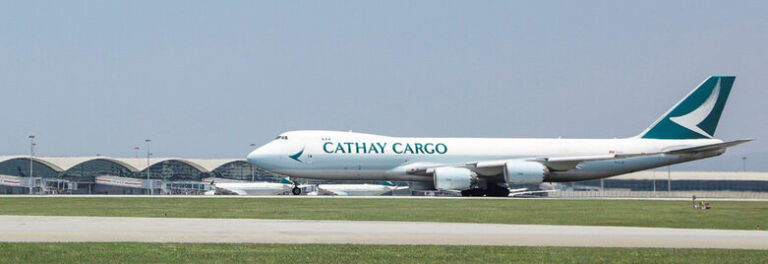
Cathay made the headlines thrice this week: the signing of an MoU with Singapore Airlines, outlining collaboration on sustainability initiatives; the launch of direct passenger flights to Riyadh, complementing its existing weekly freighter services; and lastly, a worrying development regarding repeated safety incidents amongst its trainee pilots.
But first to the positive: In the spirit of ‘greener together’, Cathay and Singapore Airlines used the backdrop of last week’s International Air Transport Association (IATA) Annual General Meeting and World Air Transport Summit in Dubai, UAE, to sign a Memorandum of Understanding (MoU). The signatories, represented by Cathay Group CEO, Ronald Lam, and Singapore Airlines CEO, Goh Choon Phong, agreed to collaborate on a number of sustainability initiatives, including advocating for the development and use of sustainable aviation fuel (SAF) in the Asia-Pacific region, and sharing best practices to boost sustainability performance.
Turbulence in pilot training. Image: Cathay Group
Aiming for net zero by 2050 Ronald Lam, Chief Executive Officer, Cathay Group, stated: “As part of our collaborative ethos of ‘Greener Together’, we actively seek like-minded industry leaders for strategic partnerships in transitioning to sustainable aviation. Our collaboration with Singapore Airlines aims to accelerate and support the development of the SAF supply chain in the region, fostering a reliable SAF ecosystem to enable the industry to achieve its long-term decarbonisation goals. Cathay was one of the first airlines in Asia to set a target of 10% SAF for its total fuel consumption by 2030, and we are undertaking a multi-pronged approach to contribute to the aviation industry’s transition towards a greener future.” SAF is one of two core areas in which the two airlines will work together. Both have already been independently active in sourcing providers and pushing for its use. They will now jointly advocate for the greater use of SAF in the Asia-Pacific region. This includes educating the public on the critical need for SAF if aviation is to decarbonise and reach its 2050 goals. Together, they will advocate for supportive policies and global standards in emissions accounting and reporting, and seek joint procurement opportunities.
Pushing for a reduction in all kinds of waste The second area of focus will be the exchange of best practices to reduce single-use plastics, minimise waste, and improve energy efficiency in ground and cargo operations. The aim is to improve sustainability performance and accelerate the development and implementation of sustainable solutions. Goh Choon Phong, Chief Executive Officer, Singapore Airlines, said: “Singapore Airlines is committed to embedding sustainability in all aspects of our operations. At the same time, we recognise that we cannot achieve our targets alone. Our partnership with Cathay signifies our mutual ambition to enhance collaboration in sustainability initiatives in the Asia-Pacific region. Together we are helping to set the foundation for a more sustainable aviation industry, and ensure that future generations continue to reap the benefits of air travel.”
Connecting Hong Kong and Riyadh On 06JUN24, Cathay Pacific announced the launch of thrice-weekly, direct passenger flights between Hong Kong and Riyadh, operated by Airbus A350-900 aircraft, starting with the winder schedule on 28OCT24. The bellies on these flights will complement its existing weekly freighter flight and provide greater capacity to customer in the countries participating in the Belt and Road Initiative. At the signing ceremony in Hong Kong, attended by top government and airline management officials, Hong Kong’s Secretary for Transport and Logistics Lam Sai-hung said: “The signing of the cooperation agreement marks a significant milestone for the already prospering aviation partnership between Hong Kong and Saudi Arabia developed for almost two decades. […] The Hong Kong SAR Government is committed to strengthening aviation services on current major routes and routes along the Belt and Road with potential. Following Cathay Pacific’s initiative to commence services to Riyadh, we will be able to expand Hong Kong’s aviation network and enhance air connectivity between us and the Middle East, which further consolidates Hong Kong’s status as an international aviation hub.”
Pilot training suspension Several media outlets, including Bloomberg and the South China Morning Post drew attention to a worrying development at U.S. pilot school in Phoenix, Arizona, this week. AeroGuard Flight Training Center has a five-year contract with Cathay since 2022, to train its future pilots in 10-month programs. At the time, the plan was to recruit and train 800 new junior pilots by 2025. Currently, around 250-300 are in training. The school took the decision, last week, to ground solo flights for all Cathay cadets, following a sequence of serious safety incidents, including a wingtip collision with a fixed object, a bounced landing leading to a substantial prop strike on the runway, and a complete runway excursion. Aside from the expensive damage to aircraft, a more worrying aspect is that the trainees failed to properly report the incidents, thus going against normal protocol. Safety first also means documenting every incident in order to learn and improve from it. AeroGuard referred to “an alarming increase in solo incidents during cadet training” in a memo to its trainees, informing them of the solo flight grounding.
Pilots needed in large numbers In a published statement, Cathay acknowledged the cases and was looking into them, supporting the school’s decision: “These incidents involve our sponsored students, who will become our employees upon successful graduation from the training course. They will then need to undergo additional structured training before being assigned any flying duty.” The airline, which lost and let go of many pilots during the pandemic, is facing a large struggle to ensure enough pilots in the industry’s fastest growing region. CAPA’s Centre for Aviation predicted in DEC23, that around 252,000 new pilots will be required, globally, in the next ten years. Of these, 91,000 will be needed in Asia Pacific (85,000 in Americas, 44,000 in Europe, 28,000 in Middle East, and 3,000 for Africa).
Despite the uncertainties at the airport (see this week’s ‘LEJ in trouble’ article), DHL Supply Chain celebrated a topping out ceremony for the construction of a new logistics center in Halle (Saale), on 28MAY24. Present were Rainer Haag, Chief Executive Officer; Aiste Slabokaite Heid, Business Unit Director North-East; Olaf Müller, Head of the Leipzig/ Halle Campus, Dr. Michael Rolle, CFO, and Adriano Rizza, Construction Director (all from DHL Supply Chain Germany & Alps) alongside Dr. Judith Marquardt, City of Halle (Saale) Deputy Mayor for Culture and Sport, and representatives from business and politics. The new logistics center, which should go into operation in about 10 months’ time, is intended to serve customers looking for efficient logistics in Germany, Europe, or worldwide.
From left: Rainer Haag, Aiste Slabokaite Heid, Dr. Judith Marquardt, Dr. Michael Rolle, CFO DHL Supply Germany & Alps. Image: DHL
The 34,000 m², modern and carbon-neutral facility adds to the company’s current multi-user campus in Leipzig/ Halle. It will be powered by a photovoltaic system capable of generating 1,000 kilowatts at its peak, and energy-smart air heat pumps will control its interior climate. Other sustainable measures include specially sealed doors, low consumption LED lighting, and a solar thermal hot water system.
Aiste Slabokaite Heid, Business Unit Director North-East, stated: “In Halle (Saale), DHL Supply Chain offers a wide range of end-to-end solutions. From manual put-away and picking, to value-added services provided by our trained and experienced employees, to complex automated solutions in the warehousing and production environment.”
Rainer Haag, Chief Executive Officer of DHL Supply Chain Germany & Alps, added: “It will boost our logistics capacities in the Central Germany metropolitan region and of course in Leipzig/ Halle and enable us to help customers grow their business in Germany, Europe and internationally. It represents an important step with regard to the achievement of our strategic growth targets with customers from different industries and sectors.”
Dr. Judith Marquardt, City of Halle (Saale) Deputy Mayor for Culture and Sport, said: “The Star Park industrial park plays an important role in attracting renowned companies to Halle (Saale). This is underscored by the city’s renewed multimillion investment in the infrastructure of the Star Park site. Logistics is a powerful industry that will continue to play a key future role for the city and as an employer for the people who live here. DHL is a welcome partner for the region. We are delighted that we can join with DHL Supply Chain in celebrating the expansion of the Leipzig/ Halle Campus.”
“We’re excited to share that the FAA has given Prime Air additional permissions that allow us to operate our drones beyond visual line of sight (BVLOS), enabling us tonowserve more customers via drone and effectively expand and scale our drone delivery operations. To obtain this permission, we developed a BVLOS strategy, including an onboard detect-and-avoid technology. We’ve spent years developing, testing, and refining our onboard detect-and-avoid system to ensure our drones can detect and avoid obstacles in the air,” the Amazon blog from 30MAY24, reads. 11 years on from Amazon’s drone beginnings and four years after the initial FAA Air Carrier Certificate award enabling Amazon to operate as an airline and deliver small packages via drone, Prime Air is now in a position to increase its network of drone deliveries across Texas using its MK-27 drone, and safely scale operations to more U.S. destinations. In the case of BVLOS, remote pilots use technology to monitor and control drone flights. Amazon is planning to operate drones near its Same-Day Delivery sites to ensure faster delivery, and offer a greater palette of products via drone.
Amazon’s drones can now fly beyond the trees. Image: Amazon
The FAA permissions came after Amazon presented the results of its BVLOS strategy including crucial engineering information regarding the design, operation, maintenance and validation of its BVLOS system, including onboard detect-and-avoid capabilities. Flight demonstrations were conducted in the presence of FAA inspectors, to give an idea of safe navigation performance in real-world scenarios, such as in the presence of real planes, helicopters, and a hot air balloon.
“Our vision has remained unchanged since we started working on Prime Air: to create a safe and scalable way to deliver packages to customers in 30 minutes orless using highly autonomous drones. To achieve our goal of delivering 500 million packages, per year, by drone, by the end of this decade, we knew we had to design a system capable of serving highly populated areas and that was safer than driving to the store. […] we’re excited to launch this next chapter for Prime Air,” the report concludes.