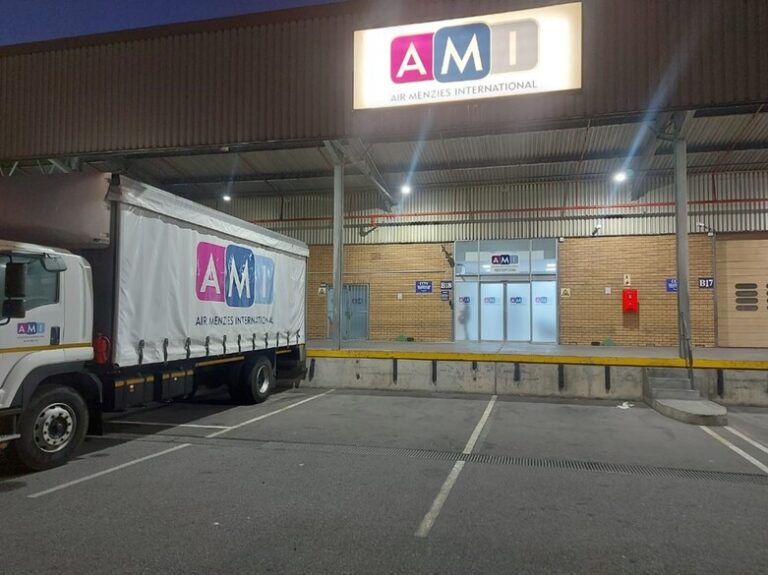
Air Menzies International (AMI) announced this week that it is upgrading its freight forwarding game in Cape Town and relocating to a bigger and more modern facility in the South African city. “The move will enhance service delivery, and further support the company’s growth ambitions,” the press release offers.The new facility is located near to Cape Town International Airport and hence also close to airline handling agents. Though the release does not stipulate how large the additional warehousing space is, it does list its features: advanced cooler and freezer facilities equipped with temperature control loggers so as to ensure optimal conditions for perishable goods; a one-way traffic flow system to avoid congestion at entry and exit points; a number of additional parking bays to facilitate seamless truck offloading and ensure zero delays [sic!]. Its ample [sic] room for operations should enable faster transit times, and more efficient operations. “The premises are monitored 24/7 with comprehensive CCTV surveillance and controlled access, ensuring the highest level of security. Furthermore, the entire facility is designed with sustainability in mind, utilizing eco-friendly equipment and energy-efficient lighting. With this significant upgrade, AMI is well-positioned to continue delivering exceptional service to its customers, while also supporting sustainable practices,” it promises.
Strategic move poised to fuel continued growth. Image: AMI
Carlos Font, CEO, AMI, said: “This impressive new facility is an important leap for AMI South Africa, as we continue to strengthen our value proposition and our ability to serve our clients. I also want to thank Milton French and Christina Adams for their leadership, vision and extraordinary passion.”
The International Air Cargo Association (TIACA) announced its conference program and the location of its upcoming TIACA Event – Central Asia. The choice has fallen on Astana, Kazakhstan, and the event will run from 19JUN-21JUN24. It is a joint event held by The International Air Cargo Association (TIACA), the Ministry of Transport of the Republic of Kazakhstan, and the Civil Aviation Committee and the Aviation Administration of Kazakhstan (AAK), and will be held at the Hilton Astana. The hotel is very close to the Mega Silk Way shopping and dining area, and five kilometers from Bayterek Tower, offering panoramic views over Astana. As is tradition, the event will kick off with a cultural tour followed by an evening reception for attendees. “A robust conference program has been developed and is aimed at not only supporting the development of Kazakhstan as an air cargo hub,” the release promises. The agenda includes titles such as ‘the Silk Road in the Sky’ and will cover both regional as well as global issues within the cargo industry, such as: a new vision for economic prosperity, industry regulatory framework and multi-modal logistics and the TransCaspian corridor; cargo industry overview, building air cargo hubs, air cargo trends, eCommerce, sustainability and SAF. It will be available in Kazakh, English and Russian.
TIACA goes Central Asia – to Kazakhstan, in fact. Image: TIACA
Steven Polmans, TIACA Chair, outlined: “The TIACA Event – Central Asia aligns with many key points in the organization’s mission by supporting the birth of an air cargo hub within Central Asia. The conference program ensures we are delivering a first-class experience for attendees while showcasing the region and underlining the importance that air cargo has within the global framework. We look forward to drawing the industry to Astana.”
Catalin Radu, Director General of Aviation Administration of Kazakhstan, enthused: “We are excited to welcome delegates to Astana for both a full conference program, networking and of course the culture. We look forward to seeing you soon.”
Glyn Hughes, TIACA Director General, stipulated: “We are excited about the conference program that includes so many topics that are important on both regional and global levels. TIACA conferences have consistently brought a refreshing breath to the conference circuit by ensuring the sessions are lively, relative to the audience and allows experts to share their knowledge.”
dnata recently reported on its new cargo handling facility currently under construction at Zürich Airport, due to go live in 2027, adding 50% more cargo capacity to the company’s Swiss operations. (In addition to Zürich Airport [ZRH], dnata is also active at Geneva Airport [GVA], serving over 30 airlines with ground handling and cargo services, and employing 1,100 staff. Over 60,000 tons of cargo passed through the two airports last year.) The 9,500 m² warehouse is being built in response to growing customer demand. dnata signed the lease agreement with the airport authority and will be the sole occupant of the warehouse facility, labeled: ‘Rächtenwisen’. It will be equipped with 20 truck docks, separate import, export, and dangerous goods handling areas, and offer temperature-controlled areas for sensitive products such as pharmaceuticals and other perishable items.
The new ‘Rächtenwisen’ warehouse at ZRH Airport. Image: dnata
As befitting a company with a sustainability strategy, dnata is concentrating on minimizing global carbon emissions and landfill waste (The target is 50% by 2030), so solar PV panels will be installed on the roof of the landside building. Likewise, it has already significantly invested in ‘green’ ground support equipment (GSE) in Switzerland. The fleet includes five new hybrid de-icing trucks, bringing dnata’s Swiss fleet up to 35% electric. In just 6 years from now, the electric portion of the fleet should have increased to 80%. Another aspect of sustainability are intelligent and smooth operations. Hence, dnata recently rolled out its advanced ‘OneCargo’ across system its cargo operations in Switzerland. “OneCargo automates key business and operational functions, including safety and quality monitoring, reporting and ULD management, with an integrated, cloud-based platform. AI-driven tools and analytics provide enhanced visibility on sales and business performance, allowing customers to match real-time demand with available capacity for maximum profitability. In addition, OneCargo eliminates all redundancies and manual check sheets, substantially improving operational efficiency,” the release explains.
Wily Ruf, Managing Director, dnata Switzerland, said: “We are delighted to have secured this new facility in partnership with Zürich Airport. Our cargo business continues to grow, and this warehouse will ensure that we go beyond the demands of our customers, providing them with our best-in-class ground and cargo handling services. We will continue to invest in people, infrastructure, and equipment to take our business to the next level in Switzerland.”
Colin Girault-Matz is Wiremind’s Co-Founder and CEO – credit: LinkedIn
“Wiremind, a trailblazer in technology solutions, is transforming the transport sector with its cutting-edge offerings, promising to enhance operational efficiency and revenue management for businesses worldwide,” the release promises, underlining its claim with the information that the company’s AI innovations have thus far been able to predict up to 15% revenue growth for those companies using it. Its solutions are highly versatile and are applied not just in air cargo, but also passenger transportation, sports and events industries. Through the application of AI, companies can benefit from more efficient and streamlined commercial processes and performance, and fully utilize their capacities and optimize distribution. Advanced machine learning models further aid in sustainability solutions, simpler revenue management processes, and better deployment of available resources. “At the core of Wiremind’s success lies a commitment to collaboration and innovation. Drawing upon insights from industry experts and customers alike, Wiremind conceives solutions suited to the unique challenges faced by transport businesses. Its strategy extends beyond revenue management to optimize the entire B2C commercial ecosystem,” from website functionality through to customer experience, the release explains. It mentions Wiremind’s flagship revenue management products, CAYZN and CAYZN Tracking, which come with the company promise of a 5-15% increase in revenue.
Colin Girault-Matz, Wiremind’s Co-Founder and CEO, explained: “At Wiremind, we pride ourselves on being efficient – we deliver what we promise. Our commitment to innovation means that we bring new solutions at every release, constantly pushing the boundaries of what’s possible. While we’ve made significant strides, there’s still much to address in the aviation industry. Our optimization engine works exceptionally well, yet we recognize the vast potential to add layers of innovation and efficiency. Our journey continues, fueled by our dedication to delivering impactful solutions that drive positive change within the industry.”
Silk Way West Airlines announced on 30MAY24, that it has appointed Onno Pietersma as its new Chief Operating Officer. Coming over from Cargolux where he spent the previous almost 13 years, he most recently held the position of Executive Vice President Maintenance & Engineering. Pietersma looks back on more than a quarter of a century of aviation industry experience, predominantly in engineering and maintenance, but also in consulting, controlling, sales and customer support. Prior employers include KLM and KPMG. In his new role as COO, Pietersma is tasked with ensuring and enhancing the airline’s stability and reliability in operations, to improve on-time delivery performance. The press release states that he is “poised to propel the airline towards new levels of operational efficiency, technological enhancement, and customer service.”
Onno Pietersma takes on the role of COO. Image: Silk Way West Airlines
Onno Pietersma concurs: “Strengthening the stability of the network is essential for elevating our service delivery. By extending network planning and enhancing turnaround efficiencies, we are committed to optimizing on-time delivery directly benefiting our customers.”
Wolfgang Meier, President of Silk Way West Airlines, stated: “Onno’s impressive career and dedication to teamwork and process improvement have consistently elevated operational standards. His strategic vision is integral to driving significant advances in our operational performance and enhancing customer satisfaction.”
It is an economic scandal. According to data provided by the World Bank and other sources, roughly 30% of all agricultural products spoil between field and shelf (see here). However, a brand-new study shows that perishables can be kept fresh over longer periods and thus be saved from ending up in a garbage can. Implementing the findings in daily operations will reduce the throw-away rate, benefiting producers, transporters, and consumers alike.
The above-mentioned alarmingly high rate of spoiled goods was highlighted by leading representatives of logistics companies, such as Kuehne+Nagel, during this year’s Fruit Logistica, held in Berlin from 07-09FEB24. The spoilage causes are very diverse: technical deficits, excessively long transit times of perishables from the field to the airport or seaport, or incorrect handling by ground service providers, are just three possible factors, for example.
Hopefully rotten fruit like this will soon be a thing of the past thanks to new handling methods – courtesy: freepick.com
Storage turned upside-down The spoilage process has now been successfully minimized or even completely contained at one interface, at least: in warehouses. Surprisingly, it wasn’t practitioners or established logistics experts who developed the ‘spoilage prevention program’, but a group of students from the Bavarian Weihenstephan-Triesdorf University of Applied Sciences. The academic title of their study: ‘Reduction of storage losses in organically produced fruit and vegetables through optimized storage management based on sensor-supported and adaptive models for predicting quality development and shelf life.’ The solution they presented contrasts the quirky title of their analysis: They claim that waste can be prevented by rearranging the order in which goods are stored and retrieved.
Source image: CFG/hs
Avoiding waste As a rule, wholesalers work according to the rigid ‘first in, first out’ principle. This means that the goods delivered first – regardless of their freshness – are the first to leave the warehouse. In contrast, with the ‘first-expired-first-out’ principle tested by the students, the quality of the perishables should determine their turnover and retrieval, and not the time of storage. By implementing this principle, the waste of perishables could be minimized, as data obtained during the tests has evidenced. In order to determine the properties of the perishables that determine their quality and shelf life, the researchers tested near-infrared spectrometers and used them to monitor the products. They also developed flexible sensor networks to closely monitor the environmental conditions in the warehouse. The effect of changes in temperature and air humidity on berries, broccoli and similar fresh products were measured and registered.
Maintaining product integrity Numerous studies have proven that freshness and taste are the most important quality characteristics of fruit and vegetables. During storage, the harvested produce changes its appearance and consistency, and tends to quickly lose its taste and properties. This is particularly challenging for producers, wholesalers, and distributors. Consumers who buy cherries, pears, beans, or asparagus expect them to have an intense flavor and a particularly high level of health-supporting properties. Especially if they come from organic farming. The aim of all parties involved in the supply chain must therefore be to maintain the quality of organic fruit and vegetables during storage, and to minimize waste. Storage losses are often higher for organically produced fruit and vegetables than for conventional produce. This is another result of the students’ research. The authors point out that their findings are only a first step towards extending the life cycle of fresh produce. In their opinion, the technologies and processes developed in the project are not yet ready for everyday use. Yet even so, they already offer interesting approaches for optimizing storage management in wholesale and intermediate trade as well as during air, ocean, and road transport.
A serious diplomatic crisis between Mexico and Ecuador, in which other countries are increasingly becoming involved, is shaking the sub-continent. It erupted when special Ecuadorian squads raided the Mexican embassy in Quito, in an attempt to detain Ecuador’s former Vice President, Jorge Glas. He had fled to the embassy to escape a prison sentence on corruption charges. Mexico had granted the politician asylum.
Ecuador is an expert when it comes to asylum issues. For years, the country granted WikiLeaks founder, Julian Assange, the right to stay in its London embassy, sheltering him from the access of the British authorities and thus preventing his extradition to the USA. This may have annoyed Downing Street, but the UK respected the extraterritorial status of the South American country’s embassy. After all, under diplomatic norms, embassies and consulates are considered protected spaces.
From 01JUL – 18DEC, Aeromexico will no longer serve the Mexico – Quito route following a diplomatic spat. Pictured here: Boeing 737 MAX – courtesy: Aeromexico
Outcry of indignation However, in an attempt to get hold of Jorge Glas, the government in Quito blatantly violated this universally respected rule by raiding the Mexican diplomatic representation in Quito. Glas was found guilty in a disputed legal case by an Ecuadorian court, of receiving US$13.5 million in bribes in what became known as the Odebrecht scandal. This led him to seek asylum in the Mexican embassy which he was granted. In Mexico, the raid caused an outcry of indignation. The government broke up diplomatic relations with Ecuador and ordered its diplomatic staff back home. Furthermore, the López Obrador administration ordered national carrier, Aeromexico, to suspend flights between Mexico City and Quito from 01JUL24 through to 18DEC24. The route is currently still operated by the airline four times a week. In the meantime, Nicaragua has also broken off diplomatic ties with Ecuador, in solidarity with Mexico. Brazil, Colombia and even the Argentinian anarcho-capitalist, Javier Milei, have voiced harsh criticism of the Ecuadorian government’s step. UN Secretary-General, Antonio Guterres was “alarmed” by the raid, with his speaker, Stéphane Dujarric “reaffirming the cardinal principle of the inviolability of diplomatic and consular premises and personnel.”
Consequences for cargo The cancellation of non-stop flights between Mexico City and Quito complicates the flow of passengers and affects cargo transportation as well. Soon, travelers will have to transit at major hubs such as Sao Paulo, Bogota, or Lima, to reach either Quito or Mexico City – the same goes for cargo. A time-consuming exercise. Among other issues, air freight faces a particular challenge not much spoken about for reasons of piety. Keyword: human remains. Since 2022, more than 115,000 Ecuadorians have left the country to reach the United States to find a job and make a living there, fleeing poverty, corruption, and criminal drug cartels in Ecuador. Among these people were more than 20,000 children and adolescents who traveled alone and often fell into the clutches of human traffickers. Some of them never reached the United States, but died in Mexico.
Diplomatic vacuum hampers processes Without diplomatic representation, the question now arises as to who is formally responsible for the repatriation of the deceased to their home country. It is currently completely unclear as to who issues the death certificates and exit permits for the bodies of Ecuadorian citizens, enabling them their last journey back home. For the repatriation of a body, a family member normally authorizes the diplomatic corps of the country concerned to make the appropriate arrangements together with the local state authorities. But without diplomatic relations, who will exercise this authority? Admittedly, the dignified treatment of human remains and their return to their home country in the cargo hold of an airplane, is a marginal aspect of this diplomatic crisis. But the example shows the consequences that actions such as the raiding of diplomatic missions can have, which hardly anyone thinks about at the time of the event.
La Roca – the Alcatraz of Ecuador As far as air freight is concerned, the supply chain of car parts manufactured in Mexico and flown to customers in Ecuador, will be disrupted as a result of the temporary route cancellation by Aeromexico, local market experts predict. Also affected are urgently needed medical and pharmaceutical goods transported southbound, while in the opposite direction, Ecuador-harvested perishables will take longer to get from the field to the shelves in U.S. supermarkets. How the diplomatic wrangling over Jorge Glas will end, cannot be predicted at present. The only thing that is clear, is that he is currently jailed in the high security La Roca prison in Guayaquil, notorious for lack of space, violence and recurring prisoner revolts. Meanwhile, the German government is trying to get in direct contact with 54-year-old Glas. The Foreign Office in Berlin confirmed this to the media. In addition to his Ecuadorian nationality, he also has German citizenship.
It was a flood of biblical proportions that hit Rio Grande do Sul in southern Brazil at the beginning of MAY24, following enormous amounts of rainfall. The death toll surpassed 150 people, with more than 100 still missing and over 600,000 displaced. Hence, rapid aid was required to provide those affected with necessities. The LATAM Group initiated its ‘Solidarity Plane Project’ several years ago to deal with emergency situations like this and quickly transport relief supplies to people in need.
LATAM’s solidarity plane flew various relief items from Colombia to Brazil – photos: courtesy: LATAM Group
100 houses = 16 tons In line with this humanitarian scheme, a B767 freighter from LATAM Cargo took off in Bogota and landed in Sao Paulo Guarulhos on 28MAY24, filled with 100 modular houses weighing 16 tons. Immediately after arrival, the items were trucked to the affected region. The shipment was donated by the United Nations Refugee Agency (UNHCR), to provide shelter to those whose homes had been washed away by the flood.
Enabling shelter and some privacy According to the UNHCR, Refugee Housing Units have a lifespan of up to 5 years. The organization uses them on various occasions to shelter people, be this in the case of earthquakes, large wildfires, hurricanes or – as in the Brazilian case – devastating floods. Each unit consists of a lightweight steel frame, roof and wall dividers, doors and windows, floor covering, solar power, LED lighting, and an anchoring system. They were developed collaboratively by UNHCR specialists, the social enterprise, Better Shelter, and the IKEA Foundation. The goal is to enable autonomous, sustainable spaces including some privacy, that are adaptable to different humanitarian emergency contexts, with UNHCR units present in Latin America, Europe, Africa, and the Middle East.
The LATAM Group flew 100 of these modular houses to Brazil to provide shelter flood victims. 100 more are to come
Part of LATAM’s ‘Shared Value’ Program In addition to the folding houses, LATAM’s ‘Solidarity Plane’ has transported a total of 142 tons of donations, free of charge, to southern Brazil since 04MAY24. The shipments consisted of basic food baskets, potable water, disposable diapers, blankets, and other essential items. A team of 102 volunteers, including doctors, nurses, veterinarians, and firefighters, also flew there. The freighter operations were complemented by passenger flights to regional airports in southern Brazil, carrying relief goods in the lower decks of the LATAM fleet. Most donations were financed by Portugal and the United States. LATAM’s ‘Solidarity Plane Program’ is part of the Shared Value pillar of the group’s sustainability strategy. It seeks to generate value in society through connectivity. Under this scheme, humanitarian alliances in Brazil, Chile, Colombia, Ecuador, and Peru were inked, making free expertise, infrastructure and connectivity through tickets and cargo transportation available to the organizations.
Airline as social actor “At LATAM, we understand that, as a company, we are also a social actor. That gives us rights, but also an obligation to work for the benefit of the societies where we operate. The terrible situation in Ukraine and the consequences of conflict on millions of people, led us to approach UNHCR, and today we are proud to be able to make transportation of refugees, donations, and humanitarian aid available to them and their families in all the destinations of our network,” states Roberto Alvo, CEO of LATAM Airlines Group. Meanwhile, most of the foldable houses have been erected in the affected areas and assigned to local users. With 100 more to come.
CargoForwarder Global’s ‘Spotlight On…’ series brings each of the many different functions involved in air cargo to the fore. Airports are at the heart of all aviation and are the ones who play a key role not only in creating the best environment for air cargo logistics, but also in educating the public as to its existence and all the positive initiatives being taken for a more sustainable future. Heathrow’s Head of Cargo, James Golding (JG), illustrates his responsibilities, views and experiences in this week’s Spotlight.
A little bit of magic, every day. Image: James Golding
CFG: What is your current function? And what are your responsibilities?
JG: I’m Head of Cargo at Heathrow, the UK’s largest port by value. I lead our team responsible for the development and deployment of Heathrow’s cargo strategy, oversight of our day-to-day cargo operation, relationships with our cargo community (everyone from airlines and handlers to forwarders and haulers), development of cargo infrastructure, and our relationship with UK Government stakeholders and trade associations. My team’s focus is on growing Heathrow’s cargo proposition, our tonnage and market share, whilst increasing efficiency and making Heathrow a better place to work and live near.
CFG: What does a normal day look like for you? Or is there such a thing?
JG: That’s the beauty about working at Heathrow – most colleagues will say there’s no such thing as a typical day. I spend a lot of time out and about in our cargo estate, speaking with partners, hosting workshops or project meetings. For example, we’re currently working with our community on designing a new approach to community engagement, with one of the first projects being focused on making our landside operation more efficient and sustainable.
CFG: How long have you been in the air cargo industry, and what brought you to it?
JG: I joined Heathrow 13 years ago, and moved into the cargo industry 4 years ago during the early months of the pandemic. At that time, cargo’s critical global importance had been heightened publicly more than it ever had before, and I was intrigued by the opportunity to make a difference to the aviation industry’s survival and the country’s needs during that period.
CFG: What do you enjoy most about your job?
JG: The cargo and broader logistics industry plays such a critical role in everyone’s lives but is often relatively less well understood by those outside the industry. I’m hugely motivated to share cargo’s importance with stakeholders in the broader aviation industry and with Government stakeholders, enabling us to make real improvements to the sector by implementing learning from other elements of aviation.
CFG: Where do you see the greatest challenges in our industry?
JG: Cargo must play its part in the pressing need to decarbonize the aviation industry. At Heathrow, we have a commitment to reach net zero by 2050 as part of our sustainability strategy, and shorter-term actions to reduce carbon on the ground across our airport by 45% by 2030. Our strategy sets out how we plan to work together with our airport partners to reduce the impact our operations have on the world around us and spread the benefits of aviation – such as maintaining critical global trade – as wide as possible. When talking with our partners and attending industry events it’s also very noticeable that the cargo industry is not nearly as diverse as it should be. I’m proud that our Cargo team at Heathrow is gender balanced, but there’s much more we can and should do to ensure true diversity of thought across the sector – and attracting new talent is critical to that.
CFG: What advice would you give to people looking to get into the air cargo industry? Any particular training they should aim for?
JG: Get involved in an aviation or cargo industry group. As an example, the Air League is the UK’s leading aviation and aerospace charity, aiming to inspire young people by awarding scholarships and work opportunities in aviation. Last year, in partnership with Worldwide Flight Services and Singapore Airlines Cargo, we hosted 11 young students and professionals, aiming to showcase Heathrow’s cargo operations and inspire the visitors to pursue a career within the air cargo industry. The event created connections that a number of the participants have used to broaden their career network.
CFG: If the air cargo industry were a film/book, what would its title be?
JG: The Harry Potter series comes to mind – because what we do in air cargo is a little bit of magic every day.Thank you, James, for sharing your views.
If you would like to share your personal air cargo story with our CargoForwarder Global readers, feel free to send your answers to the above questions to cargoforwarderglobal@kopfpilot.at We look forward to shining a spotlight on your job area, views, and experiences.
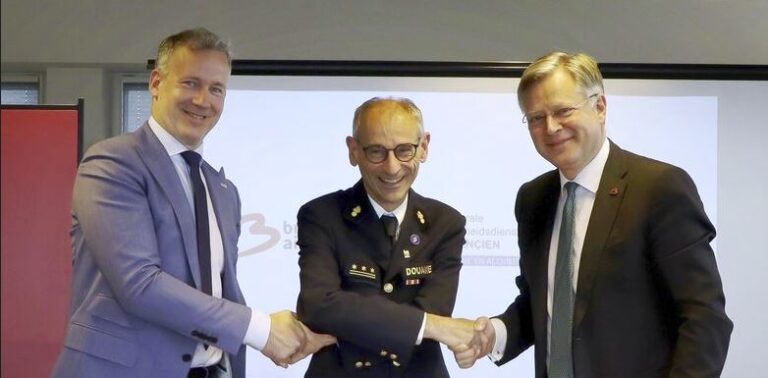
On 30MAY24, Air Cargo Belgium, Brussels Airport Company, and Belgian Customs signed a Vision Document to enable swifter declaration and inspection processes and enhance the competitive position of Brussels Airport.
According to ACB’s Director, Freek De Witte, over the years the relationship between the private operators and the Customs Administration has evolved from rather rigid to more openness. The Vision Document should further pave the way forward. “In order to make this Vision Document work, you need a partnership based on a mutual knowledge of each other’s processes, interests and goals. It must be supported by personal contacts between the people behind the processes, and mutual trust and respect,” he said. Mr. De Witte also said that, thanks to this partnership, ACB and Customs have learned to ‘speak each other’s language’, which has improved the knowledge of each other’s motives, legal framework, and economic reality. “Apart from this shared vision, a shared sense of urgency and timing are equally important.”
(left to right):Freek De Witte, Kristian Vanderwaeren and Arnaud Feist – courtesy ACB
European Customs digitization project The crux of the matter is in digitization, in which ACB is collaborating closely with Brussels Airport. “As Customs plays an important role in the BRUcargo processes, making them swifter can boost our competitiveness as an airport.” Digitization is also a prerequisite for the roll-out of the Multi-Annual Plan for Electronic Customs (MASP-C), initiated by the European Commission, aiming to replace paper-format declarations by digitized ones by 2025. Many companies across the bloc of 27 are struggling with the implementation, and ACB hopes the Vision Document will help the Brussels Cargo community to shift to a higher gear in this respect. Regular concertation between ACB and Customs, both on a regional and national level, will enable the private operators to be informed pro-actively on new developments.
Combatting drugs trafficking According to Kristian Vanderwaeren, Administrator-General of the Belgian Customs Administration, we are living in a VUCA world (volatility, uncertainty, complexity, and ambiguity). “Free trade is not a given anymore. One can feel the tension everywhere. You can expect more and more controls as the Customs Administration is seen as an instrument of policy making. This will eventually lead to more sanctioning.” Mr Vanderwaeren referred to the tsunami created by e-commerce, where more regulation is to be expected. A major problem for Belgian Customs is drugs trafficking, especially in the Port of Antwerp. “As we are trying to tighten the grip there, other gateways such as Brussels Airport may soon be seen as an alternative by the criminals.” For the Customs Administration, the main focus in combatting this plague has traditionally been on passenger controls. “In air freight, we are considering risk analysis based on the declarations, in close collaboration with the police. In post/express/courier services, we have to collaborate with the respective companies, taking quality and quantity of the consignments into account. Step by step, we want to introduce scanning of high-risk goods and packages.”
Part of Brussels Airport’s innovation strategy Brussels Airport shares the vision outlined in the document, said Arnaud Feist, CEO of Brussels Airport Company. “We have committed ourselves to the renovation of the two facilities currently used by Customs, so as to improve the working environment,” he said. “The further innovation and optimization of BRUCloud fits into this ambition and will support the improvement of customs and inspection processes.” Mr. Feist expressed the hope that Brussels Airport would also be equipped with scanning infrastructure. “Working in synergy with ACB in this respect, is of crucial importance,” he concluded.