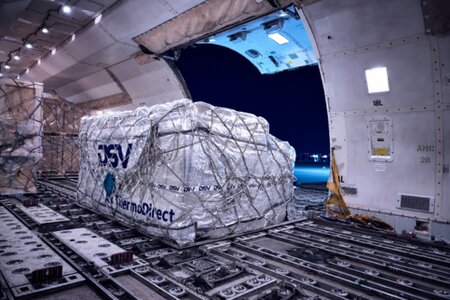
As part of its Air ThermoDirect expansion, DSV has opened a dedicated air corridor for temperature-sensitive pharmaceuticals travelling between Luxembourg and Indianapolis. This move allows the elimination of active cooling containers since it focuses on improved temperature control throughout, including cutting time in uncontrolled environments. In removing the need for containers, the direct route enables a reduction in costs and emissions and simplifies handling processes – USPs that are particularly important in Indianapolis which is among the U.S.’ fastest-growing life sciences hubs. Luxembourg is equally critical to the global pharmaceutical supply chain, and the launch of this dedicated route offers “a cold chain that is predictable and scalable, while actively minimizing the environmental impact through optimized handling and more sustainable thermal solutions”. The move reflects a broader shift in healthcare logistics. DSV says successful healthcare logistics now depends on control, consistency, and true end-to-end ownership, not just access to capacity.
Dedicated lanes are increasingly replacing active containers in cold-chains. Image: DSV
Kenneth Källström, Executive Vice President, Global Head, Healthcare, DSV, commented: “The DSV Indianapolis operations will play a pivotal role in the global Air ThermoDirect healthcare network, enhancing end-to-end visibility and control across pharma manufacturing regions in the US, Europe, the Americas, and APAC. By strengthening these critical supply-chain connections, this hub will help ensure that life-saving therapies move with greater speed, reliability, and integrity – ultimately delivering better outcomes for patients worldwide.”
Stephanie Penarete, Vice President Air Product Americas, DSV, said: “Indy Wings reflects our strategy to bring the critical points of the supply chain under full accountability, ensuring reliability, integrity and performance where it matters most. With Indy Wings, we continue linking key pharmaceutical hubs with greater precision, resilience and excellence.”
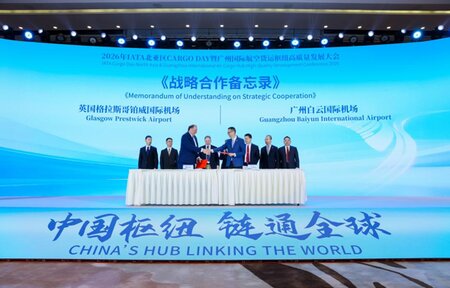
Glasgow Prestwick Airport (PIK) and Guangzhou Baiyun International Airport (CAN) used the backdrop of the International Air Transport Association (IATA) North Asia Cargo Day in Guangzhou, China, to sign a Memorandum of Understanding (MoU) that seeks to further strengthen trade flows between the UK and China. The agreement focuses on cargo development, operational knowledge sharing and improving network connectivity between the two airports. PIK is already well-acquainted with Chinese business and has steadfastly built up its role as a UK gateway for Asian e-commerce and high value exports, such as Scottish salmon and whisky. It currently handles 15 weekly scheduled flights to and from mainland China, including scheduled services to CAN, alongside three flights per week to Hong Kong.
Matteoni (left) signs a memorandum of understanding with representatives from Guangzhou Baiyun International Airport. Image: PIK
“The MoU marks the latest step in Prestwick’s strategy to pair inbound Asian e-commerce with outbound premium exports, creating a more balanced, direct, and resilient cargo model for airlines, forwarders, and shippers,” the release underlines.
Jules Matteoni, Executive Director, Glasgow Prestwick Airport, stated: “This agreement gives Prestwick a direct platform to work with one of Asia’s most important cargo gateways at a time when e-commerce growth, capacity pressure, and demand for faster export routes are reshaping trade between China and the United Kingdom. Prestwick’s value is its ability to turn available runway capacity into reliable cargo handling, fast landside access, and direct trade lanes that work in both directions, supporting Asian goods moving into the United Kingdom and Scottish exports moving into high value overseas markets.”
Qatar Airways Cargo and its ground handling partner, Qatar Aviation Services Cargo (QAS Cargo), have been recertified under IATA’s CEIV Fresh program for its Fresh perishables product. This confirms that the companies continue to meet global standards for handling and transporting temperature-sensitive cargo. CEIV Fresh certification, which follows IATA’s Perishable Cargo Regulations, covers both how operations are run and the quality systems in place. Certification follows after stringent auditing and demonstrates the airline’s commitment to delivering reliable, end-to-end cold chain coverage across its worldwide network.
Fresh as from the moment they were harvested. Image: Qatar Airways Cargo
Qatar Airways Cargo’s Fresh service handles a broad mix of perishables – fruit, vegetables, seafood, meat, flowers, and confectionery – maintaining shipment integrity from origin to destination. The recertification comes from a continuous improvement program that includes regular audits, process upgrades, focused training, and strong coordination between the airline and ground teams to stay fully compliant.
Aside from becoming officially certified and recertified, Qatar Airways Cargo also helps to continuously shape industry standards as it is part of the IATA Perishable Cargo Working Group (PCWG). The airline first earned CEIV Fresh certification in JUN23; this latest recertification runs through JUN29, reinforcing its reputation as a trusted partner for perishable air freight. In the past year (01AP25-31MAR26), Qatar Airways Cargo moved more than 240,000 tons of perishable cargo globally.
CargoAi has taken an unprecedented step in the air cargo world and made its CargoMART directly accessible through any AI assistants supporting the Model Context Protocol (MCP), which means all the current known favorites such as ChatGPT, Claude or Microsoft Copilot, for example. Thus, freight forwarders, airlines, GSAs, and logistics teams can access and interact with live cargo data via the AI chat tools they already use in daily operations. Using the AI interface of their choice, users can search and compare rates, review flight schedules, analyze total costs, enter shipments and book capacity with more than 105 airlines, or track cargo across over 240 carriers. The move eliminates the need to switch systems as operational workflows can now be executed directly within AI interfaces.
CargoAi underlines the AI in its name. Image: CargoAi
Furthermore, users now have the opportunity to build their own AI agents within these platforms. Without complex development, these agents can autonomously handle core tasks such as quoting, booking, and tracking, effectively acting as digital operators embedded in everyday workflows. CargoAi observes a growing trend within the air cargo industry, that shows what it terms the ‘operational center of gravity’ shifting away from traditional TMS and CMS systems toward AI-driven interfaces that serve as ‘orchestration layers’ connected to enterprise systems.
For CargoAi, opening CargoMART via MCP is a natural evolution of its strategy, founded as it is on AI principles. Its platform has been built around AI from the beginning – predictive tracking, rate intelligence, and automated quoting are all AI-based and already deployed at scale. As is its CargoCOPILOT chat tool.
Matt Petot, Founder and CEO of CargoAi, explained: “As AI adoption accelerates across the industry, teams are looking for flexible ways to build their own workflows using the tools they already use. We’ve been deploying AI in production for years. Today, we are opening that same intelligence to every AI platform. Making air cargo operations faster, simpler, and more efficient.”
François-Xavier Gsell, CTO of CargoAi, added: “AI is quickly becoming the standard interface to interact with systems and data. By making CargoMART data and capabilities natively accessible through MCP, we enable teams to seamlessly integrate air cargo intelligence into their existing workflows and build their own intelligent automations.”
“Match day is just around the corner, but one of the most important ‘teams’ at the tournament won’t score a single goal!” is Steve Parker’s opinion. The Director General of the British International Freight Association (BIFA) recently emphasized the importance of the air cargo and logistics industry when it comes to major sporting events such as the World Cup. “Long before the first whistle blows, logistics professionals have been working behind the scenes to move team merchandise, broadcasting equipment, hospitality supplies, medical equipment, retail products and so much more. While players prepare to battle it out on the pitch, it is the sophisticated global freight networks operating seamlessly behind the scenes, that underpin the tournament. Without the logistics team, there would be no World Cup.”
Air cargo and logistics are the invisible team involved in the World Cup. Image: BIFA
The association pointed out that tournaments of this scale depend on highly coordinated international supply chains, with every match, broadcast, and fan experience reliant on efficient logistics. Freight forwarders play a central role in ensuring goods move seamlessly across borders under tight timelines and strict security requirements. These events place significant pressure on transport infrastructure, customs processes, and supply chain resilience. BIFA’s members therefore continue to invest in digitalization, customs expertise, and sustainable transport solutions, while at the same time, having to navigate increasing challenges such as geopolitical tensions, climate disruption, and evolving trade regulations.
“Huge events can help people understand that logistics is about much more than moving cargo from A to B. It is about planning, compliance, technology, sustainability and global coordination. The expertise of freight professionals keeps international commerce and major global events functioning effectively,” Parker concluded, urging policymakers and businesses to recognize the strategic importance of the logistics sector to both the UK economy and the successful delivery of major international events.
The name ‘Argus’ comes from Greek mythology, where Argus Panoptes was a giant with a hundred eyes, who never slept completely and saw everything. For a modern company that provides airspace surveillance and security services, it’s certainly not a bad choice of name, as became clear during a conversation with its management at the ILA in Berlin.
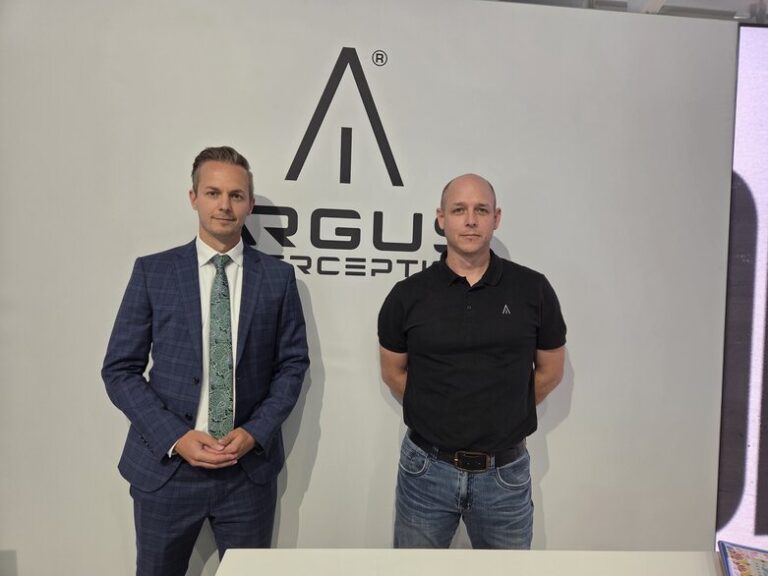
Argus Interception managers Christoph Rau (left) and Timm Bölke – photo: CFG/hs
Whereby ‘Piscator’ would also have been a fitting name, referencing the work of fishermen in the Roman Empire. Like their historical counterparts, the A1 Falke drone – developed by Argus Interception in collaboration with the Bundeswehr University in Hamburg – deploys nets to capture other drones. It is a dual-use interceptor drone. It can protect ports, industrial facilities, power plants, airports, or other critical infrastructure sites. It has been in use for some time and has proven its worth, reports CFO, Christoph Rau. He does not specify exactly where this happened, citing confidentiality reasons. However, Ukraine is certainly among the users, the Baltic countries presumably as well. It costs a “mid-six-figure million-euro amount” per unit, says Rau. The A1 Falke is part of a customized package solution, which also defines the costs, special sensors, staff training, etc., and can be booked by users according to their specific needs.
Protecting critical infrastructure If a drone is detected – for example, heading towards an airport – and is classified as a security risk by Argus operators or security personnel, the A1 Falke is dispatched to intercept the intruder. Capable of high speeds, it positions itself above the approaching drone and deploys a capture net as soon as it is directly above it. It is this innovative net-casting technology that sets the A1 Falke apart. Thanks to this automated technology, the hostile drone caught in the net is intercepted in a controlled manner and, after being placed on the ground, is forensically analyzed and identified to determine its origin. This is because the number of drone flights over critical infrastructure in Europe has increased sharply in recent times, with the origin and purpose of most of them remaining in the dark.
Oslo, Copenhagen, Munich … This happened on 22SEP25, when the airspace over Copenhagen and Oslo was disrupted by unidentified unmanned aerial vehicles, leading to extensive security measures and temporary no-fly zones.
Just one month later, in OCT25, several drones disrupted traffic at Munich Airport for days, partially bringing it to a complete standstill. Thousands of passengers were stranded. According to the DLR (German Aerospace Center), it was likely the most expensive drone incident in Germany last year. In 2025, drone flyovers were recorded at 25 German airports, causing disruptions. Where they came from and where they headed to after completing their missions, remains unclear to this day, even though military sources point at Russia as the initiator by utilizing their shadow fleet of aging tanker vessels navigating in the Baltic Sea as operational platforms.
Shooting hostile drones down is too risky Although drones now seem almost commonplace and are being used increasingly frequently in many areas, they are subject to legal regulations such as data protection laws and aviation rules. This is because as the number of drones in the airspace increases, so does the risk of collisions with civil aircraft. Security authorities suspect that most drone sightings in Western and Central Europe are being used for espionage purposes. They can also be used for cybercrime, smuggling, espionage, or terrorism.
Drones could be eliminated by targeted shooting. However, the danger of falling components is significant and can endanger people on the ground or set buildings on fire. This is precisely what the A1 Falke is designed to prevent thanks to its network technology. “Our product has proven itself as a superior solution to prevent collateral damages,” emphasizes Argus Manager, Timm Bölke. However, he does not say in which country or where exactly this has been proven.
The transport and handling specialist has acquired T World Service GmbH, thereby expanding its range of business activities by including AOG operations. With the takeover of T World, which runs stations at the airports of Frankfurt and Hamburg, the Sovereign Group is strengthening its position as an express logistics provider and expanding its core competencies in the area of urgent shipments.
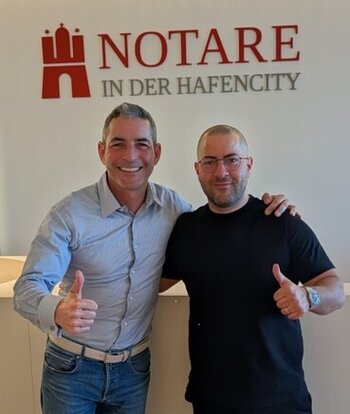
Karim El-Sayegh (left) and Rachid Touzani celebrate their partnership at the notary’s office in Hamburg’s Harbor City / courtesy of Sovereign Speed
By adding T World Service to its Group of companies, Sovereign is widening its already broad range of services. This includes direct shipments, overnight transport via its own express network – both by road and by air – on-board courier services, and, most recently, AOG services. According to its press release, with the exception of vessel solutions, there is no transport requirement in Europe that the company cannot meet.
“With this acquisition, we are expanding our group with a well-established company, thereby laying the foundation for further growth. The additional services offer great potential to expand our service portfolio to additional locations in the future and to offer our customers even more comprehensive solutions from a single source. Together, we will leverage the strengths of both companies to sustainably fortify our market position and continue our successful development,” said Karim El-Sayegh, Group Managing Director of Sovereign, while explaining the acquisition to the press.
Sovereign fills another niche T World Service, managed by its Founder, Rachid Touzan, from day one, will become a wholly owned subsidiary (100%) of the Sovereign Group as a result of the transaction. However, T World Service will retain its existing organizational structure. The company’s more than 50 employees, as well as Managing Director Rachid Touzani, will also stay on board. “We are pleased to maintain T World Service’s current course and continue its highly successful business model with the existing team,” emphasizes El-Sayegh.
Excellent fit T World Service – much like Sovereign – works exclusively with other transportation and logistics companies. This core principle of the business model will remain in place and expand. Rachid Touzani also highlights other commonalities that should facilitate collaboration: “It was particularly important to me to find a partner who shares our values. These include an uncompromising focus on the customer, a high degree of reliability, honesty, and transparency in decision-making – not only toward business partners but also toward our own people. That is why I am very pleased to know that the company I founded is in the hands of a corporate group that is an excellent fit for us and offers the best conditions for further, shared business activities.”
“Airline on wheels” Sovereign Speed was founded in 1998 as a neutral and independent express carrier, headquartered in Hamburg. Starting with a single linehaul route from Hamburg to Brussels, the newcomer quickly grew into a premium provider of urgent freight services in Europe. With more than 100 overnight connections and a wide range of express handling services for time-sensitive freight, the Sovereign Group is now one of the key players in this segment. It manages 50,000 m² of warehouse space for the handling and storage of shipments and operates 500+ vehicles from sprinters to large trucks. Due to its scheduled road services, such as from Hamburg via Cologne and Brussels to London Heathrow, the company’s founders, Karim El-Sayegh and Martin Araman, refer to Sovereign as an “Airline on Wheels”.
Each week, CargoForwarder Global’s ‘Spotlight On…’ looks at a particular segment of the air cargo industry with the aim of demonstrating just how varied the careers in this industry are. Air cargo would not be air cargo without airlines, of course – whether these are passenger airlines, dedicated cargo airlines, or a mix of the two. Cathay Cargo, for example, operates its own freighter fleet and offers cargo capacity in the holds of Cathay’s extensive passenger fleet, too. It also happens to be the largest cargo operator at the world’s busiest cargo airport (Hong Kong), and is celebrating its 80th anniversary, this year. This week Anand Yedery (AY), Regional Head of Cargo Europe at Cathay Cargo, explains his role and shares his views and advice to those looking to enter the industry.
A constant mix of planning, problem-solving and collaboration. Image: Anand Yedery
CFG: What is your current function and company? And what are your responsibilities?
AY: I currently work as Regional Head of Cargo Europe, where I’m responsible for overseeing the commercial and operational performance of Cathay Cargo across the region. My role is a mix of strategy and execution, working closely with customers, leading our regional teams and ensuring we stay aligned with our global priorities. A big part of my focus is building strong partnerships and navigating the different markets across Europe while delivering consistent growth.
CFG: What does a normal day look like for you?
AY: Honestly, there’s no such thing as a ‘normal’ day in air cargo, and that’s what keeps it exciting. One moment, I’m deep in performance reviews or strategy discussions with the team, and the next, I’m working through operational challenges or connecting with customers. With teams and customers spread across time zones, my day can sometimes be quite global by nature. It’s that constant mix of planning, problem-solving and collaboration that makes every day different.
CFG: How long have you been in the air cargo industry, and what brought you to it?
AY: My journey in aviation has been quite diverse. I started with Cathay Pacific on the operational side at the airport, which gave me a strong foundation in how the industry really works on the ground. From there, I moved into customer sales and marketing, which gave me exposure to the commercial side of the business.
Cargo has been a particularly rewarding chapter; this is actually my second stint in cargo. Earlier, I was responsible for cargo across South Asia, the Middle East and Africa for about four years, which was an incredible experience in understanding different markets and customer needs. After spending time in other parts of the airline, coming back to lead Cathay Cargo’s Europe business felt like a natural progression.
What inspires me, is how integral cargo is to global trade and how dynamic the industry is.
CFG: What do you enjoy most about your job?
AY: For me, it’s the people and the pace. You’re constantly interacting with colleagues, customers, and partners across Europe, which makes it very enriching. At the same time, the industry moves fast, there’s always something happening, something to solve or something to improve. That combination of relationships and constant evolution is what I enjoy the most.
CFG: Where do you see the greatest challenges in our industry?
AY: We are at an interesting point where the industry is balancing multiple pressures – geopolitics, market volatility, capacity constraints, rising fuel costs and the need to accelerate digitalization. Customers today expect greater transparency and agility, which means we have to continuously evolve. The challenge is not just adapting but doing so in a way that builds resilience and long-term value.
CFG: What advice would you give to people looking to get into the air cargo industry?
AY: I would say: be curious and stay open to learning. Air cargo is a fascinating space because it sits at the crossroads of aviation, logistics, and global trade. A background in supply chain or business can help, but what really matters is adaptability and a willingness to learn. Getting hands-on experience, whether in operations or commercial roles, makes a big difference.
Also, don’t underestimate the value of understanding different parts of the airline or logistics ecosystem. That broader perspective has certainly helped me in my journey so far.
CFG: If the air cargo industry were a film/book, what would its title be?
AY: ‘Catch Me If You Can.’
Because in air cargo, we’re constantly chasing something – tight connections, last minute bookings, shifting schedules or that one shipment that absolutely must make it on board. Just when you think you’ve caught up, something changes and you’re off again. It’s fast, unpredictable, and occasionally feels like a game of cat and mouse, but thanks to our teams and partners, it all comes together in the end.
Many thanks, Anand.
If you would like to share your personal air cargo story with our CargoForwarder Global readers, feel free to send your answers to the above questions to cargoforwarderglobal@kopfpilot.at We look forward to shining a spotlight on your job area, views, and experiences.
Every day, thousands of air cargo export decisions are made across Europe. Freight forwarders choose which airline to book, which airport gateway to use, and whether cargo should move by air, road feeder service, or a combination of both. These choices determine how quickly, reliably, and efficiently goods reach global markets. Yet despite their importance, the decision-making process behind them remains surprisingly underexplored. In industry terms, it is often driven by relationships, experience, trust, price, timing, commodity requirements, and operational constraints. In academic terms, however, it remains something of a “black hole” – one that Floris de Haan, University Lecturer, Erasmus UPT, aims to shed light on.
All European Freight Forwarders are invited to complete the survey. Image: Floris de Haan
This is the focus of a PhD research project being conducted by Floris de Haan with the Air Transport Management group at Cranfield University in the UK. The study examines how European freight forwarders make decisions when selecting airlines, airports and trucking companies. It seeks to identify the factors that influence those choices and, crucially, how much weight freight forwarders attach to each factor in practice.
Where did the impulse for the PhD come from? The research idea grew out of direct experience in the air cargo industry. During Floris de Haan’s time as Cargo Marketing Director at Amsterdam Airport Schiphol, it quickly became clear that air cargo is a well-established business-to-business environment. Decisions are often shaped by a simple but powerful logic: “I know you, I trust you, let’s do business.” Coming from a technical background, de Haan wanted to understand what sits beneath that logic. Why does a freight forwarder choose airline X one day and airline Y the next? What role do price, reliability, capacity, communication, speed, connectivity, and personal relationships really play?
Learning from history? “When I began reviewing the available literature, I found that there is hardly any scientific research on freight forwarder decision-making in air cargo. Some useful studies exist from Asia, particularly from Taiwan and South Korea, but there is nothing that reflects the European context. That matters because there are good reasons to believe that decision-making in Europe is done differently than in Asia, as its customs environment, industrial structure, geography, airport network, and extensive use of road feeder services create a very different decision landscape from many Asian markets,” de Haan explains. “So that immediately provided me with what we call a research gap, or in more popular terms, ‘the black hole’.”
Initial research “I approached this research by interviewing people in the air cargo industry, from freight forwarders to airlines, trucking companies, airports and consulting experts in the field. Those interviews provided the key decision factors of European based freight forwarding companies,” de Haan says. Unsurprisingly, price plays an important role in the decision making of freight forwarders. However, not always, since certain high value commodities require non-stop transport connections, while other commodities require excellent communication between freight forwarder and shipper or consignee. “So, it’s a mix and what I am now looking for is the weight of all these identified factors based on which freight forwarders decides for specific airlines, trucking companies and airports. To establish this, I have set out a survey in which I ask European based freight forwarding companies to participate – I hope I can encourage CargoForwarder Global’s European-based readers to participate in this survey, so as to generate a larger, more reliable data set.”
The aim of the survey The aim of the survey is to build a framework that can better explain, and potentially predict, how freight forwarders select airlines, airports and trucking companies. Such a framework will not remove the human element from decision-making. On the contrary, it will help the industry understand it more clearly. In a market where trust, reputation and relationships remain important, structured insight can help show when those softer factors interact with operational and commercial criteria.
Who benefits? The findings should be valuable for several parts of the air cargo ecosystem. Airlines, trucking companies and airports will be better able to tailor their propositions if they understand what freight forwarders actually value.
The research also has a forward-looking dimension. Artificial intelligence and digital booking tools are likely to play a larger role in translating shipper needs into transport decisions. Before such systems can support or automate decision-making effectively, however, the industry needs a better understanding of how those decisions are made today. This research can therefore contribute not only to academic knowledge, but also to future digitalization in air cargo.
If you are a European Freight Forwarder, please participate
“The survey is open to freight forwarders exporting from Europe and will run until 01AUG26, with preliminary results expected shortly after the summer. Obviously, for those interested, I am more than willing to share the anonymized results of this survey,” de Haan offers.” As Cranfield University is a member of TIACA, I am cooperating with TIACA’s forwarding members. However, the larger and more diverse the data set, the more reliable the eventual framework will be, and I therefore welcome freight forwarding survey participants from all over Europe.” If you would like to contribute, please click on the link here.
The EU’s primary legislation governing Sustainable Aviation Fuels (SAF) is the ReFuelEU Aviation Regulation. By 2030, all aviation fuel supplied to aircraft operators at EU airports must contain a minimum 6% SAF blend, rising progressively in the years ahead. For airlines and cargo operators, the challenge is whether enough affordable SAF will be available.
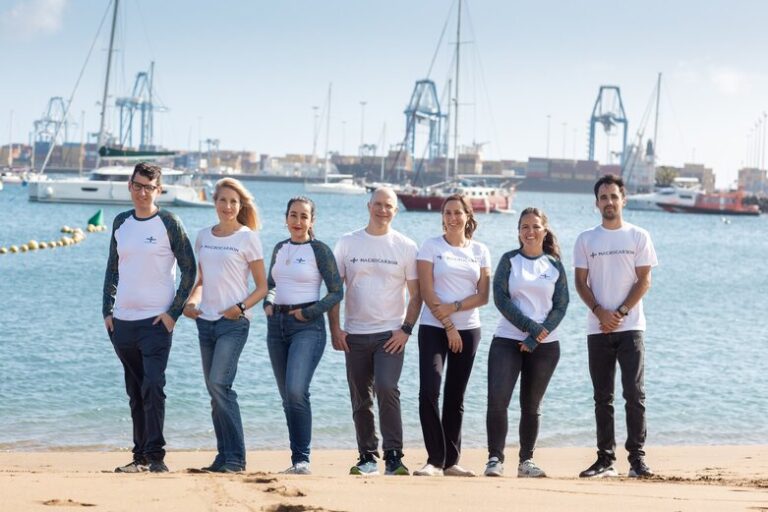
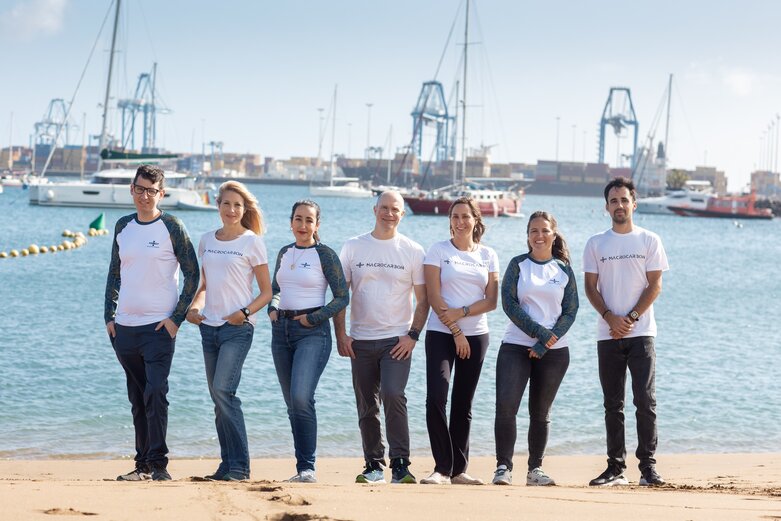
Will Spanish pioneer MacroCarbon significantly drive down the price of eSAF thanks to Seaweed? – Photos: courtesy of MacroCarbon
Spanish startup, MacroCarbon, believes that pathway may come from an unlikely source: marine biomass. Founded by Prof. Dr. Mar Fernández-Méndez and Jason Cole, the company is currently carrying out a proof of concept with Airbus, Iberia, Repsol, and claims it can produce SAF at around EUR 1,000 per ton at commercial scale. CargoForwarder Global spoke exclusively with Fernández-Méndez, MacroCarbon’s Chief Executive and Science Officer.
Not all SAF is created equal SAF is often discussed as if it were a single product. In reality, different production pathways have very different economics, feedstock requirements, and scalability challenges. Used Cooking Oil (UCO) was initially considered the easiest route to scaling SAF. However, its limited availability has led to widespread concerns about fraud, such as the case uncovered in Malaysia in 2025, by a joint investigation by The Straits Times and Climate Home News, where cheap, subsidized virgin oils were allegedly mislabeled as UCO. SAF commands a substantial green premium, and bad actors have exploited the supply chain to bypass environmental regulations and drive deforestation.
eSAF and iSAF offer significant emissions reductions, but their economics remain challenging. Producing renewable hydrogen and capturing carbon dioxide requires large amounts of electricity, making these pathways substantially more expensive than conventional jet fuel.
According to Fernández-Méndez, UCO-based SAF currently trades at roughly EUR 2,000–2,500 per ton, while eSAF can reach EUR 7,000–9,000 per ton. MacroCarbon’s target is approximately EUR 1,000 per ton once fully deployed.
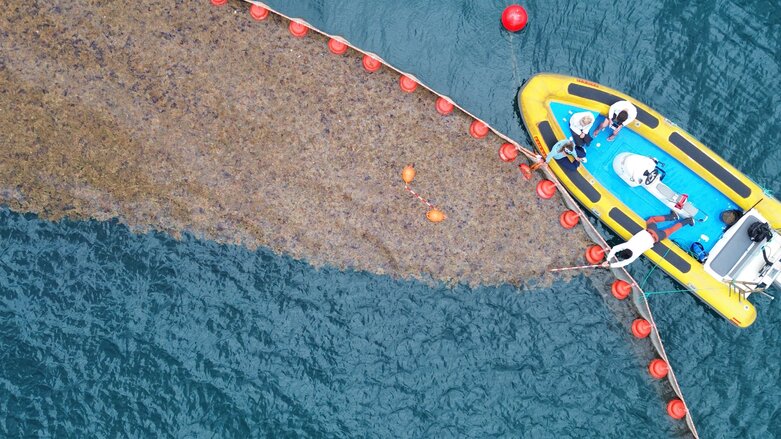
A third pathway uses biomass. Most projects focus on agricultural residues or forestry waste. The startup’s approach is different: marine biomass cultivated offshore. Fernández-Méndez believes the real advantage is not only environmental. The company argues that the ocean offers a scalable source of biomass while generating additional high-value products that improve the economics of SAF production.
According to IATA, scaling SAF production remains a major challenge for the aviation industry, with production volumes still far below what will be required to meet net-zero targets. While MacroCarbon’s target cost would be highly competitive if achieved, many emerging SAF pathways have historically encountered cost overruns during scale-up and commercialization.
Building a SAF supply chain offshore The Canary Islands-based developer is currently carrying out a proof of concept with Repsol, Airbus, and Iberia. The airline Vueling will test SAF blends produced by MacroCarbon in a laboratory-scale aircraft engine in Barcelona.
Can marine biomass be produced at sufficient scale and cost?
Under the planned deployment, the project consists of approximately 6 km² of aquaculture farms. This does not mean a single 6 km² installation, but multiple modules of 40,000 m² each, distributed across different locations and together totaling 6 km².
“Our current farm is located in the Port of Las Palmas de Gran Canaria, Spain. The 40,000 m² farm will be situated near the Oceanic Platform of the Canary Islands, which is located a few miles south of the Port of Gran Canaria,” Fernández-Méndez explains.
Can the economics work? The biomass harvested from these farms would be processed in a dedicated facility equipped with six gasification lines using pyrolysis technology and a small-scale Fischer-Tropsch unit to convert the biomass into SAF.
While MacroCarbon’s feedstock is unconventional, its gasification and Fischer-Tropsch process relies on established technologies. The key challenge will be demonstrating that marine biomass can be produced at sufficient scale and cost.
According to MacroCarbon, the processing plant would require approximately EUR 90 million in investment, while the aquaculture farms themselves would require around EUR 10 million, bringing total project CAPEX to roughly EUR 100 million. The company estimates production costs could reach approximately EUR 1,000 per ton under its projected operating model. The figure remains subject to validation through commercial-scale operation. If achieved, that would place the fuel below current UCO SAF pricing and dramatically below most eSAF pathways.
The project is expected to produce around 8,000 tons of SAF annually. At approximately EUR 100 million in total capital expenditure and an annual SAF output of 8,000 tons, long-term profitability will depend not only on fuel sales but also on revenues generated from biostimulants, fertilizers, and other co-products.
Europe’s industrial challenge The implications extend beyond passenger aviation. Air cargo operators face the same ReFuelEU blending requirements and SAF-related cost pressures as passenger airlines. Because fuel typically represents one of the largest operating expenses for freighter carriers, the availability of lower-cost SAF could directly influence future airfreight economics. If marine biomass-based SAF can be produced at the costs MacroCarbon is targeting, it could help reduce the green premium that cargo operators may ultimately pass on to shippers through SAF surcharges.
Fernández-Méndez is blunt about what she sees as Europe’s biggest challenges: fragmented and lengthy bureaucracy, combined with a venture capital system that remains heavily focused on software and AI.
The permitting process alone illustrates the problem. It took nine months to obtain approval for MacroCarbon’s farm in Las Palmas, despite the project being located in an area specifically designed for marine innovation and testing.
Financing is another challenge. While software and AI startups promise investors rapid returns, industrial projects require larger investments and longer timelines. “We need patient and non-dilutive capital and governments to get involved, basically China’s approach,” Fernández-Méndez says.
Europe has already paid a price for delaying difficult industrial decisions. The automotive sector is a recent example. Choices that once appeared too expensive became far more expensive once global competition accelerated.
Aviation has always been defined by flexibility and speed. The question is whether regulators, investors, and the industry itself can move fast enough to secure the SAF volumes it will soon be required to use. The challenge is even greater when alternative fuels must compete against an incumbent energy system that continues to benefit from decades of infrastructure, scale, and public support.
The real constraint may not be feedstock availability, but Europe’s ability to finance and permit industrial-scale SAF projects before competitors do.
How major SAF pathways compare While UCO remains the dominant commercial SAF feedstock today, concerns over feedstock availability are driving interest in alternative pathways. Marine biomass is among the newest approaches and could offer competitive economics if commercial-scale production targets are achieved.