Home Blog Page 21

Blended wing aircraft on the advance

The latest news from California is likely to have been noted with interest by Airbus, Boeing, and China’s state-owned company Comac. Two newcomers are on the verge to turning their blended wing aircraft from vision into reality. Their names: Natilus from San Diego and JetZero from Long Beach. Both have a similar focus: designing delta wing aircraft for next-generation passenger and cargo transport.

Natilus evolved its EVO passenger plane from a single-deck to a dual-deck aircraft, enabling cargo transports – credit: Natilus

With their latest announcements, both newcomers are throwing down the gauntlet to established aircraft manufacturers that keep sticking to traditional tube-and-wing jetliners. Should their models be commercially successful, it would significantly increase the pressure on Airbus and Co. to develop blended wing aircraft themselves. And that point in time is not far off anymore. Seen by the cargo version KONA developed by Natilus that is expected to fly within the next 24 months. Currently, the developer is actively pursuing FAA Part 23, Amendment 64 certification for its blended wing aircraft and is determining a location for a new 23,225-square-meter manufacturing facility to build 60 KONA freighters per year, the company reports.

There is no shortage of investors
Progress is also being made in financing the development programs. Natilus has closed a US$28 million Series A round led by Draper Associates with participation from Type One Ventures, The Veterans Fund, and Flexport. And new investors are taking notice, including New Vista Capital, Soma Capital, Liquid 2 VC, VU Venture Partners, and Wave FX.

Cross-section of the new twin-hull version of the blended wing version of Natilus, which visualizes the transport of air cargo in the lower deck of the jetliner –  courtesy: Natilus

The fundraising is complemented by a PR offensive initiated by Aleksey Matyushev, co-founder and chief executive of Natilus: “There’s a shortfall of 15,000 commercial airplanes. We need to modernize the United States to build a modern Original Equipment Manufacture [OEM]. We bring cutting-edge technology to increase the product margins while increasing the manufacturing base in the United States.”

Demand is remarkable
According to its website, the frame maker has collected 570 orders from commercial airlines for its blended wing aircraft worth an aggregate of US$24 billion. It presented and operated a prototype last year and conducted testing, giving customers confidence in its program.

Meanwhile, Natilus has introduced significant design changes to its passenger aircraft HORIZON EVO. The updated version of the variant shifts from a single-deck to a double-deck configuration. This allows air freight to be taken on board, ups revenues, speeds up turnaround times while maintaining compatibility with existing airport infrastructure.

HORIZON EVO is designed to accommodate up to 250 travelers as well as standard cargo containers. It combines the ability to carry both passengers and freight at lower fuel burn. Natilus aims to achieve FAA certification for the EVO and launch commercial flights in the early 2030s.

Founded in 2020, JetZero’s Z4 (pictured here) is being touted as the world’s first commercial all-wing aircraft – credit: JetZero.

JetZero claims to set a new benchmark with its Z4
Simultaneously, Aerospace startup JetZero from Long Beach has also successfully tapped into new sources of funding. The newcomer has raised approximately US$175 million in its Series B financing, led by global multi-stage investment firm B Capital. 3M Ventures, United Airlines Ventures, Northrop Grumman, Trucks VC and RTX Ventures, the corporate venture capital arm of RTX, participated in the round. Thanks to the new capital, JetZero can speed up the development of a prototype expected to achieve 30% improved aerodynamics compared to traditional aircraft.  

Long range at cheaper costs
“JetZero is redefining aviation with its all-wing aircraft, setting a new benchmark for efficiency, cost and the passenger experience,” stated Jeff Johnson of investor B Capital.   “As aviation faces rising emissions and fuel costs, the need for a step change in efficiency has never been greater. JetZero is positioned to reshape the industry, and we’re proud to partner with the team as they advance this groundbreaking technology.”

According to the manufacturer, the Z4 can transport 250 passengers over 9,000 kilometers – equivalent to a nonstop flight from San Francisco to Frankfurt – with significantly lower fuel consumption compared to today’s aircraft variants. The company has not disclosed the role air freight plays for the configuration of its aircraft.

JetZero further announced to set up a plant in Guilford County, North Carolina, to manufacture its Z4 jetliner, creating up to 14,500 jobs. Its design studios will be kept in Long Beach.

Automating Air Cargo: Robo-Ops – Part 2

In Part 1 of our 3-part series on air cargo automation, Manuel Wehner (MW), Project Manager and Research Associate at the Fraunhofer Institute for Material Flow and Logistics IML, touched on the overall autonomous robot testing/maturity situation in the industry, and the general scope for the future. In Part 2, we take a more detailed look at the robot projects trialed by Fraunhofer IML and Digital Testbed Air Cargo (DTAC), at Germany’s Munich (MUC) and Stuttgart (STR) Airports.

One of the 5 robots tested as part of the DTAC project. Image: Fraunhofer IML /  CFG/hs

CFG: Can you tell me a bit about the individual robot projects you are working on? Which have been piloted already (and where) and to what success?

MW: In the Digital Testbed Air Cargo (DTAC), funded by the German Ministry for Digitalization and Government Modernization (BMDS) with €13.7 million, we have already tested five different robots at the two partner airports Munich (MUC) and Stuttgart (STR). Two-and-a-half of which are Fraunhofer IML’s own research prototypes. They were developed by us as the consortium leader: O³dyn (pallet transport robot), evoBOT (piece handling robot), and a modified version of Boston Dynamic’s Spot (autonomous patrols and information gathering). These were complemented by Aurrigo’s AutoDolly Tug (ULD transports) and Götting KG’s Linde E20 forklift (storage pallet transports) as a retrofit automation solution.

AutoDolly Tug was tested at STR under the supervision of Frankfurt University of Applied Sciences; the other four were tested at MUC under IML’s lead. Furthermore, we tested IML’s openTCS as an open-source and manufacturer-independent centralized control system software. Some test insights are shared on Youtube.

In these test scenarios, we tested the five robots in air cargo import live operations between the aircraft position airside (highloader hand-over point) and RFS truck docks landside (truck loading hand-over point), with apron roads, checkpoints, and warehouses in-between. The process is as follows: AutoDolly Tug picks up ULDs from the highloader and transports them to the air cargo warehouses. After palletizing the cargo on LSPs manually – it is still a major challenge for robots to haptically deal with the little to no standardization in ULD loading around the globe – Spot identifies ready-to-store LSPs on its autonomous patrol, which triggers the forklift to transport these to the automated stacker system. After the forklift delivers ready-to-be-picked-up LSPs to the ramp, O³dyn picks up EPALs from the LSPs and transports them to other airport warehouses, where evoBOT picks up single pieces from the EPALs.

CFG: What do LSP and EPAL stand for?

MW: We use LSP as an abbreviation for Large Storage Pallet, which, in German, is a common term for certain metal pallets (“Großlagerpalette”) used in air cargo warehouses. Our robot fleet, which we tested at Munich Airport in 2024, was deployed to identify ready-to-store LSPs (with a patrol robot dog) and to then pick up and transport these LSPs (transport robot) and eventually pick up smaller standardized wooden euro pallets (EPALs) from these LSPs (another transport robot).

CFG: What is your approach to automation?

MW: We explore automation potential in a holistic way, with an airport automation vision extending beyond cargo operations, and knowing that a perfect robot does not exist. It will likely never exist, so we must continue dealing with a multitude of different solutions, manufacturers and pallet types.

To our knowledge, our current approach represents the world’s first scientific testbed for such a mixed robot fleet in an airport environment. We conducted a total of 3 months of intensive live testing, following on extensive laboratory testing.

CFG: How successful have your tests been?

MW: The individual success rates depend on the criteria used. We tested isolated functionalities, ideal world scenarios without disruption and, of course, we ambitiously and creatively challenged the robots. That was fun! For example, we had the fire brigade wet the apron, we placed all sorts of static and dynamic hindrances including humans crossing the driveway and plastic foil, we used different types of cargo, and we loaded pallets unevenly. It is not our goal to identify the ideal solution. We aim to better understand automation potential based on real-life tests and are currently developing a new robot for ULD handling from scratch, along with an updated version of openTCS as a control system. It is worth mentioning that not all use cases require level 5 autonomy and expensive new smart functions. For many cases, good old automation solutions from other industries, like maritime, production and distribution, could be a decent fit.

As Fraunhofer, representing Europe’s largest non-profit applied research organization, we think far beyond specific use cases. We view logistics automation as a goal yet to be achieved in environments such as airports and air cargo facilities. This is why we develop prototypes and software not only for cargo transport and handling, but also for all sorts of ramp and terminal automation, such as the aircraft turnaround. New solutions, based on swarm intelligence, will facilitate securing aircraft with autonomous chocks and cones, among other ideas. We work on different projects simultaneously, and we always look at economies-of-scale and long-term impact for aviation stakeholders.

CFG: Of those robots tested so far – which are the most mature and ready for commercial use?

MW: As mentioned, we employed both market solutions and research prototypes. We have evaluated all of them for their autonomy levels and their test success rates within the defined test scenarios. We are aware, and it must be mentioned, that none of the tested solutions is suitable for overnight implementation. There is still lots of work to do to have these robots operate by themselves in an air cargo environment, and to our knowledge there is no autonomous solution yet operating at level 5, no matter what marketing brochures suggest.

This means, no matter what solution is being evaluated, it will either be a level 3 to 4 automated solution that might be scalable already but not autonomous, or a level 5 prototype, which still needs further development regarding airport-specific challenges, such as taxiway crossings, dynamic obstacle avoidance, etc.

CFG: What about O³dyn and Spot? Can they also function outside in adverse weather conditions? (Snow, hail, ice?)

MW: While both robots are designed for outdoor usage, difficult weather conditions remain a serious challenge for sensors. With our trials, we could show that rain, indoor-outdoor temperature differences, and exposure to direct sunlight do somewhat affect the robots’ performance. However, they already deal fairly well with that in many scenarios. Snow, hail and ice are extreme weather conditions that are being investigated in winter-specific projects, such as de-icing and snow clearing trucks. It is not impossible to deal with extreme weather conditions, however, employing the required sensor mix in every 365/24/7 robot will make the unit costs even higher than they already are.

We expect this development to continue in two tracks for a while – standard robots not suitable for extreme weather conditions, and specialized solutions for outdoor operations in winter times. Eventually, these two tracks could obviously be brought together once prices start matching expectations.

Thank you, Manuel Wehner. In our third and final part of this interview series, next week, we will talk about Circular Economy, costs, safety, and the future warehouse set-up: man and/or machine?

Spotlight on… Boeing 777F, Freighter, Major Cargo Airlines

0

Each week, CargoForwarder Global shines its ‘Spotlight On…’ a specific segment of the air cargo industry and usually hands the mic to a human individual to explain their function and share their opinions and experience. Every now and again, the ETA of responses landing in CargoForwarder Global’s inbox doesn’t quite match the STA, and an alternative is found. Air cargo wouldn’t work without aircraft, so this week, the seven standard questions are answered from the point of view of a Boeing 777 Freighter (B777F) – the newest workhorse in the fleet of many leading cargo airlines.

Quietly keeping the world moving. Image: Albion Aviation Group

CFG: What is your current function and company? And what are your responsibilities?

B777F: I’m a Boeing 777 Freighter, part of a global cargo airline’s long-haul fleet. My main job is to carry everything from e-commerce parcels and vaccines to oversized machinery (and a great deal more in between), across continents. Once the cargo doors shut, it’s all about efficiency, punctuality, and keeping the supply chain aloft – literally.

CFG: What does a normal day look like for you?

B777F: A ‘normal’ day is anything but ordinary. Sometimes I’m climbing out of Hong Kong with a full load of electronics bound for Europe; other times, I’m crossing the Atlantic with perishables that can’t afford a delay. One night, I’m gliding over the North Sea under a full moon, and the next day, I’m baking in the Middle Eastern heat on the tarmac. My days and nights revolve around tight turnarounds, cargo load checks, and the rhythmic hum of jet engines. We freighters live by the clock of global trade.

CFG: How long have you been in the air cargo industry, and what brought you to it?

B777F: I joined the skies in the late 2000s – a younger freighter generation built for range, payload, and fuel efficiency. I was drawn by the challenge and diversity of what I carry: vaccines that save lives, live animals bound for new homes, high-value electronics, disaster relief supplies – the very heartbeat of the global supply chain. And though I’m proud of my cutting-edge design, I owe deep respect to my elder, the Boeing 747F, also known – and rightly so! – as the ‘Queen of the Skies’. She showed the world what true long-haul freight could be. I’m just carrying the torch forward, in a more fuel-efficient suit.

CFG: What do you enjoy most about your job?

B777F: The sense of purpose. Every pallet and container that I carry, tells a story – a business counting on the just-in-time delivery of a spare part, a family waiting for life-saving medication cargo, or a community rebuilding after a storm. There’s power in knowing that I help make those connections possible. Plus, there’s nothing quite like cruising at 35,000 feet with a full load and a clear sky ahead.

CFG: Where do you see the greatest challenges in our industry?

B777F: Balancing growth with sustainability. We fly because the world demands speed, but that speed must come with responsibility. Sustainable aviation fuels, smarter routing, and digital efficiency are no longer optional – they’re our new flight plan. Add to that the constant market turbulence – yield drops, over/undercapacity, regulatory pressures – and you get an industry that can’t afford to stand still. The key is adaptability – both on the ground and in the air.

CFG: What advice would you give to people looking to get into the air cargo industry?

B777F: Think of cargo as aviation’s crossroads of technology, logistics, and people. Whether you’re training as an operations planner, a loadmaster, or an analyst, stay flexible and learn how the full network works together. Courses in supply chain management, aviation technology, or sustainability will give you wings. Most of all – stay curious and tech-savvy. This industry isn’t just about airplanes and pallets anymore – it’s about data, automation, and global coordination. Learn the language of logistics and bring an appetite for innovation. This business rewards those who love thinking in global dimensions.

CFG: If the air cargo industry were a film/book, what would its title be?

B777F: ‘Lifting the World: The Invisible Engine of Trade’. It would be a sweeping global story – starring freighters like me and the iconic 747F – full of night flights, close calls, and unsung triumphs that keep the world moving, one closed cargo door at a time.

Thank you, B777F.

If you would like to share your personal air cargo story with our CargoForwarder Global readers, feel free to send your answers to the above questions to cargoforwarderglobal@kopfpilot.at We look forward to shining a spotlight on your job area, views, and experiences.

Costa Rica – Green Strategy pays off

0

The difference could hardly be greater. While north of the Rio Grande under Trump, the decarbonization of the economy and industry was put on hold, a nation located about 2,500 km south of it is celebrating great success with its green strategy: Costa Rica. Antonio Lehmann Gutierrez provided evidence of this at the Fruit Logistica trade fair in Berlin in an interview with CargoForwarder Global. He is the Central American state‘s Ambassador to Germany.

Antonio Lehmann Gutierrez is Costa Rica’s ambassador to Germany – photo: CFG/hs

The message is unmistakable: “#1 among tropical countries in reversing deforestation,” reads the large banner above Costa Rica’s stand at the Berlin-held trade show. The opposite, namely the clearing of natural forests, leads in the long term to economic decline and the impoverishment of the population, not to mention the gradual loss of biodiversity, stresses the diplomat. “Not so long ago, we exported almost exclusively coffee, bananas, pineapples and wooden products. Many forested areas fell victim to this. Our natural resources were destroyed, so we decided to stop and reverse this kind of exploitation of nature.”

Economic U-turn
Today, 60.4% of Costa Rica’s land mass is tree-covered again. Parallel to reforestation efforts, the Costa Rican government launched an education campaign. The result: 8% of GDP is invested in schools and universities, and one-third of the country’s land area has been declared protected areas. At the same time, there was a shift in tourism strategy. The country focused specifically on environmentally friendly eco-tourism rather than mass tourism. 

Amplifying the business
With the slogan “Pura vida – enjoy your life,” visitors were specifically invited to spend their vacations in Costa Rica and enjoy the country’s natural beauty. Foreign companies were encouraged to set up operations in the country with reference to its intact environment. “The prerequisite, however, was that they commit to complying with the sustainability criteria specified by the government,” stressed the Ambassador.

Intel and the pull factor
One of the first global players responding to this call was Intel, which established a branch in Costa Rica in 1993. Starting with 240 employees, it now has 3,800 people working there. In addition, there are suppliers and local service providers. This development, which was also boosted by the arrival of chemical giant Bayer, created a pull factor, attracting other European and U.S. companies. Added to this was the decision by multinationals to scale back their involvement in China and invest in Mexico or Costa Rica instead. “Due to these favorable internal conditions, which also include a well-educated workforce, as well as beneficial  external developments, our annual GDP growth is currently 19 to 20 percent,” says the diplomat. Figures, the entire EU and the U.S. are dreaming of.

Switzerland of Latin America
At the same time, he points to stable democratic conditions and a low crime rate compared to other countries on the American continent. The main beneficiaries of this development are the people of Costa Rica, emphasizes Antonio Lehmann Gutierrez’s. Earnings in Costa Rica are two to four times higher than in all other Latin American countries. Because labor in the agricultural sector is slowly becoming scarce, seasonal workers are being recruited from neighboring countries. “We bring them in seasonally and treat them in a respectful and friendly manner,” emphasizes the diplomat. This attitude sets CR apart. ”As we have no military, we refer to ourselves as the Switzerland of Latin America. Instead, we prefer to spend the money for defense on schools and universities.”

Wide product range
CR has long since moved away from its focus on pineapples, bananas, and coffee. Today, the product range is very diverse and broad, as official figures show: Last year, 644 companies exported 320 agricultural products from Costa Rica to 109 different destinations. Many of these goods were transported by air, such as flowers and other perishable products. In addition, there is an increase in industrial goods such as optical, technical, and medical apparatus, accounting for 44% of all exports, added by pharmaceuticals and electrical machinery equipment. 

Challenges impact production and supply chains
Despite all changes, agribusiness remains a cornerstone of the country’s economy, contributing around 7% to the national GDP and employing nearly 14% of the population. According to a report by the Ministry of Foreign Trade (COMEX), over 50% of Costa Rica’s agricultural exports are sent to markets in North America and Europe. But new challenges are just around the corner, impacting international supply chains. Evolving global trade dynamics, shift towards more protectionist policies, as seen in the USA, and growing demand for sustainable practices (EU) are reshaping the landscape of Costa Rica’s agricultural export market. As a result, many small and medium-sized farmers, as well as larger cooperatives, are navigating these changing conditions with urgency.

Cuba’s airports go dark

0

No kerosene, no flights, no tourists, and no air freight transport. The Caribbean Island is largely cut off from international air traffic. Lighting at José Martí Airport, the capital’s airport, is kept to a minimum. The fuel shortage is the result of the oil embargo imposed by Washington and the regime’s chronic dependence on external sources.

Aeropuerto José Martí – Habana,  few passengers, hardly any air freight, and most lights are turned off at night  –  courtesy: operator

Until now, Venezuela was Cuba’s main supplier of crude oil and aviation fuel. However, since Maduro’s overthrow and imprisonment by the Trump administration, this source has dried up. The result: an increasing number of international airlines have suspended their flights to Cuba or announced doing so due to the worsening fuel shortage. This includes, among others, Air Canada and its national competitors, WestJet and Air Transat. Air Canada said in a statement that aviation fuel is not commercially available at local Cuban airports, as governments issue notices warning that the supply is likely to be unreliable.

Traffic figures plummet
Other airlines such as Iberia, Air Europa, and Turkish Airlines have changed their routes and are making an additional tank stop in the neighboring Dominican Republic. The German leisure airline, Condor, had already announced before the oil crisis that it would stop serving Cuba come spring. This is likely to cause a further slump in air freight exports of Cuban cigars and perishable goods for the country, which is already short of foreign currency.

Germany advised on Tuesday (10FEB26) against all non-essential travel to Cuba. The country is “facing an acute energy crisis, which is also being compounded by widespread dilapidated energy infrastructure,” the German foreign ministry said in its announcement. “The shortages are affecting all areas of life, including medical care.”

Fuel instead of cargo
Copa Airlines from Panama has found an alternative solution. The carrier refrains from loading air freight in the lower decks of its passenger jetliners on routes between its home base, Tocumen International, and Havana’s José Martí Airport. This saves weight and allows an increased amount of kerosene on board to ensure a safe round trip.

The three major U.S. carriers, American Airlines, Southwest Airlines, and Delta Air Lines, which serve routes between Florida and Cuba, are taking a similar approach. They haven’t canceled their Cuban services because their aircraft are capable of carrying sufficient kerosene to operate safe roundtrips, they unanimously declared.

In contrast, the Russian airlines, Rossiya and Nordwind, will only continue to fly there until around 4,000 Russian tourists have been flown out. Then it’s over. Communist Cuba has been a favorite destination for Russian tourists since the days of Fidel Castro. In other words: for more than 60 years.

Fuel shortage becomes systemic crisis
The oil shortages have threatened to plunge Cuba into complete darkness, with power plants struggling to keep their operations running. The government’s decision to restrict fuel sales, reduce banking hours, cancel cultural events, and implement a four-day working week for state-owned companies, demonstrates how grave the situation has become. In Havana, the public transport system has effectively ground to a halt, leaving residents stranded as endemic power outages and grueling fuel lines reach a breaking point.

Historically, Venezuela was the biggest supplier of oil and jet fuel to Cuba followed by Mexico. Oil from Caracas covered around 30% of Cuba’s energy needs, with between 32,000 and 35,000 barrels per day.

No relief from Mexico
Mexico only ever shipped a fraction of the oil that came from Venezuela. Mexican President, Claudia Sheinbaum has now confirmed that oil shipments to Cuba are “on hold” following U.S. President, Donald Trump’s threats to impose tariffs on any country that provides oil to the Caribbean island.

Nicholas Watson, Managing Director, Latin America, at consulting firm, Teneo, summarized the situation with a grim forecast that is unlikely to please those in power in Havana: “The economic crisis is so severe that it could be existential for the regime.”

Cuba’s dire situation is not the result of an isolated event. It is the consequence of decades of mismanagement, of an economic model that never generated real wealth or autonomy, and of a chronic dependence on external allies who can no longer – or do not want to – sustain the island.

IATA sets agenda for 2026 World Cargo Symposium in Lima

The International Air Transport Association (IATA) has outlined its program for the 2026 World Cargo Symposium (WCS), highlighting priorities that reflect the evolving dynamics of global trade and air-cargo operations. The event will be held in Lima, Peru from 10–12 March and — for the first time — takes place in South America, underscoring the region’s growing role in global logistics.

IATA Director General Willie Walsh outlined his organization’s schedule for the upcoming WFS in Lima – photo: IATA

Under the theme “Advancing Air Cargo in a Dynamic World,” IATA says the symposium will examine shifting trade lanes, regulatory developments, the latest progress in digitalization and emerging practices in special cargo handling. Delegates will explore how industry players can respond to geopolitical uncertainty, tariff changes and supply-chain pressures while enhancing speed and reliability across freight networks.

The program includes core sessions on digitalization and regulatory frameworks, as well as spotlight workshops on sustainability, technology adoption and operational resilience. Dedicated forums will address future talent development, data standards such as ONE Record, and specialized sectors including e-commerce and lithium-battery safety — the latter accompanied by a preview of IATA’s LAR Verify compliance solution for live animal shipments.

IATA Director General Willie Walsh framed the symposium as a platform for industry alignment amid ongoing trade volatility, noting that air cargo’s recent growth — including a reported 3.4 % increase in demand in 2025 — has tested global supply chains and highlighted the value of agility and collaboration.

Lufthansa Cargo announces key leadership changes to strengthen market focus

Lufthansa Cargo has announced a series of management appointments aimed at reinforcing its commercial and regional leadership as the airline continues to navigate evolving global freight markets. Among the changes, Gunnar Löhr has been named Head of Region DACH & KAM EMEA, bringing extensive operational experience to the role overseeing Germany, Austria, Switzerland and key account management across Europe, the Middle East and Africa.

Known faces, new responsibilities at LHC, (left to right): Gunnar L?hr, Philip Rauchhaus, Markus Cirjan  –  credit LH Cargo

In parallel, Markus Cirjan will assume responsibility for Hub Management at Munich, one of Lufthansa Cargo’s most important operational gateways outside Frankfurt. Cirjan’s career spans leadership positions in sales and handling across major US stations, underscoring the company’s emphasis on strengthening performance in strategically significant hubs.

Effective from January 1, 2026, Philip Rauchhaus became Vice President of Global Revenue Management and Pricing, a role central to optimizing commercial performance across the airline’s global network. His appointment reflects Lufthansa Cargo’s broader push to refine pricing strategies in a market shaped by capacity shifts and demand volatility.

Company executives say the leadership changes are designed to streamline decision-making, boost regional accountability and sharpen commercial focus. Priorities for Lufthansa Cargo as it seeks to enhance customer responsiveness and competitive positioning in 2026 and beyond.

Silk Way West advances fleet renewal with fourth Boeing 777 Freighter

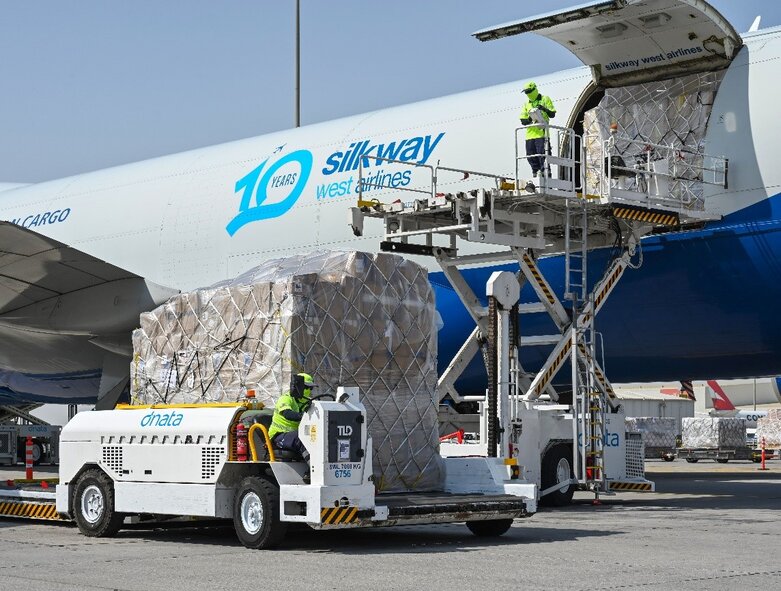
Silk Way West Airlines has taken delivery of its fourth Boeing 777 Freighter, continuing the steady execution of its long-term fleet renewal strategy and reinforcing its focus on modernizing long-haul cargo operations. The aircraft arrived in Baku following a direct ferry flight from Seattle and forms part of an order for six 777Fs, positioning the airline to progressively replace older widebody freighters and improve overall fleet efficiency.

Silk Way West’s Tripple Seven freighter fleet is growing – company courtesy

The latest delivery follows the phase-out of two Boeing 747-400 Freighters and underlines the carrier’s transition towards next-generation aircraft offering higher payload performance, extended range and improved fuel efficiency. With two additional Boeing 777 Freighters scheduled for delivery in 2027, Silk Way West expects to complete the first phase of its renewal program, establishing a more streamlined and modern core fleet for its intercontinental cargo network.

Wolfgang Meier, President of Silk Way West Airlines, said: “The delivery of our fourth Boeing 777 Freighter demonstrates our disciplined approach to fleet renewal and our ability to deliver on long-term strategic commitments. By transitioning away from older aircraft and introducing next-generation freighters, we are strengthening our operational performance, supporting sustainability objectives, and laying a solid foundation for the next phase of fleet modernisation.” Looking ahead, the airline plans to launch a second renewal phase from 2028, including Airbus A350 Freighters and Boeing 777-8 Freighters, supporting both capacity growth and continued efficiency gains as Silk Way West expands its global cargo footprint.

WFS en route to airside access at BRU

0

Following earlier attempts in the past, WFS and Aviapartner are negotiating a take-over of the latter’s cargo handling business by the former. This may bring airside access to WFS. “The transaction concerns only the cargo handling entity operating at Brussels Airport and is subject to the usual approvals and closing conditions,” Brussels Airport says in a flash press release. “Following completion of the agreement, WFS will take over the activities currently performed by Aviapartner Cargo, including cargo handling, full-freighter ramp handling and cargo and mail handling activities. All parties, including Brussels Airport Company, will work together to ensure a smooth transition of services.”  

WFS grows in BRU  –  credit: WFS

The operation does not include the cargo handling activities at Ostend-Bruges and Liège Airport. In view of the on-going regulatory process, WFS has declined any comment until this is completed.

Since last October Aviapartner has been one of the three handling companies that secured a license for full freighter handling at BRU, together with Menzies and dnata. To date WFS is operating as second-line handler, with no tarmac access. It is expected that the license held by Aviapartner may be part of the dowry, but eventually the Belgian Civil Aviation Authority and Brussels Airport will have the last say.

The take-over initiative is not the first courtship of the two companies. In 2012 plans were forged for a merger through a share swap, but that scheme fell through in 2013.

Brussels Airport points out that “Aviapartner Cargo has been a long-standing and reliable partner at Brussels Airport, active in the cargo zone since 1980.”

The origins of the company go back even further. It was founded in Antwerp in 1949 under the name Herfurth Air Service, as a subsidiary of ship agent Herfurth & Boutmy, primarily to perform the handling of ships spare parts flown in at Antwerp Airport. The company changed its name to Belgavia in 1968, and then to Aviapartner in 1999.  

Cathay Pacific deepens SAF commitments with growing global partner network

Cathay has recorded another milestone year in its Corporate Sustainable Aviation Fuel (SAF) Program, with partner commitments more than doubling year on year as corporate and cargo customers intensify efforts to decarbonize air travel and freight. Building on momentum since the program’s launch in 2022, Cathay reported SAF commitments of around 17,400 tons in 2025, nearly 180% higher than the previous year and equivalent to a lifecycle reduction of approximately 54,600 tons of CO₂e.

Cathay Pacific has become SAF thirsty – picture: company courtesy

The growth was driven by 17 global partners across cargo, logistics and corporate travel, underlining the program’s increasing relevance for supply-chain decarbonization. Cargo players played a central role, with Kuehne + Nagel remaining the largest cargo contributor, while collaboration with DHL Express enabled the first SAF uplift on flights operated by Air Hong Kong, a wholly owned subsidiary of the Cathay Group. New and existing long-term partners, including Microsoft, DSV and Ernst & Young, committed to multi-year participation, signaling sustained demand for scalable SAF solutions in air cargo and business travel.

Cathay Group Chief Executive Officer Ronald Lam said: “The growing collaboration between our corporate customers and SAF suppliers through the Corporate SAF Program is a powerful example of how partnership can help scale SAF adoption. While the progress in 2025 is encouraging, supportive policies and effective market incentives will be critical to achieving aviation’s long-term decarbonization goals.” Alongside customer commitments, Cathay continues to expand SAF availability through partnerships with global fuel suppliers and targeted investments aimed at accelerating SAF production, reinforcing its position at the forefront of SAF adoption in Asia’s air cargo and passenger markets.