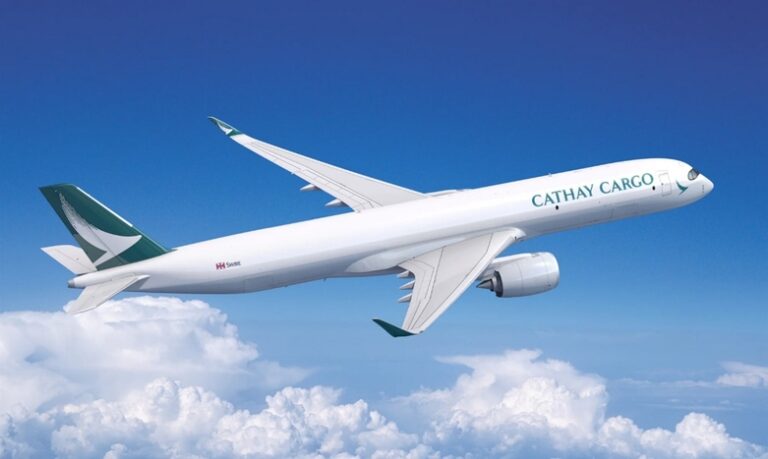
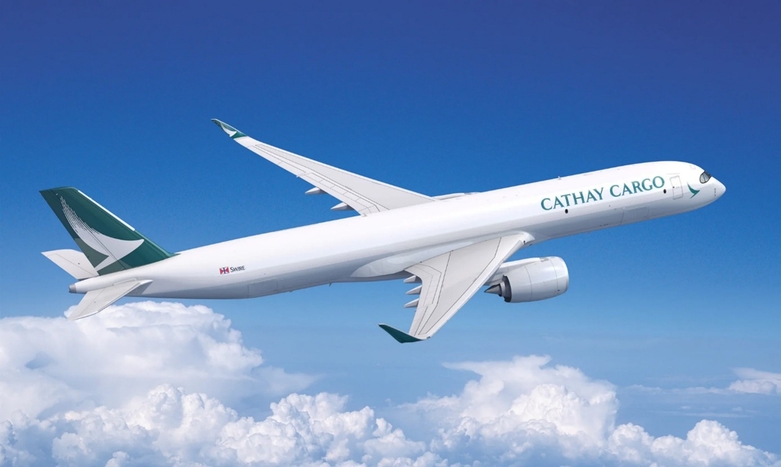
Picture: Airbus A350F in Cathay livery – credit: CX
Cathay Pacific Airways has expanded its future freighter fleet plans with the addition of two more Airbus A350F aircraft, increasing its total order commitment for the next-generation freighter to eight aircraft.
The additional order follows Cathay Cargo’s initial commitment for six A350Fs announced in 2023 and forms part of the group’s broader long-term fleet renewal and expansion strategy.
According to the company, the new aircraft will further strengthen cargo connectivity between Hong Kong, mainland China, and key international markets across Cathay Cargo’s global network. The investment is also intended to support Hong Kong International Airport’s position as one of the world’s leading air cargo hubs.
The Cathay Group is currently ranked among the five largest cargo airline groups globally in terms of cross-border air cargo capacity, based on available freight tonne kilometres, while Hong Kong International Airport has repeatedly been named the world’s busiest cargo airport in recent years.
“We are pleased to further strengthen our fleet with these additional A350F freighters that will provide greater connectivity at our home hub and more choices for our customers,” said Ronald Lam, Chief Executive Officer of the Cathay Group. “This strategic, future-ready investment reflects our confidence in our long-term growth prospects and supports Cathay Cargo’s goal of being the world’s best air cargo carrier.”
The Airbus A350F is designed as a more fuel-efficient and lower-emission freighter aircraft, supporting Cathay Group’s broader sustainability objectives while modernizing its cargo operations.
The eight new A350Fs will complement Cathay Cargo’s existing freighter fleet of 20 Boeing 747 aircraft, including 14 B747-8Fs and six B747-400ERFs. In addition to dedicated freighter operations, the airline also offers belly cargo capacity through its passenger network serving more than 100 destinations worldwide. The Cathay Group said it currently has more than 100 aircraft on order across narrowbody, regional widebody, long-haul, and freighter segments as part of its long-term investment programme focused on fleet growth, digital innovation, and customer experience enhancements.
On 11JUN26, the World Cup kicks off in Mexico, the U.S., and Canada. Thousands of international spectators are expected to show up, most of them coming to the U.S., where most games will be played. They all will have to pass through immigration after landing, for instance at Newark Liberty Airport. But instead of upping personnel, Homeland Security Secretary Markwayne Mullin plans to redeploy customs and immigration officers to assist federal officials in stamping out the ongoing protests against a nearby immigration detention facility. Airlines, tourism associations, and business lobbies have now issued strong warnings against this withdrawal of service personnel, affecting passenger and cargo flows severely.
President Trump shakes hands with newly sworn-in Homeland Security Secretary, Markwayne Mullin in the Oval Office on 24MAR26 – courtesy: U.S. Gvmt.
Markwayne Mullin’s intended move would create havoc, warns a joint statement published by the organizations last week. A shortage of customs officers at an airport could lead to a wave of flight cancellations. Airlines might also start advising passengers to fly to other cities. But whether this is a wise recommendation remains to be seen.
Punishing sanctuary cities After all, the measures suggested for Newark could be extended to other U.S. gateways, even though there are no protests there that would require pulling off airport staff to assist detainers of the federal law enforcement agency ICE. It seems that Mullen wants to make an example of Newark as a first step toward further, more significant actions against so-called sanctuary cities. These cities, counties, and entire states have laws, ordinances, regulations, resolutions, policies, or other practices that obstruct immigration enforcement and shield them from ICE – either by refusing to or prohibiting local agencies from complying with ICE detainers. Meanwhile there are 13 States and hundreds of counties and cities that refuse to cooperate with ICE. This said, Mullen plans to set an example in Newark and thereby intimidate opponents of the ICE to make them submissive.
FIFA remains silent In addition to Newark, Homeland Security Secretary Markwayne Mullin is also considering drastic measures against other sanctuary cities that oppose ICE’s deportation policies. These include the FIFA host cities of Los Angeles, San Francisco, Seattle, Boston, and Philadelphia. And the final is scheduled to be held in New York, which in turn brings Newark Liberty Airport into play.
If these and other cities were to be cut off from air travel even for a short period of time, 68 million passengers would be affected and the economy would suffer losses of more than $70 billion, warns the U.S. Travel Association. Critics argue that just before the start of the World Cup, the damage to America’s reputation as a hospitable travel destination would be enormous. The entire catering for the participating soccer teams, the air transport of their equipment, and the import of goods such as medicines and semiconductor chips worth billions of dollars could be jeopardized.
It’s tantamount to sabotage Mullin is using air travel as a lever for his plans. If Customs and Immigration are severely understaffed, chaos looms. In addition, the airlines’ tightly scheduled flight plans would be thrown into complete disarray. “The entire plan borders on sabotage,” stated an administration official who wished to remain anonymous!
For FIFA, the international soccer federation, the politically driven crisis in U.S. air travel comes at an inopportune time. Just last December, FIFA President Gianni Infantino presented U.S. President Trump with a soccer peace prize, effectively as a substitute for the Nobel Peace Prize. And now, chaos in U.S. airspace threatens the participating teams and their supporters.
Mullin – a brown-noser? But perhaps the whole issue isn’t as hot as Mullin made it out to be. “His push is seen internally as more of a personal desire,” a source stated. Mullin has been bringing up the proposal “unprompted during meetings at the White House.”
Insiders at the Department of Homeland Security have revealed that Markwayne Mullin has been whispering in Trump’s ear that he intends to punish sanctuary cities and opponents of the president. In plain words, following the downfall of his predecessor Kristi Noem, the Department of Homeland Security is now led by another opportunist and wimp.
In Part 1 of this series, we examined how Artificial Intelligence is moving rapidly into the operational core of the air cargo industry. What only recently sounded futuristic is now becoming operational reality. AI-driven systems are already supporting airlines, freight forwarders, handlers, and logistics providers in capacity planning, disruption management, forecasting, pricing, and shipment prioritization.
The pressure to accelerate this transformation continues to grow.
Who Will Control the Systems Running Global Cargo Operations? Geopolitical instability, volatile demand, labor shortages, disrupted supply chains, and increasingly complex cargo flows are forcing the industry to rethink traditional operating models. For many companies, AI is no longer viewed simply as innovation. It is increasingly seen as a competitive necessity.
At the same time, the deeper AI becomes integrated into operational control, the more strategic the discussion becomes.
The industry is entering a phase in which operational efficiency alone is no longer the primary issue. Governance, accountability, transparency, and control are becoming equally important. The discussion has therefore shifted from what AI can do to how far operational authority should be delegated to intelligent systems.
Governance Is Becoming a Core Operational Requirement For years, digitalization in air cargo focused primarily on efficiency improvements. Automation, digital booking environments, visibility platforms, and paperless processes dominated investment strategies across the industry.
AI fundamentally changes that environment.
Traditional software follows fixed instructions. AI systems increasingly interpret operational situations independently, evaluate scenarios, prioritize outcomes, and support real-time decision-making. In some operational environments, AI systems are already capable of identifying disruptions and operational risks faster than human control teams.
This development is pushing governance to the center of industry discussion.
As AI systems gain influence over operational workflows, companies are being forced to establish new control structures surrounding transparency, escalation management, system validation, and human oversight. Regulators are moving in the same direction.
The European Union’s AI Act has already classified many transportation-related AI applications as “high-risk systems.” This classification introduces stricter requirements surrounding explainability, accountability, documentation, and human supervision.
For aviation, this development is particularly significant because the industry operates within one of the world’s most tightly regulated safety environments. Operational decision-making has historically remained closely linked to clearly defined responsibility structures. AI increasingly challenges those structures because intelligent systems are becoming active participants in operational processes rather than passive software tools.
The result is a growing industry consensus that AI deployment in aviation logistics will ultimately require governance frameworks that are nearly as sophisticated as the operational systems themselves.
The Human Role Inside Cargo Operations Is Changing One of the most underestimated aspects of AI is its impact on the people working inside the industry itself. Air cargo has always been a people business. Operational experience, improvisation, customer relationships, crisis management, and human judgment under pressure still define large parts of day-to-day cargo operations. Many situations simply cannot be solved through data alone.
But operational roles are beginning to change.
Tasks that once required years of operational experience are increasingly supported by intelligent systems capable of processing far larger volumes of operational data than humans ever could. This creates both opportunity and uncertainty.
For many operational teams, AI can reduce repetitive administrative workloads and allow employees to focus more on strategic decision-making, customer interaction, and exception management. In many ways, AI already functions as what some experts describe as a “cognitive co-pilot”, extending human capabilities through speed, data processing, and scenario analysis.
For experienced cargo professionals, this can feel like operational knowledge is suddenly being amplified by an additional layer of computational power.
And the industry clearly sees the advantages. At the same time, however, the discussion is becoming far more human than technological. The deeper AI moves into operational decision-making, the more the role of the human operator begins to shift.
Operational expertise is gradually evolving from direct process execution toward supervision, validation, and control of machine-supported environments. Cargo professionals may increasingly become supervisors of automated systems rather than traditional operational decision-makers themselves.
And this transformation raises growing concerns inside the industry.
Work in air cargo has never only been about productivity. Operational responsibility also creates identity, structure, experience, and professional value. As intelligent systems take over larger parts of operational analysis and decision support, many professionals are beginning to question how their own expertise will evolve in increasingly AI-driven environments.
This challenge is therefore not only operational. It is cultural. And perhaps even existential.
The industry is entering a phase in which human value may no longer depend primarily on processing information manually, but on the ability to interpret, challenge, and supervise machine-generated recommendations before they become operational reality.
That may ultimately become the defining skill of the next generation of cargo professionals.
Because despite all technological progress, AI still does not “understand” operations the way humans do. Intelligent systems recognize patterns, probabilities, and correlations at enormous speed. But contextual judgment, ethical prioritization, intuition, and accountability remain deeply human capabilities.
And this is exactly why the debate around human oversight is becoming so important.
The more operational authority AI receives, the more critical human supervision becomes.
Not because humans are faster than machines. But because humans remain responsible when systems fail.
Outlook to Part 3 The discussion surrounding AI in air cargo is only beginning.
While operational efficiency and human-machine collaboration currently dominate the debate, the next phase will become even more strategic. As intelligent systems gain greater influence over operational environments, entirely new questions surrounding responsibility, liability, cybersecurity, and technological power are emerging across the industry.
Part 3 of this series will therefore focus on:
liability and accountability in AI-supported operations
growing dependence on technology ecosystems
cybersecurity and operational risk
the concentration of technological power
and why human oversight may become more important, not less, in increasingly autonomous cargo environments
Because the future of air cargo will not only depend on how intelligent AI systems become.
It will depend on how effectively the industry remains capable of controlling them.
In the public eye, Munich is primarily seen as an airport where passenger traffic takes center stage. That remains the case. But now the cargo business is drawing significant attention with remarkably positive figures. The key message is this: Air cargo has become a major revenue driver for airlines operating scheduled flights to/from Munich. It often determines the success or failure of a route. We spoke with Markus Heinelt (MH), Director of Cargo Development at MUC Airport, about the growing role of air freight at his airport. Here is what the executive said.
Belly cargo accounts for the largest volume handled at MUC, says head of cargo, Markus Heinelt – courtesy: Munich Airport
CFG:As stated in our CFG issue from 17MAY26,Central and Eastern Europe are fast becoming new cargo hotspots seen by the tonnage growth in VIE, BUD, WAW or PRG during 2025. Since Munich is also geographically part of this greater region, the question is whether MUC did also experience a significant uptick in volume in 2025?
MH: In 2025, Munich Airport saw a 9.5% increase in cargo, reaching approximately 340,000 tons, while the average growth rate for all German airports was just 1.1%. However, unlike others, we do not include trucked air freight in this figure. If we did, the total would be around 570,000 tons. We can therefore proudly state that we were No.1 in Germany for cargo growth in 2025, and we continue to lead the ranking in terms of tonnage among the other airports mentioned by you.
CFG: Did the upswing continue in the first quarter of this year? And if so, what is your forecast for cargo throughput until 31DEC2026? MH: In January and February 2026, we achieved a growth of 11.7% (ADV/average of all German airports: +3.7%). However, due to the conflict in the Middle East, which began on 28FEB26, this growth momentum could not be sustained, although the first quarter still closed with a 5.2% increase in tonnage (ADV/average of all German airports: +2.4%). Looking at May, we have already returned to a cargo growth rate of just under 8%. Provided there will be no further global conflicts and the situation at the Gulf region is easing up, we expect air traffic to and from the Middle East to normalize again. In addition, we expect long-haul routes to grow further. This will be driven partly by additional flights— for example, Singapore Airlines will increase its service from Munich from daily to ten flights per week, starting with the winter schedule — and partly by new airlines that we will announce shortly. This said, I am optimistic about our cargo performance in 2026.
Growing integrator traffic
CFG:At MUC, belly cargo dominates. Not many freighters are serving the airport. An exception is the integrators. What role do DHL, FedEx at alia currently play and what are their business prospects?
MH: You are right.It is estimated that belly cargo accounts for between 10 to 20% of the revenue generated by passenger airlines on long-haul flights to and from Munich, depending on the routing and market situation. In that regard, it is, of course, very important to us that our airline partners continue to succeed and keep growing their business. Sometimes cargo is the deciding factor for a passenger airline’s decision in favor of an airport or for upping its flight frequencies. Not only the integrators DHL, FedEx, and UPS, but all major airlines are successfully expanding their cargo activities here in Munich seen by their steadily growing volumes and sales figures. The business of the package delivery companies, for example, grew by almost 6% from January until mid-May this year – with corresponding upside potential. Just a few months ago, DHL moved into a brand new, state-of-the-art cargo terminal at MUC Airport. The 105 million euros invested by the integrator are likely to be money well spent and should serve as a springboard for the company’s continued growth here.
CFG: Are flights from e-commerce platforms like Temo, Shein, Shaoke, or Alibaba/Cainiao a topic of discussion in Munich as they are in neighboring Budapest, for instance? Or is Munich not very interested in this kind of air freight? MH: Despite an upcoming change to EU regulations, e-commerce is the ‘new normal’ in air freight and of great interest to Munich Airport. An increasing number of theses shipments are already passing through our airport. However, they cannot be classified by tonnage or volume because this data is not tracked statistically. With 26 million residents in the greater Munich area, we have an excellent catchment area and are highly attractive to e-commerce providers. However, because of certain local conditions, many shipments are still sent to other European airports and then trucked to Germany (as the largest e-commerce market in Europe). This results in longer transit times and additional costs. However, despite these “deviations”, we see excellent opportunities for direct flights and growth.
Strong cargo trade lane TPE > < MUC
CFG:According to information, EVA Air intends to up its passenger services between Taipei and Munich. This would also be good news for your cargo business. Can you deliver specifics?
MH: We are proud that EVA Air decided more than three years ago to choose Munich as airport of choice. MUC is still their only destination in Germany. Consequently, the airline’s German passenger and cargo headquarters is also located at Munich Airport. Due to their successful operations and the high passenger and cargo demand, the flights, which were previously operated with the B789, have been switched to the larger B777. In the cargo industry, this type of passenger aircraft is referred to as a “mini-freighter” because its cargo capacity is exceptionally high – effectively doubling the previous capacity they offered for sale. Taiwan is known for its leading position in semiconductor production, and our region is also home to companies active in this sector. Therefore, the increased capacity offering between the two markets is particularly good news for this industry. Southern Germany accounts for around 45% of the total air freight tonnage between Germany and Taiwan. Therefore, EVA Air’s capacity expansion positively impacts not only our cargo business but also stimulates our local Bavarian industry and their trade relations with Taiwan.
CFG:Finally, MUC intends to expand the Cargo Handling Area. Kindly unveil the plans, allowing our readers to get a holistic picture.
MH: Given our continued growth in cargo volumes, the construction of approximately 15,000 square meters of additional cargo handling space on the apron is currently underway. This space will be ready by the end of the year. However, this is only a small part of our plans for growth in the cargo sector. We will have more information on this coming soon. Stay tuned!
Every week, CargoForwarder Global’s “Spotlight On…” series looks at a particular segment of the air cargo industry through the voice of someone working there. IT solutions companies provide the digital backbone of this complex industry, bringing visibility, paperless data exchange, customs processes, booking and handling support and much more to the complex world of air cargo. CHAMP is one of the few IT solutions providers that cover the entire stakeholder chain from airlines to ground handling agents (GHAs), general sales agents (GSAs), freight forwarders, software houses, and shippers. In other words: true end-to-end reach. This time, Zeta Loo, Head of Sales APAC at CHAMP Cargosystems, takes us through her responsibilities and shares her thoughts and advice for those looking to forge a career within this industry.
Air cargo is diverse and multi-faceted, whilst challenging and rewarding. Image: Zeta Loo
CFG: What is your current function? And what are your responsibilities?
ZL: I am CHAMP Cargosystems’ Head of Sales for the APAC region, which stretches from China in the north, to New Zealand in the south; from Bangladesh in the west to the middle of the Pacific Ocean; and everywhere in between.
Based in Singapore, I work closely with airlines and handlers across the region who want to overcome common challenges such as tighter margins, growing shipment volumes, increasing expectations around speed, visibility and compliance. My focus is on understanding each stakeholder’s operational pain points. Whether it’s fragmented systems, manual workflows, or limited data visibility, my aim is to help them identify the right digital solutions to optimize their cargo operations, unlock new efficiencies and support their business success through CHAMP’s comprehensive digital solutions – covering our cargo management portfolio and more. I also have the pleasure of managing the commercial relationship between CHAMP and some of our key customers.
CFG: What does a normal day look like for you? Or is there such a thing?
ZL: It can be very dynamic because I work across multiple countries and time zones, with customers from different backgrounds and cultures. Sometimes I travel to meet clients directly, while other times, I engage with them remotely, building relationships and trust while supporting sales discussions, commercial matters, and follow-ups. Throughout the day, I also work closely with global teammates on proposals, customer support, and problem-solving. Outside of work, I make it a priority to stay connected with my family daily, whether it’s having conversations during dinner or making time for calls when I’m traveling outside Singapore. Maintaining that balance helps keep me grounded and motivated.
CFG: How long have you been in the air cargo industry, and what brought you to it?
ZL: I have been fortunate to work in enterprise technology sales for the past 15 years. Before that, I started my career doing weight and balance and later worked with both a Cargo GSA and directly within an airline cargo department for several years. I’m grateful that CHAMP recognized the value I could bring to the air cargo industry through a combination of hands-on cargo experience and technology sales expertise.
Just another interesting fact here. When I was in my last regional technology sales job, I was in the position of a shipper and consignee that could never get proper status of my IT equipment delivery for my overseas implementations, that was also a real wakeup call of a comeback as it gave me an even deeper appreciation of the end-to-end challenges within air cargo. That’s why it’s especially rewarding today to see how solutions such as CHAMP’s premium tracking service are helping improve visibility and customer experience across the industry.
CFG: What do you enjoy most about your job?
ZL: There are so many aspects of my job that I enjoy. I gain huge pleasure from dealing with a diverse range of clients across my region and enjoy the opportunity to assist them improving their business processes through CHAMP’s extensive portfolio of solutions. I also work with a great group of colleagues and some outstanding individuals that help with my day-to-day responsibilities. One thing I appreciate about CHAMP is the diversity of our team. I work with talented colleagues from all over the world and really enjoy being part of such an international and diverse culture.
CFG: Where do you see the greatest challenges in our industry?
ZL: One of the greatest challenges is that air cargo involves many different stakeholders including airlines, ground handlers, freight forwarders, customs authorities, and so on, all operating across different systems and levels of digital maturity. Achieving seamless integration and real-time information sharing is not always easy. At the same time, customer expectations continue to increase. Businesses now expect faster responses, real-time tracking, automation, and greater transparency throughout the shipment journey. I do see strong momentum in the industry, especially with solutions involving automation, API connectivity, real-time tracking, and data-driven decision-making. Companies like CHAMP are playing an important role in helping the industry modernize and improve operational efficiency and customer experience.
CFG: What advice would you give to people looking to get into the air cargo industry? Any particular training they should aim for?
ZL: I would certainly recommend the air cargo industry to anyone seeking a career or career change. It is diverse and multi-faceted, whilst challenging and rewarding. And overall, it is fun!
As for training that new industry entrants should aim for:
When I started working in the airport and air cargo, I was a generalist, dealing with everything at the grass roots level of the businesses, with many manual processes. This experience was, to me, invaluable, helping me to understand the business and allowing me to develop along the way. What I learnt from my past roles holds me in good stead today because my practical experience helps me understand the issues my clients face. For any newcomers, should there be a chance to work on the shopfloor of a busy cargo operation to gain an understanding of the overall scope of the business, that is what I recommend.
At the same time, I believe we should not be afraid to improve the way things have always been done. Younger professionals today often have a very natural grasp of technology and can quickly identify ways to turn manual processes into something much more efficient.
If someone has a good idea, they should feel encouraged to raise it respectfully, explain the value clearly, and prove their case through results.
That is what I did previously, and it proved that continuous improvement and openness to new approaches are important for both personal growth and business success.
CFG: If the air cargo industry were a film/book, what would its title be?
ZL: I would call it ‘More Than Cargo’ because behind every shipment there is a business need, a customer expectation, or sometimes even something critical for people’s lives.
Thank you very much, Zeta!
If you would like to share your personal air cargo story with our CargoForwarder Global readers, feel free to send your answers to the above questions to cargoforwarderglobal@kopfpilot.at We look forward to shining a spotlight on your job area, views, and experiences.
The cargo industry is splitting into two camps. One believes automation replaces humans. The other believes automation removes routine work so humans can focus on operational complexity. Both paths make humans more valuable, not less.
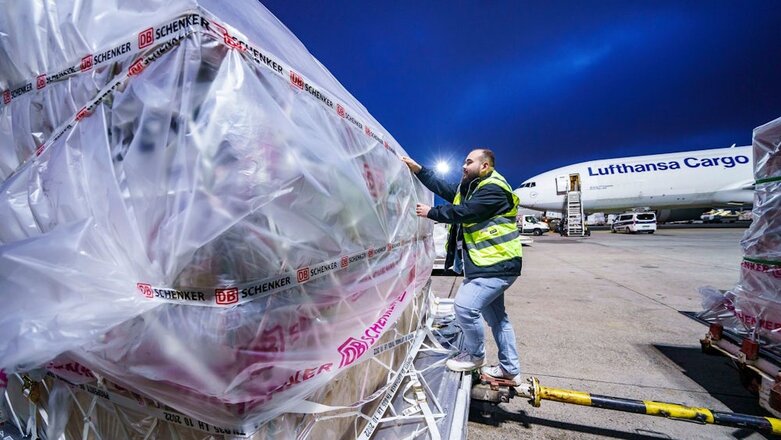
Am Frankfurter Flughafen wird ein Flugzeug mit Luftfracht beladen. (zu dpa: «Lufthansa Cargo: Keine Vorfälle mit Brandsätzen»)
Knowledge-retention crisis While humans are increasingly moving upward in the operational stack, a huge amount of cargo operations currently depends on aging supervisors, undocumented workarounds, and informal relationships. As automation increases and senior people retire, tacit operational knowledge may disappear faster than expected.
A senior warehouse supervisor may know from experience that two simultaneous truck arrivals at a specific dock configuration will block forklift circulation for 20 minutes during peak export build-up. That operational instinct rarely exists inside software logic, yet it directly affects throughput, cut-off compliance, and aircraft loading reliability. How operators improvise under pressure remains deeply human.
Leadership detached from physical reality is the biggest future risk. If decision-makers only see dashboards, they will lose intuition, trust bad data, misunderstand constraints, and optimize unrealistic workflows.
Entry paths and training AI should become a training amplifier, not only a labour replacement. Removing junior roles is not the answer. Those roles should evolve toward exception coordination, judgment environments, customer interaction, and recovery strategy.
The best future operators will understand both cargo operations and digital systems. Most companies are not thinking this way yet.
The Economics of Fragmentation A pharma shipment arriving late from a trucking feeder into Frankfurt misses cargo build-up by 18 minutes. The ULD has already closed. The airline refuses late acceptance. The GHA manually rebuilds another pallet position while customs documents are revalidated. The forwarder escalates to secure uplift on the next flight. Two temperature-controlled shipments sit exposed on the ramp longer than planned while four organizations exchange calls, spreadsheets, and WhatsApp messages to recover the shipment. Nobody owns the recovery process end-to-end.
This is where air cargo still leaks money: not inside the aircraft itself, but at the interfaces between organizations. The industry still runs on fragmented systems, manual coordination, duplicated data entry, and reactive operations.
In a 2025 report, McKinsey Global Institute argues that the largest productivity gains from AI and automation come not from automating isolated tasks, but from redesigning entire operational workflows. In air cargo, that challenge becomes exponentially harder because disruption recovery spans multiple organizations with fragmented incentives and systems.
Why Ground Handling Agents (GHAs) matter GHAs sit at the intersection. That makes them the most exposed, but also potentially the most strategically important. The industry often still underestimates them commercially.
Airlines externalize operational complexity while GHAs absorb execution risk. This increasingly compresses margins. Exception handling remains mostly unpaid: tracing freight, fixing paperwork, handling no-shows, rebuilding pallets, coordinating late cargo, dealing with truckers, and handling customs are often outside standard handling economics. In practice, many GHAs already coordinate operations, but they are still priced like warehouse labour.
GHAs sit on operational data they barely use, while airlines and forwarders would pay for operational predictability if the data were reliable. The risk for GHAs is that they continue creating process visibility while airlines, software vendors, and digital platforms capture the economic value.
Different strategic positions No GHA has fully solved the industry’s core issues yet: cross-company coordination across fragmented cargo systems with misaligned incentives. Swissport continues emphasizing operational standardization at scale, while dnata benefits from its integration within The Emirates Group, allowing it to operate closer to an integrator model than many traditional GHAs.
Yet despite these different approaches, the industry’s core challenge remains largely unresolved: coordinating disruption recovery across fragmented systems, organizations, and incentives.Top of FormBottom of Form
The real battle The industry is not moving toward “humanless cargo.” It is moving toward fewer humans with higher operational leverage.
The real battle is not who has the best AI. It is who controls recovery and decision-making across fragmented cargo systems.
The cargo communities of the airports of Brussels, Liège and Ostend-Bruges have joined forces in a project aimed at digitalizing cargo customs processes. This is the first collaboration initiative between the three air cargo platforms, which facilitates the flow of goods.
Air Cargo Belgium and Customs have learned to ‘speak each other’s language’ – photo: CFG/ms
The project is coordinated by Air Cargo Belgium, in collaboration with its newly-formed Liege counterpart LGG Connect.
A joint newsflash states that through the airports’ community platforms, companies will be able to uniformly exchange customs declarations for import, export, and transit with Belgian customs. To enable this, the airports use the same principles and interfaces, each on their own platform.
This unified approach will facilitate customs processes, further strengthening Belgium’s position as a logistics hub for international trade. In the coming months, this unified approach will be developed and rolled out.
EC initiative The joint initiative follows the further roll-out of the Multi-Annual Strategic Plan for Electronic Customs (MASP-C), the next phase of the E-Customs project initiated by the European Commission in 1997. This led to the development of the Paperless Customs & Excise Systems, through which air cargo companies today still exchange part of their electronic messages with the Belgian Customs and Excise Authorities.
This will be substituted by the above-mentioned MASP-C, which will allow the companies to smoothly follow the further digitisation of customs processes at the European level through their airport’s community platforms.
New portal Specifically, air cargo companies will be able to submit their Temporary Storage Declarations digitally via a new portal on their airport’s data platform: BRUCloud for the cargo community at Brussels Airport and LGG Tracking at Liege Airport. Both platforms will work in the same way for exchanging customs messages. They will also each be separately connected to electronic customs systems for further processing and follow-up of declarations. The customs office’s counter notification is then sent back to the companies via the portal.
CFG asked Nathan Goethals, who monitors customs matters at ACB, why the initial focus is on Temporary Storage. “Because that is the basis on which the customs declaration processes are being built,” he explains. Mr Goethals refers to the growing alignment of the airport’s processes with the Customs Administration, finalized in a Vision Document two years ago.
As a result of this, ACB joined recently joined the National Forum Steering Committee at the Belgian Customs & Excise Administration. The collaboration between BRU and LGG is a first in Belgian aviation history and Ostend-Bruges is also joining. It is the intention to further develop the digital portal before the end of 2026, but Mr Goethals could not yet predict the next stages to follow.
Last week we reported about air freight being featured at the upcoming ILA Berlin Air Show, as a main driver for SAF deployment. But the cost of SAF is still a prohibitive barrier, reaching three- to five-fold levels compared to fossil jet fuel. Since Aviation is a global business, which requires cross-border measures to decarbonize this industry, India is on its way to becoming a key player in the effort to reduce greenhouse gas emissions. Details will be presented and discussed at the ILA.
FedEx grows traffic to/from India. Credit: FedEx
Recently, the airports of Frankfurt and Bangalore celebrated a new air freight partnership, CFG reported.
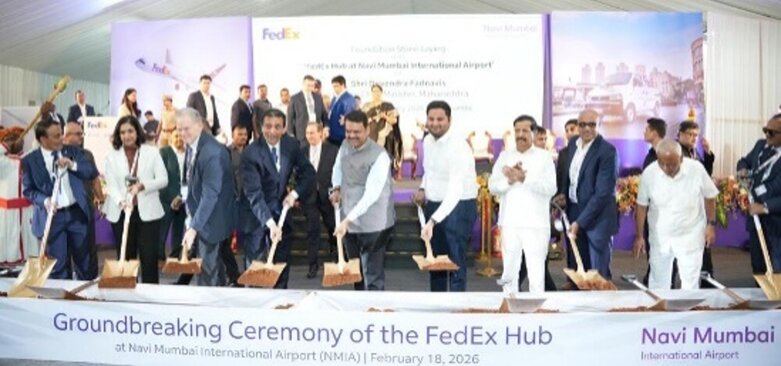
Mumbai progresses too, aligning with Paris and Guangzhou as regional FedEx hub. These signs of business enthusiasm follow the conclusion last January of the India–EU Free Trade Agreement (FTA), and its pivotal role in shaping trade relations between the two partners who together account for nearly a quarter of global GDP.
Sustainability is a key part of the agreement evidenced by the dedicated chapter on Trade and Sustainable Development (TSD) standing in the EU-India trade treaty. The chapter builds on existing international commitments that both parties have already endorsed – such as the Paris Agreement – and states that trade and investment should not come at the expense of environmental or social protections.
Air Show debate on hard-to-abate emissions However, Sustainable Aviation Fuel (SAF) is still four to five times more expensive than traditional Jet A-1 fuel. This price difference is the biggest obstacle to the aviation industry’s transition from fossil fuels to SAF.
Scaling up SAF production to increase supplies is the only way to drive down costs. But that’s easier said than done, as an overview of European projects shows, many of which struggle to reach FID (final investment decision), or even stepped out of business meanwhile. The fastest growing SAF volumes during the next decades need to be eSAF, based on a Fischer-Tropsch process with feedstock of Green Hydrogen, made with renewable energy built up for that purpose. But this is exactly what makes the costs explode.
India powers a clean future This is where India comes into the game. It started in 2022 by the first talks between both countries, when the German top political leaders met their counterparts in India. It took a while, but now the breakthrough came with a long-term import deal between the German (still) state-owned energy company Uniper, and their Indian supplier AM Green. India is one of several selected partner countries for Green Hydrogen imports, a multi-origin sourcing strategy to compensate limited domestic German production. The Hydrogen is shipped as Green Ammonia, being the safest technical solution. In return, Germany’s engineering capabilities will enable faster manufacturing build-up, for Green Hydrogen, and ultimately SAF made in India.
Bharat Electricity Summit 2026 – photo: Hugo Duchemin
In speed of building up huge capacities of renewable energy, India is almost second-to-none, as again demonstrated at the recent Bharat Electricity Summit in Delhi and clearly advertised when promoting Green Hydrogen production. Economic production overcompensates transportation cost, and certification makes the product suitable for the EU. Highly dependent on oil and coal imports, India chose the year 2047 as target for independence in the energy sector, including fuels, making it the centennial of the country’s political independence. And 2070 is the declared target year for achieving net-zero emissions.
A growing aerospace superpower All of this progress is perfectly in line with India’s role in aviation and space, promoted by the Federation of Aviation Industry in India. As partners of Airbus, industry champions like Hindustan Aeronautics Limited have built helicopters for over 60 years, with another Airbus Final Assembly Line just announced in cooperation with Tata Advanced Systems. Huge orders from the Indian state and its airlines, major customers of Airbus, Boeing, Dassault Rafale and others, contribute to above-average growth of this industry, especially in clusters like the one existing in the Bangalore aera. Hence it comes as no surprise that Germany’s capital region, with Berlin’s Senator for Economic Affairs, recently opened an overseas office in Bengaluru and has started a joint space research & industry partnership program.
Cochin Airport solar farm – courtesy of Cochin Int’l Airport
The ILA Berlin Air Show will feature challenging discussions organized by Germany’s leading international SAF initiative aireg (Hall C, Stand 121), and more India-specific by the SAF driver of the capital region, Berlin-Brandenburg Aerospace Allianz (Hall B, Stand 331), with a panel on the Indo-German value chain for SAF on 11 June at 13:00-14:00.
Both companies have entered a technical collaboration to develop and certify the application of AeroSHARK riblet technology on the wings and stabilizers of the Airbus A330ceo series. The aim is to secure the world’s first commercial certification of this specific riblet technology for the wings and tail of this aircraft variant. Once completed, it would be a significant milestone for the use of drag-reducing technologies in commercial aviation.
Lufthansa Technik press officer Pia Luedtke speaks of fuel savings of up to 2.5% once an A330ceo is fully coated with riblets measuring around 50 micrometers that mimic the fine structure of a shark’s skin. The riblet technology’s effect on reducing aerodynamic drag is most significant during cruise flight of passenger or cargo aircraft since the foil optimizes the aerodynamics on flow-related parts of a jetliner leading to reduced greenhouse gas emissions, she explains. This makes carriers operating long-haul routes ideal candidates for skin modification, is stated in an LHT release.
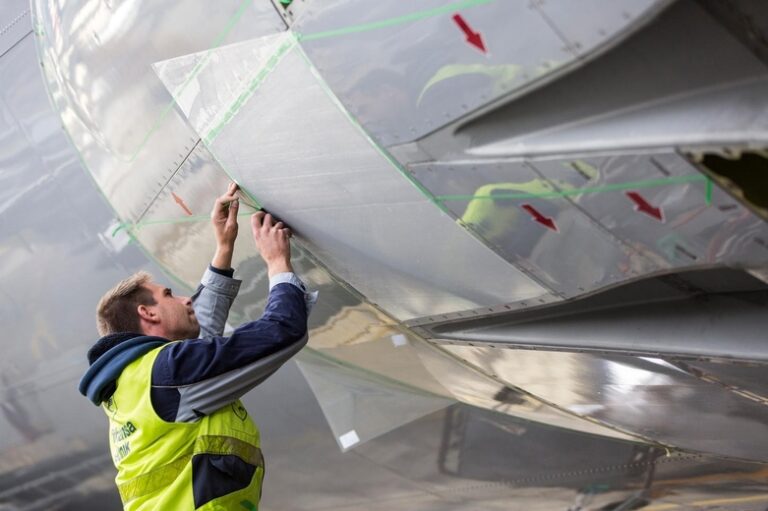
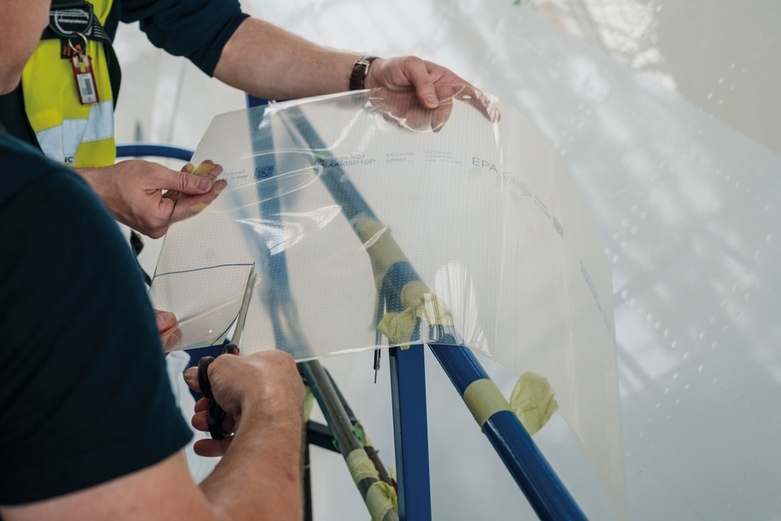
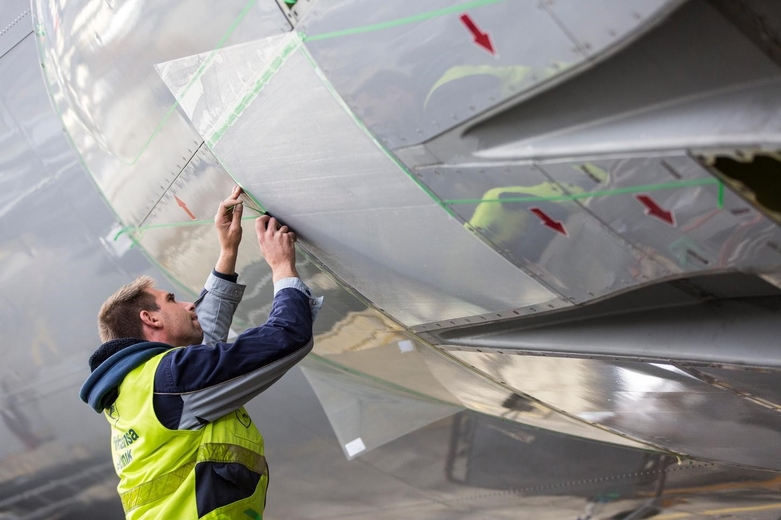
The Shark Skin films are applied manually, one piece at a time, to the surface of an aircraft – credit: @BASF Coatings
At best, 1,000 A330 aircraft could become “flying sharks” The technology was jointly developed by Chemical firm BASF Coatings and Lufthansa Technik and is currently utilized by several airlines, including LATAM and Lufthansa Cargo. To date, a total of 30 B777 passenger and cargo aircraft have been fitted with the artificial shark skin, among them are the fleets of LATAM Airlines and Lufthansa Cargo. LH Technik estimates that the life span of the shark skin coating is at least six years. In a joint project with Airbus, the outfitter is now extending the technology by coating the wings and tail sections of the Airbus A330ceo series. “The choice of the A330ceo as the next candidate for AeroSHARK certification is strategic, given the type’s widespread use and significant leverage on global fuel consumption and emissions. With about 1,000 A330-200 and -300 aircraft in service worldwide, the potential for operational cost savings and substantial environmental benefits is vast,” stated Andrew Muirhead, Vice President Original Equipment Innovation at Lufthansa Technik during the presentation of the project at his company’s Hamburg homebase.
Certification to follow Following successful validation and approval by the European Union Aviation Safety Agency (EASA), the solution is intended to be commercialized. Lufthansa Technik will hold the Supplemental Type Certificate (STC) and lead the certification activities. The company’s Engineering unit will be responsible for the overall certification concept and execution and will be supported by Airbus’ Engineering through the provision of key aircraft type data and safety assessments. From a technical perspective, the certification program will comprehensively assess the impact of riblet application on flight dynamics, lightning strike protection, structural loads, maintenance aspects and all relevant aircraft systems, including flight control, autopilot and navigation systems.
Precision work is required when installing the shark skin—here by a mechanic from LH Tehnik – photo: courtesy of LHT
Every step helps to reduce global warming The wing and tailplane application is intended to complement AeroSHARK coverage on the fuselage and engine nacelles, which was being developed separately by Lufthansa Technik and BASF Coatings. Especially in times of rising jet fuel prices and stricter regulatory requirements to reduce aircraft CO2 emissions, AeroSHARK technology can make a contribution – albeit a modest one – to improving airlines’ environmental footprints. Lufthansa Technik already holds certifications for the AeroSHARK retrofit on the Boeing 777-300ER, 777-200ER and 777F. The A330 is the second-most delivered wide-body aircraft type after the Boeing Triple Seven.
Sustainable Aviation Fuel (SAF) stands high on the agenda of the Berlin-Brandenburg Aerospace Alliance at the upcoming ILA Berlin Air Show. At BBAA’s booth 331 in Hall B, experts will discuss how SAF could gradually replace conventional Jet A-1 kerosene to reduce CO2 emissions and slow global warming. The air cargo industry can play a key pioneering role here. Although minimizing the environmental footprint of the aviation industry is a Herculean job. Without cargo, our world would be significantly poorer. Exemplified day after day during the COVID-19 pandemic, when airfreighted vaccines saved many lives. And – something few people probably realize – without the carriage of freight shipments in the holds of passenger aircraft, most airlines would struggle to be profitable.
Global warming is increasingly changing the environment we live in. It is a universal challenge that can only be addressed through cooperation and shared responsibility. Back in the 1980’s, we started talking about the ozone hole, caused by CFC gases which were used in refrigeration and spray bottles. We were experiencing the loss of protection against UV radiation, and areas like New Zealand were a live display of how bad it could become. In 1987 the Montreal Protocol was signed, CFC gases were banned, the ozone hole shrank to such an extent that nobody talks about it anymore. It is an encouraging example of collective action. Mankind’s response to advancing global warming, however, has not been a success story so far. We have known about air pollution since the industrial revolution and about effects of greenhouse gas emissions (GHG) since the early 1800’s. Yet, we have never managed to get any control over the constantly increasing emissions. For more info, check: https://science.nasa.gov/climate-change/evidence/
It took until 2007 for air freight customers to ask their freight forwarders for ways to reduce the GHG emissions caused by the transportation of their goods. Multinationals were first, given their need to publish environmental governance information in their annual reports. Back then, forwarders could only offer to use airlines with the most modern equipment, with the least fuel consumption and thus least emissions. GHG reporting was introduced, but it was still a long way to go until anyone mentioned Sustainable Aviation Fuel.
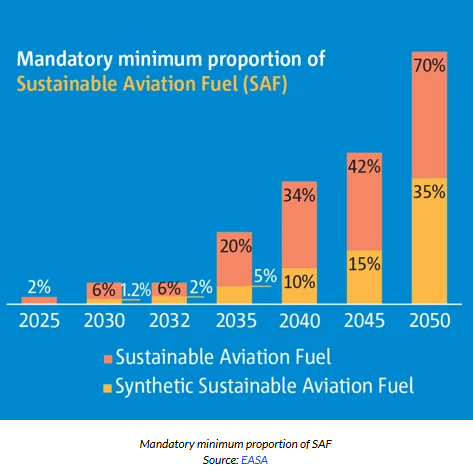
But as early as 100 years ago, the German scientists Franz Fischer and Hans Tropsch developed and patented a process to make synthetic liquid fuel. Today, the Fischer-Tropsch process is still the most promising technology to scale up production of Sustainable Aviation Fuel (SAF), while fortunately there is strong competition from the side of biogenic SAF which is the first kind to be available to match the EU mandates of (currently still only) 2% SAF in the fuel blend. It seems ironic that the country that gave birth to relevant technology, and acts as a driver within the EU in introducing environmental targets, now must admit that their own emissions reduction roadmap has dramatically failed to materialize, as reported on 15 May by the German government-mandated Council of Experts. Another ironic fact is that the findings of the honorable U.S. institution NASA are not convincing their own government to support the COP Paris agreement of 2015 or even the shipping industry’s IMO efforts to reduce emissions in the maritime sector. Both Germany and the U.S. are heavyweight users of airfreight, unavoidable in the global supply chain for industry sectors like pharmaceuticals, aerospace, electronics etc., typically in trade deals with other European and Asian industrial strongholds. A tiny bit of confidence comes up when despite insufficient leverage created by the policy makers, some airfreight users and their service providers become proactive and invest in SAF purchase agreements.
Many cases reported by this publication since 2020, about initiative and joint action, have shown the way to get the ball rolling. Among the first, DB Schenker’s customers Merck KGaA, Siemens Healthineers, Lenovo and others supported a weekly freighter between Frankfurt and Shanghai, operated by Lufthansa Cargo. The following years saw ups and downs of this development, fortunately more ups in recent times, such as DHL and FedEx securing large SAF allocations, Air France KLM MP Cargo cooperating with their customers on the subject, airlines United, Cathay Pacific, IAG and others, forwarders DSV, CEVA, and even the mid-size Quick Cargo are following the given examples.
But is it sufficient? Certainly not, when you consider research by specialized institutions such as impact on Sustainable Aviation and Transport & Environment. In summary we can say OK, there are beginnings of emission reduction, but they are more than neutralized by the constant global annual 5% growth rate of aviation.
Can the airfreight community have an impact? Yes, because it is ultimately driven by financial foresight. As explained above, manufacturing companies are getting aware of their increasing emission cost, under the still small but sharpening “polluter pays” policies. The upcoming ILA Berlin Air Show will feature challenging discussions organized by Germany’s leading international SAF initiative aireg (Hall C, Stand 121), and more airfreight-specific by the SAF driver of the capital region, Berlin-Brandenburg Aerospace Allianz (Hall B, Stand 331), with a panel on SAF in air freight on 11JUN26 at 12:00h-13:00h.