
Home Blog Page 68

Abu Dhabi: Clear for Take-off

0
CargoForwarder Global looks forward to seeing you there! Image: TIACA/CFG

TIACA’s Air Cargo Forum (ACF) 2025’s take-off slot is in six weeks from now, and CargoForwarder Global is firmly strapped into seat 1A, ready for a flight into the current and future world of air cargo. Whilst ACF veterans connect the event with Miami, where it was last held in 2024 and is due there again in 2026, TIACA has expanded the concept and decided on an annual event which alternates between two permanent bases. The second base being the UAE’s Abu Dhabi. It is being premiered this 03-06NOV25 at the Etihad Arena, Yas Island, Abu Dhabi.

The world of aviation and logistics is shifting eastwards. A trend that has been progressively accelerating as the advancement of production centers in Asia and the expansion of logistical hubs in the middle east, providing supply chain connectivity between Asia/Africa/Europe and beyond to North America. Maritime Ports in the region are innovating with their airport partners to create new multi-modal solutions designed around the industry ethos of fast, secure, safe, and efficient high quality supply chain solutions. With this in mind, the TIACA Board took the decision that the successful TIACA Air Cargo Forum (ACF), currently held every two years in its permanent home in Miami, should become an annual gathering of supply chain professionals, world class solution providers and industry thought leaders and influencers. After a vigorous process of evaluating many exceptional venues throughout the Middle East region, the TIACA Board selected Abu Dhabi as the second permanent location for the now annual ACF,” TIACA’s press release explains. It reminds people to make sure their hotel arrangements are complete as the three suggested hotels only have a few remaining rooms. A look at What’s On in Abu Dhabi reveals that we’ll likely have missed Enrique Iglesias, Ed Sheeran and Coldplay, who are all there on 01NOV25, but the event will coincide with the region’s annual Flag Day on 03NOV25, and any ACF participants showing particular prowess during the “inaugural Etihad Golf cup on a beautiful beachside links course” might want to hang around for the European World Tour Golf that is also due to take place at Yas Island, but from 06-09NOV25.

Anyway – back to the ACF itself: aside from golf, it lures with yoga and networking functions on the beach, a private function in the fast-paced Ferrari World, world class exhibitors, industry leaders sharing ideas during engaging discussions “and a few surprises thrown in for good measure”. Four fireside chats with senior global leaders, two industry CEO roundtables, and dedicated sessions on industry outlook and trends, innovation, digitalization, sustainability, workforce challenges, plus a concentrated focus on air cargo in the Middle East, and more. See you there!

Global K9 and Het Twickelerveld sign partnership agreement

0
Stronger in Europe, together. Image: Global K9

The U.S. air cargo security provider, Global K9 (GK9) which last year acquired UK-based Dog Detectives (see https://cargoforwarder.eu/2024/11/03/gk9pg-acquires-uk-based-dog-detectives/ ), has now expanded its European presence by entering into partnership with the Dutch screening specialist, Het Twickelerveld Cargo Screening B.V.. The aim is to reinforce cargo security operations across Europe.
Under the agreement, Het Twickelerveld will support GK9 with screening services in the Netherlands, pairing GK9’s detection expertise with the Dutch company’s strong European foothold. The collaboration covers canine detection as well as X-ray, Explosive Trace Detection (ETD), and authorized representative services, enabling both companies to deliver compliant, customized solutions for air cargo clients. Founded in 2005, Het Twickelerveld brings extensive experience in training and handling dogs for cargo security. This alliance strengthens GK9’s presence in Europe while broadening the operational scope of both screening companies in meeting the region’s air cargo security requirements.
Eric Hare, Founder and Chief Executive Officer (CEO), Global K9, explained: “By combining our proven detection services with Het Twickelerveld’s local expertise, this agreement is aimed at replicating our successful U.S. operations, providing enhanced security solutions across the region. Our goal is to provide the same level of excellence in Europe that our clients have come to expect in the U.S., building upon our growing global presence.” Martin Lipsius, Founder and CEO, Het Twickelerveld, said: “Partnering with a well-established screening company such as GK9, allows us to enhance our services in the air cargo sector, bringing mutual benefits to our clients. We look forward to integrating GK9’s expertise to strengthen our air cargo security operations across the Netherlands and Western Europe.”

Rhenus to open new office in Abu Dhabi

0
A new Rhenus office is due to open in Abu Dhabi. Image: Rhenus

The Rhenus Group has strengthened its presence in the United Arab Emirates as part of a wider regional growth strategy, moving from a limited setup to a more integrated role in the market. Having operated in the UAE for nearly a decade, the company will soon be opening a new office in Abu Dhabi, positioning itself to better serve clients across the Emirates and the wider GCC region, including high-potential markets such as Qatar and Saudi Arabia.
The UAE’s role as a logistics hub between Europe, Asia and Africa forms the backbone of this expansion. Rhenus will introduce a new Air-Ocean service connecting Asia, Europe and the Americas, with the UAE serving as a key transshipment base. This initiative builds on the company’s established Air & Ocean Freight offering and will be implemented gradually, to ensure ongoing stability and service quality.
As part of its regional footprint, Rhenus has also been named official freight forwarder and handling agent for dmg events at the Riyadh Front Exhibition & Conference Centre, covering major exhibitions including INDEX Saudi Arabia and ORGATEC – WORKSPACE.
Rhenus continues to provide industry-specific solutions across FMCG, fashion, aerospace, high-tech, pharmaceuticals, automotive, and oil and gas, delivering logistics services ranging from temperature-controlled transport to complex project forwarding. This sector-focused approach underpins the company’s strategy of combining customer-centric solutions with sustainable long-term growth.
Jan Harnisch, Member of the Board – Air & Ocean, commented: “Our expansion in the UAE marks a pivotal step in our commitment to sustainable global growth and regional empowerment. The Gulf’s logistics landscape is undergoing rapid transformation, and we see immense potential in contributing to its evolution. By strengthening our presence here, Rhenus is not only enhancing supply chain resilience but also reinforcing our long-term vision of creating value through local partnerships and innovation-driven logistics solutions.” Hassan Alzeer, General Manager at Rhenus Logistics UAE, said: “This development reflects our commitment to building a more agile and responsive logistics network in the region. By aligning more closely with the local market, we’re not only improving service delivery for our clients but also positioning ourselves to support the UAE’s role as a strategic trade hub.”

Silk Way West Airlines and GE Aerospace extend agreement

0
Powered by GE9X engines. Image: Silk Way West Airlines

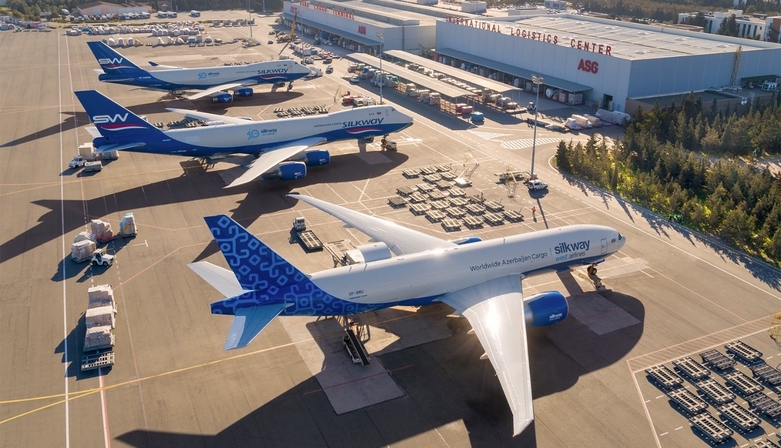
Silk Way West Airlines has extended its services agreement with GE Aerospace to support its expanding fleet of Boeing freighters. The deal covers five GEnx‑2B-powered 747‑8Fs, six GE90‑115B-powered 777Fs, and up to four GE9X-powered 777‑8Fs, further strengthening the partnership as the Azerbaijani carrier advances its fleet renewal program.
The airline, which handles more than 500,000 tons of cargo annually and serves over 40 destinations across Europe, the CIS, the Middle East, Asia, and the Americas, first committed to new 777 freighters in 2021 and 2022. The agreement aligns with its long-term modernization strategy and global growth ambitions.
The GE9X, set to power the airline’s future 777‑8Fs, is the most powerful and efficient commercial engine in its class, delivering a 10% improvement in fuel consumption over the GE90. The GEnx family, powering Silk Way West’s 747‑8Fs, has accumulated over 62 million flight hours since 2011 and remains GE’s fastest-selling high-thrust engine with more than 3,600 units in service and backlog. The GE90, which powers the airline’s current 777Fs, introduced several industry firsts, including composite fan blades and additive manufacturing.
All GE Aerospace engines are certified to operate with Sustainable Aviation Fuel blends, supporting Silk Way West’s sustainability objectives as it continues to grow its modern widebody cargo fleet. 
Onno Pietersma, Chief Operating Officer of Silk Way West Airlines, commented: “We are pleased to announce this extension of our partnership. It will continue to help us deliver on our long-term strategy of sustainable growth and allow us to continuously improve the services we provide to our valuable customers.”
Russell Stokes, President and CEO, Commercial Engines and Services for GE Aerospace, stated: “We are proud to continue building our relationship with Silk Way West Airlines as they modernize their fleet. GE Aerospace widebody engines represent the pinnacle of aviation technology, designed to lower operating costs and reduced environmental impact.”

Riyadh Air counts on Unilode for its ULDs

0
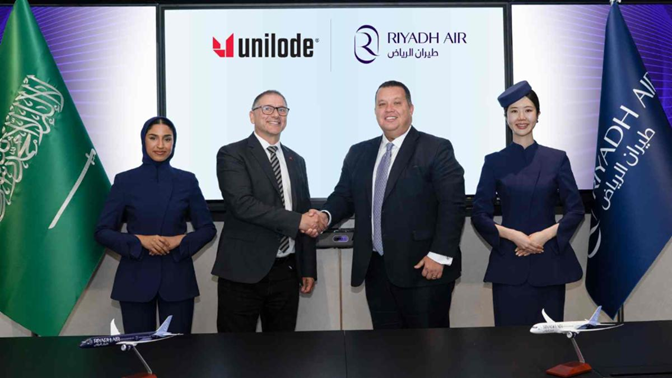
At the partnership signing in Saudi Arabia. Image: Unilode

Riyadh Air has signed a strategic partnership with Unilode to supply, manage, and maintain Unit Load Devices (ULDs) in support of the airline’s upcoming 2025 launch. Under the agreement, Unilode will provide lightweight, durable ULDs equipped with Bluetooth-enabled tracking, helping the new Saudi carrier strengthen efficiency, sustainability, and reliability across its passenger and cargo operations.
The collaboration leverages Unilode’s global management model, repair network, and digital infrastructure, ensuring real-time visibility, asset optimization, and condition monitoring. These features are aimed at reducing mishandling, losses, and disruptions while supporting Riyadh Air’s smooth launch and long-term growth. By digitizing ULD assets, the airline will streamline irregular-operations recovery and enhance operational resilience as it expands.
Aligned with Saudi Arabia’s Vision 2030 goals, Riyadh Air plans to rapidly scale its presence, with a fleet of more than 180 aircraft and service to over 100 destinations by the end of the decade. The airline aims to contribute $20 billion to the Kingdom’s non-oil GDP and generate over 200,000 jobs worldwide through its operations.
This partnership reflects Riyadh Air’s strategy of building alliances across the aviation value chain as it develops a modern, technology-driven global carrier. It also highlights Unilode’s role as a leading provider of lifecycle ULD management, digital solutions, and maintenance services, offering the capabilities needed to support Riyadh Air’s growth and sustainability ambitions.
Adam Boukadida, Chief Financial Officer of Riyadh Air, stated: “At Riyadh Air, every decision is about creating journeys that feel effortless, personalized, and responsible. Our partnership with Unilode is more than a technological upgrade; it’s about building trust, reducing our environmental footprint, and delivering the premium experience our guests deserve. Together, we’re shaping the future of travel with smart, sustainable, and human-centered solutions.
Ross Marino, Chief Executive Officer of Unilode, added: “Partnering with Riyadh Air at such a pivotal stage of its journey, underscores Unilode’s ability to deliver value not only today, but also well into the future. Our innovative ULD solutions, unrivalled global network, and pioneering digital platform will give Riyadh Air the agility and resilience needed to build one of the most forward-looking airlines in the world. We are proud to contribute to the Kingdom’s Vision 2030 by supporting its aviation transformation.”

ECS Group drives cargo expansion for JetSMART Cargo

0
ECS Group’s first TCM contract in South America is a success. Image: JetSMART

ECS Group has marked a breakthrough six months in South America with JetSMART Airlines, achieving the region’s first-ever Total Cargo Management (TCM) contract. Covering JetSMART’s domestic and international networks, ECS now manages cargo operations for more than 25,000 annual flights across the carrier’s four AOCs in Chile, Peru, Colombia, and Argentina. Within just half a year, ECS has established operations in eight countries and fourteen key destinations, including Buenos Aires (EZE, AEP), Córdoba, Mendoza, and Tucumán in Argentina, Rio de Janeiro (GIG), and São Paulo (GRU) in Brazil, Iquique (IQQ) in Chile, Bogotá (BOG), Cali (CLO), Medellín (MDE) in Colombia, Quito (UIO) in Ecuador, Asunción (ASU) in Paraguay, Lima (LIM) in Peru, and Montevideo (MVD) in Uruguay.
A central Control Tower in San José, Costa Rica, drives this expansion by digitally coordinating compliance, efficiency, and operational oversight for JetSMART’s A320/A321 fleet. ECS’s scope goes beyond traditional GSA roles, integrating advanced tools such as Apollo, Quantum, and CargoAi to offer real-time analytics and enabling freight forwarders to access both domestic and cross-border cargo flows. Through collaboration with TCE, ECS also covers ramp coordination, security, and auditing to unify processes across the network.
ECS and JetSMART share the ambition of making the full airline network cargo-accessible by the end of 2025. This includes more than 25 planned interline partnerships to extend connectivity beyond South America to markets in the United States, Europe, and Asia. Looking ahead, ECS is preparing for further growth in e-commerce logistics. From 2026, the company aims to build regional warehousing, roll out an express product, and create new alliances to strengthen delivery speed and efficiency.
This milestone demonstrates the potential of integrated cargo management in South America and positions JetSMART Cargo as a dynamic new player in the market, offering streamlined digital booking and reliable access to major regional trade hubs.

Spotlight on… Carina Tüllmann, Chief Commercial Officer, Open Logistics Foundation

0

Every week, CargoForwarder Global highlights a different part of the air cargo industry in its ‘Spotlight On…’ series, through the eyes of someone working there. Digitalization is such a large factor for the air cargo industry’s success now and in the future, and yet, because it is so fragmented both in function and development, digital transition has been slow. That is why, not too long ago, one group of stakeholders came together to try to smooth the way to a more unified approach to data and processes through open source solutions, offering a more level playing field for each company’s digital evolution. The Open Logistics Foundation (OLF) was born. (CFG reported: https://cargoforwarder.eu/2025/06/15/olf-a-fair-approach-to-logistics-digitalization/) This week, Carina Tüllmann (CT), Chief Commercial Officer of the Open Logistics Foundation, talks about her role, experiences and views.

Diversity and the opportunity to constantly gain new experiences. Image: Carina Tüllmann

CFG: What is your current function and company? And what are your responsibilities?
CT: I’m currently the Chief Commercial Officer (CCO) of the Open Logistics Foundation (OLF). In this role, I’m responsible for communication and community management, business development, and human resources development.
My role involves intensifying the dialogue with member companies and the open source community, expanding our international networks, and integrating new partners, all with the aim of further advancing open source solutions across company boundaries.

CFG: What does a normal day look like for you?
CT: There is no such thing as a typical day. My tasks are closely linked to the current focus of the OLF, its members and our community. Sometimes the focus is on planning our strategic development; at other times, it is on preparing events, publications, panels, connecting current & scouting new partners and so on. But that is exactly what I value so much about this work. It’s the diversity and the opportunity to constantly gain new experiences.

CFG: How long have you been in the air cargo industry, and what brought you to it?
CT: I have been involved in the logistics / supply chain / innovation space for quite a while. Before joining OLF, I spent over ten years working with Fraunhofer IML and other innovation / digital hub organizations, focusing on fostering research and innovation, communicating new solutions, and connecting people.
My strong belief in collaboration, open solutions, and the fact that many of the biggest challenges in logistics cannot be solved in isolation is what brought me here. My desire to combine my experience in marketing, communication and economics with the impact of digital and open source tools led me to work with organizations focused on open standards, such as OLF.

CFG: What do you enjoy most about your job?
CT: The combination of technical, social, legal and organizational challenges—it’s a field where I can use both strategic thinking and people skills, connect different kinds of stakeholders, and see the impact of what we build. The opportunity to help shape the future of logistics in a more sustainable, efficient, and fair way – through open source standards, open community participation, and shared innovation motivates me greatly.
As a committed European, I am truly delighted that we are making a decisive contribution to Europe’s competitiveness, resilience, and position as a strong logistics hub through the Open Logistics Foundation.

CFG: Where do you see the greatest challenges in our industry?
CT: When it comes to standardization, moving from proof‑of‑concept to widespread use in much shorter times, ensuring usability, reliability, and support for varied use cases and company sizes.

CFG: What advice would you give to people looking to get into the air cargo industry?
CT: Develop strong communication, stakeholder management, negotiation, and change management skills. You’ll often need to bring different parties together and navigate varying interests.

CFG: If the air cargo industry were a film/book, what would its title be?
CT: “Unlocked: The Power of Sharing in Logistics”Many thanks, Carina!


If you would like to share your personal air cargo story with our CargoForwarder Global readers, feel free to send your answers to the above questions to cargoforwarderglobal@kopfpilot.at We look forward to shining a spotlight on your job area, views, and experiences.

Menzies World Cargo expands in Scandinavia

0

The manager of global transportation and cargo ground handling has launched operations at Oslo Gardermoen Airport. The step follows Menzies’ acquisition of Spirit Cargo Handling.The takeover was announced in June this year and completed on 01SEP2025. Spirit was previously owned by SAS Ground Handling Norway and has capacity for 150,000 tons of air freight per year, boosting Menzies’ annual cargo throughput.
Further to this, the first electric powered cargo flight was launched in Norway.

Menzies is a new cargo operator at Oslo Airport and intends to focus on high demand items. This applies above all to salmons and other maritime products harvested at the coastal waters of Norway, mainly its northern part. There, large fish farms have been established whose contribution to Norway’s gross domestic product now ranks third after oil and gas. Hence, seafood is crucial to Norway’s economy, since this industry provides a large number of jobs, both directly and indirectly, and supports many coastal communities. With record export revenues, a long coastline, and strong growth in its aquaculture sector, Norway has become a leading global seafood producer and exporter. After being caught and packaged, the salmon, king crabs, and other seafood produce are transported by truck in cool boxes filled with fresh ice to southern Norway, 1,000 to 2,000 km away, to be flown from Gardermoen Airport to destinations around the world, with the exception of quotas destined for the domestic market.

Menzies offers cargo handling services at Oslo Gardermoen Airport its newest station in Scandinavia – photo: Menzies

Speed and reliability are essential
It goes without saying that these time-critical logistics services combined with utmost reliability in ground handling are essential for these perishable goods to secure their integrity. This service was previously provided very competently by Spirit, but is now the responsibility of Menzies’ headcount following Spirit staff’s takeover. The agreement signed by both parties also includes the warehouse at Oslo Airport formerly run by Spirit which will be rebranded under Menzies Aviation. Miguel Gomez Sjunnesson, Executive VP Europe of Menzies Aviation said: “By adding a new cargo station to the Menzies global network, we’re building momentum in key markets and reinforcing our commitment to supporting cargo growth across the region.” Beau Paine, Executive Vice President Cargo at Menzies Aviation added: “As we grow our global cargo network, we remain committed to being the cargo provider of choice through operational excellence, reliability and innovation.”

Head of Cargo at Avinor, Eva Beate Lande. Photo: Helene Wattanapradit Jensen/Avinor

Gardermoen is part of airport operator Avinor that runs 43 airports all across Norway with Oslo, Bergen Stavanger and Trondheim being the most prominent ones. “We are very pleased that Menzies World Cargo is now becoming part of the Oslo Airport community,” says Eva Beate Lande, Head of Cargo at Avinor. Their establishment strengthens both capacity and services within cargo, providing airlines and businesses with an even stronger foundation for further growth.”
Menzies already has a strong presence at OSL through passenger and ramp services, among others. Thanks to their broad global network and multiple ground handling activities they bring both experience and growth opportunities to airports where they run stations. Over time, this may bring new momentum to the cargo sector at Gardermoen and help further develop its service and product offerings, states OSL management in a release.
Oslo Airport plays a central role as a hub for Norwegian exports and imports. A broad and competitive cargo throughput is crucial for the seafood industry, manufacturing, and other exporters. Menzies World Cargo will help strengthen this position even further, says Lande. Final remark from the operator: Avinor looks forward to a good partnership with Menzies World Cargo and to further developing Oslo Airport as an efficient and modern hub for air cargo in the Nordic region.

BETA ALIA en route from Stavanger to Bergen, courtesy: Avinor/Margareth Aske

Norway reports first electric powered cargo flight
An electric aircraft ALIA, produced by BETA Technologies, completed its first flight taking from Stavanger to Bergen. The operation of the ALIA electric aircraft is part of Norway’s international test arena for zero- and low-emission aviation, and the route was flown to simulate cargo service. The route Stavanger – Bergen will be flown regularly throughout the entire duration of the test phase. ALIA has an ultimate range of 400 km, making the 160 km distance between the two cities well within reach. The aircraft is single-engine, designed for single-pilot operations, and has a total payload capacity of 562 kg – equivalent to 5 passengers. It flies at speeds between 210–270 km/h, comparable to a light aircraft.

Evaluating use cases
The test arena is performed in a partnership between Airport operator Avinor, the Norwegian Civil Aviation Authority (CAA.no), Vermont, USA-based Beta Technologies a manufacturer of electric VTOL aircraft and Helicopter operator Bristow Norway. It is designed to evaluate use cases and routes for zero- and low-emission aviation in the Nordic region.
The test flight program is carried out in three phases, running until JAN2026. During the initial phase, the project focuses on takeoffs and landings in Stavanger, followed by visual flights and the familiarization with the aircraft for pilots as well as ground and tower personnel. Phase two will focus on operational maturity and full-route flights between Stavanger and Bergen. In phase three, the aircraft will operate under instrument flight rules. Avinor and the Civil Aviation Authority of Norway have established Norway as an international test arena to prepare the aviation ecosystem for zero- and low-emission aircraft and to lay the foundation for scaling new technologies. The purpose of the test arena is to generate and share knowledge, provide operational learning, and gain hands-on experience by testing in real operational environments.

ONE Record: Building momentum for 2026

0

01JAN26 marks the official industry deadline when IATA’s ONE Record is due to become the preferred standard for digital data exchange in air cargo. Last month, CargoForwarder Global published an article on the subject (See: https://cargoforwarder.eu/2025/08/03/one-record-communication-is-a-24-way-street/ ) and subsequently opened the floor to guest authors to share their views on the topic. Radhesh Menon, Head of Product Management and Strategy, Air Cargo at IBS Software, answered the call and has written the following piece for CFG:

Radhesh Menon, Head of Product Management and Strategy, Air Cargo. Image: IBS

ONE Record and the last mile: Building momentum for 2026
Deadlines in aviation are not symbolic. Aircraft depart on schedule, safety checks follow precise sequences, and cargo cut-offs are immovable. Which is why the upcoming January 2026 milestone for ONE Record adoption is so pivotal. It is not just a date; it is an inflection point for the industry.
When IATA launched ONE Record, the vision was bold: a single source of truth for shipment data, underpinned by APIs and linked data. Decades of inefficiency caused by siloed systems, redundant messaging, and patchwork integrations could finally be cleared away. Importantly, the technical foundation is already in place. The standards are defined, the reference servers are available, and numerous proof-of-concepts have shown that the model works in practice.
Encouragingly, airlines representing 72 percent of global air waybill (AWB) volumes are already on track, according to IATA. This demonstrates strong momentum and confirms that the standard is technically viable at scale. The opportunity now is to extend this readiness across the broader ecosystem, so that forwarders, handlers, and regional carriers can realize the same benefits and ensure industry-wide transformation.
ONE Record is not another incremental standard shift, like the move from Cargo-IMP to XML. It is a reset. It is the backbone of what IATA itself calls the “Internet of Logistics” – a web of interoperable systems where real-time data flows securely and seamlessly. If we fall short now, the cost will not just be measured in missed deadlines but in missed relevance.

Beyond proof of concept
At IBS, we approached ONE Record differently from typical pilots. Most industry POCs demonstrate a single use case in isolation. Our collaborations, for example with Singapore Airlines and Cargo Community Network, and later with SATS and dnata, tested ONE Record in a multi-party environment, the true measure of its value. Multiple stakeholders exchanged data against a common record, eliminating duplication and manual reconciliation while integrating seamlessly with existing business processes.
Through these projects, we implemented nearly all of IATA’s prescribed APIs for shipment records, tackling one of the most complex use cases. The result was not only a working model but also a scalable one. After establishing the initial integration, we could add new partners quickly and at a fraction of the original effort. We are now extending similar POCs with Qantas, further validating that adoption is achievable across different contexts.
This matters because adoption should not mean tearing down established workflows. ONE Record enables a smooth transition – plug into the standard, and partners interoperate without wholesale redesign. That reduces the turbulence of change management and makes adoption more scalable.

The myth of complexity
Smaller stakeholders often argue that adoption is too complex, too costly, or too dependent on others moving first. These arguments sound reasonable, but they misunderstand the design of ONE Record.
The model is deliberately open, modular, and API-first. It supports step-by-step integration, beginning with something as simple as a single record type.
ONE Record is not about multiplying APIs to unmanageable levels. It is about creating a standard structure where any partner can connect once and interoperate with many. Whether you are a regional forwarder or a global carrier, the principle is the same – build to the standard, and the ecosystem becomes plug-and-play.
And if anyone doubts the feasibility, consider what happened at the IATA ONE Record Hackathon in Dublin. Competitors Cargolux, Air France KLM Martinair Cargo, and Lufthansa Cargo joined forces with IBS Software and Fraunhofer IML. In just 28 hours, we built two working solutions on top of the open-source ONE Record server. OneBooking.ULD streamlined quotations and ULD (Unit Load Device) bookings using AI and natural language processing. ne:one simulate gave non-technical users a way to test and validate implementations across the shipment lifecycle. These were not proofs of concept left on a whiteboard. They were working tools, developed by rivals collaborating in real time, to advance the entire industry. If direct competitors can align to build the future, what excuse remains for others to stall?

From pilots to production
The real value of ONE Record comes when adoption is broad. Implementing it in pockets or silos will not realize the network effects. Proof-of-concepts should not be endpoints; they are runways to adoption. Only when a critical mass of forwarders, handlers, and carriers embrace the standard will the benefits of speed, visibility, compliance, and competitiveness flow at scale.
This is why waiting on the margins is risky. ONE Record is designed for a connected ecosystem, not isolated implementations. The benefits are exponential when the majority of transactions run on a common standard. Without that collective shift, the network effects cannot fully materialize, and late adopters will find themselves struggling to catch up.

The last mile to 2026
As the new year approaches, the industry has a choice. Treat the deadline as optional and risk diluting momentum. Or recognize that the standards, technology, and proof points are ready, and that what remains is a collective commitment to act. ONE Record is not just another technical upgrade. It is a once-in-a-generation opportunity to move from document-driven processes to a truly data-centric ecosystem. For those still waiting on the sidelines, the time to move is now, not after competitors have already proven the advantage.


This article was contributed by Radhesh Menon, Head of Product Management and Strategy, Air Cargo at IBS Software

EDIfly turns 15

0

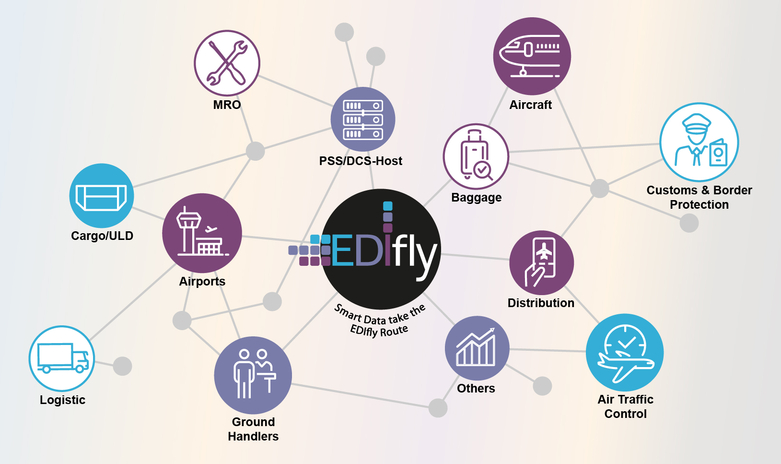
The Luxembourg-based developer of a cutting-edge message handling software and transmission technology is celebrating its 15th birthday. Right from the start, EDIfly’s open architecture has allowed seamless integration with existing IT ecosystems including Amadeus, SITA, Collins (ARINC), or LH Systems, fostering innovation across the industry. What began 1.5 decades ago with Cargolux as launching customer, has now evolved into a global community of users. In addition to the aviation landscape, authorities also rely on the tech provider’s messaging tool featuring state-of-the-art encryption.

If anyone deserves a knighthood for founding EDIfly, it is visionary Anders Dam Jensen. Back in 2010, the Danish national set out to solve a persistent problem in aviation communications: the inefficiencies and costs associated with legacy Type B messaging. His invention, EDIfly, was designed as a backwards-compatible platform that modernized data exchange while maintaining interoperability with industry-standard protocols and systems. Jensen’s vision was to create an open, secure, and cost-effective alternative based on open-source components, that would future-proof airline messaging without disrupting established workflows in a globalized aviation industry.

The chart proves it: Edifly has grown enormously since its founding in 2010 to the present day – photos: Credit EDIfly

Game-changer
Cargolux became the launching customer and achieved operational savings and improved reliability from day one. Henrik Ambak, who then served as Cargolux’s VP of Cargo Operations and later held leadership roles at Emirates Airlines, recalls: “EDIfly gave us the confidence to modernize our communications without losing touch with partners still reliant on legacy systems. Its reliability and seamless integration were game changers for our operations.” EDIfly’s success at Cargolux quickly caught the attention of other airlines, airports, and aviation service providers. The technology’s backwards compatibility meant organizations could upgrade their messaging infrastructure at their own pace, without risking disruptions to critical operations. Over a period of 15 years, EDIfly has been adopted by a wide range of aviation stakeholders, from passenger airlines to airports, ground handlers, cargo carriers and government authorities. EDIfly’s most significant contributions have been its role in supporting the airline industry’s digital transition, enabling airlines to move beyond traditional ticketing and embrace dynamic, customer-centric retail models based on Offer & Order.

Tjutjuk Septiadi, CEO & Founder ESI Jakarta, photo: company courtesy

Overcoming Type B messaging limitations in cargo, passenger & MRO
Most importantly, the technology achieves this while remaining backwards compatible with legacy Type B communication – a critical requirement for airlines navigating the complexities of digital transformation. Type B Communication Drawbacks and the June 2024 White Paper issued by The International Air Transport Association – IATA (https://www.iata.org/contentassets/badbfd2d36a74f12b021c9dd899ecbad/type-b-messaging-whitepaper-v2.5.pdf) has long identified limitations in the industry’s reliance on Type B messaging, including high costs, inflexibility, transmission capacity and security vulnerabilities. In its 14JUN25 White Paper, IATA reiterated these concerns and called for urgent modernization of aviation communications. EDIfly directly addresses these drawbacks by offering the market a secure, cost-effective, and interoperable alternative. The preliminary conclusion so far is that its adoption has helped organizations comply with evolving IATA recommendations while minimizing operational risk and investment. In its initial version 2.1, IATA mentions EDIfly as a mechanism for airlines to avoid SITA and ARINC and their high charges. In the updated version 2.5 from MAY25, this paragraph has miraculously disappeared. Industry experts have consistently applauded EDIfly’s reliability and integration capabilities. Henrik Ambak notes, “The beauty of EDIfly is that it bridges the old and the new. We could innovate and integrate with modern platforms without losing connectivity to our partners.” Paul Heber, formerly with Amadeus and now at T2RL, adds, “EDIfly has set a new standard for secure unconstrained messaging in aviation. Its flexibility has been instrumental in driving digital transformation across the sector.” Tjutjuk Septiadi, CEO of ESI Jakarta, highlights the global reach: “EDIfly’s low-cost, scalable model has opened new possibilities for airlines, airports, and even governments in emerging markets. It’s not just a technology – it’s a catalyst for industry-wide progress, which allowed us to create an EDIfly-based ecosystem across most aviation-related exchanges in Indonesia.”

Ingo Roessler joined EDIfly shortly after the messaging service was founded on 20SEP2010.

Global reach
Kicked off 15 years ago, EDIfly’s adoption has since spread far beyond Europe, with implementations in Asia, Africa, the Americas, and Australasia. As confirmed by developments to date, the system’s cost efficiency and ease of integration have made it an attractive option for organizations seeking to modernize operations without incurring prohibitive expenses. “For a growing number of users, EDIfly represents the first viable alternative to proprietary, high-cost legacy networks, democratizing access to advanced messaging capabilities and fostering a more competitive, collaborative global aviation ecosystem that avoids a complex end-to-end integration like IATA’s OneOrder or ONE Record, expected to be implemented over the next 10-15 years,” Ingo Roessler, Chief Commercial Officer of EDIfly, states. According to a recent study by the UK consultancy T2RL the industry spends about one billion USD annually for transmission through networks, managed fixed links, and related infrastructure to handle Type B exchanges. If the aviation community adopted this peer-to-peer principle widely, cost savings of more than 80% could be achieved In a nutshell: Fifteen years after its inception in Luxembourg, EDIfly has left an indelible mark on aviation as a driver of the industry’s transformation and modernization. In line with its commitment to data security and trust, EDIfly has also partnered with SeeZam, another Luxembourg-based innovator specializing in secure digital exchange and notarization of sensitive information. This collaboration further reinforces Luxembourg’s position as a hub for secure, cutting-edge aviation technology. It is to be expected that further chapters will be added to the company’s success story during the forthcoming 15 years.