Time literally does fly if you look at the fact that WestJet has already been operating its new freighters since a year. The company posted a Happy Birthday video last week, to accompany its “monumental milestone [… on 25APR24] today, WestJet Cargo marks the first anniversary of our dedicated freighters launch!” and thanking its customers for their support as the airline continues to “redefine air cargo transportation and shape the future of global trade.” There’s nothing like full freighter capacity to help get the economy moving. Or as WestJet Cargo put it in their release: “Our dedicated freighters have not only strengthened existing trade routes but have also opened doors to new opportunities, facilitating the seamless movement of goods across borders. From perishables to e-commerce and beyond, our commitment to versatility and reliability in air cargo transportation remains unwavering.”
WestJet Cargo operates a fleet of four P2F converted B737-8F
And 2024 also offers a second anniversary for the airline. In a separate LinkedIn post that week, it announced: “We’re flying high with excitement as we celebrate 10 years of transatlantic adventures! WestJet has been a part of your European journey since our inaugural transatlantic flight between St. John’s and Dublin in 2014.” That European journey continues to grow. WestJet Cargo announced that it would be expanding its cargo flights between Calgary and Paris Charles de Gaulle (CDG), with 5-7 weekly flights, each offering a payload capacity of 18 tons. In doing so, the airline – with the help of ECS Group’s technological tools providing transparency on market opportunities and cargo operations – aims to optimize its efficiency and use of strategic hubs.
Kirsten de Bruijn, Executive Vice President of Cargo at WestJet, disclosed: “Our expansion into European markets through the Paris hub is a key part of our growth strategy. ECS Group’s technological support and network have been indispensable in enhancing our service capabilities, allowing us to pursue new opportunities in additional European countries.” Jean Ceccaldi, Managing Director of Aero Cargo France – subsidiary of ECS Group, commented: “We’re proud to support WestJet Cargo with our Quantum e-quotation system and Apollo business intelligence platform. These tools enable efficient management of cargo capacities and market analysis, supporting WestJet Cargo’s goals of technological excellence and enhanced service delivery.”
Olaf Hagelstein and Fanny Chan join Cargo iQ Board. Image: Rock-It Cargo
Last week saw the re-election of Hendrik Leyssens, VP Process, Planning and Project Delivery, Emirates; Jussi Lemola, Vice President, Global Operations – Cargo, Swissport; Klaas Kurz, Director Aviation Security & Governance, Schenker AG, and Rutger-Jan Pegels (RJ), Director Performance Management, Air France KLM Martinair Cargo. The latter also holds the function of Vice Chair of Cargo iQ. Two new appointments were announced and formally welcomed at Cargo iQ’s Working Group meeting in Geneva, Switzerland. They are Fanny Chan, Head of Cargo Global Operations at Cathay Pacific Airways; and Olaf Hagelstein, SVP, Global Head of Operations, Processes & Systems – Air Freight, DHL Global Forwarding. Lothar Moehle, outgoing Cargo iQ Executive Director, predicted: “These individuals bring with them a wealth of knowledge and valuable expertise that will help steer and advise our organisation during a year of exciting changes. Their appointments come as we prepare to launch two major initiatives that will result in enhanced cooperation and collaboration across the air cargo chain, and with our new Executive Director Marie Seco-Köppen driving implementation.” The Cargo iQ Board now consists of 11 voting members from Air France KLM Martinair, Cargomind (Austria), Cathay Pacific, DB Schenker, DHL Global Forwarding, Emirates SkyCargo, Hellmann Worldwide Logistics, Kuehne+Nagel, Lufthansa Cargo, Qatar Airways Cargo and Swissport International, and is supported by observers Riege Software, FIATA, and ASA, and advisor, Im3Pact AG. Cargo iQ community currently counts more than 60 members, and is in the process of launching two new initiatives this year to further increase its membership engagement. One of these is a new scorecard system “which will be open to both members and non-members alike, enabling them to measure their own, and their partners’ performance against Key Performance Indicators (KPIs) derived from Master Operating Plan (MOP) milestones and data exchange between parties,” the press release says. Cargo iQ is also preparing for the handover from Lothar Moehle to Marie Seco-Köppen as new Executive Director in MAY24.
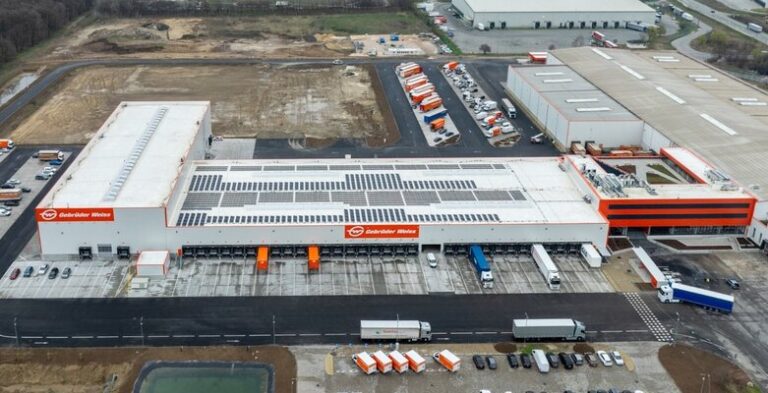
Expansion in Budapest, Hungary, with more to come in Györ in 2026. Image: Gebrüder Weiss
Less than a week after a large celebration in Bavaria’s Straubing, complete with VIP presences in the form of the region’s Minister President Markus Söder, Gebrüder Weiss also inaugurated its new logistics complex in Dunaharaszti, near Budapest. The extension cost in the region of 25 million euros and added 10,000 m² of office, handling, and high-bay warehousing to the existing logistics facility. Equipped with the latest automation (robots carry containers to picking workstations, for example), solar technology, and zero emission delivery using e-vehicles, the new facility offers additional storage capacity to its customers, and will become the Budapest center for Gebrüder Weiss’ Home Delivery services. Speaking at the opening on 25APR24, Wolfram Senger-Weiss, CEO of Gebrüder Weiss, detailed: “The expansion in Budapest offers room for further growth in the future. Increasing industrial production, especially in the automotive and electrical sectors, means that demand for transport and logistics services is expected to increase in the coming years. We opened our first Central and Eastern Europe branch in Hungary in 1989. Since then, the country has become an important hub for transporting goods between our core markets in the Black Sea region, the Balkans, the Adriatic and Western Europe. Today, our countrywide organization in Hungary is a pioneer in automation and sustainable transport.” To which Thomas Schauer, Regional Manager Central and Southeastern Europe at Gebrüder Weiss, added: “This saves time, space, and energy. We achieve an even higher level of efficiency in how trucks and containers are utilized. Cargometer cameras and 3D scanners measure the packaged items while they are still on the forklift truck. By ascertaining the size and weight of these items, we can make optimum use of the available space.”
Over in Straubing, where 150 industry and government representatives viewed the new 3,700 m² and 14 million euro forwarding location on the German Logstics Day (18APR24), Minister-President Dr. Markus Söder declared the company’s investment as: “excellent news at a time when the Federal Government is massively jeopardizing truck logistics in Germany. CO2 prices are up, tolls have doubled, e-mobility funding has been cut. This is damaging to such a systemically relevant industry, and once again fueling inflation. It can’t be overstated: we need forward-looking entrepreneurs and motivated employees more than ever.” And, according to Senger-Weiss, the country needs better e-infrastructure: “e-trucks cost three times as much as diesel-powered vehicles, which is why we need a clear roadmap in Germany on the future of e-truck subsidies.” Gebrüder Weiss will continue to expand, both in Germany and Hungary, with the next location being Györ in 2026.
CargoForwarder Global’s ‘Spotlight On…’ series aims to highlight the many different functions involved in ensuring that cargo flies from A to B safely, efficiently, and on time. And we want to get to know the people behind the job title: what brings them to our industry, and what advice they have for those considering a career in air cargo. This week, Jaran Vromen (JV), Global Key Account Manager at Challenge Air Cargo takes us through his job, how he discovered the industry and where he sees challenges and opportunities.
Jaran Vromen – image: private
CFG: What is your current function? And what are your responsibilities?
JV: I am the Global Key Account Manager at Challenge Group, based in the Netherlands. My role involves developing the framework to support our global key account team based around the world, which I also lead. This team is designed to deepen our understanding of our customers’ strategies and align our products and services accordingly. Additionally, we provide customers with a dedicated point of contact for daily operations, ensuring they receive extra attention and support.
CFG: What does a normal day look like for you? Or is there such a thing?
JV: Currently, it’s a mix of dealing with customer RFQ’s, Project management (creating new and improved services) such as creating our E-commerce end-to-end service and traveling to industry events like Air Cargo India, IATA WCS, etc.
CFG: How long have you been in the air cargo industry, and what brought you to it?
JV: I spent 6 years with FedEx Europe responsible for the Aerospace Key Accounts in Europe and since a year joined Challenge Group. I started my sales journey in the returnable packaging for the automotive industry but got inspired by a talk from a couple TNT executives at a conference that really made me excited about the industry and eventually fueled the move to the Express world.
CFG: What do you enjoy most about your job?
JV: That you do not know what the day brings and being able to learn new things every day. Next to that it’s great to work at a company like Challenge Group where there is a real entrepreneurial mindset to improve and grow on a daily basis and use the experience of the team members to enhance the business.
CFG: Where do you see the greatest challenges in our industry?
JV: We work in an industry with a need for young and innovative individuals to add value and work towards a more innovative, efficient industry. That is why I also joined Cargo Collective!
CFG: What advice would you give to people looking to get into the air cargo industry? Any particular training they should aim for?
JV: In my line of work, it’s very beneficial if you have specific knowledge in a vertical (pharma, automotive, etc.) and specialize/build your network in these industries by visiting industry events, join groups like cargo collective, etc.
CFG: If the air cargo industry were a film/book, what would its title be?
JV: Around the world in 80 days.
CFG: Many thanks, Jaran, for your insights.
If you would like to share your personal air cargo story with our CargoForwarder Global readers, feel free to send your answers to the above questions to cargoforwarderglobal@kopfpilot.at We look forward to shining a spotlight on your job area, views, and experiences.
The 13th Nordic Air Cargo Symposium took place in Stockholm’s magnificent Grand Hotel from 22-23APR24. It was a trade show of a special kind for many reasons: the many sparkling topics presented and discussed there; the first joint public appearance of the new cargo chiefs of SAS and Finnair; Atlas Air’s fact-filled Market Outlook tabled by Martin Drew; the overview over the salmon business including the growing challenges it is facing; and the fascinating insights into the rapidly evolving Life Science and Healthcare business and its effects on the transport and cargo industry, highlighted by Frank Van Gelder of Pharma.Aero.
However, before going into more detail on key topics, a review of the Symposium would be incomplete without mentioning this: The event was an ode to the organizer, Lars-Gunnar Comen. Not only was it the 13th Air Cargo Symposium that he had set on track but also the 50th Trade Show worldwide orchestrated by his company Euroavia. An incredible lifetime achievement.
TIACA Chairman Steven Polmans’ advice to Euroavia boss Lars-Gunnar Comen was that he should only think about retirement after he ran his 100th trade show – courtesy: Euroavia
ARN gets a Cargo City
The keynote speech was delivered by Jonas Abrahamsson, CEO of the public Swedish airport operator, Swedavia. He explained that air traffic is extremely important for his country due to Sweden’s geographical location on the fringes of northern Europe. Currently, passenger numbers in Sweden are still -20% below pre-pandemic times and will reach 22 million in 2023, but they are steadily increasing. Freight traffic is developing rapidly, mainly due to e-commerce. Abrahamsson announced that a new Cargo City is to be built one kilometer south of Stockholm’s Arlanda Airport. Gothenburg remains the leading logistics center, with plans for local Landvetter Airport to be expanded into an intercontinental gateway.
Slow recovery
As far as the competitiveness of Nordic airlines is concerned, they are at a clear disadvantage on routes to/from the Far East. Due to the closure of Russian airspace as a result of the Ukraine attack by Putin’s armada, SAS and Finnair have to circumvent Russia on southbound routes. This increases costs and leads to sales losses of 0.15 USD/kg in air freight in comparison to their Central or Southern European peers, stated analyst Ronald Veltmans from consulting agency Rotate.
Seafood continues growing fast
Panelist Tom Mikkelsen of Mikkelsen Consulting, pointed at the outstanding importance of the salmon industry, especially for Norway and the Nordic airlines, including Finnair. An annual growth rate of 30% is the rule. In 2023, 1.2 million tons were produced and marketed by Norwegian salmon farms. While shipments destined for Europe are transported by truck, the other target markets, primarily the USA and the Far East, are served by air freight. In addition to the two Nordic airlines mentioned above, the main carriers are Emirates, Qatar, Etihad, Korean Air, Ethiopian, the Challenge Group, but also the three integrators: DHL, UPS, and FedEx (CFG will take a closer look at the topic of seafood in our upcoming issue on 05MAY24).
More pandemics are to come
In a remarkable presentation, Frank Van Gelder, MD Medicon and Secretary General of Pharma.Aero, illustrated the transformation of the supply chain for products in the life science and healthcare industry. The starting point of his journey was the current supply situation, leading to sophisticated and futuristic personalized medicines that are precisely tailored to each patient, thanks to the creation of a digital twin. He pointed out new production processes, the monitoring of an individual’s health status from remote and the increasing use of AI. At the same time, new pandemic outbreaks are just around the corner, as the progressive growth of the world’s population and the increasing cohabitation of humans with animals have already created the starting conditions for global epidemics. A rather gloomy outlook…
Concluding remarks
Key takeaways from the events were summarized at the end of the Nordic Symposium by TIACA Chairman, Steven Polmans, who moderated the trade show in a concentrated, yet entertaining way.
Sustainability is on everybody’s agenda, be they airlines, forwarders, airports, or handling agents. That, including the ongoing mental change, was the good news delivered at the Stockholm event, Steven emphasized. However, the amount of SAF production is still way too low. Scaling effects are needed fast to lower the SAF price and balance demand and supply. This all the more since other modes of transportation act as competitors for the use of SAF, he reminded.
The salmon business is of enormous importance for the Nordic countries, including cargo transportation, but the rate of fish that die in the fish farms before commercialization is frightening high, experts speak of up to 20%.
In the Nordics, air freight is on the way from recovery to stability, with e-commerce being the most important growth driver.
AI continues to gain in importance, including in the cargo industry. However, the digitalization of processes is still too slow. It remains an urgent task to finally become faster in order to accelerate business processes and minimize sources of error.
Host, Lars-Gunnar Comen from organizer Euroavia, will soon be announcing where the 14th Nordic Air Cargo Symposium will take place next year. A hot candidate seems to be Denmark.
The two Nordic airlines, SAS and Finnair, do not operate freighters. Finnair used to have some, but they are a thing of the past. All cargo shipments are therefore transported in the belly compartments of the respective passenger fleets. Yet, freighters would be desirable, according to the air freight managers of both airlines. This ‘dream’ might be realized through ‘togetherness’, in other words: close cooperation with partners.
Gabriela Hiitola became Senior VP, Finnair Cargo in January 2923, succeeding Fredrik Wildtgrube in this position – photo: CFG/hs
Gabriela Hiitola, the new Head of Cargo at Finnair Cargo, mentioned that operating freighters is desirable but currently highly unrealistic. She stated this in a panel at the Nordic Air Cargo Symposium held on 23APR24, in Stockholm. Getting into the freighter business would only be feasible if done in close cooperation with peers, she said. Her keyword for this was: togetherness.
Her SAS colleague, Markus Ek, sounded the same note. He has been at the helm of the cargo division of the traditional Nordic airline since August 2023. For his carrier in particular, the chances of potential freighter operations are slightly better compared to its geographical neighbor, Finnair. This is because the airline’s imminent switch from the Star Alliance to the Sky Team club, which will take place at the end of August, could make freighter capacity available for SAS, at least on intercontinental routes with strong demand or in the form of triangular flights. The options are there since Air France and KLM operate own freighters. Whether they will be considered, remains to be seen. Finnair does not have comparable opportunities. Its closest European one world partner, British Airways, does not have any cargo aircraft in its fleet after it phased out three B747-8Fs a decade ago.
Geographical disadvantages
At the moment, Finnair is plagued by completely different problems. Due to the sanctions against Russia following its war on Ukraine, Russian airspace is closed to Western airlines. This means that Finnair’s aircraft need 3 hours longer on routes to and from the Far East, compared to the direct link via Siberia. The routing increases costs, leads to higher kerosene consumption, and makes the entire product more expensive.
Sustainability is more than just a fuel issue, it includes social aspects like diversity and Inclusion, stated Markus Ek from SAS Cargo at the Nordic Air Cargo Symposium – photo: credit SAS
Leisure demand dictates networks
Markus Ek from SAS drew attention to another challenge affecting the cargo divisions of both Nordic airlines. Since the end of the pandemic, the route network has been heavily concentrated on leisure destinations due to tourist demand. However, these are generally locations that are not very attractive for freight transportation. The same applies to Finnair, where only 10% of the cargo transported originates from the domestic market, but 90% is transit. By concentrating its network on tourist demand, the airline is also becoming less attractive for the air freight market.
Waiting for IATA’s ONE Record data sharing standard
Both cargo executives agreed that there is no alternative to digital transformation. The documentation of all processes in air freight is still far too complex and is often based on different systems, which doesn’t make communication easier. The two managers agreed that the implementation of the ONE Record platform is urgently needed to streamline data flow and massively reduce complexity. “There is no alternative to digital transformation, otherwise we would die, since customers might find other ways how to work,” warned Mrs. Hiitola.
High ecological awareness
Sustainability is another issue ranked high on Finnair and SAS Cargo’s priority list. “Reducing greenhouse gases, increasing the proportion of sustainable aviation fuel and renewing the fleet, are right at the top of our sustainability agenda. In a broader sense, this also includes diversity and inclusion, which we see as part of social sustainability,” argued Markus Ek.
At Finnair, “SAF currently accounts for 0.2% of our flights. In two years, it should be 2%. And in ten years, it will be 34.5%,” stated Mrs. Hiitola. She added to this that not only governments should drive this issue forward, but also private investors should get more involved. And the trend is proving her right. More and more shippers are asking their service partners to provide proof of a green transport chain when tendering for contracts. This is positive and welcome pressure from the industry, Hiitola and Ek agreed.
Real-time air cargo capacity and rate information used to be distant dream, but over the past five years or so, that dream has become reality, and an increasing number of airlines have begun offering their capacity on the few, established online marketplaces out there. CargoAi is one of these platforms and has seen a meteoric rise in acceptance since its inception in 2019. As its claim “Another way to think cargo” states, its success is down to ongoing innovation and new features. Following on from its additional Sustainability focus, CargoAi now also offers a Quality perspective. For the first time in the digital marketplace world, users of CargoAi’s CargoMART are given an overview of each airline’s quality performance on a given route. CargoForwarder Global (CFG) asked Matt Petot (MP), Founder and CEO of CargoAi, to elaborate on his company’s new CargoQUALITY feature.
Matt Petot talks to CargoForwarder Global about CargoAi’s new quality feature. Image: CFG collage of CargoAi and Canva stock image
CFG: CargoAi is adding a comparative Quality indicator as a further decision-making support for forwarders looking to book general cargo on routes offered on the CargoAi platform. When is this going live, and will it be available for all airlines on all routes?
MP: The CargoQUALITY feature is now live as of April and available on all 100+ airlines and countless routes available on CargoMART. It is also available in our analytics solutions for freight forwarders and airlines.
CFG: What is CargoAi’s own definition of Quality in air cargo? And does it share this with its CargoTech peers?
MP: We calculate a standardized Quality score per airline per route as the percentage of shipments that were ready to be delivered by the airline at 6 hours after flight arrival, according to a baseline roadmap derived from the booking information. The planned NFD (Notify for Delivery) is compared against the actual NFD milestone (or AWD, where necessary) to calculate the Quality score. The result flows into a historical CargoQUALITY score for the airline and route (origin and destination), as well as the historical CargoQUALITY score for all airlines on the route in question. The Quality scores of the past three months are considered, thus always offering an up-to-date view of the airline’s true quality performance.
CFG: You are the first online air cargo booking platform to offer Quality as a comparative indicator to forwarders. What led to CargoAi establishing this indicator? And why NFD?
MP: As part of our vision, we want to create the best air cargo booking experience. It is clear to us that adding an operational comparative indicator was necessary to drive better procurement/booking decisions as an additional consideration factor when choosing between multiple airlines. Freight forwarders no longer need to rely on intuition regarding an airline’s efficiency and reliability, as they can now base their purchasing decisions on accurate, recent, and up-to-date quality information. To drive standardization and alignment in our industry, CargoQUALITY applies the same long-established standard NFD indicator – 6 hours after flight arrival to all of the airlines included on the CargoMART platform – providing an equal measure for every airline and every forwarder.
CFG: NFD and other quality milestones were developed by Cargo iQ, previously Cargo2000. What are your views on Cargo iQ’s achievements and your own experiences working with these milestones, and how do these play into your decision to launch?
MP: As a fun fact, I, Matt Petot, worked on Cargo2000 many years back – and we respect what they do for the industry. Cargo iQ standard is great for the industry and the measures deserve to be extended to many more airlines, forwarders, and to be public. The only way to really improve quality is to have this data used in the operational process, and we want to expand on what they are driving, ensuring that every airline on CargoMART can get benchmarked with the same 6-hour standard. The CargoAi and Cargo iQ teams are actively taking on the subjects for the last 2 years to find solutions on how to work closely together. In no way are we competing as we both want to work in the same direction.
CFG: Certain IT system providers have a monopoly on messaging systems, and there are still many air cargo players using outdated EDI messaging systems – what challenges do these pose on quality measurement?
MP: The monopoly is not in place anymore as EDI messaging is not updated anymore and created too many challenges. The data in EDI is not the same anymore as what the airline website shows! Most freight forwarders are now using alternatives to get the accurate tracking of their shipment, such as visibility companies like P44 or our own CargoCONNECT tracking solution which also includes CO2. It does not pose any particular challenge for us for the 100+ airlines integrated with us, as we get access to the data from the millions of air waybills (AWBs) booked and tracked every year via our different CargoAi solutions.
CFG: Did you pilot the NFD-indicator with selected users (airlines and/or forwarders) before going live? What was their feedback?
MP: As part of our processes, we always test any new product with our beta users before going live. The initial feedback from our testing freight forwarders using CargoQUALITY has been positive. Users have praised the product for its ease of use, comprehensive dataset, and ability to filter according to their need. Many across Procurement and Operations departments have noted the spark of new conversations around certain booking decisions – which is exactly what we wanted to drive for our industry.
CFG: The NFD based on the same time measurement across all airlines on a certain route is an objective indicator. What about introducing a subjective quality indicator where a forwarder can rate the outcome of a booked shipment on a particular route with a 1-5 star system (like Amazon) or 1-10 number scale (such as in Booking.com)? Would that make sense and be something CargoAi would consider?
MP: We already have this feature in place as part of CargoMART. The main difference is that the shipment rating system includes multiple other independent aspects (e.g. platform experience, operational experience, payment experience), other than what CargoQUALITY is purposely built for.
CFG: What is the next step, now, for CargoAi? Can users look forward to further quality features this year? Perhaps in collaboration with other CargoTech members and/or Cargo iQ?
MP: As a matter of fact, we released our CargoMART Pro for forwarders and CargoMART Airline pro for airlines this month – helping both sides to streamline and optimize their processes when it comes to air cargo booking. As part of our DNA, we’re constantly looking for new products and partnerships based on customers’ pain points – and we can share that our teams are already working on our new products for 2024.
Thank you, Matt, for those insights. Is there any other message you’d like to share?
MP: We recommend staying informed about our platform updates and new upcoming features at cargoai.co as our team is already working on exciting new features!
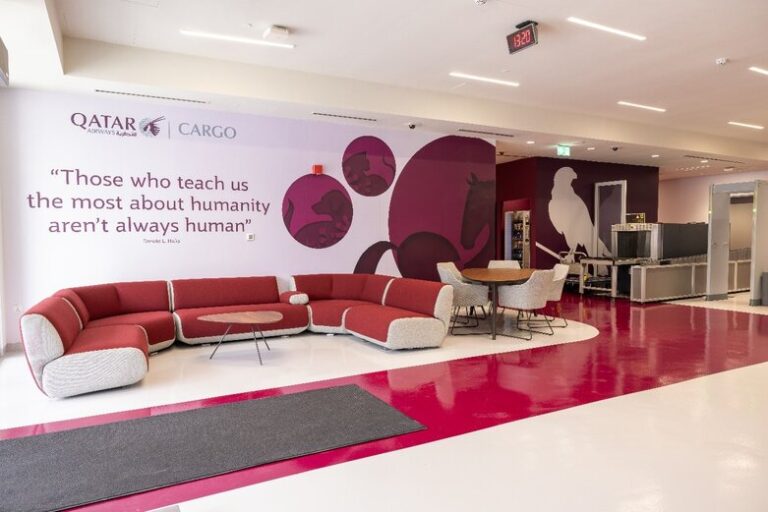
The scent of rose water in the air, the familiar deep burgundy color associated with Qatar Airways, and the sound of gentle lounge music playing through discreet speakers – the image that comes to your mind may be that of a premium airline lounge. And you would not be wrong. You may, however, be surprised to learn that this particular facility’s comfort and relaxation aspects have been designed with very specific passengers in mind: Welcome to Qatar Airways Cargo’s new Animal Center. The largest animal hub in the world!
Just ten years after its previous and already impressive, 4,200 m² Animal Center went into operation at Doha’s then pristine, new Hamad International Airport, Qatar Airways Cargo has now officially opened a massive, state-of-the-art successor. On 24APR24, local and international cargo press, along with representatives of some of the cargo airline’s largest clients, were invited for an exclusive viewing and question and answer session with Chief Officer Cargo, Mark Drusch, and the project and product managers involved.
The landside entrance to the world’s largest Animal Center. Image: Qatar Airways Cargo
Going beyond the interests of business The new complex is the result of four-and-a-half years of intricate design and planning to deliver a facility unparalleled in its flexibility, scope, and size. “We learned a lot from the old facility,” Mark Drusch says, and you can almost see his eyes begin to water at the thought of the sum of money invested which he is discreet not to disclose. His pride, enthusiasm, and open praise to those involved in the now successfully completed project, however, is unbounded. “I had nothing to do with it,” he smiles, having been appointed to Chief Officer Cargo only at the start of this year, and pointing out and thanking his colleagues in the room, who have dedicated their work to ensuring the ultimate in wellbeing for the animals placed in the care of the Qatar Airways Cargo. Not just the animals, either, given that the press event is held in the “Groom Room” – a lounge area equipped with a sofa, private rooms, Netflix and self-service catering and beverage bar, for the benefit of the many grooms accompanying their horses on international journeys. Primarily the animals, however, as Mark Drusch emphasizes more than once in his welcoming speech: “the focus here is entirely on the emotional needs of the animals,” he stresses, and gives as one such example, the fact that cats and dogs travelling as pets (which make up between 10-15% of the carrier’s animal shipments), are played music to help them destress after and before their journey. He underlines that “we have gone beyond the interests of business, here. We have a five-star airline, a five-star airport and now a five-star Animal Center.”
Largest carrier, facility and animal transporter in the world As the largest carrier in the world with the largest segment of the animal transport market, it is only fitting that it should also operate the largest animal hub. And hub is what it is. Unlike its many, smaller, peers across Europe (AMS, LGG, FRA, for example), the majority of the animals transit the airport as opposed to reaching final destination for onforwarding by truck. (And the scope for handling different species is greater.) The Animal Center sees a similar pattern to what happens to the general cargo, dangerous goods, and perishables over at the HIA cargo center: There, 90% of cargo is transit to other destinations, 1% is export and 9% are Doha imports of food and clothing, for example.
Dedicated as well as flexible holding areas Back to the Animal Center: At 5,260 m², the complex boasts dedicated rooms for certain species such as reptiles, fish, birds (and a separate, dedicated falcon room which sees up to 220 falcons/day pass through in August peak season), horses, cats, and dogs, to name but a few, but also caters for more exotic creatures. Recently a hippo transited the new center and whilst an elephant has yet to travel on Qatar Airways Cargo, there is a 20ft ULD zone ready and waiting for when that day comes. Meanwhile, the 140 dog kennels and 40 cat kennels on offer contained a number of individual pets destined for Australia, the US, or Europe, and the 24 stables had already seen their guests checked out the night before. Some 10,000 horses are transported annually – a figure that continues to grow. We visit a huge Caster Room where up to 47 ULD positions can be handled easily and in tempered comfort on roller beds leading from airside to landside – particularly for cattle and sheep transports. And we observe and discuss the different docks enabling the flexible transport and care of those animals with quick turnarounds (90 minutes are possible, but animal welfare and health comes first, so they are preferably given a minimum transit time of 3 hours to ensure that they are destressed and comfortable.)
24-hour service The center is open 24/7 and there are always 3-4 vets from the Canadian Veterinary Service on duty per shift to ensure the health and wellbeing of the animals passing through. While the vets walk to check the animals in their designated areas on regular facility tours, there is even a particular holding area with a window facing into the vet office, where certain species can be kept under constant observation.
The Animal Center is located a mere 5-minute (at most) drive away from freighter positions F11 and F12, which are primarily reserved for animal transports to absolutely minimize the ramp time. And there is more that goes on behind the scenes. We are shown a luxury bathroom area for dogs, complete with hair-drying grooming area. And the center has its own launderette to ensure that all animal boxes always have clean blankets.
More to come The old Animal Center is being decommissioned, but the airport and Qatar Airways Cargo have big expansion plans that will come to fruition in the foreseeable future. With regard to animals, Qatar Airways Cargo is heavily involved in the different animal standards bodies, and was the first airline in the Middle East to become IATA CEIV Live-certified back in 2022. A certification that is coming up for renewal this year, and where the audit will now examine processes and facilities in the new Animal Center. It should pass with full marks. Aside from the long planning time, the move from the old to the new center was carried out in phases, and only completed after around two months of trial shipments and agreements with all the relevant authorities. That said, prior to the tour, Mark Drusch urges his visitors: “If you have any suggestions for improvement, tell us. We are always looking to improve,” he says, promising, “If we can do it, we’ll do it!”
The reason the air cargo industry is still around, is down to the multitude of incredible individuals keeping it running. And some of those are fortunate to have had industry knowledge passed down through their own family members. This week’s CargoForwarder Global’s ‘Spotlight On…’ talks to Ram Menon (RM), Group Chief Commercial Officer of Wallenborn Transports. He takes us through his responsibilities and industry experience, and has a lot of advice for those looking to forge a career in air cargo.
Second Generation Air Cargo – “it’s in my blood”. Image: Ram Menon
CFG: What is your current function? And what are your responsibilities?
RM: Group Chief Commercial Officer, Wallenborn Transports. I am responsible for the Key Accounts, Sales, Product Management, Invoicing, and Marketing teams across the Wallenborn Group. I work closely with the leadership team to deliver operational excellence and added value for Key Accounts.
CFG: What does a normal day look like for you? Or is there such a thing?
RM: No two days are the same. Given that Wallenborn is a multi-layered company with offices all over Europe & the Middle East, delivering different products, every day is a new day. Given the commercial aspects of my role, most of our customers are outside of Luxembourg, being based pan-EU, the Americas, China etc… Therefore, traveling is a big part of the daily routine, whether it is to visit customers or our different branches. It is very important to me to have the face-to-face aspect of working together. A lot can be done via Teams, but this business is and will always remain a people business, so we put a lot of focus on that.
CFG: How long have you been in the air cargo industry, and what brought you to it?
RM: I have been around air cargo my entire life as I am the ‘second generation’ in my family to be in air cargo. My father was the founder of Emirates SkyCargo so you can say air cargo runs through my blood. Professionally I have been working in the domain for 11 years now. Took a small break when I was with Amazon but came back to my roots last year when I re-joined Wallenborn.
CFG: What do you enjoy most about your job?
RM: Logistics is a dynamic industry with constant challenges. I don’t like quiet and calm, so the hectic nature of the business appeals to me. I get to meet new people, experience new cultures and ways of thinking on a very regular basis, which helps me grow as a person. There are so many talented people in the industry that the scope and potential to learn and grow are unending. To survive and thrive, you learn to make decisions on the fly and execute without having all facts, making sure that life is never boring. I enjoy building lots of somethings out of nothings, and truly enjoy running teams and helping my teams to grow as individuals. I believe in the pass-it-on concept and was lucky enough to learn from some of the best; so now it is my turn to share where possible and also to continue learning.
CFG: Where do you see the greatest challenges in our industry?
RM: People and technology are the two biggest factors. It is getting harder and harder to attract talent for numerous reasons, and the age delta within the industry is becoming apparent. You have a lot of the founders and pioneers coming of age where they enjoy their well earnt retirements, but the knowledge gap is growing larger and larger as the transfer of tribal knowledge is not being done in a structural way. Technology is a big topic as well. In discussing with my dad, challenges that we are facing today are the same ones that he faced two decades ago, showing that there has been a distinct lack of innovation on many fronts with regards to air cargo. E-commerce has shown that there is a way, but the air cargo industry needs to adapt and get with the times as well now in or to sustainably scale and grow in the future.
CFG: What advice would you give to people looking to get into the air cargo industry? Any particular training they should aim for?
RM: Come into the industry with a eyes wide open perspective. This is a tough industry to be in with many challenges and rewards. If you want an easy life, then go work for the government. If you like a challenge and want to continuously be tested, this is the place to be. Start small, start humble and work your way up. In this industry, if you work hard, you can and will be rewarded. I started at the bottom doing truck monitoring and then planning and worked my way up within a decade. Anything is possible if you risk it for the biscuit and trust that things will work out. Getting training via university or certifications is super important and I put a lot of value on this, however, theory and practice are worlds apart sometimes, and having both is super important. Hence, get stuck in, start from the bottom, and work your way up. Understand the company / industry that you are in from the grassroots level and keep being hungry for growth. Learn by doing has always been my motto and I continue to live by it.
CFG: If the air cargo industry were a film/book, what would its title be?
RM: Sun Tzu, the art of war.
Excellent! Thank you, Ram.
If you would like to share your personal air cargo story with our CargoForwarder Global readers, feel free to send your answers to the above questions to cargoforwarderglobal@kopfpilot.at We look forward to shining a spotlight on your job area, views, and experiences.
The document specifies and updates the Hapag-Lloyd’s previous objectives, and names five building blocks as future priorities: the rapid modernization of its fleet, achieving quality leadership, strengthening sustainability efforts, becoming one of the most innovating maritime actors, and continuously increasing operational efficiency. Further to this, the shipping company announced plans to retrofit and convert five 10,100 TEU container ships powered by conventional motors to dual-fuel engines capable of operating on methanol which drives down greenhouse gas emissions.
The updated ‘Strategy 2030’ is the result of in-depth market analysis and customer insight, as well as extensive internal collaboration including input from the company’s global experts, the shipping line states in a release. Top priorities are delivering outstanding and tailored customer service while prioritizing environmental responsibility and innovative digital solutions to navigate the ever-changing global landscape. “Our ‘Strategy 2030’ is our most ambitions masterplan to date,” exclaimed CEO, Rolf Habben Jansen, while presenting the new operational framework.
Improved punctuality, less greenhouse gas emissions: These are just two of the goals standing in Hapag-Lloyd’s ‘Strategy 2030’, announced by CEO Rolf Habben Jansen last week. Photo: CFG/hs
Cross-divisional strategy Compared to the previous development priorities, there are no radical changes or decisive novelties. However, the aforementioned targets are to be implemented at an increased pace across all divisions, holistically and binding on and off shore. The new Terminal and Infrastructure division, based in Rotterdam and announced in SEP23, has already been included in the scheme. In future, it will also be responsible for upping the carrier’s share of inland transport in direct support of its core global maritime business.
Binding punctuality of voyages As far as the reliability of transportation is concerned, the Strategy 2030 sets a punctuality rate of 80+% as a binding quota on its way to achieving operational excellence. According to management, the Gemini Cooperation with Maersk announced only weeks ago, “will be an important step towards realizing this goal.”
In a nutshell, Hapag-Lloyd aims to remain an industry frontrunner by leveraging cutting-edge IT solutions, increasing productivity, and achieving even higher performance ratings by its customers. As part of its commitment to fighting global warming, it is scaling up its sustainability efforts aimed at continuously reducing greenhouse gas emissions by around one third come 2030.
Retrofitting initiative Further to this, the shipping company has entered into a new pact with Hong Kong-headquartered Seaspan Corporation, aimed at retrofitting and converting five 10,100 TEU container vessels powered by conventional MAN S90 motors to dual-fuel engines capable of operating on methanol.
Maximilan Rothkopf, COO Hapag-Lloyd, noted: “The methanol retrofit project is a further step in our ambitious sustainability agenda which aims to achieve the decarbonization of the entire fleet by 2045. By enabling these vessels to use green methanol as of 2026, we will meet our customers’ growing demand for green transportation solutions.”
Hapag-Lloyd favors the use of green methanol Torsten Holst Pedersen, Chief Operating Officer (COO) of Seaspan, commented: “Collaboration between strong and like-minded partners, Hapag-Lloyd and Seaspan, drives innovation. Retrofitting must be an integral part of the strategy if the container shipping industry wants to deliver on its decarbonization targets.” In addition to investing in newbuilds or retrofitting its current fleet, Hapag-Lloyd is stepping up its efforts to explore the sourcing of green fuels. In this context, it has been shown that green methanol is one of the promising low emission fuels of the future.